




Last Monday, Mary from Massapequa Park discovered that her favorite specialist at Northwell Health might not be in her new plan network for 2026. It’s a stressful realization we see often here, where the choice between Medicare Advantage vs Medigap in Massapequa NY feels more like a burden than a benefit. We know you’re likely feeling the weight of the new $2,000 out of pocket prescription cap and wondering how it’ll impact your monthly budget. It’s overwhelming to choose when a single mistake might mean losing access to Catholic Health specialists or facing unexpected costs.
Our goal is to move you from confusion to confidence by showing you exactly how these two paths protect your health and your wallet this year. We promise to simplify the jargon so you know exactly how the 2026 changes affect your specific situation. We’ll break down the network differences, the impact of the new federal cost limits, and how to lock in a predictable budget for the year ahead.
Key Takeaways
- Learn how to navigate the 2026 Medicare mailer craze by understanding the core differences between bundling your benefits and choosing a supplement.
- We explain the financial impact of the new $2,000 prescription drug cap and how it affects your choice between Medicare Advantage vs Medigap in Massapequa NY.
- Find out if your doctors at St. Joseph Hospital are still in-network and how to tell the difference between HMO and PPO options in Nassau County.
- Discover why working with an independent broker gives you more options than a captive agent when trying to avoid late enrollment penalties.
- Follow our simple 5-step process to trade your Medicare confusion for total confidence as we prepare for the 2026 plan year together.
Table of Contents
-
The Two Paths: Understanding Medicare Advantage and Medigap in Nassau County
-
Comparing the Costs: Premiums, Deductibles, and the 2026 Prescription Cap
-
Local Network Reality: Will Your Massapequa Doctors Accept Your Plan?
-
How We Help Massapequa Seniors Move From Confusion to Confidence
Navigating the Medicare Maze in Massapequa for 2026
If your mailbox in Massapequa is overflowing with glossy brochures and thick envelopes this week, you aren’t alone. It is October 2026, and the Annual Enrollment Period is in full swing. We’ve seen the stacks of mail our neighbors are receiving. Some of it looks like official government documents, while others make bold promises about "free" benefits that sound too good to be true. It’s enough to make anyone feel anxious and pressured. Our goal is to replace that stress with clarity. We want to help you decide between Medicare Advantage vs Medigap in Massapequa NY without the typical insurance headache.
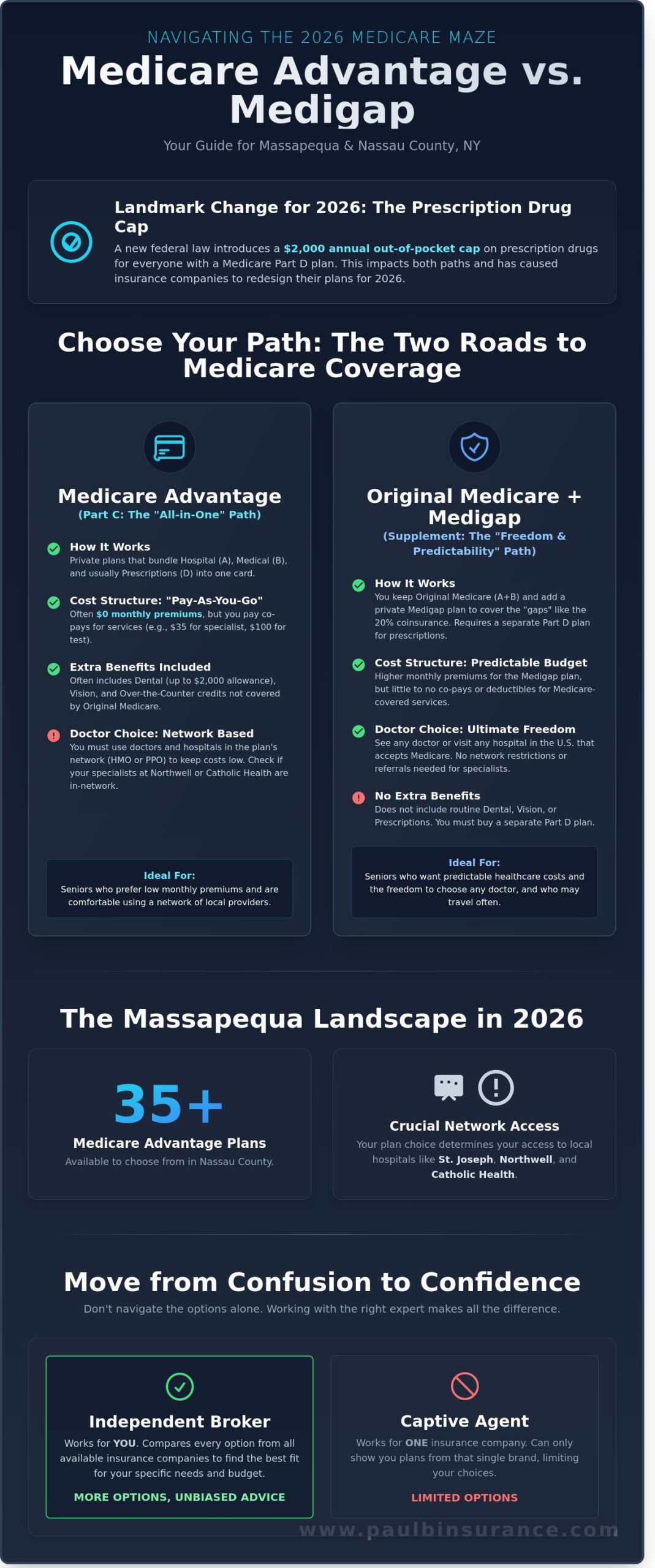
There are two primary roads you can take when you’re on Medicare. The first is staying with Original Medicare and adding a supplement. Understanding Medigap is the first step for many, as these plans are designed to pay for the 20% coinsurance and deductibles that the government doesn’t cover. The second road is Medicare Advantage, often called Part C. These plans are run by private companies that bundle your doctor visits, hospital stays, and often your prescriptions into one single card. Both paths have pros and cons, and the right choice depends entirely on your specific health needs and budget.
This year, 2026, is a landmark year for every senior in Nassau County. Because of federal law changes that took effect this January, the Medicare landscape has shifted significantly. For the first time, there is a hard $2,000 out-of-pocket cap on prescription drug costs for everyone on a Part D plan. While this is great news for your wallet, it has caused insurance companies to completely redesign their 2026 plan structures. We’ve spent hundreds of hours studying these changes so you don’t have to. We’re here to simplify the jargon and move you from a state of confusion to a place of total confidence.
Why Massapequa Seniors Face Unique Choices
Nassau County is one of the most competitive insurance markets in the country. In 2026, Massapequa residents have over 35 different Medicare Advantage options to choose from. This high density of plans can be paralyzing. You also have to consider our local healthcare landscape. Whether you use St. Joseph Hospital right here in town or travel to major systems like Northwell or NYU Langone, your plan choice determines your access. We are independent brokers who live and work near you, not in a call center halfway across the country. We know which local doctors are actually accepting which plans today.
What to Expect in This 2026 Guide
We’ve designed this guide to give you a clear comparison of costs, networks, and those critical 2026 prescription drug changes. Our mission is to help you find a plan that fits your Massapequa lifestyle, whether you’re spending your summers at Tobay Beach or traveling to see family. We work for you, not the insurance companies. Unlike a captive agent who can only sell one brand, we compare every option available to ensure you don’t overpay. We’ll show you how to steer clear of costly enrollment mistakes and late penalties while finding the peace of mind you deserve.
The Two Paths: Understanding Medicare Advantage and Medigap in Nassau County
Choosing between Medicare Advantage vs Medigap in Massapequa NY is the most critical decision you will make regarding your healthcare. We see many neighbors feel paralyzed by the options, but it helps to view these as two distinct roads. One road offers a bundled, all-in-one experience, while the other provides a traditional foundation with an added safety net. Both paths lead to coverage, but the way you pay for care and access your doctors differs significantly. We are here to help you see through the marketing noise and find the path that fits your life in 2026.
The Medicare Advantage (Part C) Reality
Medicare Advantage plans are private insurance contracts that bundle your Hospital (Part A), Medical (Part B), and usually your Prescription Drugs (Part D) into one card. We often describe this as a "pay-as-you-go" model. In 2026, many plans in Massapequa offer $0 or very low monthly premiums. You trade that low monthly cost for co-pays when you actually use the services. For example, a visit to a specialist might cost you $35, or a diagnostic test could have a $100 co-insurance fee.
These plans are popular because they include "extras" that Original Medicare lacks. You might find plans offering a $2,000 annual dental allowance, vision exams, or even credits for over-the-counter health supplies. However, you must stay within a specific network of doctors to keep your costs low. If you want to dive deeper into how these networks function, read our Medicare Advantage guide. This path is often chosen by those who prefer lower monthly bills and don’t mind following plan-specific rules for referrals and providers.
The Medigap (Supplement) Advantage
Medigap works differently. You keep your Original Medicare as your primary insurance and buy a supplemental policy to pay the "gaps," such as the 20% co-insurance that Medicare doesn’t cover. This is the "fixed cost" model. You pay a higher monthly premium, but your out-of-pocket costs at the doctor’s office are often zero. This predictability is a massive relief for those who want to budget their healthcare expenses to the penny.
The biggest draw for Medigap is freedom. You can visit any doctor, specialist, or hospital in the United States that accepts Medicare. There are no networks and no need for referrals. You can compare the standardized benefit levels on the official Medicare website to see which plan letter fits your needs. For a local perspective on these options, our Medigap overview explains how these plans perform for Nassau County residents. If you value seeing any doctor without a gatekeeper, this is likely your best fit.
New York’s Unique Medigap Protections
New York is one of the few states that truly protects its seniors through unique legislation. While 47 other states allow insurance companies to "underwrite" or deny you coverage based on your health history after your initial window closes, New York does not. We have continuous open enrollment. This means you can join or switch a Medigap plan at any time during the year without a medical exam.
You cannot be denied coverage or charged a higher premium for pre-existing conditions like heart disease or diabetes. This law provides incredible peace of mind for your 2026 strategy. It means if your health needs change, we can help you adjust your coverage without the fear of being rejected. Deciding between Medicare Advantage vs Medigap in Massapequa NY becomes much less stressful when you realize the law is on your side. If you feel stuck, we can review your current coverage together to ensure it still meets your goals.
Comparing the Costs: Premiums, Deductibles, and the 2026 Prescription Cap
The first step to finding peace of mind is understanding the baseline costs of your coverage. In 2026, every person on Medicare pays the standard Part B premium. For most of our neighbors in Massapequa, this monthly amount is $185.70. This premium is mandatory whether you choose a Medicare Advantage plan or a Medigap policy. If your individual income from two years ago was higher than $106,000, you will likely pay an additional Income Related Monthly Adjustment Amount (IRMAA) surcharge. At The Modern Medicare Agency, we help you review your past tax returns to ensure you aren’t surprised by these extra charges when your Social Security check arrives.
When we help you weigh Medicare Advantage vs Medigap in Massapequa NY, the monthly budget looks very different for each path. Most Advantage plans in our area offer a $0 monthly premium, which feels like a big relief for many seniors. In contrast, a Medigap Plan G in New York for 2026 typically costs around $315 per month. While the Medigap premium is higher, it acts as a shield against unpredictable medical bills. At The Modern Medicare Agency, we help you thoroughly understand these options so you can decide if you prefer a steady monthly bill or a "pay as you go" approach through copays and coinsurance.
The 2026 Prescription Drug Revolution
This year brings a massive victory for your wallet. The Inflation Reduction Act has completely eliminated the confusing "donut hole" coverage gap. For 2026, there’s a hard $2,000 annual out-of-pocket cap on your prescription drugs. Once you spend $2,000 on your medications, your plan pays 100 percent of the remaining costs for the year. This is a huge relief for anyone managing chronic conditions. Even with this new cap, we still recommend an annual review of your prescriptions. Plan formularies change every January, and we want to make sure your specific medications are still on the preferred list. You can explore more about how these plans work in our Medicare Part D guide.
Hidden Costs to Watch For in Massapequa
We want to make sure you see the full picture, not just the $0 premium. Every Medicare Advantage plan has a Maximum Out-of-Pocket (MOOP) limit. In 2026, this limit can be as high as $9,350 for in-network services. If you have a PPO plan and see a specialist out-of-network, your costs could be even higher. These "hidden" costs often appear when you need care the most. At The Modern Medicare Agency, we simplify these numbers so you can plan for the worst-case scenario without the stress of the unknown.
Consider a common procedure like a total knee replacement. If you have a Medigap Plan G, your only cost is usually the $257 Part B deductible. Once that is met, the plan typically covers the rest. If you are on a Medicare Advantage plan, you might pay a $350 daily copay for the hospital stay, plus 20 percent for the surgeon and physical therapy sessions. When we compare Medicare Advantage vs Medigap in Massapequa NY, we run these specific numbers for you. We want you to feel confident that you won’t face a massive bill during your recovery. Our goal is to move you from confusion to confidence by showing you exactly how much each path will cost when you actually use your benefits.
Local Network Reality: Will Your Massapequa Doctors Accept Your Plan?
The biggest worry we hear from neighbors in our community is whether they can keep their doctors. You’ve built a relationship with your primary care physician near Sunrise Highway or your specialist at St. Joseph Hospital over many years. You don’t want to lose that trust just because you changed your insurance. In 2026, the network landscape in Nassau County is more complex than it was just two years ago. We see many residents struggling to distinguish between "accepting Medicare" and being "in-network" for a specific plan. This distinction determines whether you pay a small co-pay or the full bill yourself.
When weighing Medicare Advantage vs Medigap in Massapequa NY, the network is the deciding factor for most. Medicare Advantage plans usually operate as HMOs or PPOs. In 2026, about 62% of local Advantage plans are HMOs, which means you must stay within a specific group of providers. If your doctor leaves that group, you might have to find a new one. PPOs offer more flexibility, but you’ll pay significantly higher out-of-pocket costs to see a doctor outside the preferred list. We help you look past the marketing brochures to see which doctors are actually contracted for the coming year.
St. Joseph Hospital and Local Specialists
If you prefer the Catholic Health system, you must be cautious. As of January 2026, some Advantage plans have narrowed their networks to exclude specific high-cost specialists in Massapequa Park. We always recommend checking the National Provider Identifier (NPI) number of your doctor against the 2026 directory. Just because a doctor "takes Medicare" doesn’t mean they are in-network for an Advantage plan. Catholic Health and Northwell Health often have different contract terms with different carriers, so we verify each one for you.
The Freedom of Medigap in NY
Medigap offers a level of certainty that Advantage plans cannot match. With a Medigap policy, you can see any doctor in the United States who accepts original Medicare. There are no networks to worry about and no gatekeepers. This is a massive relief for the 35% of Massapequa seniors who spend their winters in warmer climates like Florida or Arizona. You won’t need to find a "guest" network or worry about out-of-state emergencies. You simply show your card and get the care you need without asking for a referral first.
To ensure you aren’t caught off guard by network changes this year, follow this 2026 provider audit checklist:
-
Verify Hospital Affiliation: Confirm your plan includes both St. Joseph Hospital and Northwell facilities if you want maximum coverage.
-
Check Specialist Referrals: Determine if your plan requires a primary doctor’s "OK" before you can see a cardiologist or dermatologist.
-
Confirm NPI Numbers: Use the specific provider ID to search the 2026 digital directory, as names can sometimes be listed incorrectly.
-
Review Snowbird Coverage: If you travel, ensure your plan provides full coverage outside of New York, not just "emergency only" care.
We believe that your healthcare should revolve around your needs, not an insurance company’s list of approved providers. Choosing between Medicare Advantage vs Medigap in Massapequa NY is about more than just premiums; it’s about your freedom to choose your medical team. We take the time to sit down with you and call your doctors’ offices directly if we have to. Our goal is to move you from a state of worry to a state of total confidence.
Don’t risk losing access to the doctors you trust. Schedule a call with Paul Barrett today to perform a personalized network audit for your 2026 coverage.
How We Help Massapequa Seniors Move From Confusion to Confidence
We know that looking at Medicare Advantage vs Medigap in Massapequa NY feels like staring at a puzzle with missing pieces. In 2026, the stakes are higher because plan costs and networks change every single year. Our goal is to take that weight off your shoulders. We work as your personal advocates to find a plan that fits your life, not a corporate quota. Best of all, our guidance costs you zero dollars. We are paid by the insurance companies, which means you get expert advice at a $0 price tag. We simplify the jargon so you know exactly how your coverage works before you ever use it.
Our Simple 5-Step Enrollment Process
Step 1: The Initial Discovery. We start by listening. We want to know your health goals for 2026 and your budget. Every person has a unique medical history, and we take the time to understand yours without any rush or pressure.
Step 2: The Doctor and Drug Audit. We verify your specific requirements. With the 2026 Medicare Part D changes, including the $2,000 out-of-pocket cap on prescription drugs, we ensure your medications are covered at the lowest possible cost. We also check that your preferred specialists at facilities like St. Joseph Hospital are in-network.
Step 3: The Side-by-Side Comparison. We show you the math. We compare the monthly premiums of a Medigap plan against the potential copays of a Medicare Advantage plan. This helps you see the total "out-of-pocket" picture clearly instead of just looking at the monthly bill.
Step 4: The Enrollment. We handle the paperwork for you. You won’t have to spend hours on hold with an insurance company or struggle with confusing online portals. We make sure the application is submitted correctly the first time to avoid any delays in your coverage.
Step 5: The Annual Review. We don’t disappear once you sign up. We check in with you every year during the Annual Enrollment Period. If a better plan for Massapequa seniors launches for 2027, we will be the first to tell you so you always stay in the best possible position.
Why Choose The Modern Medicare Agency?
Paul Barrett founded this agency to be a shield for seniors navigating a complex system. Most "captive" agents only represent one company, which limits your choices and often leads to biased advice. We operate as independent brokers with access to over 40 different carriers. This independence allows us to compare every available option for Medicare Advantage vs Medigap in Massapequa NY without any loyalty to a specific insurance brand. Our only loyalty is to you.
We’ve helped over 1,500 local residents find peace of mind since we started our mission. Whether you join us for a local seminar at the library or prefer a private one-on-one consultation, we provide a safe space to ask questions. We stay by your side year-round to help solve billing issues, find new doctors, or explain benefit updates. You deserve a partner who is committed to your long-term health and financial security. If you are ready to move from confusion to clarity, we are ready to help you take that next step.
Ready to find the perfect plan for your needs?
Take the Next Step Toward 2026 Healthcare Clarity
Deciding between Medicare Advantage vs Medigap in Massapequa NY doesn’t have to be a source of stress. We’ve explored how the $2,000 out-of-pocket prescription cap in 2026 changes the financial landscape for Nassau County seniors. We also highlighted why verifying your local Massapequa doctor networks is the most vital step you’ll take to avoid surprise bills. Whether you want the low monthly premiums of an Advantage plan or the freedom of a Medigap policy, we’re here to help you weigh the pros and cons for your specific situation.
As local experts based in Melville, NY, we represent over 40 different insurance carriers. This means we work for you, not the big insurance companies. Our approach is always "never rushed, never pressured" because we believe you deserve the time to understand your options fully. We’re ready to help you move from confusion to confidence so you can enjoy your retirement years without worrying about your coverage.
Schedule a Call With Paul for Your 2026 Medicare Review
You’ve worked hard for your benefits, and we’re honored to help you protect them for the year ahead.
Frequently Asked Questions
Is Medicare Advantage better than Medigap in Massapequa for 2026?
The best choice depends entirely on your personal health needs and your monthly budget for 2026. Medicare Advantage plans in Massapequa often feature $0 monthly premiums and include extra perks like dental, but they require you to use a specific network of doctors. Medigap plans usually cost around $280 to $320 per month in New York, yet they allow you to see any doctor in the country who accepts Medicare. We help you weigh these options so you can feel confident in your decision.
Does St. Joseph Hospital in Bethpage/Massapequa accept Medicare Advantage?
Yes, St. Joseph Hospital currently participates in several major Medicare Advantage networks for 2026, including plans from UnitedHealthcare, Aetna, and BlueCross BlueShield. It is vital to remember that while the hospital is in-network, certain specialist groups operating inside the building might not be. We always double-check your specific surgeons and specialists against the 2026 provider directories. This simple step prevents you from receiving an unexpected bill for 20% or 40% of the total cost.
What is the most popular Medigap plan in New York for 2026?
Plan G remains the most popular Medigap choice for New York seniors in 2026 because it offers the most comprehensive coverage available to new enrollees. It covers every gap in original Medicare except for the small Part B annual deductible. Roughly 60% of our clients choose this plan because it provides total peace of mind and predictable monthly spending. We find that people prefer the "no surprises" nature of Plan G when they are managing a fixed retirement income.
Can I switch from Medicare Advantage to Medigap in New York without a health exam?
New York is one of the only states that allows you to switch to a Medigap plan at any time of the year without a medical background check. State law requires "continuous open enrollment," which means an insurance company cannot charge you more or deny you coverage for pre-existing conditions like heart disease or diabetes. When we compare Medicare Advantage vs Medigap in Massapequa NY, we use this protection to help you move into a more stable plan if your health needs change.
How much does a Medicare broker in Massapequa cost?
Our expert guidance costs you exactly $0 because the insurance companies pay us a standard commission to help you enroll. You will pay the same monthly premium whether you use our services or try to navigate the 40 plus plans in Nassau County on your own. We act as your personal advocate to ensure you don’t make a $500 mistake or miss a critical deadline. Our goal is to move you from a state of confusion to total confidence without any added expense.
What is the $2,000 prescription drug cap I keep hearing about for 2026?
The $2,000 out-of-pocket cap is a federal law that limits your total spending on covered prescription drugs to exactly $2,000 for the 2026 calendar year. Once you reach this limit, your Part D or Medicare Advantage plan pays 100% of your drug costs for the remainder of the year. This is a significant change from previous years when seniors often faced unlimited costs in the "donut hole" phase. We review your specific 2026 medications to ensure they are on the plan’s list of covered drugs.
Do Medicare Advantage plans in Nassau County include dental and vision?
Most Medicare Advantage plans in Nassau County include dental, vision, and hearing benefits as part of their 2026 packages at no extra premium. Many of these plans provide a $2,000 annual allowance that you can use for expensive procedures like root canals, crowns, or high-end eyeglasses. We compare these specific "extra" benefits across 15 different carriers to find the one that fits your lifestyle. It’s important to check the details, as some plans limit you to specific dental networks while others offer more flexibility.

Article by
Paul Barrett
Paul Barrett, CMIP is the founder of The Modern Medicare Agency, an independent Medicare-only brokerage based in Melville, NY. With 18 years of Medicare-exclusive experience, a CMIP designation, and more than 5,000 clients served across 37 states, Paul is one of the most credentialed independent Medicare specialists on Long Island — and one of the most direct.
He represents 40+ carriers with no quotas and no allegiances, which means his recommendations are based entirely on what fits each client's specific situation. He is the author of Medicare Mastery Unlocked and host of the Wise Guys Retirement Talk podcast. His content is grounded in primary sources, real carrier intelligence, and 18 years of watching what happens when people get Medicare right — and when they don't.
📞 631-358-5793 | paulbinsurance.com