



The plan with the $0 monthly premium might actually be your most expensive choice in 2026. As we look at the current landscape of Medicare Advantage Vs Medigap In Northport NY, it’s clear that the "cheaper" option often carries hidden risks for your savings. At The Modern Medicare Agency, we know how overwhelming it feels to stare at a stack of mail while worrying if your doctor at Northwell Health or Huntington Hospital will still be in-network next month. You’ve likely noticed that Suffolk County Medigap premiums climbed by an average of 7.2% this year, which adds a lot of unnecessary stress to your morning coffee.
We believe you shouldn’t have to be an insurance expert just to get the care you need. You deserve to know exactly what your healthcare will cost before you step into an exam room. We promise to simplify the 2026 Part D changes, including the new $2,100 out-of-pocket prescription cap, so you can move from confusion to confidence. This guide compares local provider networks and out-of-pocket maximums to help you secure the peace of mind you’ve earned.
Key Takeaways
-
We break down the unique healthcare landscape of Suffolk County to help you move from confusion to confidence when choosing your coverage path.
-
Discover how the $0 premium plans available in 2026 provide bundled dental, vision, and fitness benefits specifically for retirees staying local to Northport.
-
We simplify the Medicare Advantage Vs Medigap In Northport NY debate so you can decide if the freedom to see any specialist in the country outweighs a restricted local network.
-
Learn why the "Snowbird Test" is essential for your 2026 planning if you intend to spend your winters away from Long Island.
-
Understand how the latest Inflation Reduction Act changes impact your prescription costs and why an independent broker is your best defense against enrollment mistakes.
Table of Contents
-
Medicare Advantage in Northport: Bundled Benefits and Local Networks
-
Medigap in Northport: Freedom of Choice and New York’s Unique Rules
-
The Decision Matrix: Which Path Fits Your Northport Lifestyle?
Understanding the Medicare Crossroads in Northport, NY
Living in Northport means enjoying the harbor views and the quiet charm of Main Street, but it also means facing some of the highest healthcare costs in the country. As we enter 2026, the decisions you make about your coverage carry more weight than ever. Suffolk County residents often see medical service prices that sit 12% higher than the national average, making your choice between two very different paths a vital financial decision. You are essentially standing at a crossroads. One path leads toward Original Medicare paired with a supplement, while the other leads toward a private Medicare Advantage plan. We see the stress this causes every day. Our mission is to move you from confusion to confidence by stripping away the complex insurance talk and giving you a clear, honest map of your options.
Deciding on Medicare Advantage Vs Medigap In Northport NY requires looking at your specific doctors at Huntington Hospital or Northwell Health facilities. The 2026 landscape has changed significantly due to the full implementation of the $2,100 out-of-pocket cap on prescription drugs, a change that started with the 2022 Inflation Reduction Act. This shift affects how both types of plans are priced this year. We simplify the jargon so you know exactly how these changes impact your wallet. You deserve to feel protected, not pressured. We act as your advocate to ensure you steer clear of costly enrollment mistakes and late penalties that could haunt your retirement savings for years to come.
The Basics of Medigap (Medicare Supplement)
A Medigap policy is designed to work right alongside your red, white, and blue Medicare card. It acts as a secondary layer of protection, picking up the "gaps" like deductibles and 20% coinsurance that Original Medicare leaves behind. In 2026, Plan G remains the gold standard for Northport seniors because it offers the most comprehensive coverage available to new enrollees. While Medigap gives you the freedom to see any doctor in the country who accepts Medicare, it does not include drug coverage. Because of this, we always help our clients pair their supplement with a standalone Medicare Part D plan to ensure their prescriptions are covered under the new 2026 pricing rules.
The Basics of Medicare Advantage (Part C)
Medicare Advantage is a different approach where private companies like UnitedHealthcare, Aetna, or BlueCross BlueShield manage your care. These plans are often called "all-in-one" because they bundle hospital, medical, and drug coverage into a single package. Many Northport residents find the low or $0 monthly premiums attractive, especially when they include extra perks like dental, vision, and gym memberships. However, the trade-off involves staying within a specific network of doctors in Suffolk County. We help you weigh the HMO vs. PPO options to see if your favorite local specialists are included. Choosing Medicare Advantage Vs Medigap In Northport NY often comes down to whether you prefer the predictable monthly costs of a supplement or the lower premiums and bundled extras of an Advantage plan.
Medicare Advantage in Northport: Bundled Benefits and Local Networks
We know the feeling of opening your mailbox in Northport and seeing a mountain of shiny brochures. It’s a lot to take in, and the pressure to choose the right plan can feel heavy. For many of our neighbors, the biggest draw of Medicare Advantage plans is the price tag. In 2026, we’re seeing several plans in Suffolk County that continue to offer $0 or very low monthly premiums. This bundled approach combines your hospital, medical, and usually your prescription drug coverage into one single package. When you’re weighing Medicare Advantage Vs Medigap In Northport NY, those initial monthly savings are very hard to ignore.
These plans operate differently than the traditional Medicare you might be used to. Instead of the government paying your bills directly, private insurance companies take on that responsibility. This allows them to offer those extra perks we hear so much about, but it also means they have more control over which doctors you see and which treatments they’ll approve. We want to make sure you understand the trade-offs so you can move from a place of confusion to a state of total confidence.
The Local Network Factor: Northwell and Beyond
In Northport, the healthcare conversation often starts and ends with Northwell Health. Since Huntington Hospital is a cornerstone for our community, we always tell our clients that checking your specific doctor’s network status is the absolute first priority. Medicare Advantage plans are built on these local networks. If your favorite specialist at Northwell isn’t in the plan’s network for 2026, you might face much higher costs or find you have no coverage at all. We also have to be honest about "Prior Authorizations." In 2026, Suffolk County Advantage plans still require the insurance company to approve certain procedures before you receive them. It’s a layer of bureaucracy that Medigap doesn’t have. You can use our Medicare Advantage Guide to see how local providers align with different plans this year.
Extra Perks That Actually Matter
The "extras" are where Advantage plans try to win you over, and for many, they provide genuine value. We see many Northport residents getting excited about SilverSneakers memberships at local gyms or the quarterly OTC (Over-the-Counter) allowances. In 2026, these allowances for items like vitamins, sunblock, or toothpaste often reach $125 every three months. You should also look closely at the dental insurance components of these plans. While they offer convenience, the coverage limits might not be enough if you need a major crown or bridge. For those who no longer drive, some plans now offer 24 one-way trips for medical visits within the Town of Huntington. It’s a helpful benefit that provides real peace of mind for families.
One thing we never want you to overlook is the Maximum Out-of-Pocket (MOOP) limit. For 2026, the legal limit for in-network services is $9,350. While many local plans set their MOOP lower, perhaps around $4,500 or $5,900, it’s a number you must be comfortable with if a health crisis hits. Unlike the predictable costs found in New York’s Unique Medigap Rules, Advantage plans mean you "pay as you go" until you hit that limit. The choice between Medicare Advantage Vs Medigap In Northport NY often comes down to whether you prefer a low monthly premium or the total cost certainty of a supplement. We’re here to help you weigh these bundled benefits against the freedom of a supplement. If you’re feeling stuck, you can reach out to us for a quick chat to see which path fits your lifestyle best.
Medigap in Northport: Freedom of Choice and New York’s Unique Rules
We believe that your healthcare should never feel like a trap . For many seniors, the biggest draw of a Medicare Supplement plan is the total freedom it provides. If a doctor, hospital, or specialist anywhere in the United States accepts Medicare, they will accept your Medigap plan. You don’t need to check a provider directory or ask for a referral before seeking care. This level of access is a primary factor when weighing Medicare Advantage Vs Medigap In Northport NY, especially for those who want to visit specialists at Stony Brook University Hospital or even facilities in Manhattan without restriction.
Predictability is the second pillar of Medigap. When you choose this path, you trade the "pay-as-you-go" uncertainty of other plans for a steady monthly premium. Once you pay that premium and your Part B deductible, your medical bills are largely covered. We see this bring immense peace of mind to our clients. You won’t face the "medical necessity" denials that have become increasingly common in Part C plans. Because Medicare, not a private insurance company, makes the final call on your care, you get the treatments your doctor recommends without the red tape. To understand the baseline of these benefits, we suggest looking at this official guide on comparing Medigap policies to see how the standardized levels work.
The New York Medigap Advantage: No Medical Underwriting
New York is a unique place to age, thanks to our "Continuous Open Enrollment" law. In most other states, if you miss your initial window, you have to answer health questions to get a policy. If you have a heart condition or diabetes, a company in Florida could charge you more or deny you entirely. In New York, we can help you join or switch Medigap plans at any time of the year. No health exam is required, and you cannot be charged more for a pre-existing condition. This rule acts as a permanent safety net for Northport residents.
Comparing Plan G vs. Plan N in Suffolk County
As we look at the landscape for 2026, two options stand out for Suffolk County residents. Plan G remains the "set it and forget it" favorite. It covers 100 percent of the gaps in Medicare once you meet the annual Part B deductible, which sits at $283 for the 2026 calendar year. It is the gold standard for total financial protection. If you are looking for a lower monthly cost, Plan N is an excellent alternative. You can save roughly 25 percent on your monthly premiums by agreeing to small copays, such as $20 for a doctor visit or $50 for an emergency room trip.
In 2026, we are seeing Plan G premiums in the Northport area range between $370 and $560 per month, while Plan N offers a more budget-friendly entry point around $299 to $480. We help you look at your historical doctor visit frequency to decide which math works best for your wallet. Choosing between Medicare Advantage Vs Medigap In Northport NY often comes down to this choice: do you want a low premium now with potential costs later, or a higher premium now for a $0 bill at the doctor’s office? We are here to help you find that balance with confidence.
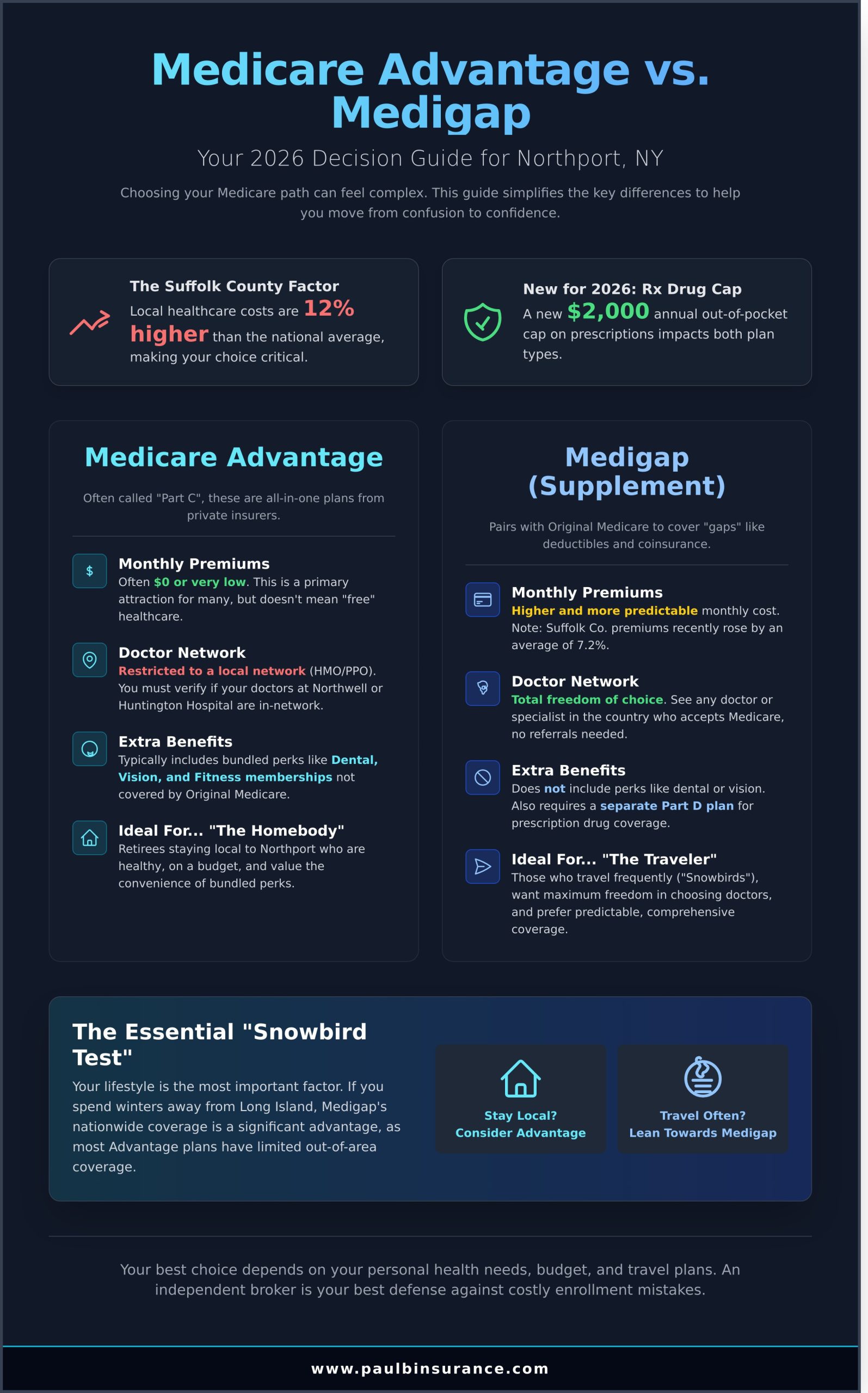
The Decision Matrix: Which Path Fits Your Northport Lifestyle?
Choosing the right coverage isn’t just about comparing brochures. It is about how you live your life here in Suffolk County. We want you to feel confident that your plan works when you are at home on Main Street or visiting family down south. To find the right fit, we put every client through three specific tests to see which path provides the most security.
The first is the Specialist Test. Many of our neighbors rely on Northwell Health or Stony Brook specialists for chronic conditions like heart disease or diabetes. If you have a specific doctor you trust, we must verify their network status. Medigap plans allow you to see any doctor in the country who accepts Medicare. This gives you total freedom. Medicare Advantage plans often use restricted networks. If your specialist leaves the network mid-year, you might be forced to find a new doctor or pay out-of-network rates.
The Budget Test is the second step. We ask if you prefer a predictable monthly bill or a "pay as you go" model. Medigap has a higher monthly premium but covers almost everything. You won’t see a bill at the doctor’s office. Medicare Advantage plans usually have low or $0 monthly premiums. However, you pay co-pays for every visit and procedure. We help you calculate which "math" makes sense for your specific health history.
Finally, we look at the 2026 Drug Cap Factor. This year, the $2,100 out-of-pocket limit on prescription drugs has changed the game for everyone. This federal cap means that even if you have high-cost medications, your financial risk is limited. This change makes it easier to compare Medicare Advantage Vs Medigap In Northport NY because the "worst-case scenario" for drug costs is now the same on both paths.
Medicare for the Northport Snowbird
If you spend three months a year in Florida or the Carolinas, Medigap is almost always the superior choice. We have seen too many people rely on "emergency only" coverage on an Advantage plan while traveling. An emergency is a heart attack; it is not a nagging hip pain or a strange rash. With Medigap, you can visit a local doctor in your winter home just as easily as you do in Northport. We coordinate your coverage so you never have to worry about state lines.
Predicting Your Out-of-Pocket Costs
Let’s look at the actual numbers for a common procedure like a knee replacement at a Northwell facility. On a typical 2026 Medicare Advantage plan, you might pay $350 per day for the first five days of your hospital stay. That is $1,750 out of your pocket. You will also have co-pays for physical therapy and follow-up visits. With a Medigap Plan G, your total cost for the surgery and stay is $0 once you have met your annual Part B deductible. We find that clients with Medigap enjoy a much lower stress level during recovery because the bills simply don’t exist.
In 2026, a Medigap plan caps your total medical spending at the annual Part B deductible of approximately $283, while a Medicare Advantage plan can legally require you to pay up to $9,350 in out-of-pocket costs for the year.
We know these numbers can feel overwhelming, but you don’t have to figure them out alone. We are here to simplify the jargon and show you exactly how these plans impact your bank account. If you want a clear, unbiased comparison of Medicare Advantage Vs Medigap In Northport NY, we can help.
Schedule a Call With Paul to find your perfect fit
Navigating 2026 Changes and Taking Your Next Steps
The year 2026 marks a significant turning point for retirees in Suffolk County. With the full implementation of the Inflation Reduction Act, the landscape of Medicare Advantage Vs Medigap In Northport NY has shifted. We’ve seen the out of pocket maximum for prescription drugs set at a firm $2,100 for the year. This change provides a safety net that didn’t exist in previous decades, but it also means insurance carriers have adjusted their premiums and formularies to compensate. Choosing the right path requires a fresh look at the data.
The 2026 Part D "Smoothing" Option
A major highlight this year is the Medicare Prescription Payment Plan, often called the smoothing option. If you face high costs for maintenance medications like Eliquis or Jardiance, you can now elect to spread those costs into uniform monthly payments. This prevents the "sticker shock" often felt at the pharmacy counter in January or February. We help you decide if this monthly budgeting tool fits better with a standalone Part D plan alongside Medigap or within a bundled Medicare Advantage plan.
Northport residents currently have access to over 40 different insurance carriers. This variety is a double edged sword. While it creates competition that can lower prices, it also creates a "paradox of choice" that leaves many seniors paralyzed by indecision. We believe an independent broker is your only true defense against this complexity. A captive agent works for one company; we work for you. We compare every available plan in the 11768 zip code to ensure your specific doctors and medications are covered at the lowest possible price point.
We’ve refined a 5-step process to move you from confusion to confidence in a single 30-minute consultation:
-
Step 1: The Needs Discovery: We listen to your specific health concerns and financial goals.
-
Step 2: Provider Verification: We confirm which plans your current Northport or Huntington doctors actually accept.
-
Step 3: Medication Analysis: We run your drug list through the 2026 formularies to find the lowest annual cost.
-
Step 4: The Comparison: We lay out a side by side look at Medicare Advantage Vs Medigap In Northport NY options.
-
Step 5: Seamless Enrollment: We handle the paperwork and electronic filings to ensure no late enrollment penalties occur.
Your Local Northport Medicare Advocate
Working with a local neighbor like Paul Barrett is fundamentally different than calling a 1-800 number you saw on a television commercial. Those national call centers often lack the nuances of the Long Island healthcare network. We know the local hospital systems and the small specialist groups right here on Main Street. Our "Never Rushed, Never Pressured" promise ensures you feel empowered to make a decision on your own timeline. We simplify the jargon so you know exactly how your coverage works before you ever use it.
Don’t let the 2026 changes leave you feeling vulnerable or overcharged. You deserve a plan that protects your health and your hard earned savings. You can Schedule a Call with Paul today to clear the air and find your perfect plan with total clarity.
Take Control of Your Northport Healthcare Future
Navigating the choice between Medicare Advantage Vs Medigap In Northport NY doesn’t have to feel like a heavy burden. As we move through 2026, the new $2,100 out of pocket cap on prescription drugs has changed the math for many Suffolk County seniors. Whether you prefer the bundled benefits of an Advantage plan or the predictable freedom of Medigap, your decision impacts how you access local care at Northwell Health or St. Catherine of Siena. We’ve seen how easily the wrong choice leads to unexpected bills; we’re here to make sure that doesn’t happen to you.
Our team acts as your personal advocate. We compare options from over 40 different insurance carriers to find your perfect fit. We focus on the facts and your specific lifestyle, removing the pressure and the jargon from the process. You deserve to feel certain about your healthcare future. We’ll help you steer clear of costly enrollment mistakes and late penalties while ensuring your favorite local doctors remain in reach.
Get Your Unbiased Northport Medicare Comparison Today
We’re ready to help you turn that lingering confusion into total confidence today.
Frequently Asked Questions
Is Northwell Health in-network for Medicare Advantage plans in Northport?
Yes, Northwell Health is currently in-network for most major Medicare Advantage plans in the Northport area for 2026. However, network participation can change annually, so we always verify your specific specialists against the latest provider directories. We make sure your preferred doctors at Huntington Hospital or the Northwell Physician Partners locations are fully covered so you don’t face unexpected out-of-network bills.
Can I switch from Medicare Advantage to Medigap in New York without a health check?
You can switch from Medicare Advantage to Medigap at any time in New York without answering a single health question. New York is one of only four states that follows "continuous open enrollment" rules. This means you won’t be denied coverage or charged more for pre-existing conditions like heart disease or diabetes when comparing Medicare Advantage Vs Medigap In Northport NY. We help you navigate this transition to ensure your new coverage starts the moment your old plan ends.
What is the maximum out-of-pocket limit for Medicare Advantage in Suffolk County for 2026?
The maximum out-of-pocket limit for Medicare Advantage plans in Suffolk County is $9,350 for in-network services in 2026. While this is the highest amount a plan can legally charge you for covered medical services, many local Northport plans set their own lower limits near $4,200. We compare these limits for you so you can feel confident that a major health event won’t result in a financial crisis.
Does Medigap Plan G cover dental and vision in Northport?
Medigap Plan G does not cover routine dental, vision, or hearing services. It’s designed to pay the 20 percent coinsurance that Original Medicare leaves behind for medical and hospital care. Since a single dental implant can cost over $3,500, we often help our clients set up a separate dental and vision policy. This ensures you have the comprehensive protection you need without the gaps found in basic Medigap plans.
Why are Medigap premiums higher in New York than in other states?
Medigap premiums are higher in New York because the state requires "community rating" for all policies. This means an insurance company must charge a 65-year-old in Northport the same premium as an 85-year-old. While a monthly premium of $372 might seem high compared to other states, it protects you from massive price spikes as you age. We’ll show you how this system actually provides long-term stability for your retirement budget.
What happens to my Northport Medicare coverage if I move to Florida for the winter?
Your coverage depends on whether you chose Medicare Advantage Vs Medigap In Northport NY before heading south. If you have a Medigap policy, you can see any doctor in Florida who accepts Medicare. If you have a Medicare Advantage plan, you may be limited to emergency care only unless your plan includes a specific "travel benefit" or "passport" feature. We’ll check your plan’s 2026 travel rules to make sure you’re protected while snowbirding.
How does the 2026 $2,100 drug cap affect my choice between Advantage and Medigap?
The new $2,100 out-of-pocket cap on prescription drugs in 2026 makes both options more affordable for seniors with high medication costs. Before this change, you might have spent $4,000 or more at the pharmacy. Now that your annual drug costs can’t exceed $2,100, the decision usually comes down to whether you prefer the low premiums of an Advantage plan or the freedom of Medigap. We’ll run your specific medications through our software to find your lowest total cost.
Is there a local Medicare office in Northport, NY, for in-person help?
There isn’t a Social Security or Medicare office located directly in Northport, with the closest office being at 75 Oak Street in Patchogue. Rather than spending your afternoon waiting in a government office, we offer personal consultations right here in the community. We’ll sit down with you to simplify the jargon and help you avoid the 10 percent lifetime late enrollment penalty. Our goal is to move you from confusion to confidence without the stress of a long commute.

Article by
Paul Barrett
Paul Barrett, CMIP is the founder of The Modern Medicare Agency, an independent Medicare-only brokerage based in Melville, NY. With 18 years of Medicare-exclusive experience, a CMIP designation, and more than 5,000 clients served across 37 states, Paul is one of the most credentialed independent Medicare specialists on Long Island — and one of the most direct.
He represents 40+ carriers with no quotas and no allegiances, which means his recommendations are based entirely on what fits each client's specific situation. He is the author of Medicare Mastery Unlocked and host of the Wise Guys Retirement Talk podcast. His content is grounded in primary sources, real carrier intelligence, and 18 years of watching what happens when people get Medicare right — and when they don't.
📞 631-358-5793 | paulbinsurance.com