




Does stepping into the world of Medicare feel like navigating a confusing maze? You’re not alone. The choice between an Advantage plan and a Medigap policy is one of the most important decisions you’ll make for your healthcare, and the fear of a costly mistake is real. Understanding the medicare advantage vs medigap pros and cons is the first step toward peace of mind, but the jargon and complex rules can feel overwhelming, leaving you worried about your budget and whether you can keep your trusted doctors.
That’s why we created this simple, clear guide. We’re here to walk you through the differences without the confusing industry-speak. You will get a straightforward, side-by-side comparison that explains exactly how each option works, what it covers, and what it means for your wallet. Our promise is to move you from a place of confusion to one of confidence, empowering you to choose the right coverage for your unique needs and secure your health for the years to come.
Key Takeaways
- Understand the core financial trade-off between lower monthly premiums and predictable out-of-pocket costs to protect your budget.
- Discover whether you can keep your trusted doctors and specialists, a crucial factor when choosing between network restrictions and nationwide freedom.
- We break down the medicare advantage vs medigap pros and cons by comparing extra perks like dental against comprehensive core medical protection.
- Learn how to assess your personal health needs and lifestyle to confidently decide which path is the right fit for your peace of mind.
The Two Paths of Medicare: A Simple Start
If you’re feeling overwhelmed by Medicare, you are not alone. Once you’re enrolled in Original Medicare (Part A for hospital care and Part B for medical services), you face a critical decision. Think of Original Medicare as your foundation. Now, you must choose one of two paths to build upon it for more complete coverage. Understanding the medicare advantage vs medigap pros and cons is the first step toward making a confident choice for your health and budget.
This decision is a fork in the road, and it’s essential to get it right from the start. You must choose one path or the other.
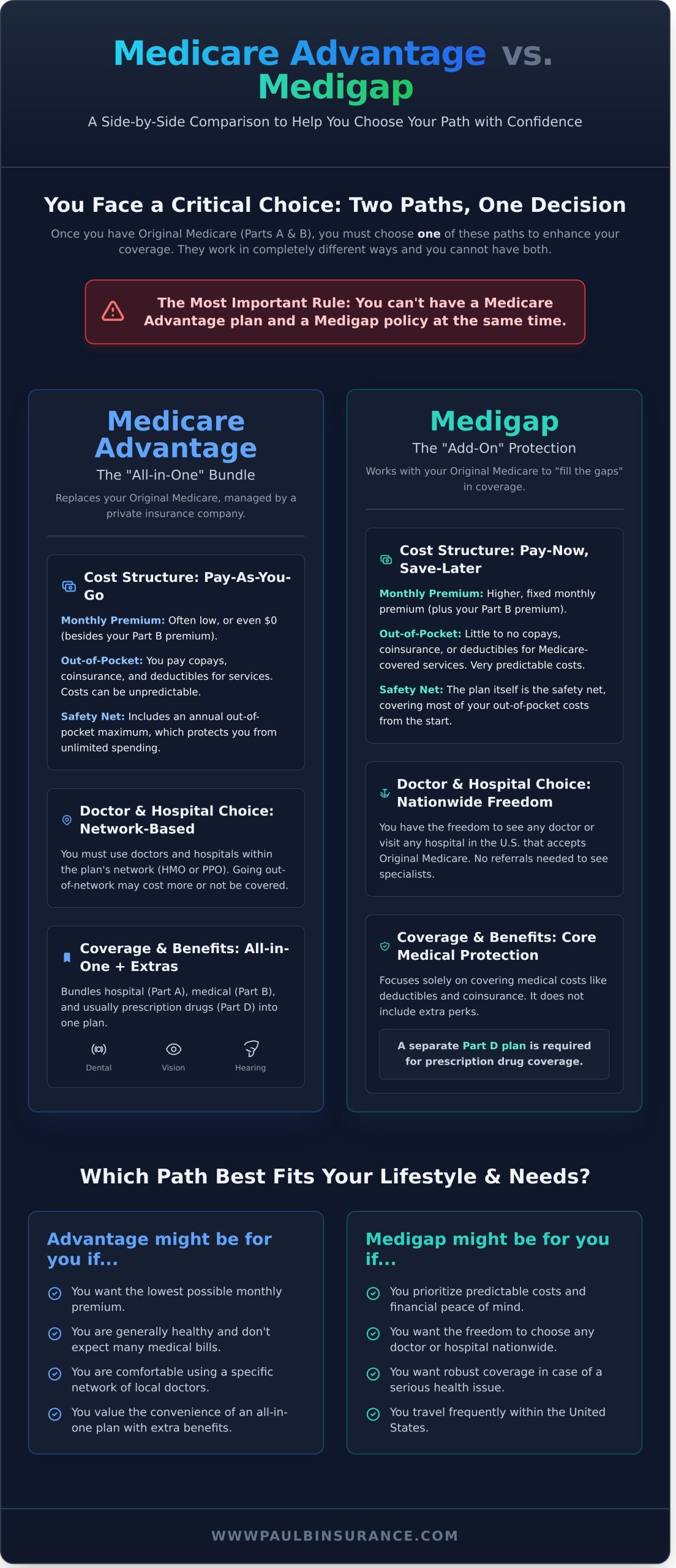
The most important rule: You cannot have a Medicare Advantage plan and a Medigap plan at the same time. They are two entirely different ways to receive your Medicare benefits.
What is a Medicare Advantage (Part C) Plan?
Think of Medicare Advantage as the “all-in-one” bundled approach. These plans are offered by private insurance companies approved by Medicare. They take over the administration of your benefits, replacing Original Medicare. A Part C plan bundles your Part A and Part B coverage and, in most cases, includes Part D prescription drug coverage. Many also offer extra benefits like dental, vision, and hearing, all in a single plan with one monthly premium (often as low as $0).
Common plan types include HMOs (Health Maintenance Organizations), which use a specific network of doctors, and PPOs (Preferred Provider Organizations), which offer more flexibility.
What is a Medigap (Medicare Supplement) Plan?
Medigap is the “add-on” coverage that works alongside your Original Medicare. It doesn’t replace it; it enhances it. Its sole purpose is to “fill the gaps” that Original Medicare leaves behind, such as paying for your deductibles, coinsurance, and copayments. These standardized Medigap policies help predict and stabilize your out-of-pocket healthcare costs. It is crucial to remember that Medigap plans do not include prescription drug coverage, so you will need to purchase a separate Part D plan.
Cost Comparison: Monthly Premium vs. Out-of-Pocket Spending
When it comes to the financial side of the medicare advantage vs medigap pros and cons, the core difference boils down to a simple question: Do you prefer to pay more now or potentially pay more later? It’s a common point of confusion, and many people mistakenly believe the plan with the lowest monthly bill is always the cheapest. The truth is, your total annual healthcare cost depends entirely on this trade-off between premiums and out-of-pocket spending.
Let’s break down the two cost structures with clarity so you can feel confident in your understanding.
Medicare Advantage: Pros & Cons of its Cost Structure
Advantage plans are designed with a “pay-as-you-go” model. Their biggest appeal is a low, or even $0, monthly premium, which can be very attractive for those on a fixed budget. Every plan also includes a yearly out-of-pocket maximum, which acts as a crucial financial safety net. However, the trade-off is that you pay for services as you need them through copays and coinsurance. If you are healthy and rarely see a doctor, your costs may stay low. But if you face a serious health issue, those costs can add up quickly until you hit your annual cap, making your budget less predictable.
Medigap: Pros & Cons of its Cost Structure
Medigap policies work in the opposite way, offering a “pay now, save later” approach. You pay a higher, fixed monthly premium, but in return, the plan covers nearly all of your Medicare Part A and B deductibles and coinsurance. This structure provides incredible predictability and financial peace of mind. This predictable model is a key reason why, according to a recent KFF analysis of Medigap enrollment, millions of beneficiaries choose this path for its stability. The primary cons are the higher premium that you must pay every month, regardless of your healthcare usage, and the need to purchase a separate Part D plan for prescription drug coverage.
Doctor Choice & Flexibility: Networks vs. Nationwide Freedom
Of all the questions we hear, one stands out with the most urgency: “Can I keep my doctor?” This is more than a practical question; it’s about trust, comfort, and continuity of care. The answer depends entirely on which path you choose, as this is one of the most significant differences when weighing medicare advantage vs medigap pros and cons. One path is built on structured networks, while the other offers nationwide freedom.
Medicare Advantage: Pros & Cons of Provider Networks
Medicare Advantage plans operate like the HMO or PPO plans you may be familiar with. They rely on a specific network of doctors, hospitals, and providers. While this can create a streamlined experience, it also comes with significant trade-offs.
- Pro: Coordinated Care. When your primary doctor and specialists are all in the same network, it can lead to more efficient, coordinated care.
- Con: Strict Network Rules. You must use providers within your plan’s network. Going out-of-network for non-emergency care can result in you paying the full cost.
- Con: Referrals and Delays. Many plans, especially HMOs, require a referral from your primary care physician to see a specialist. This extra step can delay necessary treatment and add a layer of administrative hassle.
Medigap: Pros & Cons of its Flexibility
Medigap plans (also called Medicare Supplement Insurance) work very differently. They don’t have networks. Instead, they supplement your Original Medicare benefits, giving you the freedom to choose your care without restrictions.
- Pro: Unmatched Freedom. You can see any doctor or visit any hospital in the United States that accepts Medicare. There are no networks to worry about.
- Pro: No Referrals Needed. If you need to see a cardiologist, dermatologist, or any other specialist, you simply make an appointment. No permission or referral is required.
- Pro: Coverage That Travels With You. For those who travel or are “snowbirds,” your Medigap coverage goes with you. This freedom is a core feature, as the official Medicare website explains Medigap plans work alongside Original Medicare nationwide.
- Con: You Manage Your Care. This plan doesn’t coordinate your care for you. You are in the driver’s seat, responsible for choosing your specialists and managing your own appointments.
Ultimately, your choice here comes down to what you value most. Is it the potential for lower premiums within a structured network, or is it the absolute freedom to see any doctor you choose, anywhere in the country? Understanding this key difference is essential to moving from confusion to confidence in your Medicare decision.
Coverage & Benefits: Extra Perks vs. Core Protection
One of the most confusing parts of choosing a plan is understanding what you actually get. It’s not just about doctor visits; it’s about prescriptions, dental cleanings, and eyeglasses. When we examine the medicare advantage vs medigap pros and cons, the difference in benefits is often the biggest deciding factor. It’s a choice between an all-in-one package with extra perks and foundational coverage that protects you from major costs.
Let’s break it down with simple clarity, so you can feel confident in your understanding.
Medicare Advantage: Pros & Cons of Bundled Benefits
Think of Medicare Advantage (Part C) plans as a complete package deal. They bundle your Part A (hospital) and Part B (medical) coverage and, in most cases, include other benefits in a single plan, often for a low or $0 monthly premium.
- Pro: All-in-One Convenience. Most Advantage plans include prescription drug coverage (Part D). This means one card, one plan, and one company to deal with for most of your healthcare needs.
- Pro: Valuable Extra Perks. These plans often attract members with benefits Original Medicare doesn’t cover, such as routine dental, vision, and hearing care, as well as gym memberships like SilverSneakers.
- Con: Benefits Can Change Annually. The extra perks that look great this year might be reduced or removed next year. You must review your plan’s “Annual Notice of Change” each fall to avoid surprises.
- Con: Coverage for Extras May Be Limited. A dental benefit might only cover cleanings or provide a small annual allowance for more complex work, leaving you with significant out-of-pocket costs.
Medigap: Pros & Cons of Standardized Coverage
Medigap plans, also known as Medicare Supplements, work differently. They aren’t a package deal; their sole purpose is to fill the “gaps” in Original Medicare, like deductibles, copayments, and coinsurance. Their strength lies in their predictability and simplicity.
- Pro: Standardized and Predictable. Medigap plans are standardized by the federal government. This means a Plan G from one insurance company offers the exact same core medical benefits as a Plan G from another. This makes comparing plans simple and straightforward.
- Pro: Benefits Are Guaranteed. As long as you pay your premium, your Medigap plan’s benefits are guaranteed to remain the same year after year. There are no annual changes to your core medical coverage.
- Con: No Built-In “Extras.” Medigap plans do not include prescription drugs, dental, vision, or hearing coverage. Their focus is strictly on medical cost-sharing.
- Con: Requires a Separate Part D Plan. To get coverage for your medications, you must enroll in and pay a separate monthly premium for a standalone Medicare Part D plan.
Ultimately, the decision comes down to what provides you with greater peace of mind. Do you prefer the potential value of bundled extras, or the rock-solid, predictable protection against major medical bills? Understanding this fundamental difference is a critical step toward making the right choice. If you’re feeling unsure, getting unbiased guidance can help you weigh these pros and cons for your specific situation.
How to Choose: Which Path is Right for Your Life?
You’ve learned the key differences, but now it’s time for the most important step: deciding what’s right for you. There is no single “best” plan for everyone. The right choice depends entirely on your personal health, your financial situation, and the lifestyle you want to live. Understanding the medicare advantage vs medigap pros and cons is about finding the path that gives you peace of mind.
To find your fit, ask yourself these simple questions:
- Your Health: Are you in excellent health, or do you manage a chronic condition that requires frequent specialist visits?
- Your Budget: Do you prefer a lower, predictable monthly premium, or are you more comfortable paying as you go for services, knowing you have a safety net for major expenses?
- Your Doctors: Are your preferred doctors and hospitals part of a specific network, or do you want the freedom to see any provider who accepts Medicare?
- Your Lifestyle: Do you travel frequently across the country? Do you value extra benefits like dental, vision, or gym memberships?
Who is a Good Fit for Medicare Advantage?
A Medicare Advantage plan could be an excellent choice if you are relatively healthy and want to keep your monthly premiums as low as possible. These all-in-one plans are ideal if you don’t mind using a network of doctors to receive care and you appreciate the convenience of having prescription drug coverage and extra perks like dental and vision bundled into one simple package.
Who is a Good Fit for Medigap?
A Medigap plan is often the best fit if your top priority is predictable costs and robust protection against high medical bills. This path offers you the ultimate freedom to choose any doctor or hospital that accepts Medicare, anywhere in the U.S. It’s a powerful option for those who travel often, have chronic health conditions, or simply want the assurance of comprehensive, worry-free coverage.
Still Unsure? The Value of Unbiased Advice
Navigating this decision alone can feel overwhelming. Even after weighing the medicare advantage vs medigap pros and cons, you might still have questions. That’s where trusted, unbiased guidance makes all the difference. An independent broker works for you, not an insurance company. We can review every plan available in your area to find the one that perfectly matches your needs and budget. You don’t have to do this alone. Let us help you move from confusion to confidence.
Making Your Medicare Choice with Confidence
Navigating the Medicare maze can feel overwhelming, but you’ve taken a huge step toward clarity. The choice between Medicare Advantage and Medigap often comes down to what you value most: the potential for lower monthly premiums and bundled perks like dental with an Advantage plan, versus the predictable out-of-pocket costs and nationwide freedom to see any doctor with a Medigap plan. Understanding the medicare advantage vs medigap pros and cons is a critical first step, but the most important part is matching the right plan to your unique health needs and budget.
You don’t have to make this final decision alone. Our mission is to take you from Medicare confusion to confidence with simple, unbiased guidance. As independent brokers representing over 40 top insurance carriers in 34+ states, our advice is always focused on you. We’re here to help you find the perfect fit. Feeling clearer but still have questions? Schedule your free, no-pressure Medicare plan review today.
Let us help you secure the peace of mind that comes from knowing you’ve made the best possible choice for your health and financial future.
Frequently Asked Questions About Medicare Advantage vs. Medigap
Can I switch from Medicare Advantage to Medigap later on?
Yes, but it can be difficult. Once you leave your initial 6-month Medigap enrollment window, insurance companies can require medical underwriting. This means they can review your health history and may deny your application or charge you a much higher premium. Switching is possible during certain trial periods or if you have a “guaranteed issue” right, but it’s not a given. This is why making a confident choice from the start is so important.
What is the most popular Medigap plan and why?
For new Medicare enrollees, Plan G is the most popular choice. The reason is simple: it provides the most comprehensive, predictable coverage available. After you meet your annual Medicare Part B deductible, Plan G pays 100% of the remaining costs for Medicare-approved services. This gives beneficiaries incredible peace of mind by virtually eliminating surprise medical bills and protecting them from high out-of-pocket expenses, no matter their health needs.
Do Medigap premiums increase as you get older?
Yes, you should expect your Medigap premium to increase over time. Most plans are “attained-age rated,” which is a simple way of saying the price is based on your current age and will go up as you get older. Rate increases are also tied to overall healthcare inflation. Our unbiased guidance helps you compare how different insurance companies have historically managed these increases, so you can plan for your financial future with confidence.
Are the extra benefits in Medicare Advantage plans really free?
This is a major point of confusion when analyzing medicare advantage vs medigap pros and cons. While many Advantage plans feature a $0 premium, those “free” benefits like dental and vision are paid for through cost-sharing. You will typically face copays, deductibles, and a limited network of doctors. These costs can add up quickly when you need care, making the plan a trade-off: you get extra perks in exchange for potentially higher costs and less freedom.
Do I need to worry about medical underwriting when choosing a plan?
Timing is everything. When you first enroll in Medicare Part B at age 65 or older, you get a one-time, 6-month Medigap Open Enrollment Period. During this protected window, you have a guaranteed right to buy any Medigap policy, and companies cannot ask health questions or deny you coverage. If you miss this window, you will likely have to go through medical underwriting, which is why we help our clients get it right from the very beginning.
Which option is better if I travel a lot within the United States?
For frequent travelers, Medigap is almost always the better choice. Because Medigap supplements Original Medicare, you have the freedom to see any doctor or visit any hospital in the U.S. that accepts Medicare-no networks and no referrals needed. In contrast, most Medicare Advantage plans (like HMOs and PPOs) have local or regional networks. Seeking care outside that network can be very expensive or may not be covered at all, except in emergencies.