




What if your healthcare didn’t feel like a second full-time job spent juggling different cards and worrying about which doctor takes which plan? We know how exhausting it is to manage both systems, especially when you are trying to understand medicare and medicaid dual eligible plans while fearing you might lose your Medicaid coverage. It’s frustrating to hear about “extra” benefits like dental or vision but never quite know how to use them. We believe you shouldn’t have to be an expert just to get the care you deserve.
In this guide, we’ll show you how to combine your benefits into one simple, high-value plan for 2026. Since the VBID program ended this year, we’ll explain how you can still access help with groceries or utilities through new chronic condition verification rules. You’ll also learn about the new monthly enrollment period that allows you to switch to integrated plans more easily. Our goal is to move you from a state of confusion to total certainty, ensuring you maximize every benefit available to you this year.
Key Takeaways
- We’ll show you how to simplify your daily life by moving to an integrated plan that uses one card and one network for all your medical needs.
- We explain the 2026 differences between full and partial eligibility so you can claim every specific benefit you are entitled to.
- We provide a simple checklist to verify that your favorite doctors and prescriptions are compatible with new plan options before you make a switch.
- Discover why we recommend medicare and medicaid dual eligible plans as a more secure way to manage your health than navigating two separate systems alone.
- We’ll share why an independent broker acts as your personal advocate to protect your coverage and remove the stress from the enrollment process.
What Does It Mean to Be Dual Eligible for Medicare and Medicaid in 2026?
Being “dual eligible” simply means you qualify for two different types of health coverage at the same time. It’s a unique status where the federal government and your state government work together to provide your care. Understanding what it means to be dual eligible is the first step toward finding peace of mind. We often tell our clients that having both programs is like having a safety net under a safety net. It’s designed to ensure you never have to choose between buying groceries and seeing a doctor.
In 2026, the distinction between full and partial eligibility is more important than ever. Full dual eligibility means you receive the complete range of Medicaid benefits alongside your Medicare coverage. Partial dual eligibility usually means the state helps pay for your Medicare premiums or cost-sharing through Medicare Savings Programs. While having both is a massive financial relief, we know it can be stressful. Many people feel overwhelmed by carrying two different ID cards and trying to figure out which one to show at the pharmacy. This is where medicare and medicaid dual eligible plans come in to bridge the gap.
Medicare vs. Medicaid: How They Work Together
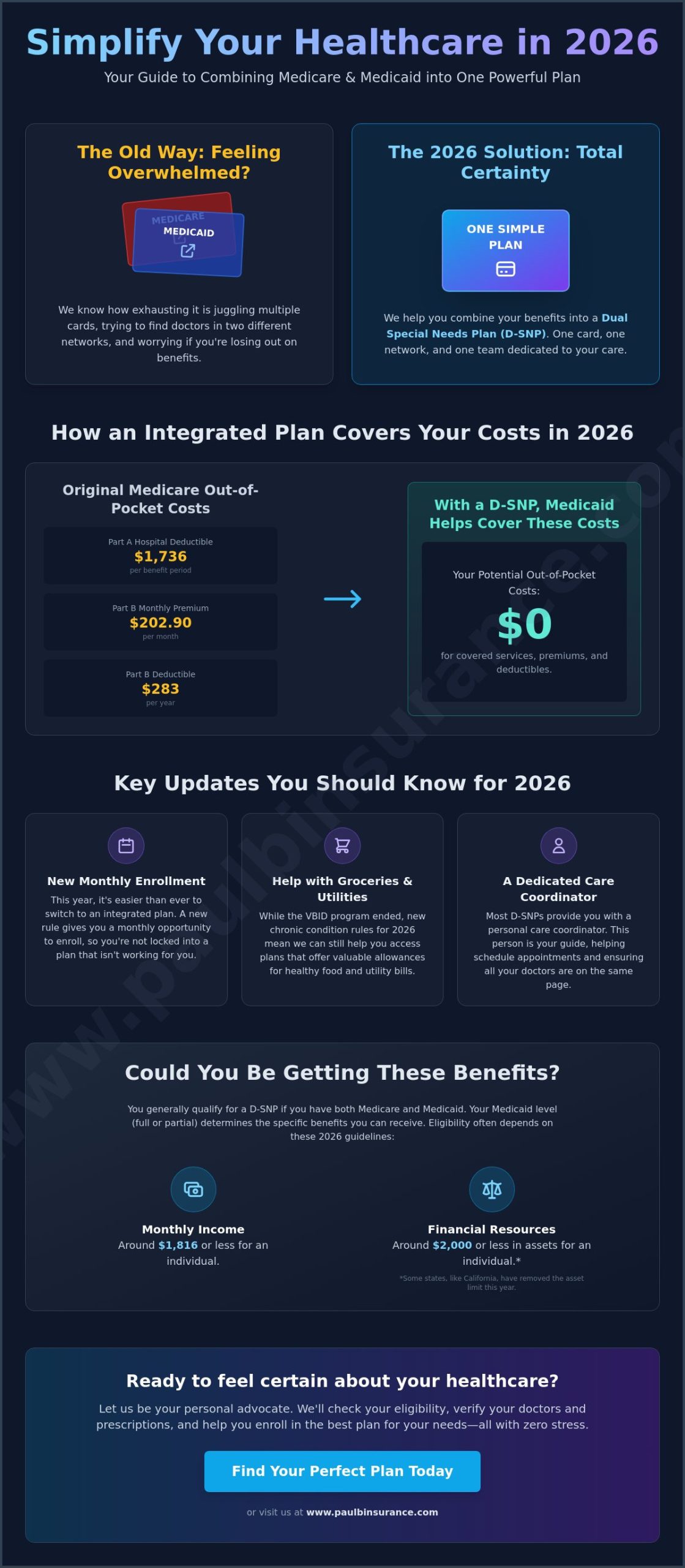
Think of Medicare as your primary health coverage. It’s there for your doctor visits, hospital stays, and prescriptions. However, Medicare often comes with costs you have to pay yourself. In 2026, the standard Part B deductible is $283, and the Part A hospital deductible has risen to $1,736 per benefit period. These numbers can be scary if you are on a fixed income.
Medicaid acts as the partner that catches these costs. When the two programs “handshake” correctly, Medicaid covers those deductibles and your monthly Part B premium, which is $202.90 this year. This coordination can reduce your out-of-pocket spending to nearly zero. We want to help you move away from the confusion of two systems and toward one coordinated path.
Who Qualifies for Dual Status This Year?
Qualifying for dual status depends on your age, disability status, and financial situation. For 2026, the general income limit for an individual to qualify for a Medicare Savings Program is approximately $1,816 per month. Asset limits generally stay around $2,000 for individuals, though some states like California have removed asset limits entirely this year. We recommend checking with your local state office or the Social Security Administration to confirm your specific status.
If you are 65 or older, or if you have a qualifying disability, you are likely already halfway there. Once your status is confirmed, you can look into medicare and medicaid dual eligible plans that combine these benefits. These plans are often referred to as D-SNPs, and they are specifically built to make your life easier by putting all your benefits into one place. You can learn more about how these work in our Medicare Advantage guide.
How Dual Special Needs Plans (D-SNPs) Simplify Your Care
Managing two different health programs can feel like trying to speak two languages at once. This is why medicare and medicaid dual eligible plans, often called D-SNPs, were created. These are a special type of Medicare Advantage plan designed specifically for people who have both Medicare and Medicaid. In 2026, the focus is on “Integrated Care.” This means you no longer have to worry about which program pays for what. You get one plan, one member ID card, and one network of doctors who are all on the same page.
One of the biggest reliefs for our clients is having a dedicated care coordinator. This person acts as your personal guide through the healthcare system. They help you schedule appointments, organize your medical records, and make sure your doctors are actually talking to each other. It removes the heavy burden of management from your shoulders. If you want to see how these benefits fit your specific situation, you can explore our Medicare Advantage guide for more details. For a broader look at how these systems overlap, the CMS dual eligibility fact sheet provides a helpful breakdown of the different categories of support.
The ‘Extras’ That Make a Difference
D-SNPs offer benefits that Original Medicare simply doesn’t cover. Most plans include comprehensive dental, vision, and hearing care. This means you can get your teeth cleaned, your eyes checked, and your hearing aids fitted without the high costs. Many plans also provide transportation to and from your medical appointments, ensuring you never miss a visit because of a ride.
In 2026, there is a specific change regarding supplemental benefits like grocery and utility assistance. While these credits are still available, eligibility now often requires verification of a qualifying chronic condition. We can help you check if you qualify for these credits, which can be used for healthy food or to help pay your monthly bills. It’s about providing the support you need to stay healthy at home. If you’re feeling overwhelmed by the choices, we invite you to connect with us so we can walk through your options together.
Prescription Drug Coverage (Part D) in D-SNPs
You won’t need to shop for a separate drug plan because D-SNPs automatically include Medicare Part D. Because you have Medicaid, you likely qualify for the “Extra Help” program. This program drastically lowers your pharmacy costs, often bringing your copays down to just a few dollars or even zero. We want to make sure you never have to worry about the cost of your life-saving medications. This integrated approach ensures your medical and pharmacy benefits work in perfect harmony.
Comparing Your Coverage Options: Which Path Provides the Most Value?
Deciding how to receive your healthcare is a personal journey. We understand the hesitation you might feel when looking at new options. One common fear we hear is the worry that you might “lose” your Medicaid if you join a private plan. We want to clear that up right now. Joining a Dual Special Needs Plan (D-SNP) does not take away your Medicaid status. Your eligibility is determined by your state, and this KFF analysis of eligibility pathways explains how those rules work. A D-SNP simply changes how those benefits are delivered to you.
In 2026, the healthcare landscape is shifting toward a more holistic approach. Plans are looking beyond just doctor visits and focusing on what we call “Social Determinants of Health.” This includes things like making sure you have access to nutritious food and a safe living environment. We believe that medicare and medicaid dual eligible plans are at the forefront of this change, offering a bridge to total health security that the traditional path often misses.
Original Medicare and Medicaid: The Traditional Way
The traditional route involves using Original Medicare alongside your state Medicaid. This path offers a lot of flexibility. You can see any doctor in the country who accepts both programs. For some, this freedom is the most important factor. However, this flexibility comes with a hidden cost of stress. You are responsible for managing two separate systems. You have two different ID cards to keep track of and two different sets of paperwork to navigate. This path also typically lacks the “extra” benefits like gym memberships, over-the-counter (OTC) credits, or help with utility bills that have become so valuable this year.
The D-SNP Advantage: The Modern Way
We see the D-SNP as the modern, empathetic way to receive care. These medicare and medicaid dual eligible plans coordinate everything for you. There are no surprise bills because the plan knows exactly how your Medicare and Medicaid benefits work together. You can find many of these features in our Medicare Advantage Guide, which highlights how these plans are tailored for those with lower incomes. By choosing this path, you get an advocate who helps you manage your health journey. It’s about moving from a state of constant worry about your coverage to a place of absolute certainty and peace of mind.
Eligibility and Enrollment: Taking the Stress Out of the Process
The journey from feeling overwhelmed to having total peace of mind is shorter than you think. We’ve broken down the path into four manageable steps. First, we must confirm your Medicaid status with your local state office. This ensures you know exactly which tier of assistance you qualify for this year. Second, we review your current doctors and medications. This is vital because medicare and medicaid dual eligible plans work best when they include the providers you already trust.
The third step involves utilizing your Special Enrollment Period (SEP). This is a unique advantage that many people don’t realize they have. Finally, we recommend working with an independent broker to compare every available 2026 plan. Unlike a representative who only works for one insurance company, we look at over 40 carriers to find the one that prioritizes your specific needs. We are here to act as your advocate, removing the anxiety from the paperwork so you can focus on your health.
When Can You Enroll? (The SEP Secret)
Most people have to wait for the fall to change their coverage. If you are dual eligible, the rules are much more flexible. In 2026, many members have a monthly opportunity to switch to integrated plans managed by their same Medicaid insurer. This new monthly enrollment window is designed to keep your care coordinated without long wait times. Understanding how Medicare Eligibility works when Medicaid is involved is the key to staying protected all year long. You don’t have to feel “stuck” in a plan that isn’t serving you well.
Avoiding Common Enrollment Pitfalls
One of the biggest mistakes we see is joining a plan without checking the formulary. A formulary is just a list of the drugs the plan covers. If your specific medication isn’t on that list, you could face unexpected costs at the pharmacy. We also make sure your favorite specialists are in the new plan’s network. With the end of the VBID program this year, we also help you verify any chronic conditions required to keep your grocery or utility credits. We handle the details so nothing gets lost in the mail or forgotten in a pile of forms. If you’re ready to see which plans fit your life, we invite you to speak with a specialist today and take the first step toward certainty.
Finding Your Best Plan with The Modern Medicare Agency
We know the healthcare system can feel like a maze designed to keep you from the benefits you deserve. We are here to be your compass and your shield. Working with an Independent Medicare Broker is your best defense against the stress of choosing the wrong coverage. Unlike a representative from a single insurance company, we represent over 40 carriers. This means we don’t have a favorite brand or a sales quota to meet for one specific firm. Our only priority is you. We look at every available option for medicare and medicaid dual eligible plans to see which one actually fits your doctors and your prescriptions.
Our commitment to you doesn’t end on the day you sign your enrollment forms. We provide year-round support because we know your health needs don’t follow a schedule. If you receive a confusing letter from the state or your pharmacy tells you a copay has changed, we want you to call us immediately. We take the time to explain every detail in plain English. We simplify the complex so you can breathe easy. This is our “Peace of Mind” promise. We aim to move you from a state of distress to a state of absolute certainty, protecting you from the high-pressure tactics often found elsewhere.
Personalized Guidance at No Cost to You
You might wonder how we can offer this level of personal service without charging you a single dollar. It’s a fair question. We are compensated by the insurance carriers, which keeps our expert guidance free for you. This allows us to act as your dedicated advocate without adding any financial burden to your household budget. As local experts, we understand the specific 2026 landscape in your area, including which local clinics are joining integrated networks. We also help you coordinate secondary needs like Dental Insurance to ensure your smile is protected alongside your medical health.
Our Methodical Approach to Your Security
We don’t believe in high-pressure sales pitches. Our process always starts with a calm, patient conversation. We listen to your concerns about your Medicaid status and learn about your health history. Then, we build a custom comparison of every D-SNP available in your specific zip code. This methodical path leads you to a clear, confident choice for your 2026 healthcare. We act as your lead figure and educator. We are your unambiguous champion in a system that can often feel indifferent to your needs. By working together, we ensure your medicare and medicaid dual eligible plans provide the total security you need for the year ahead.
Take the Next Step Toward Healthcare Certainty
We’ve explored how a single, integrated plan can replace the stress of managing two different health systems. By combining your benefits into one card and one network, you gain more than just convenience; you gain a dedicated team focused on your total well-being. From dental care to the updated 2026 grocery assistance rules, the current landscape offers powerful tools to protect your health and your budget. You don’t have to carry the burden of these complex systems alone.
Finding the right medicare and medicaid dual eligible plans shouldn’t feel like a gamble. As an independent broker representing over 40 carriers, we work for you rather than the insurance companies. We provide free personalized guidance across 34+ states and offer expert support through every step of your enrollment journey. We are ready to move you from a state of uncertainty to one of total confidence. Get your free, simple 2026 plan comparison today and let us help you secure the care you deserve. We are here to protect your future every step of the way.
Frequently Asked Questions
Can I have both Medicare and Medicaid at the same time?
Yes, you can absolutely have both programs at the same time. This status is known as being “dual eligible,” and it means you qualify for both federal Medicare and your state’s Medicaid program. We often help clients understand that these two programs work together to provide a stronger safety net. Medicare acts as your primary coverage for doctors and hospitals, while Medicaid covers many of the costs that Medicare usually leaves behind.
What is a Dual Special Needs Plan (D-SNP) exactly?
A Dual Special Needs Plan, or D-SNP, is a specialized type of Medicare Advantage plan designed specifically for people who have both Medicare and Medicaid. These medicare and medicaid dual eligible plans are built to simplify your life by combining all your benefits into one coordinated system. Instead of managing two different programs with two different cards, you get a single plan with one member ID and a dedicated coordinator to help manage your doctors and prescriptions.
Will I lose my Medicaid benefits if I join a Medicare Advantage plan?
No, you will not lose your Medicaid benefits by joining a D-SNP or any other Medicare Advantage plan. Your Medicaid eligibility is determined by your state based on your income and assets. Joining a specialized plan simply changes the way your benefits are delivered to you. We make sure you understand that your state-level protections remain fully intact while you gain the extra coordination and support that these integrated plans provide.
Do dual eligible plans cover dental and vision in 2026?
Yes, most dual eligible plans in 2026 provide comprehensive coverage for dental and vision care that Original Medicare does not offer. This typically includes routine exams, cleanings, and even credits for eyeglasses or contacts. We believe this is a vital part of your health security. Since 2026 rules have changed for some extra credits, we verify exactly which specialized services your plan includes so you never face a surprise bill at the dentist or eye doctor.
How much does a dual eligible plan cost per month?
For most people with full Medicaid benefits, the monthly premium for a D-SNP is $0. This is because your state’s Medicaid program typically covers the cost of your Medicare Part B premium, which is $202.90 in 2026, as well as the plan’s monthly fee. We help you confirm your specific eligibility level to ensure you aren’t paying for costs that your dual status is designed to cover for you. It’s about maximizing your value without adding any financial stress.
What is the difference between full dual and partial dual eligibility?
Full dual eligibility means you receive the complete range of Medicaid benefits alongside your Medicare. Partial dual eligibility usually means you qualify for a Medicare Savings Program where the state helps pay for your premiums or deductibles but doesn’t provide the full suite of Medicaid services. We look at your specific status to determine which medicare and medicaid dual eligible plans offer the most support for your unique situation. Both levels of eligibility offer significant savings over traditional coverage.
Can I change my dual eligible plan at any time of the year?
Yes, dual eligible individuals have more flexibility to change plans than the general population. In 2026, new regulations allow you a monthly Special Enrollment Period to switch into integrated plans managed by your Medicaid insurer. This means you don’t have to wait for the fall enrollment period if your current plan isn’t meeting your needs. We help you navigate these timing rules so you can move toward a better care option whenever you feel ready to make a change.
How do I know if my doctor accepts a dual eligible plan?
You can find out if your doctor is included by checking the specific plan’s provider network directory. Because these plans are integrated, it’s important to verify that your specialists accept both the Medicare and Medicaid portions of the plan. We do this work for you by searching the networks of over 40 carriers. This ensures the doctors you already trust are part of the plan you choose for your 2026 care, giving you total peace of mind.

Article by
Paul Barrett
Paul Barrett, CMIP is the founder of The Modern Medicare Agency, an independent Medicare-only brokerage based in Melville, NY. With 18 years of Medicare-exclusive experience, a CMIP designation, and more than 5,000 clients served across 37 states, Paul is one of the most credentialed independent Medicare specialists on Long Island — and one of the most direct.
He represents 40+ carriers with no quotas and no allegiances, which means his recommendations are based entirely on what fits each client's specific situation. He is the author of Medicare Mastery Unlocked and host of the Wise Guys Retirement Talk podcast. His content is grounded in primary sources, real carrier intelligence, and 18 years of watching what happens when people get Medicare right — and when they don't.
📞 631-358-5793 | paulbinsurance.com