




Did you know that by 2026, nearly 30% of people between ages 65 and 74 are expected to still be in the workforce? If you are one of them, you likely feel a mix of pride in your career and a deep sense of anxiety about your health coverage. It’s completely normal to worry about lifelong late-enrollment penalties or losing access to your favorite doctors. We understand how overwhelming this transition can feel, especially when you’re trying to figure out how medicare and working past 65 actually works.
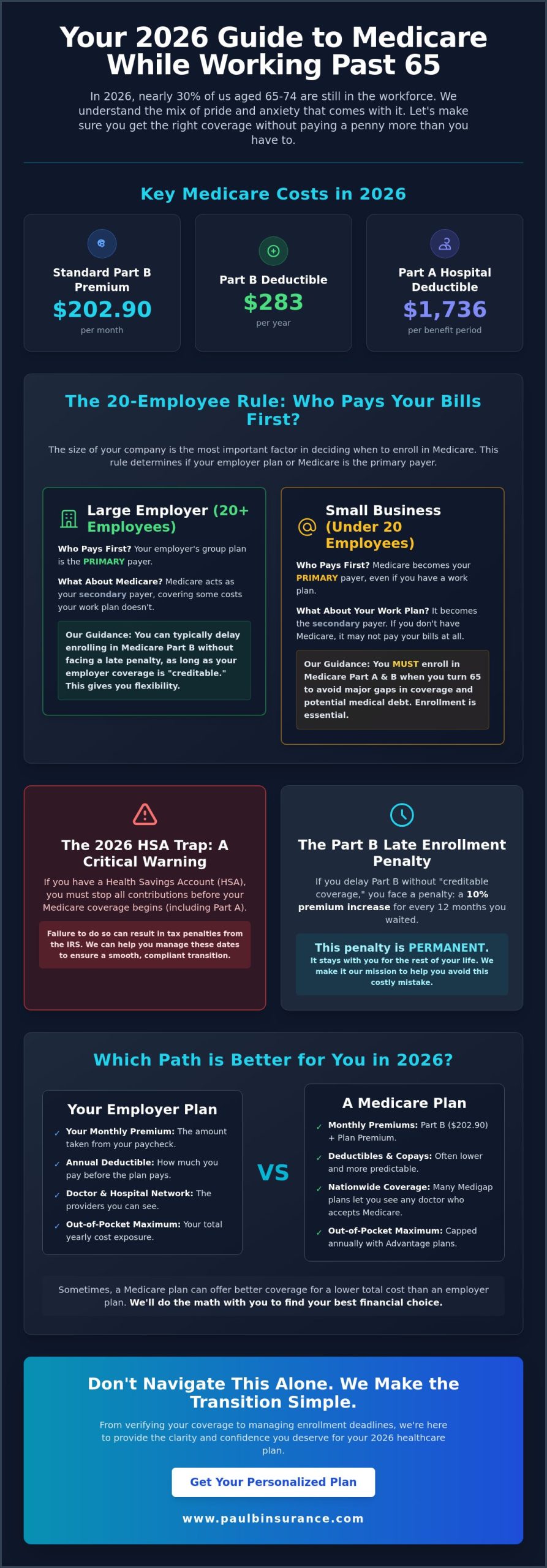
We want to give you back your peace of mind. In this guide, we’ll show you exactly how to coordinate your employer benefits with Medicare so you don’t pay a penny more than you have to. We will break down the 2026 figures, including the $202.90 standard Part B premium and the $283 deductible. You’ll get a clear “yes or no” on delaying Part B, a simple way to compare your current costs against Medicare options, and the truth about how Medicare affects your HSA contributions.
Key Takeaways
- Learn how to identify “creditable coverage” so you can delay enrollment without the fear of permanent late penalties.
- Discover how the size of your company determines whether Medicare or your employer plan takes the lead on your medical bills.
- Avoid the common HSA trap by understanding why you must stop contributions before Medicare begins to stay compliant with 2026 IRS rules.
- Use our simple framework to compare your work insurance costs against Medicare options to see which choice saves you the most money.
- We simplify the journey of medicare and working past 65 by managing the step-by-step transition from your group plan to your new coverage.
Medicare and Working Past 65: Do You Really Need to Enroll at 65?
Turning 65 used to be a clear signal that it was time to retire and start your new chapter. Today, things look much different. Many of us find joy and purpose in our careers well into our late sixties and beyond. This change often brings up a major point of confusion: how does medicare and working past 65 actually work? We want to help you understand that you have choices. You aren’t necessarily forced into a new system the moment you blow out your 65 candles, but you do need a plan to avoid expensive mistakes. For those who continue to manage their own business operations, keeping your infrastructure efficient is just as important as health planning; learn more about tailored payment solutions for your trade.
Your Initial Enrollment Period is a seven-month window that centers around your 65th birthday. If you are still working and have “creditable coverage” through your employer, you might be able to delay Part B. In 2026, coverage is considered creditable if it is expected to pay out at least as much as standard Medicare. Most people still choose to enroll in Part A at age 65 because it is usually premium-free. Since the Part A hospital deductible is $1,736 in 2026, having this as a secondary payer can provide a valuable safety net for unexpected emergencies.
The “Stay or Go” Dilemma
Deciding whether to keep your work insurance or switch can be deeply stressful. We often talk to people who feel stuck on their corporate plan simply because it feels familiar. However, the math might tell a different story. In 2026, the standard Part B premium is $202.90 per month. If your employer plan costs more than this or has a very high deductible, you might find better value in a Medicare Advantage Plan or a Medigap policy. We are here to help you weigh these costs so you can feel confident in your financial future.
What Happens if You Miss the Window?
If you don’t have creditable coverage and you miss your enrollment date, the consequences are permanent. The Part B late enrollment penalty adds an extra 10% to your premium for every year you waited. This isn’t a one-time fee; it stays with you for the rest of your life. It can turn a manageable monthly cost into a significant burden. We make it our mission to help you track these vital dates and verify your coverage status. Our goal is to ensure you never have to pay a penalty for a simple misunderstanding of the rules.
The 20-Employee Rule: Does Your Company Coverage Count?
One of the most important questions we answer for our clients is whether their current work insurance will actually pay their bills after they turn 65. The answer depends almost entirely on the size of your company. This is known as the “20-employee rule.” It serves as the legal dividing line for how medicare and working past 65 functions in the real world. If your employer has 20 or more employees, your group health plan is generally the primary payer. This means they pay your medical claims first, and Medicare acts as a secondary backup.
However, if your company has fewer than 20 employees, the roles reverse. Medicare becomes the primary payer. If you don’t enroll in Medicare Part B because you think your small business plan is enough, you could be left with massive medical bills that neither side will cover. We want to help you avoid this “coordination of benefits” nightmare. You can find more details in the official Medicare guidance on working past 65 to see how these rules apply to your specific situation.
Working for a Large Employer (20+ Employees)
If you are part of a larger team, you usually have the freedom to stay on your employer’s plan without any penalties. Your employer’s coverage remains primary, so you can often delay enrolling in Part B and save that $202.90 monthly premium. Even so, we recommend reviewing your options every year. Sometimes, a Medicare Advantage Plan can offer better benefits or lower out-of-pocket costs than a standard corporate plan. We can help you compare these options side-by-side to ensure you’re making the best financial choice for 2026.
Working for a Small Business (Under 20 Employees)
Small business employees face a much tighter set of rules. At age 65, Medicare expects to be your primary insurance. If you stay only on your work plan, your insurance company might refuse to pay their portion of a bill, claiming that Medicare should have paid first. This creates “ghost coverage,” where you pay for a plan that doesn’t actually protect you. For those in this position, enrolling in Part B is not just an option; it is a necessity to keep your coverage intact. We specialize in helping small business owners and their employees navigate this specific hurdle with total clarity.
As business owners plan for this transition, they may also consider the future of their company; for those looking at growth or exit strategies, PP-X offers expert advisory on strategic acquisitions.
To be absolutely certain where you stand, we suggest a quick meeting with your HR department. Ask them specifically: “Is my group health coverage primary or secondary to Medicare?” Getting this answer in writing provides the peace of mind you deserve. If you find out you need to make a move, we are here to walk you through the process step-by-step.
The HSA Trap: Why Working Past 65 Requires Careful Planning
Many of our clients love the tax advantages of a Health Savings Account (HSA). It’s a powerful tool for building a medical nest egg while you are still on the job. However, the rules change the moment you enter the world of medicare and working past 65. The IRS is very strict: you cannot contribute a single dollar to an HSA once you are enrolled in any part of Medicare. This includes Part A, which most people receive automatically if they start taking Social Security benefits. If you aren’t careful, a simple administrative update could lead to unexpected tax headaches.
The most confusing part for many is the “6-month look-back” rule. When you eventually sign up for Medicare or Social Security after age 65, your Part A coverage often starts retroactively. It can go back up to six months, but not earlier than your 65th birthday month. If you were still putting money into your HSA during those six months, the IRS considers those “prohibited contributions.” Understanding these timelines helps you avoid some of the most common 5 Medicare pitfalls to avoid when you are trying to balance work benefits and federal coverage.
Avoiding Unintended Tax Penalties
To stay safe, we recommend stopping all HSA contributions at least six months before you plan to apply for Social Security or Medicare. For 2026, the HSA contribution limits are $4,400 for self-only coverage and $8,750 for family coverage. If you are 55 or older, you can also add a $1,000 catch-up contribution. We help you calculate your “pro-rated” limit for the year you transition. This ensures you maximize your savings without crossing the line into penalty territory. Remember, you can always keep and spend the money already in your HSA for medical costs, even after you’ve joined Medicare.
Is the HSA Benefit Worth Delaying Medicare?
Deciding whether to keep your HSA or move to Medicare is a deeply personal choice. You have to weigh the triple-tax advantage of the HSA against the benefits of Medicare. In 2026, the Medicare Part A hospital deductible is $1,736. If your employer’s high-deductible plan has a much higher out-of-pocket cost, Medicare might actually be the more affordable path. We don’t believe in one-size-fits-all answers. Instead, we sit down with you to run these specific numbers. We look at your health needs and your budget to find the path that gives you the most security and the least amount of stress.
Medicare vs. Employer Insurance: How to Decide Which Is Better
Once you understand the rules of medicare and working past 65, the next step is to run the numbers. Many people assume their work insurance is the best deal because their employer pays part of the premium. This isn’t always true. To make a smart choice, we look at three specific figures: your monthly premiums, your annual deductible, and your maximum out-of-pocket limit. In 2026, the standard Medicare Part B premium is $202.90. If your work plan costs you more than that each month, you might already be overpaying for coverage.
We also have to consider your doctor network. Many corporate plans use restricted networks to keep costs down. If you have a specialist you trust, you’ll want to verify they accept Medicare before making a move. A Medicare Supplement insurance plan offers a level of certainty that most high-deductible work plans can’t match. With these plans, you can often see any doctor in the country who accepts Medicare, and your out-of-pocket costs for covered services can be virtually eliminated.
The Hidden Costs of Employer Plans
Don’t forget to look at how your choice affects your family. If your spouse is under 65 and covered by your work plan, leaving that plan might leave them without insurance. We also help you check if your work drug coverage is “creditable.” If it isn’t, you’ll need to join Medicare Part D to avoid future penalties. Sometimes, a Medicare Advantage plan is the better financial choice because it includes “extras” like gym memberships or transportation that your job doesn’t provide.
A Simple Comparison Checklist
We recommend taking this short list of questions to your HR benefits manager today to get the clarity you need:
- Is my current drug coverage considered “creditable” by Medicare standards?
- What is my exact monthly premium for just myself, excluding my spouse or children?
- What is the maximum amount I could pay out-of-pocket for medical care this year?
- How much does the company contribute to my health account or HSA?
- Will my coverage change or become secondary once I turn 65?
We define Total Cost of Care as the sum of your monthly premiums plus what you expect to pay out of your own pocket for doctor visits and prescriptions. When you look at the total picture, the lower deductibles of Medicare often win. If you feel stuck trying to compare these two worlds, reach out to us for a personalized plan comparison so you can see the math for yourself.
Transitioning to Medicare: How We Help You Move from Work to Retirement
The journey from a long, successful career into your next chapter should be filled with excitement. It shouldn’t be buried under a mountain of confusing forms and conflicting deadlines. While we have already explored the rules for medicare and working past 65, the actual transition requires a steady hand to ensure everything happens in the right order. We take the weight off your shoulders by managing the step-by-step process of moving you from a group plan to your new coverage. Our goal is to make this move so seamless that you can stay focused on your job and your family while we handle the heavy lifting.
We believe you deserve more than just a list of plans. As an independent broker, we have the freedom to compare options across more than 40 different carriers. This is a vital distinction. Unlike a representative who works for a single insurance company, we work for you. We don’t have a bias toward one specific brand. Instead, we look at the whole market to find the Medicare Advantage or Medigap plan that fits your specific needs and budget. Our support doesn’t end once you sign up, either. We provide year-round assistance to help you with any questions that arise long after your first ID card arrives in the mail.
Your Special Enrollment Period (SEP) Roadmap
When you decide to stop working or your employer coverage ends, you enter an eight-month window called a Special Enrollment Period. We strongly advise you not to wait until the final month to take action. We help you coordinate your Medicare start date with your job’s end date so there is never a single day where you are unprotected. This careful timing ensures you avoid the $202.90 monthly Part B premium until you actually need the coverage, while also protecting you from any late-enrollment penalties.
Get Expert Guidance and Peace of Mind
We know that the fear of making a mistake can be paralyzing. The “system stress” of Medicare is real, but it doesn’t have to be your reality. We act as your personal guide, removing the anxiety from the process and replacing it with certainty. We provide clear, straightforward answers and a logical path forward. If you are ready to move from uncertainty to a solid plan, we are ready to help. Schedule your free Medicare consultation with us today and let us protect your health and your future.
Take Control of Your Health Future Today
You’ve worked hard to build your career and your benefits. Now, you deserve a health plan that works just as hard for you. We’ve explored how the size of your company changes your enrollment needs and why timing your HSA contributions is vital to avoiding tax penalties. Most importantly, you now have a framework to see if Medicare actually offers better value than your current employer plan. Managing medicare and working past 65 doesn’t have to be a source of stress or confusion.
Paul Barrett and our dedicated team are here to act as your personal advocates. With access to over 40 insurance carriers and experience supporting families in 34+ states, we have the tools to find your perfect fit. We promise to provide the clarity you need to move forward with total confidence. Let us help you compare your work plan to Medicare for free. You don’t have to do this alone. We are ready to walk this path with you and ensure your transition is smooth, safe, and successful.
Frequently Asked Questions
Do I have to sign up for Medicare at 65 if I am still working?
You don’t necessarily have to sign up if your employer has 20 or more employees. In this case, your work plan stays primary, and you can delay Part B without worry. If your company has fewer than 20 people, you usually must enroll at 65 because Medicare becomes the primary payer. We always suggest checking with your HR manager to be 100% certain of your status before your 65th birthday.
Can I keep my HSA if I enroll in Medicare Part A?
You can definitely keep your existing HSA funds and use them for medical costs, but you must stop making new contributions. The IRS rules for 2026 are very clear that any Medicare enrollment disqualifies you from adding money to the account. This includes the catch-up contribution for those over 55. We help you time your final 2026 contribution to stay within the $4,400 self-only limit and avoid tax penalties.
What is considered “creditable coverage” for Medicare?
Creditable coverage is insurance that is expected to pay out at least as much as standard Medicare. Most large employer group plans meet this requirement for both hospital care and prescription drugs. If your coverage isn’t creditable, you could face late-enrollment penalties later on. We can review your plan’s “Notice of Creditable Coverage” to give you peace of mind that your current work insurance meets the federal standards.
How long is the Special Enrollment Period after I stop working?
You have an eight-month window to sign up for Medicare after your employer coverage or employment ends. This period starts the month after your job ends or the insurance stops, whichever happens first. While eight months sounds like a long time, we recommend starting the process early. This ensures your new 2026 coverage is active the very day your work plan expires so you never have a gap in protection.
Will I get a penalty if I wait to sign up for Medicare Part B?
You won’t face a penalty as long as you have creditable coverage through a current employer. The rules for medicare and working past 65 allow you to delay Part B until you actually need it. However, if you go more than 63 days without creditable drug coverage or miss your eight-month window after retiring, a lifelong penalty will be added to your monthly premiums. We track these dates for you to keep your costs low.
Does my spouse need to sign up for Medicare if they are on my work plan?
Your spouse generally doesn’t need to sign up for Medicare at 65 if they are covered under your active group health plan at a large company. They will qualify for their own Special Enrollment Period when you eventually retire or leave the job. It’s important to remember that this only applies to current employment. Retiree health plans and COBRA do not count as active coverage, which could lead to penalties if they wait.
What happens to my COBRA coverage if I sign up for Medicare?
In most cases, your COBRA coverage will end the moment you enroll in Medicare. If you already have Medicare and then become eligible for COBRA, you might be able to keep both, but Medicare will pay first. This is a very complex area that often leads to gaps in protection. We can help you look at the 2026 costs to see if moving to a Medicare Supplement or Advantage plan is better than staying on COBRA.
How do I prove to Medicare that I had employer coverage so I avoid penalties?
You provide proof by submitting Form CMS-L564 to the Social Security Administration. This form is completed by your employer and verifies that you had group health coverage based on your current employment. It is the official way to show you didn’t just skip enrollment without a good reason. We can guide you through the paperwork to ensure medicare and working past 65 remains a smooth and simple transition for you.

Article by
Paul Barrett
Paul Barrett, CMIP is the founder of The Modern Medicare Agency, an independent Medicare-only brokerage based in Melville, NY. With 18 years of Medicare-exclusive experience, a CMIP designation, and more than 5,000 clients served across 37 states, Paul is one of the most credentialed independent Medicare specialists on Long Island — and one of the most direct.
He represents 40+ carriers with no quotas and no allegiances, which means his recommendations are based entirely on what fits each client's specific situation. He is the author of Medicare Mastery Unlocked and host of the Wise Guys Retirement Talk podcast. His content is grounded in primary sources, real carrier intelligence, and 18 years of watching what happens when people get Medicare right — and when they don't.
📞 631-358-5793 | paulbinsurance.com