




Where can you find your Medicare number, and why is it different from the one you may remember? Your Medicare Beneficiary Identifier (MBI) is an 11-character combination of letters and numbers printed on your Medicare card. Here, the Medicare Beneficiary Identifier is explained in plain language, including how to locate it and what to do if you don’t have your card.
It’s understandable that the shift from Social Security number-based identifiers and HICNs can be confusing. Medicare introduced the MBI to separate its identifier from your personal information and help reduce fraud and identity theft. This guide explains where to find your MBI, how to recognize its format, and why Medicare replaced the older number. You’ll learn what to keep private and which identifier to use for Medicare matters.
Key Takeaways
- Learn where to look for your Medicare number if your card isn’t nearby.
- Recognize how an MBI differs from older Social Security number-based identifiers.
- Understand why Medicare moved to a different identifier and what that change means for you.
- Know how to handle your Medicare number carefully and keep it private.
How do I find my Medicare number?
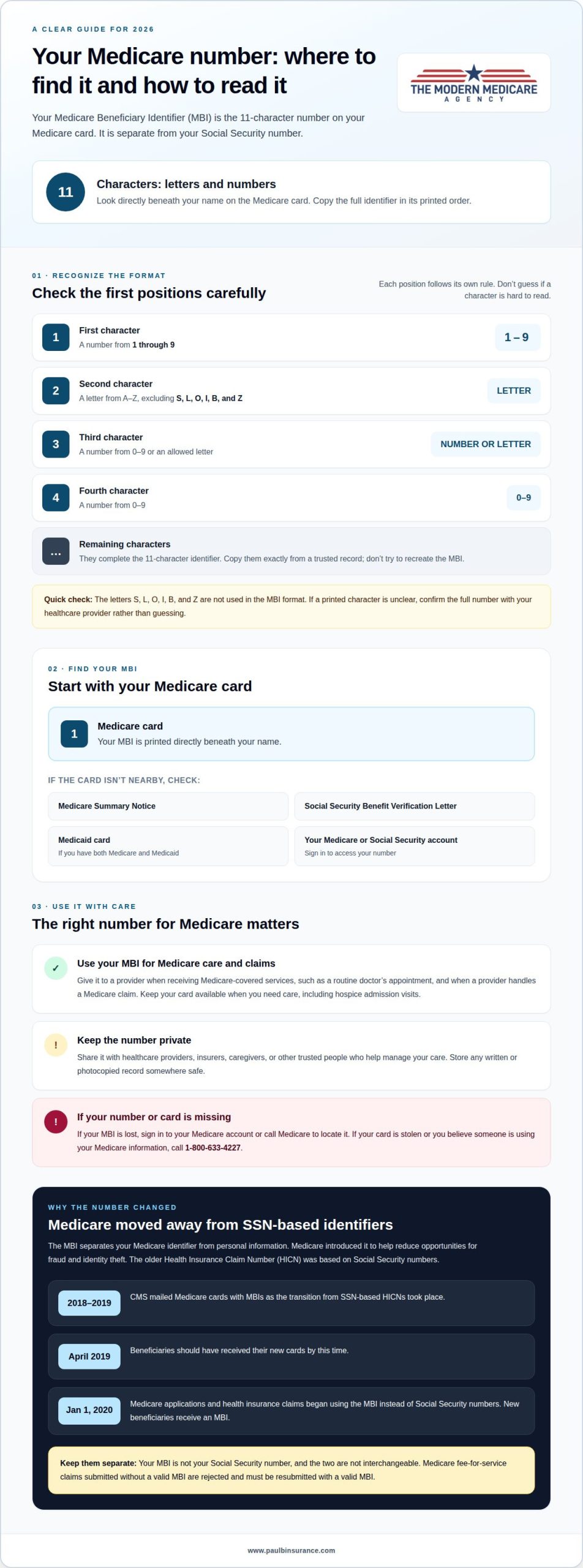
Your Medicare number is printed beneath your name on your Medicare card. It is an 11-character Medicare Beneficiary Identifier, or MBI, made up of letters and numbers. Use the card to find the number you need for Medicare services and claims.
The MBI format is the pattern of characters used to create this identifier. The Centers for Medicare & Medicaid Services (CMS) says its first character must be a number from 1 through 9. This helps distinguish the MBI from a number that begins with zero.
The second character must be a letter from A to Z, except S, L, O, I, B, and Z. The third character can be a number from 0 through 9 or an allowed letter. The fourth character must be a number from 0 through 9. Those excluded letters are not used anywhere in the MBI format.
Look for all 11 characters together when reading your card. For example, an MBI begins with a number, then a permitted letter, followed by an allowed number or letter and a number. The remaining characters complete the identifier. Don’t mistake a letter for a number, or vice versa, when sharing it with a healthcare office.
If your card isn’t nearby, check a Medicare Summary Notice or your Social Security Benefit Verification Letter. If you have both Medicare and Medicaid, your Medicaid card may also show your Medicare number. These documents can help you find the identifier, but on your Medicare card it appears directly beneath your name.
Use your MBI when receiving Medicare-covered services, such as at a routine doctor’s appointment, and when a provider handles a Medicare claim. Keep your card available when you need care, including for hospice admission visits.
Your MBI identifies you in Medicare records; it is not your Social Security number. Treat it as confidential information and share it only with healthcare providers, insurers, caregivers, or other trusted people handling your care. If you’re also considering plan coverage, the Medicare Advantage guide can help explain that separate decision.
For the second position, compare the character with the permitted alphabetic range: A through Z, excluding S, L, O, I, B, and Z. Check this position separately before reading the rest of the identifier, since a character may look plausible but still be excluded. If you can’t tell whether a printed character is a letter or a number, inspect it carefully and confirm the full MBI with your healthcare provider rather than guessing. Keeping the characters in their printed order can help you communicate the identifier accurately. This alphabetic rule applies only to the second character, so use each position’s own format rule and review the complete identifier before using it for care or a claim.
Replacing Social Security Numbers and HICNs with MBIs
Medicare replaced identifiers based on Social Security numbers with MBIs to separate Medicare identification from personal information. The change also phased out the older HICN, or Health Insurance Claim Number.
Transition from SSNs and HICNs
The transition replaced the SSN-based HICN with a Medicare Beneficiary Identifier. The Centers for Medicare & Medicaid Services (CMS) mailed Medicare cards with MBIs in 2018 and 2019, and beneficiaries should have received new cards by April 2019. As of January 1, 2020, Medicare applications and health insurance claims use the MBI instead of Social Security numbers. New beneficiaries receive an MBI.
Medicare Number Locations
You can find your MBI on your Medicare card, where it appears beneath your name. It may also appear on a Medicare Summary Notice or Social Security Benefit Verification Letter. If you have both Medicare and Medicaid, check your Medicaid card as well. You can also sign in to your Medicare or Social Security account to access it.
Allowed MBI Letters and Numbers
Allowed MBI letters and numbers are the characters used in the identifier’s format. An MBI has 11 characters, and its first character is a number from 1 through 9. Its format excludes the letters S, L, O, I, B, and Z. The other positions follow specific letter-and-number rules, so copy the identifier exactly from a trusted record rather than trying to recreate it.
The change also affected claim handling. Starting January 1, 2020, Medicare fee-for-service claims submitted without a valid MBI are rejected and must be resubmitted with a valid MBI. This makes the number on a current Medicare card important when a provider files a claim. The MBI is separate from your Social Security number, so don’t substitute one for the other.
If your MBI is lost, sign in to your Medicare account or call Medicare to locate it. If your card is stolen or you believe someone is using your Medicare information, call Medicare at 1-800-633-4227.
Keep your MBI private, much like a Social Security number, credit card number, or driver’s license. Share it with healthcare providers, insurers, caregivers, or other trusted people who help manage your care. CMS recommends destroying your old Medicare card and using the new one after it arrives. If you keep a written or photocopied record, store it somewhere safe.
Why Medicare replaced SSN-based identifiers
Medicare replaced identifiers based on Social Security numbers to reduce the connection between beneficiaries’ Medicare records and their personal information. Using a Social Security number as a health insurance identifier could expose sensitive identity details. The Medicare Beneficiary Identifier, or MBI, gives Medicare a separate number to identify beneficiaries, helping reduce opportunities for fraud and identity theft.
The Health Insurance Claim Number, or HICN, was Medicare’s older identifier based on Social Security numbers. Medicare phased out the HICN as it moved to MBIs during 2018 and 2019. The Centers for Medicare & Medicaid Services mailed new Medicare cards with MBIs during those years. Beneficiaries should have received their new cards by April 2019.
The change also clarified which number belongs on Medicare paperwork. As of January 1, 2020, Medicare applications and health insurance claims use the MBI instead of Social Security numbers. A Medicare number is different from a Social Security number, and the two aren’t interchangeable. New Medicare beneficiaries are assigned an MBI, rather than an SSN-based HICN.
A replacement Medicare card is a new card issued when the original is lost, stolen, or unavailable after an identifier change. If you haven’t received a new card after an MBI change, sign in to your Medicare account or call 1-800-Medicare to get the number. Medicare sends cards to the address listed with Social Security, so keeping that address current helps the card reach you.
If the address in your records is wrong, update it with the Social Security Administration. Beneficiaries whose address on file differs from the address in an eligibility response can call the Social Security Administration at 1-800-772-1213. Once you have the replacement card, use it for Medicare matters and destroy the old card, as CMS recommends.
Although the MBI reduces reliance on personal information, it still needs careful handling. Keep your card secure and share the identifier only with healthcare providers, insurers, caregivers, or other trusted people helping with your care. A safe copy or written record can help if the card goes missing, but store it privately rather than somewhere others can easily see it.
If you suspect someone is using your Medicare information, call Medicare at 1-800-633-4227. Keep a note of the date you noticed the concern and the records involved, such as a Medicare Summary Notice. That information can help you explain what happened when you report it. The new identifier supports stronger privacy, while prompt reporting helps address suspected misuse.
What the Medicare Beneficiary Identifier (MBI) is
A Medicare Beneficiary Identifier, or MBI, is a randomly generated identifier used to identify Medicare beneficiaries. It connects a person to Medicare records for tasks such as applications, eligibility inquiries, and claims. The MBI is an identifier, not a Medicare plan or a description of someone’s medical care.
Think of the MBI as a reference used in Medicare transactions. For example, when a provider submits a claim, the MBI helps identify which beneficiary the claim concerns. The number itself doesn’t explain which services are covered or what a plan pays. Those details depend on the person’s Medicare coverage and the service involved.
The Centers for Medicare & Medicaid Services (CMS) introduced the MBI on Medicare cards as part of the transition away from older identifiers. Its design separates the Medicare identifier from a beneficiary’s Social Security number. This distinction matters because the MBI identifies a person within Medicare rather than serving as a general personal identification number.
An MBI supports administrative tasks beyond paper claims. For example, eligibility inquiries made with a new MBI return eligibility data. If a beneficiary’s MBI changes, Medicare information and claim data remain available under the current identifier. This helps connect later Medicare transactions with the beneficiary’s records, even when an older number is no longer current.
The MBI isn’t a Medicare plan number or a Social Security number. A person may have Medicare coverage and enroll in a separate plan, but the MBI identifies them in Medicare processes. It doesn’t name a Medicare Advantage, Medigap, or Part D plan. Put simply, the Medicare beneficiary identifier identifies a person, not a coverage choice.
For example, imagine a provider checking eligibility before care. The MBI is used for the inquiry, while the eligibility response provides information about Medicare coverage. A claim is another transaction that uses the identifier to connect paperwork with the right beneficiary. The MBI helps with identification; it doesn’t replace eligibility information or claim details.
In 2026, the clearest way to understand an MBI is as Medicare’s beneficiary identifier, not a measure of health or a promise of payment. Keep the number available for Medicare-related transactions, and protect it as personal information. When a form asks for a Medicare number, use the MBI shown on the beneficiary’s current Medicare card. In everyday terms, that’s the Medicare beneficiary identifier explained by its role in Medicare records and transactions.
Where can beneficiaries find their Medicare Beneficiary Identifier?
Your Medicare Beneficiary Identifier, or MBI, is the number Medicare uses to identify you. In 2026, start with your Medicare card, then use an account or Medicare support if you can’t find it.
The card is mailed to the address Medicare has on file through Social Security. If you signed up for Medicare, the card typically arrives in the “Welcome to Medicare” packet within two weeks. People who receive Social Security or Railroad Retirement Board benefits for at least four months before turning 65 usually receive the card around three months before their birthday.
If you’re new to Medicare, you need your MBI to create a Medicare.gov account. Once you have an account, signing in can help you access your number without carrying your card. You can also sign in to your Social Security account to find Medicare information. The Social Security Administration doesn’t allow someone to create a my Social Security account for another person, even with written permission.
If you don’t have your physical card, check a Medicare Summary Notice or Social Security Benefit Verification Letter. If you have both Medicare and Medicaid, your Medicaid card may also show your Medicare number. Use these records to find the identifier, then keep it private like other personal information.
If a replacement card hasn’t arrived after an MBI change, sign in to your Medicare account or call 1-800-Medicare. A card may not reach you if the mailing address is incorrect. Compare the address Medicare has with your current address; if your Social Security address needs updating, contact the Social Security Administration at 1-800-772-1213.
For help by phone, call Medicare at 1-800-Medicare. TTY users can reach Medicare at 1-877-486-2048. Before calling, have a safe place to note the number and keep your card or account details private. Don’t share the MBI in response to an unexpected request.
Once you find the MBI, save it securely so it’s available for care and Medicare paperwork. If you need guidance with Medicare coverage choices after locating your number, get help understanding your Medicare options.
The Modern Medicare Agency
Once you’ve found your MBI, The Modern Medicare Agency can help you understand your coverage choices. As an independent brokerage, the agency helps eligible individuals compare Medicare Advantage, Medicare Supplement (Medigap), and Medicare Part D plans based on their needs. Your MBI identifies you in Medicare records; it doesn’t tell you which plan suits your coverage needs.
Consider reaching out when you’re weighing plan options or want to understand how coverage choices differ. The Modern Medicare Agency offers personalized, independent guidance to help you navigate those decisions without confusing your Medicare identifier with your insurance selection. Your MBI is personal information, so share it only when it’s needed to discuss or manage your care.
Contact The Modern Medicare Agency to discuss your Medicare coverage questions.
Take Your Next Medicare Step With Confidence
With the Medicare beneficiary identifier explained, you can separate the question of your number from the decision about coverage. Your MBI helps identify you in Medicare records, while choosing coverage is a separate step shaped by your health needs, budget, and preferences. Take time to consider what matters most to you and which questions you want answered.
If you’re ready to talk through your options, The Modern Medicare Agency offers a free Medicare consultation by phone or Zoom. You can compare Medicare Advantage, Medigap, and Part D plans with personalized, independent guidance, without pressure. Book a free consultation to discuss your needs and decide what to explore next.
Contact The Modern Medicare Agency to discuss your Medicare questions. You can take the next step at your own pace.
Frequently Asked Questions
What Is the MBI?
MBI stands for Medicare Beneficiary Identifier, the identifier used for Medicare beneficiaries. It helps connect a Medicare transaction, such as an eligibility inquiry or claim, to the correct beneficiary. For example, a provider may use it when handling Medicare paperwork. It identifies you within Medicare; it doesn’t describe your medical needs or tell you which plan to choose.
What is a Medicare Beneficiary Identifier (MBI)?
A Medicare Beneficiary Identifier is a randomly generated identifier assigned to people enrolled in Medicare. It appears on the Medicare card and is used in Medicare processes. Keep it handy when a provider needs to identify your Medicare record, but share it only with people involved in your care or trusted helpers. It isn’t interchangeable with your Social Security number.
How is the Medicare Beneficiary Identifier different from the Social Security Number-based Health Insurance Claim Number (HICN)?
The HICN was Medicare’s older identifier, based on a person’s Social Security number. The MBI is separate and isn’t based on that number. Medicare transitioned from HICNs to MBIs, so use your current MBI for Medicare transactions rather than substituting your Social Security number. If an old document shows an HICN, use your current Medicare information for new transactions.
What does each character in a Medicare Beneficiary Identifier mean?
The characters in an MBI identify a beneficiary through a random combination, not personal details such as a birth date. An MBI has 11 characters. The first is a number from 1 through 9; the second is an allowed letter; the third can be a number or allowed letter; and the fourth is a number. The letters S, L, O, I, B, and Z are excluded. Copy the full identifier from your card rather than interpreting it.
Can a Medicare Beneficiary Identifier change, and how can beneficiaries request a new one?
Yes, an MBI can change, and the new identifier becomes the one to use for Medicare matters. If you haven’t received a new card after a change, sign in to your Medicare account or call 1-800-Medicare to get the updated number. Check that your mailing address is current with Social Security so a replacement card can reach you. Don’t keep using an older identifier for new transactions once you have the updated one.
How can beneficiaries protect their Medicare Beneficiary Identifier from fraud?
Protect your MBI by sharing it only with healthcare providers, insurers, caregivers, or other trusted people handling your care. Store a written copy or photocopy of your Medicare card securely, not somewhere others can easily see it. Destroy an old card after receiving its replacement. If you think someone is using your Medicare information, call Medicare at 1-800-633-4227 and explain your concern.

Article by
Paul Barrett
Paul Barrett, CMIP is the founder of The Modern Medicare Agency, an independent Medicare-only brokerage based in Melville, NY. With 18 years of Medicare-exclusive experience, a CMIP designation, and more than 5,000 clients served across 37 states, Paul is one of the most credentialed independent Medicare specialists on Long Island — and one of the most direct.
He represents 40+ carriers with no quotas and no allegiances, which means his recommendations are based entirely on what fits each client's specific situation. He is the author of Medicare Mastery Unlocked and host of the Wise Guys Retirement Talk podcast. His content is grounded in primary sources, real carrier intelligence, and 18 years of watching what happens when people get Medicare right — and when they don't.
📞 631-358-5793 | paulbinsurance.com