




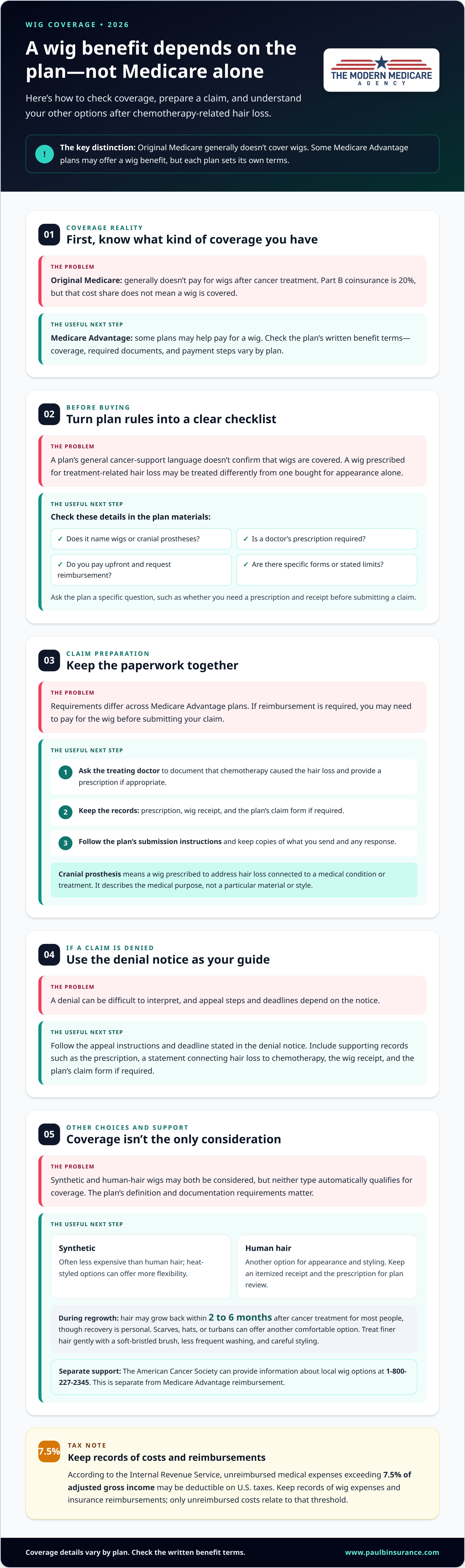
Original Medicare generally doesn’t cover wigs after cancer treatment. For people seeking Medicare coverage for wigs for cancer patients, the key distinction is the plan: some Medicare Advantage plans may offer a wig benefit, but coverage depends on the plan’s terms.
It’s understandable to feel overwhelmed when you’re managing treatment and trying to make sense of insurance at the same time. A wig can offer comfort and confidence, yet coverage rules can be unclear. Understanding the difference between Original Medicare and Medicare Advantage helps you know where to look for support.
This guide explains what each type of Medicare coverage may provide in 2026, what plan requirements may apply, and where to find free wigs or financial assistance. You’ll also see how Medicare Supplement insurance fits in, so you can focus on the options most relevant to your situation.
Key Takeaways
- Original Medicare generally doesn’t pay for wigs after cancer treatment, so understand what your plan does and doesn’t cover before budgeting.
- Some Medicare Advantage plans may help with wig costs. Learn which plan rules and documents can affect reimbursement.
- Free wig programs and other financial assistance may be available. The article explains where to start looking.
- Unreimbursed medical expenses above 7.5% of adjusted gross income may be deductible on U.S. taxes, according to the Internal Revenue Service.
- Medicare Part B coinsurance is 20%, according to the Centers for Medicare & Medicaid Services, but that cost share doesn’t mean a wig is covered.
Can Medicare Advantage help pay for a wig after chemotherapy-related hair loss?
In 2026, some Medicare Advantage plans may help pay for a wig after chemotherapy causes hair loss. Benefits vary by plan, so the plan’s coverage rules determine what documents and payment steps apply.
Eligibility After Chemotherapy-Related Hair Loss
Eligibility depends on a plan’s requirements for a wig related to hair loss from cancer treatment. A plan may treat a medically prescribed wig differently from one purchased for appearance alone. Some Medicare Advantage plans may cover wigs for chemotherapy-related hair loss, but coverage depends on the plan. Medicare Advantage plans must cover at least the services Original Medicare covers.
Before buying a wig, ask what the plan requires. It may require a doctor’s prescription or ask you to pay upfront and submit a claim for reimbursement. Documentation connecting the hair loss to chemotherapy can help explain the medical need. Keep the prescription and purchase receipt together to make the claim process clearer.
What Medicare Advantage plans cover wigs for cancer-related hair loss? Some plans include wig coverage, but there is no single benefit that applies to every plan. The plan’s written terms determine whether it covers a wig, what documentation it requires, and whether payment happens upfront or through reimbursement. A Medicare Advantage plan can include benefits beyond Original Medicare, but coverage details differ.
How can someone appeal a Medicare denial for a medically necessary wig? Start with the denial notice and follow the appeal instructions and deadline stated there. Include supporting documents, such as the doctor’s prescription, a statement connecting hair loss to chemotherapy, the wig receipt, and the plan’s claim form if required.
Wig Types and Cranial Prostheses
A cranial prosthesis is a wig prescribed to address hair loss connected to a medical condition or treatment. The term describes its medical purpose, not a particular material or style. Synthetic and human-hair wigs may both be considered, but the plan’s definition and documentation requirements matter more than the wig’s construction. The prescription should clearly connect the wig to chemotherapy-related hair loss.
Synthetic wigs are often less expensive than human-hair wigs, and heat-styled synthetic options can offer more flexibility. Human-hair wigs provide another choice in appearance and styling, with specialized providers such as Thursday’s Calabasas designing custom non-surgical hair replacement solutions for individuals experiencing medical hair loss. Neither type automatically qualifies for coverage. Keep the prescription and itemized receipt so the plan can assess the specific wig and its stated medical purpose.
Hair may grow back within 2 to 6 months after cancer treatment for most people, though recovery is personal. During that time, treat finer hair gently: use a soft-bristled brush, wash less frequently, and style carefully. Scarves, hats, or turbans can also give the scalp a break from a wig while offering another comfortable option.
Keep possible tax treatment in view, too. According to the Internal Revenue Service, unreimbursed medical expenses exceeding 7.5% of adjusted gross income may be deductible on U.S. taxes. Keep records of wig expenses and insurance reimbursements, since only unreimbursed costs relate to that threshold.
Medicare Advantage wig benefits
Some Medicare Advantage plans may help pay for a wig after chemotherapy-related hair loss, but benefits vary. Medicare Advantage plans must cover at least the services Original Medicare covers; a wig benefit depends on the plan’s additional coverage and rules.
What are the Medicare coverage requirements and documentation for a cranial prosthesis? There isn’t one set of wig requirements for every Medicare Advantage plan. Some plans require a doctor’s prescription, the wig receipt, and a completed claim form, while others may have different steps.
When comparing Medicare Advantage cancer support benefits, focus on details that affect a wig claim, not just general cancer-related language. Check whether the plan names wigs or cranial prostheses, requires a prescription, and reimburses purchases. Also check whether you must pay upfront. These details show how the benefit works in practice.
For a member of SCAN Inspired, the same distinction applies: a plan’s name alone doesn’t explain its wig reimbursement rules. Review the plan’s benefit materials for terms related to wigs, hair loss, or cranial prostheses. Then ask plan customer service a specific question, such as whether you need a prescription and receipt before submitting a claim.
How can patients get a wig prescription and submit a claim to Medicare? Ask the treating doctor to document that chemotherapy caused the hair loss and provide a prescription if appropriate. For a Medicare Advantage claim, gather the prescription, wig receipt, and the plan’s claim form, then follow the plan’s submission instructions.
Requirements can affect both timing and out-of-pocket costs. If a plan requires reimbursement, for example, a member may need to pay for the wig before submitting the receipt and claim form. An insurer may also require a prescription connecting the wig with treatment-related hair loss. Keep copies of submitted documents and any response.
Compare coverage in writing when choosing among plans. A useful side-by-side review includes the wig benefit, required documents, reimbursement steps, and any stated limits. A plan’s general cancer support language doesn’t by itself show that wigs are covered. The Medicare Advantage plan details can help you understand how plan benefits differ.
Insurance isn’t the only source of support. The American Cancer Society can provide information about local wig options at 1-800-227-2345. That assistance is separate from Medicare Advantage reimbursement, so keep the plan’s claim requirements distinct from community resources.
Some Medicare Advantage plans offer wig coverage as an additional benefit for chemotherapy-related hair loss. Check the plan’s benefit materials for wigs or cranial prostheses, and review the reimbursement rules and requirements.
Financial assistance and free wigs
A wig can be expensive, so it may help to explore support beyond Medicare. Free or lower-cost options may be available through cancer support resources, Medicaid programs, or private insurance. Each option has different rules. Keep prescriptions, receipts, and insurance decisions together so you can identify any costs that remain unpaid.
Where can you begin? The American Cancer Society can be reached at 1-800-227-2345 for information about local wig options. When you call, explain that hair loss followed cancer treatment and ask what local options are available. If you have a prescription or insurance decision, keep it nearby. Those details can help make the conversation more focused.
Do Medicaid or other insurance programs cover wigs for cancer patients? Some state Medicaid programs may reimburse part of a hair prosthesis cost after chemotherapy or radiation when an oncologist prescribes it. Private insurance plans may also cover wigs for treatment-related hair loss or alopecia areata, but coverage depends on the policy’s terms.
For Medicaid, the state program’s rules and the prescription are key. An oncologist’s prescription can connect the hair prosthesis to chemotherapy or radiation. Keep the prescription and proof of purchase together, and organize any paperwork provided by the state program. This creates a clear record of the medical reason and expense if reimbursement is available.
Private insurance coverage varies by policy. Look for terms about wigs, hair prostheses, or hair loss caused by treatment. If the policy requires a claim, the insurer may ask for a doctor’s prescription, receipt, or completed form. Save copies before submitting documents, and keep any denial notice because it explains the insurer’s reason and next steps.
Ask support organizations about practical options as well as payment. For example, the American Cancer Society can share information about local wig resources, while your insurer’s written benefit terms explain coverage. Keep these separate: finding a local wig resource doesn’t mean insurance will reimburse the cost. Clear records help distinguish assistance from an insurance benefit.
If a wig isn’t accessible, scarves, hats, and turbans can cover the scalp and provide a break from wearing one. Synthetic wigs are often less expensive than human-hair wigs, which may help when comparing options. Comfort, fit, and the plan’s documentation rules all matter. Start with the support route that fits your situation: local resources, state Medicaid, or private insurance.
Original Medicare coverage for wigs
In 2026, Original Medicare Parts A and B do not cover wigs after cancer treatment. A doctor’s prescription alone doesn’t make a wig a covered Medicare benefit.
Original Medicare and Chemotherapy Hair Loss
Original Medicare distinguishes cancer care from products used for appearance. Part A covers inpatient hospital care, while Part B covers outpatient services. Neither part pays for a wig used to address chemotherapy-related hair loss. This matters when planning expenses: a wig can be important for comfort, but a cancer diagnosis doesn’t change the coverage rule.
Medicare covers some medically necessary prostheses, such as breast prostheses, when they replace a body part or restore function. That coverage doesn’t extend to wigs for hair loss. A prescription can explain why a wig is needed, but it can’t make an item covered when Original Medicare excludes it.
Part B Coverage for Prescribed Wigs
Medicare Part B covers some prosthetic devices classified as durable medical equipment, but a prescribed wig isn’t covered in that category. The distinction is the item’s function, not whether a doctor wrote a prescription. This can prevent confusion when cancer care includes covered treatments but the related hair replacement product remains outside Original Medicare coverage.
Does Medicare Part B cover a wig or cranial prosthesis prescribed by a doctor? No. A prescription doesn’t change the fact that Original Medicare Parts A and B don’t cover wigs for chemotherapy-related hair loss.
Medicare Part B coinsurance is 20%, according to the Centers for Medicare & Medicaid Services. That percentage applies to covered Part B services, not to a wig Medicare excludes. In other words, the coinsurance figure doesn’t mean Medicare pays the remaining amount for a prescribed wig.
For example, Part B may cover an eligible outpatient service related to cancer care, while the wig purchased during treatment remains uncovered. These expenses have different coverage decisions. Keep the medical bill and wig receipt separate to distinguish costs related to Medicare-covered services from those that aren’t covered.
A denial for a wig doesn’t mean every cancer-related service is excluded. It means the wig itself doesn’t meet Original Medicare’s coverage rules. If you receive a Medicare notice about another service, read the item named in the notice and the reason for the decision. A decision about one service shouldn’t be treated as a decision about all cancer care.
When estimating the amount you’ll pay for a wig, don’t apply Part B’s 20% coinsurance as though Medicare approved it. Original Medicare doesn’t contribute toward the wig under these rules. That clear distinction can help you separate covered treatment costs from the cost of hair replacement.
Does Original Medicare cover wigs for cancer patients experiencing hair loss from chemotherapy?
No. In 2026, Original Medicare Parts A and B typically do not cover wigs for hair loss caused by chemotherapy. The key distinction is between covered cancer care and a wig purchased to address hair loss.
Original Medicare treats a wig differently from a prosthesis that replaces a body part or restores function. For example, Medicare may cover breast prostheses when they replace a body part or help restore function. A wig doesn’t meet that same description simply because cancer treatment caused the hair loss.
A doctor’s prescription can explain why a wig is medically important, but it doesn’t change the item’s coverage category. Part B covers some prosthetic devices classified as durable medical equipment, but that rule doesn’t make a wig covered equipment. The question isn’t only whether a doctor prescribed it, but whether Medicare covers that type of item.
It also helps to separate costs connected with treatment. Part A covers inpatient hospital care, while Part B covers outpatient services. A chemotherapy visit or another eligible cancer service may have its own coverage decision. The wig remains a separate item, even when hair loss began during the same treatment period.
Congress saw proposals addressing this gap. In February 2026, the Wigs as Durable Medical Equipment Act was reintroduced as H.R. 7546 and S. 3872. The proposed bill would allow Medicare to cover wigs for people affected by alopecia and patients undergoing chemotherapy. A reintroduced proposal is not the same as an existing Medicare benefit, so it does not change the coverage answer above.
For a practical review, separate three documents: the Medicare notice for a covered service, the doctor’s prescription, and the wig receipt. The notice concerns the service Medicare processed. The prescription documents the medical reason for the wig, and the receipt records the purchase. These documents serve different purposes and don’t prove that Original Medicare paid for the wig.
If you have Original Medicare and another form of coverage, identify which plan issued the decision before interpreting it. A notice about a Medicare-covered cancer service doesn’t establish wig coverage. A separate plan benefit may have its own rules. Keeping each plan’s documents together can clarify the distinction when reviewing treatment expenses, and experts at The Modern Medicare Agency can help you navigate these complex options.
The direct answer remains no: Original Medicare generally does not pay for wigs after chemotherapy-related hair loss, even with a prescription. While proposed legislation like H.R. 7546 and S. 3872 could affect this coverage in the future, a mere proposal does not itself create a current Medicare benefit.
The Modern Medicare Agency: Cancer insurance
The Modern Medicare Agency can help you understand how cancer insurance and Medicare plan choices fit your needs. Original Medicare’s wig coverage rules remain separate, but reviewing your insurance options can clarify what other coverage you have and what questions to ask about its benefits.
If you’re weighing Medicare Advantage, Medicare Supplement (Medigap), or Medicare Part D plans alongside cancer insurance, the agency offers personalized guidance to compare options from more than 40 carriers. That support can help you make informed decisions during a difficult time, without confusing a separate insurance benefit with Medicare coverage for a wig.
Contact The Modern Medicare Agency to discuss your coverage options.
Make your next coverage decision with confidence
As you plan for care in 2026, keep the wig decision separate from the broader question of how you want your health coverage to work. Understanding Medicare coverage for wigs for cancer patients can help you set realistic expectations, while a careful review of your plan can clarify how other medical needs fit into your coverage choices.
The Modern Medicare Agency helps you compare Medicare Advantage Plans, Medicare Supplement (Medigap) Plans, and Medicare Part D Plans. This support can be useful when weighing plan options alongside cancer-related concerns and seeking clear, personalized guidance that distinguishes a plan’s benefits from Original Medicare.
You don’t have to sort through every coverage detail alone. Contact The Modern Medicare Agency to talk through your Medicare plan options and decide what questions matter most for your situation. Take the next step at your own pace, with clearer information to guide you.
Frequently Asked Questions
Does Medicare cover wigs for people with cancer?
Original Medicare generally doesn’t cover wigs for hair loss from cancer treatment. Questions about Medicare coverage for wigs for cancer patients often depend on whether you have Original Medicare or a Medicare Advantage plan. Some Advantage plans may offer wig benefits, but terms differ. Review the plan-year documents and keep the wig receipt with related medical paperwork.
Can cancer patients get a free wig with Medicare?
Medicare itself doesn’t provide free wigs, and Original Medicare doesn’t cover wigs for chemotherapy-related hair loss. A Medicare Advantage plan may offer some help, but that isn’t the same as a free wig. For local wig resources, call the American Cancer Society at 1-800-227-2345. Ask about nearby options and whether they involve donated wigs or other assistance.
Do I have to purchase my wig from a specific retailer?
Original Medicare doesn’t set a retailer requirement for wigs because it generally doesn’t cover them. For Medicare coverage for wigs for cancer patients through Medicare Advantage, the plan’s terms determine whether it limits where you can buy a wig. Before purchasing, review any instructions about retailers, prescriptions, receipts, and claim forms. Keep the receipt and product paperwork in case you need them for a reimbursement claim.
How much does Medicare pay for a wig?
Original Medicare pays nothing toward a wig for chemotherapy-related hair loss because it doesn’t cover the item. A Medicare Advantage plan may provide a benefit, but the amount and reimbursement method depend on its terms. Review the wig benefit rather than applying Medicare Part B coinsurance to the purchase. Part B cost-sharing applies to covered services, not to a wig excluded by Original Medicare.
How much does a wig cost?
The amount depends on the wig selected. Stands, cleaning products, combs, or adhesive may add separate expenses, so include them in your budget.
How much does a wig cost for cancer patients, and what costs might Medicare pay?
Original Medicare doesn’t pay toward a wig after chemotherapy-related hair loss, even with a doctor’s prescription. Some Medicare Advantage plans may help under their own benefit rules. Keep the prescription and receipt, and distinguish wig expenses from bills for covered cancer treatment.
Where can cancer patients find free or low-cost wigs and financial assistance?
Call the American Cancer Society at 1-800-227-2345 for information about local wig options. Some state Medicaid programs may reimburse part of a hair prosthesis cost after chemotherapy or radiation when an oncologist prescribes it. Private insurance may also cover wigs for treatment-related hair loss, depending on policy terms. Keep prescriptions, receipts, and insurance responses organized for assistance requests.

Article by
Paul Barrett
Paul Barrett, CMIP is the founder of The Modern Medicare Agency, an independent Medicare-only brokerage based in Melville, NY. With 18 years of Medicare-exclusive experience, a CMIP designation, and more than 5,000 clients served across 37 states, Paul is one of the most credentialed independent Medicare specialists on Long Island — and one of the most direct.
He represents 40+ carriers with no quotas and no allegiances, which means his recommendations are based entirely on what fits each client's specific situation. He is the author of Medicare Mastery Unlocked and host of the Wise Guys Retirement Talk podcast. His content is grounded in primary sources, real carrier intelligence, and 18 years of watching what happens when people get Medicare right — and when they don't.
📞 631-358-5793 | paulbinsurance.com