
Did you know that nearly half of adults over age 75 live with hearing loss, yet a single pair of prescription hearing aids in 2026 can still cost you up to $8,500? It’s a heavy burden to carry, especially when you’re trying to figure out the truth about medicare coverage for hearing aids and exams. We know how exhausting it is to search for clear answers only to find a maze of confusing rules and fine print.
You might feel like the system is working against you, but we’re here to act as your patient guide through this process. We’ll show you exactly why your $283 Part B deductible covers a diagnostic test for an ear injury but leaves you paying full price for a routine checkup. Our goal is to replace that anxiety with peace of mind by explaining how Medicare Advantage plans and new over-the-counter options can protect your savings. We’ll walk you through the 2026 options step by step so you can hear clearly without the financial strain.
Key Takeaways
- We clarify why Original Medicare only pays for diagnostic tests and what that means for your 2026 healthcare budget.
- Learn how to navigate medicare coverage for hearing aids and exams by identifying plans that offer specific dollar allowances.
- Discover the simple steps to verify which hearing aid brands and models are covered before you commit to a new plan.
- Understand the vital differences between Medicare Advantage and Medigap when it comes to routine wellness and hearing health.
- Gain the confidence to choose a path that lowers your out-of-pocket costs while ensuring you have the support of an expert advocate.
Does Medicare Cover Hearing Aids and Exams in 2026?
We understand that hearing is vital for staying connected to your loved ones and ensuring your personal safety. Being able to follow a conversation at a family dinner or hear a siren while driving is essential for a full, independent life. However, many of our clients are frustrated to learn that Original Medicare (Parts A and B) still does not cover routine hearing exams or hearing aids. This policy has not changed for 2026, which means the responsibility for these costs often falls directly on you.
It’s a confusing system to manage, especially when you’re trying to prioritize your health on a fixed budget. While the government provides basic medical care through Medicare (United States), it often leaves out the supplemental services that keep you feeling your best. This is why we focus on helping you find the right path to get the medicare coverage for hearing aids and exams you actually need.
The 2026 Medicare Coverage Gap
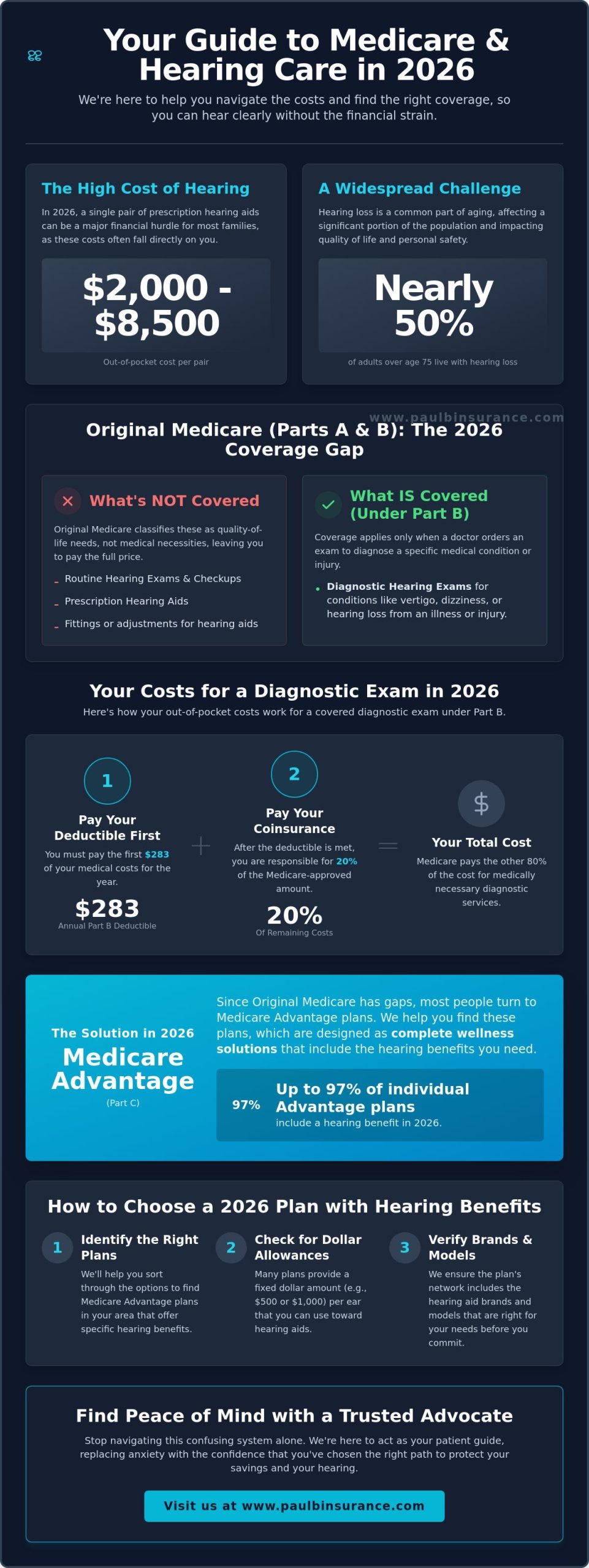
Why does this gap exist? In the eyes of the federal government, routine hearing care is often classified as a quality-of-life need rather than a medical necessity. This means that while a broken bone is covered, a gradual loss of hearing usually isn’t. In 2026, the price for a pair of prescription hearing aids typically ranges from $2,000 to $8,500. Paying that much out-of-pocket is a major financial hurdle for most families.
To solve this problem, most beneficiaries now look toward Part C. Our Medicare Advantage Plans are the primary way to get help with these costs. In 2026, about 95% to 97% of individual Advantage plans include some form of hearing benefit. These plans are designed to be a wellness solution, providing the coverage that Original Medicare lacks.
Diagnostic vs. Routine: Why the Label Matters
The label your doctor puts on your visit determines who pays the bill. It’s a small detail that makes a big difference in your wallet. Diagnostic exams are covered under Part B when they are related to a specific injury or illness. Diagnostic exams are tests meant to identify a specific medical condition like vertigo.
- Diagnostic Exams: Part B covers these if a doctor orders them to see if you need medical treatment. You’ll pay 20% of the cost after meeting your $283 Part B deductible.
- Routine Exams: These are for standard checkups or to see if you need hearing aids. Original Medicare will not pay for these visits.
We’re here to help you move from a state of confusion to one of certainty. By understanding the rules for medicare coverage for hearing aids and exams, you can make an informed choice for your 2026 coverage and avoid unexpected bills at the doctor’s office.
Understanding Diagnostic Hearing Exam Coverage Under Medicare Part B
We know how stressful it is to wonder if a doctor’s visit will result in a surprise bill. When you experience a sudden change in your hearing or feel like the room is spinning, you need answers, not financial anxiety. While Original Medicare is limited, there are specific situations where Part B steps in to help. We are here to act as your guide, ensuring you understand exactly when the government will help pay for these essential medical evaluations.
When is a Hearing Exam Considered Diagnostic?
A hearing exam is considered diagnostic when its purpose is to treat a medical condition rather than just checking your hearing for a new device. For example, if you have persistent dizziness or a sudden loss of hearing due to an injury, Medicare Part B will generally cover the evaluation. According to the National Institute on Deafness and Other Communication Disorders, hearing loss can often be linked to other health issues, which is why these medical evaluations are so important.
To qualify for this coverage, your doctor or another healthcare provider must order the test. They need to show that the exam is medically necessary to diagnose a condition like vertigo or hearing loss from an illness. Once you have that order, you can visit an audiologist who participates in Medicare to get the answers you need. This is a key part of medicare coverage for hearing aids and exams when the focus is on your immediate medical health rather than a routine checkup.
Your Costs for Diagnostic Services
Even when a service is covered, you will still have some out-of-pocket costs to manage. For 2026, the annual Medicare Part B deductible is $283. You must pay this amount first before Medicare begins to pay its share for the year. After you meet that deductible, you are usually responsible for 20% of the Medicare-approved amount for the exam. This 20% is known as your coinsurance.
If your exam takes place in a hospital outpatient setting, you might also owe a separate copayment to the facility itself. We always recommend asking your doctor for a cost estimate before the appointment. It’s also vital to ensure your provider “accepts assignment.” This means they agree to the Medicare-approved price, which protects you from higher “excess charges” that some providers might try to bill. If you’re worried about these gaps, you might consider how Medicare Supplement (Medigap) Plans can help cover that 20% coinsurance and give you more predictable monthly costs.
We want you to feel empowered as you manage your hearing health. By focusing on the difference between a routine checkup and a diagnostic necessity, you can better navigate the rules of medicare coverage for hearing aids and exams. This clarity helps you move from uncertainty to a solid plan for your 2026 healthcare needs.
Comparing Options: How Medicare Advantage and Medigap Handle Hearing
We know that choosing between Medicare Advantage and Medigap feels like a high-stakes decision. It is often a choice between a lower monthly premium and the freedom to see any doctor you choose. Finding the right medicare coverage for hearing aids and exams requires looking beyond the basic government rules. While the official Medicare hearing aid coverage rules remain strict for Original Medicare, your choice of supplemental coverage changes your financial picture entirely. We are here to help you weigh these options with clarity and care.
Medicare Advantage: The All-in-One Solution?
Many people choose Medicare Advantage Plans because they bundle several benefits into one package. In 2026, approximately 95% to 97% of these plans include some form of hearing benefit. These plans typically offer a hearing aid allowance, which can range from $500 to over $2,500 per ear. This benefit can significantly lower your out-of-pocket costs for the devices themselves. However, you must often use a specific network of audiologists. We help you check these networks carefully so you don’t lose access to a specialist you trust. The trade-off is usually a lower monthly premium in exchange for following the plan’s specific rules on where you receive care.
Medigap and Hearing: What You Need to Know
If you prefer the flexibility of Medicare Supplement (Medigap) Plans, the approach is a bit different. Medigap is designed to pay for the “gaps” in Original Medicare, such as your 20% coinsurance for diagnostic exams. Because Original Medicare does not cover routine hearing aids, a Medigap plan won’t cover them either. This can be a source of anxiety if you were counting on your supplement to pay for new devices. To solve this, many of our clients choose to add a separate dental, vision, and hearing policy. This combination gives you the freedom to see any doctor in the country while still protecting you from high hearing aid costs.
Our goal is to remove the stress from this process. Whether you want an all-in-one plan or a combination of policies, we’ll show you the path to better hearing. We’ll look at your specific needs for 2026 and find the medicare coverage for hearing aids and exams that fits your lifestyle. You don’t have to navigate these complex choices alone; we are here to protect your health and your budget.
How to Choose a 2026 Plan with Hearing Aid Benefits
We believe that finding the right plan shouldn’t feel like a second job. When you are looking for medicare coverage for hearing aids and exams, the details matter more than the marketing headlines. Our mission is to protect you from unexpected costs by helping you look under the hood of every plan. We’ve developed a simple process to move you from confusion to a clear, confident choice for 2026.
- Step 1: Verify the specific hearing aid brands and models covered by the plan. Not all technology is treated equally.
- Step 2: Check the “allowance” amount. Some plans offer a flat dollar amount toward aids, while others use a fixed copay.
- Step 3: Look at the frequency of the benefit. Most plans in 2026 provide coverage once every two or three years.
- Step 4: Confirm if the plan covers hearing aid fittings and follow-up adjustments. These visits are essential for your comfort.
- Step 5: Work with an independent broker. We compare over 40 carriers at once to find the best fit for your specific needs.
Evaluating Hearing Aid Allowances
It’s vital to understand how your plan pays for your devices. Some plans use a copay system where you pay a set fee, like $500 or $1,000 per aid. Others give you a total allowance to spend as you wish. You should always check the Evidence of Coverage (EOC) for hidden costs like separate dispensing fees. A $2,000 allowance may still leave a balance for high-end digital aids. We help you calculate these potential out-of-pocket costs before you sign up.
Network and Provider Flexibility
Your relationship with your audiologist is personal. The first thing we do for you is check if your local specialist is in-network. Without this step, you might be forced to drive long distances for follow-up care or battery replacements. We also look at how your hearing needs fit into your overall health picture. For instance, we can simplify your Medicare Part D search at the same time to ensure all your prescriptions and wellness needs are met in one go.
We represent you, not the insurance companies. This independence allows us to be your unambiguous champion in a crowded market. If you want a partner who prioritizes your peace of mind, we invite you to start your plan comparison with us today.
Finding Peace of Mind with a Trusted Medicare Advisor
We know that choosing a plan feels overwhelming. The rules for medicare coverage for hearing aids and exams are designed in a way that often leads to more questions than answers. You don’t have to do it alone. Our 2026 goal is to ensure you can hear every word at the dinner table without financial stress. We want you to focus on the conversation, not the cost of your care.
Why an Independent Broker Makes the Difference
As independent brokers, we represent you, not the insurance companies. This is a vital distinction. A representative who works for a single insurance carrier can only offer you a limited set of options. We have the freedom to compare over 40 different carriers at once. By looking at the full scope of medicare coverage for hearing aids and exams, we ensure no detail is missed. This allows us to look objectively at which 2026 plans offer the best hearing aid allowances and the most flexible provider networks.
We remove the high-pressure sales pitch from the equation. Our focus is entirely on your specific health needs and your financial security. We act as your advocate and educator throughout this entire process. To learn more about how we protect our clients, you can read our Medicare Broker Guide. This resource explains our commitment to your journey from a state of distress to one of absolute certainty.
Your Next Steps Toward Clearer Hearing
Taking the first step toward better hearing in 2026 is simple. We invite you to schedule a no-pressure consultation with us. During this call, we’ll listen to your concerns and review your current health situation. To make the most of our time together, please have a list of your current prescriptions and the names of your preferred doctors ready.
We follow a methodical, logical path to find your solution. Whether you need the extra benefits of Medicare Advantage Plans or the predictable costs of Medicare Supplement (Medigap) Plans, we’ll find the right fit. Our support doesn’t end once you enroll. We provide year-round assistance to help you use your benefits and navigate any changes in the system. We are here to serve and protect your peace of mind.
Take the Next Step Toward Clearer Hearing
You now have a clear path to understanding medicare coverage for hearing aids and exams in 2026. We’ve explored how Original Medicare focuses on diagnostic medical needs while Medicare Advantage and supplemental policies offer the wellness benefits you deserve. Choosing a plan doesn’t have to be a source of stress or confusion. We provide methodical, jargon-free Medicare planning and personalized support in over 34 states. Because we work with over 40 insurance carriers, our guidance is always unbiased and focused on your unique health needs.
We are here to protect your budget from the high costs of hearing loss so you can stay connected to the people you love. Let us help you find the perfect plan for your hearing needs; contact us for a free consultation today! We are ready to act as your patient guide as you move from a state of uncertainty to one of peace of mind. You deserve to feel confident in your 2026 coverage and certain about your future.
Frequently Asked Questions
Does Medicare Part B cover hearing aids in 2026?
No, Medicare Part B does not cover hearing aids in 2026. Original Medicare is designed to handle medical emergencies and acute illnesses, while hearing aids and routine checkups are currently excluded from that federal coverage. To find help with these costs, we guide our clients toward Medicare Advantage plans that include these essential wellness benefits as part of their supplemental coverage.
How much do hearing aids cost with a Medicare Advantage plan?
Your out-of-pocket cost depends on your plan’s specific allowance or copay structure. In 2026, many Medicare Advantage plans offer a hearing aid allowance ranging from $500 to over $2,500 per ear. We help you compare these totals against the price of the devices you need so you can choose the plan that protects your savings best and reduces your final bill.
Can I get a free hearing test through Medicare?
Original Medicare does not cover routine hearing tests, but most Medicare Advantage plans in 2026 do. These plans often provide one routine exam per year with a $0 copay as long as you stay within their network. We can help you verify if a plan includes this benefit so you can stay on top of your hearing health without any surprise costs at the clinic.
Will Medigap pay for my hearing aid fittings?
No, Medigap plans do not pay for hearing aid fittings. Because Medigap only follows the rules of Original Medicare, it cannot cover services that Medicare itself excludes. If you want help with fittings and the cost of the devices, we often suggest adding a separate dental, vision, and hearing policy to your coverage or switching to a Medicare Advantage plan during an enrollment period.
What happens if my doctor says a hearing exam is medically necessary?
If your doctor orders an exam to diagnose a medical issue like vertigo or an injury, it is covered under Part B. You’ll be responsible for your 20% coinsurance after you meet the $283 Part B deductible for 2026. This is a key part of medicare coverage for hearing aids and exams when the situation is medical rather than a routine checkup for new devices.
Are there 2026 Medicare plans that cover high-end digital hearing aids?
Yes, many 2026 Medicare Advantage plans allow you to use your benefit toward high-end digital hearing aids. While the plan’s allowance might not cover the full cost of premium technology, it can significantly reduce what you pay out of pocket. We help you check the plan’s specific brand list to ensure your preferred technology is included in the medicare coverage for hearing aids and exams.
How often will Medicare Advantage pay for new hearing aids?
Most Medicare Advantage plans that offer this benefit will pay for new hearing aids once every two or three years. This timeline ensures you have access to modern technology as your hearing changes over time. We’ll help you review the specific frequency rules for your 2026 plan so you know exactly when you’ll be eligible for a new pair without paying the full retail price.
Do I need a referral to see an audiologist under Medicare?
For a diagnostic exam under Part B, you must have an order from your doctor to prove medical necessity. If you have a Medicare Advantage plan, you might not need a referral for a routine exam if you have a PPO, but HMO plans usually require one. We simplify this for you by checking your specific plan’s rules before you schedule an appointment with a specialist.

Article by
Paul Barrett
Paul Barrett, CMIP is the founder of The Modern Medicare Agency, an independent Medicare-only brokerage based in Melville, NY. With 18 years of Medicare-exclusive experience, a CMIP designation, and more than 5,000 clients served across 37 states, Paul is one of the most credentialed independent Medicare specialists on Long Island — and one of the most direct.
He represents 40+ carriers with no quotas and no allegiances, which means his recommendations are based entirely on what fits each client's specific situation. He is the author of Medicare Mastery Unlocked and host of the Wise Guys Retirement Talk podcast. His content is grounded in primary sources, real carrier intelligence, and 18 years of watching what happens when people get Medicare right — and when they don't.
📞 631-358-5793 | paulbinsurance.com