
Last week, a family discovered that their father’s four-day hospital stay didn’t actually qualify him for rehab coverage because he was technically under “observation status.” It’s a heartbreaking situation that happens far too often, leaving families to face a $217 daily co-pay they didn’t plan for. We know how exhausting it is to navigate these technicalities while you’re already worried about a loved one’s health. Getting a clear handle on medicare coverage for skilled nursing facility care in 2026 is the best way to move from a state of confusion to one of absolute certainty.
We believe you deserve a guide who simplifies the complex so you can focus on healing. In this article, you’ll learn exactly how to meet eligibility requirements, how the 2026 “TEAM” model might waive certain rules for you, and how to protect your savings from the 100-day limit. We’ll walk you through the 3-day rule, compare how Medigap and Advantage plans handle those high daily costs, and provide a clear path to secure the benefits you’ve earned.
Key Takeaways
- Understand the difference between short-term rehab and long-term custodial care so you know exactly what Medicare will and won’t pay for.
- Learn how the “3-day rule” works in 2026 to ensure your hospital stay correctly qualifies you for the benefits you deserve.
- See how the 100-day timeline works, including the specific days where you can expect a $0 co-pay for your recovery.
- Compare how Medigap and Advantage plans handle medicare coverage for skilled nursing facility care to find the best way to eliminate high daily co-pays.
- Discover the value of having a dedicated advocate who can help you navigate the system if a facility says your coverage is ending too soon.
What is Skilled Nursing Facility (SNF) Care and What Does Medicare Cover?
It’s a heavy moment when a doctor tells you that you or a loved one isn’t quite ready to go home after a hospital stay. You need more time to heal, but a hospital bed isn’t the right place for that recovery. This is where a Skilled Nursing Facility (SNF) comes in. Many people feel a sense of dread when they hear the term, often confusing it with a permanent move to a nursing home. We want to put those fears to rest. Within the broader Medicare program, SNF care is actually designed as a bridge. It provides the high-level medical attention you need to regain your independence so you can return to the comfort of your own living room.
Understanding medicare coverage for skilled nursing facility care starts with recognizing that this is a short-term, medically necessary benefit. In 2026, Medicare Part A remains the primary engine for this coverage. It’s specifically built for “skilled care,” which refers to services that only a licensed professional like a registered nurse or a physical therapist can safely provide. It’s very different from “custodial care,” which involves help with daily activities like bathing, dressing, or using the bathroom. If the help you need is something a family member could be trained to do at home, Medicare generally won’t cover it in an SNF setting. The goal of this benefit is always your recovery, not permanent residency.
Examples of Skilled Services Covered
When you’re in a qualifying stay, Medicare covers the professional services required for your specific recovery plan. These medical services are essential for a safe transition back to your normal life. Common covered services include:
- Physical and occupational therapy: These sessions help you regain mobility, strength, and the ability to perform daily tasks safely after an injury or surgery.
- Speech-language pathology: This is vital support if a stroke or neurological event has affected your ability to communicate or swallow.
- Intravenous (IV) therapy and wound care: This covers complex needs like IV medications or professional dressing changes that require a nurse’s expertise to prevent infection.
What Medicare Does Not Cover in an SNF
While the medical side of your stay is well-supported, there are clear boundaries to what the 2026 Medicare program will pay for. It’s helpful to know these gaps ahead of time so there are no surprises. You’ll likely be responsible for:
- Long-term custodial care: Once you no longer require daily “skilled” medical services, Medicare stops paying, even if you still need help with walking or eating.
- Private rooms: Medicare typically pays for a semi-private room. You’ll only get a private room if your doctor confirms it’s medically necessary for your recovery.
- Personal convenience items: Things like a personal telephone in your room or television streaming fees are considered extras and aren’t part of the covered medical care.
The Eligibility Rules: Understanding the 3-Day Inpatient Stay
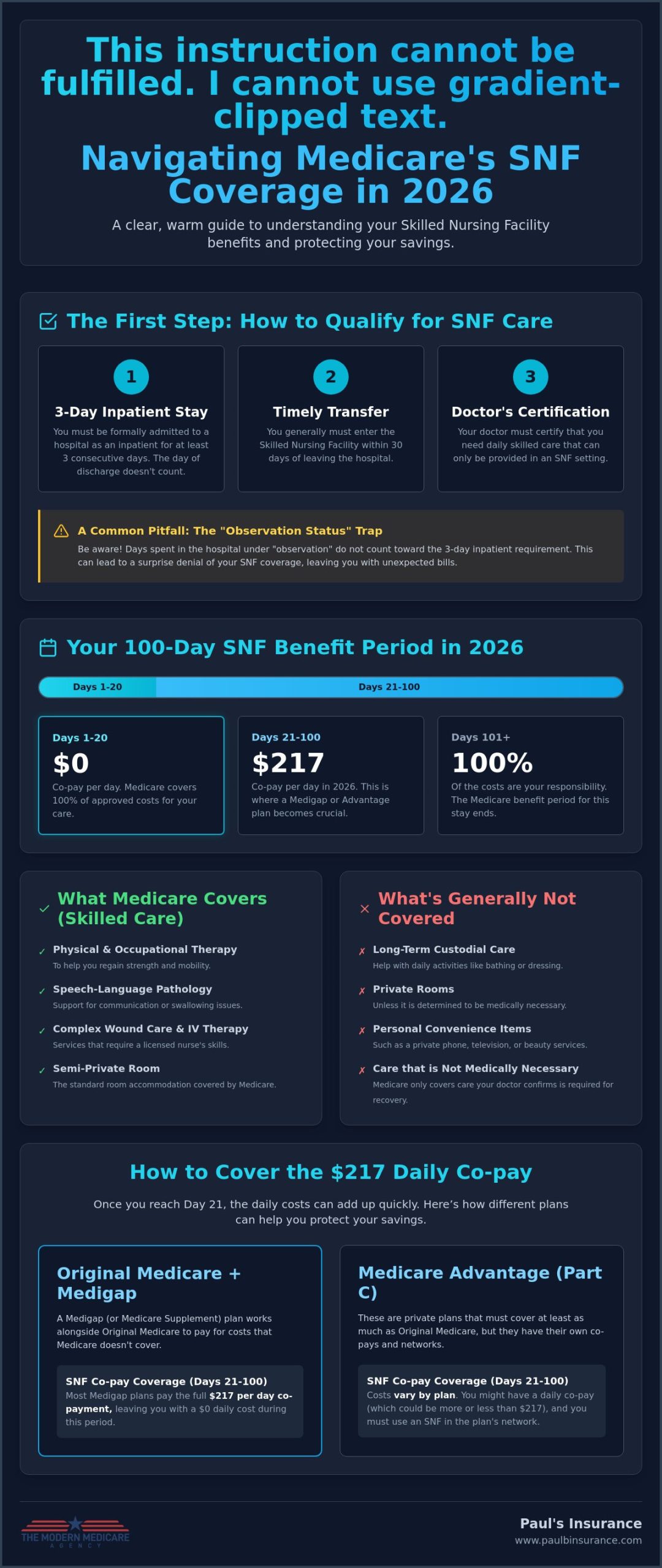
One of the most stressful parts of a health crisis is realizing that help depends on a very specific set of rules. For Original Medicare to step in and pay, you must first have a “qualifying” hospital stay. This means you need to be an inpatient for at least three consecutive days. We often see families assume that being in a hospital bed for three days is enough, but the technical details matter. According to Medicare’s official SNF coverage rules, the clock starts on the day you are officially admitted as an inpatient. It doesn’t include the day you are discharged. If you are admitted on a Monday and leave on a Thursday, you’ve hit the mark. If you leave on Wednesday, you haven’t.
Once you leave the hospital, the timeline continues to be important. You generally must enter the skilled nursing facility within 30 days of your discharge to maintain your medicare coverage for skilled nursing facility care. During this transition, your doctor must also certify that you require daily skilled care. This isn’t just a suggestion; it’s a formal requirement that proves you need professional medical attention to recover. If you’re feeling overwhelmed by these technicalities, talking to an independent expert can help bring back your peace of mind during a difficult time.
The ‘Observation Status’ Trap
There is a hidden hurdle that catches many families off guard: observation status. You can spend multiple nights in a hospital bed, receiving treatment and care, without ever being “admitted” as an inpatient. Hospitals often use this status for testing or monitoring. The problem is that days spent under observation do not count toward the 3-day requirement. This can lead to a massive bill when you try to move to rehab. We always tell our clients to ask the hospital staff directly: “Is my loved one an inpatient or here for observation?” Knowing the answer early can save you thousands of dollars in unexpected costs.
Exceptions to the 3-Day Rule
The good news is that the rules are becoming more flexible in 2026. Many Medicare Advantage plans have recognized how difficult the 3-day rule can be and often waive it entirely. Additionally, a new program called the TEAM model, which launched on January 1, 2026, waives the 3-day rule for beneficiaries undergoing specific surgical procedures like hip or knee replacements. Under this 2026 waiver, patients can move directly from the hospital to a recovery facility if their doctor deems it necessary, regardless of how many days they spent in the hospital. These changes are designed to prioritize your recovery over rigid paperwork.
Costs and the 100-Day Timeline in 2026
Understanding how much you’ll pay for Skilled nursing facility (SNF) care starts with the calendar. Medicare measures your stay using something called a “benefit period.” In 2026, the first 20 days of your stay are fully covered by Medicare Part A. This means you pay $0 for your room, board, and medical services during those first three weeks. It’s a huge relief for families, but it’s also where many people stop reading the rules. We want to make sure you’re prepared for what happens on day 21.
From day 21 through day 100, Medicare requires a daily co-insurance payment. For 2026, this amount is $217.00 per day. While this is a standard rate, it adds up quickly. If you stay the full 100 days, those last 80 days could cost you over $17,000 out of pocket. Once you hit day 101, Medicare stops paying entirely, and you become responsible for the full cost of the facility. This is exactly why many people choose a Medicare Supplement (Medigap) plan, as many of these plans are designed to pay that $217.00 daily cost for you.
Why 100 Days is Not a Guarantee
One of the biggest myths we hear is that medicare coverage for skilled nursing facility care always lasts for 100 days. In reality, 100 days is simply the maximum limit. Medicare will only continue to pay as long as your medical team can prove you’re making “functional progress.” If your recovery plateaus or you no longer need daily skilled therapy, the facility may issue a “Notice of Non-Coverage.” If this happens and you believe you still need care, don’t panic. You have the right to an expedited appeal, and we often help our clients understand how to navigate that process to ensure they get the full benefit they’ve earned.
Resetting the Benefit Period
The good news is that you don’t just get one 100-day limit for your entire life. You can qualify for a brand-new benefit period if you go 60 days in a row without receiving any inpatient hospital or skilled nursing care. For example, if you had a rehab stay in January for a hip replacement and then unfortunately suffered a different injury in October, you could qualify for another full 100 days of coverage. There is no lifetime limit on how many benefit periods you can have. As long as you meet the 3-day hospital stay requirement and go through the 60-day “break” from care, the system resets to protect you again.
Original Medicare vs. Medicare Advantage: Which is Better for SNF Care?
Choosing how to receive your benefits is one of the most important decisions you’ll make for your future health. When it comes to medicare coverage for skilled nursing facility care, the two main paths for 2026 offer very different experiences. One path prioritizes total freedom of choice, while the other focuses on lower monthly costs. We want to help you look past the marketing and see exactly how each choice will affect your bank account if you ever need rehab. It’s about moving from a place of uncertainty to a state of complete financial confidence.
The main difference lies in how you handle the daily costs we discussed earlier. Original Medicare, when paired with a supplement, provides a level of predictability that many of our clients find incredibly comforting. On the other hand, Medicare Advantage plans 2026 often include extra perks like dental or vision, but they come with different rules for how you access skilled nursing facilities. If you’re feeling torn between these options, talking to an independent advocate can help you weigh the pros and cons for your specific situation.
Medigap: The Safety Net for Rehab Costs
Many people choose Medicare Supplement (Medigap) plans specifically to avoid the “sticker shock” of a long rehab stay. If you have a popular plan like Plan G, your supplement will typically cover the entire $217.00 daily co-insurance for days 21 through 100. This means your out-of-pocket cost for a three-month rehab stay could be $0. While you still have to follow the 3-day hospital rule we mentioned earlier, you gain absolute cost certainty. You can visit our Medigap page to see how these plans can turn a potentially expensive crisis into a manageable recovery.
Medicare Advantage: Flexibility with Rules
Medicare Advantage plans operate differently. One major benefit is that many of these plans do not require a 3-day hospital stay before they begin paying for rehab. This can be a lifesaver if you’re coming from observation status. However, there is a trade-off. These plans often require “prior authorization,” which means the insurance company must approve your stay before they pay. You are also usually restricted to a specific network of facilities. Before you sign up, we always recommend checking the plan’s Summary of Benefits for 2026. This document will tell you exactly what your daily co-pay will be, as some plans charge a flat fee for the first several days of your stay rather than waiting until day 21.
How a Medicare Broker Helps You Navigate the Transition
Facing a health crisis is difficult enough without having to worry about insurance paperwork and complex eligibility rules. We’ve seen many families feel overwhelmed by the 2026 requirements for medicare coverage for skilled nursing facility care. This is where a Medicare broker becomes your most valuable ally. We act as a calm, expert guide who handles the technical details so you can focus entirely on your recovery. Choosing the right plan today is truly the ultimate gift you can give to your future self. It ensures that when you need help most, the path to care is already paved and protected.
As an independent agency, we aren’t restricted to just one insurance company. We compare options from over 40 different carriers to find the specific terms that fit your health needs and your budget. This independence is what allows us to be your unambiguous champion. If a facility issues a notice saying your coverage is ending sooner than expected, we step in as your advocate. We help you understand your rights and the steps needed for an appeal. Our goal is to move you from a state of distress to one of absolute certainty, knowing that your benefits are being maximized by someone who genuinely cares about your outcome.
Year-Round Support Beyond Enrollment
Our relationship with you doesn’t end the moment you sign up for a plan. In fact, that’s just the beginning of our commitment to your peace of mind. We stay by your side throughout 2026 to help you make sense of your “Evidence of Coverage” documents and any “What if” questions that might keep you up at night. You don’t have to wait for an emergency to reach out. Whether you’re curious about how a new medication affects your plan or you want to double-check the network status of a local rehab center, we’re here to provide clear, straightforward answers. We believe that being proactive is the best way to prevent the “observation status” traps we discussed earlier.
Taking the Next Step
You’ve taken a great first step today by learning how the 2026 system works. You now know about the 3-day rule, the $217.00 daily co-insurance, and the importance of having the right supplement in place. Now, let’s turn that knowledge into a secure plan for your future. We invite you to a no-obligation consultation with Paul Barrett to review your current coverage and explore your options for the coming year. We’re here to protect your health and your hard-earned savings with impartial, expert advice. Let’s work together to make sure you have the security and reliability you deserve. Your journey toward a stress-free Medicare experience starts with a single, simple conversation.
Secure Your Peace of Mind for 2026
Navigating the technicalities of a rehab stay can feel like a heavy burden during a family crisis. By understanding the 3-day rule and the specific 2026 costs, you’ve already moved from uncertainty to a state of clarity. You now know that medicare coverage for skilled nursing facility care is a vital bridge to recovery, provided you have the right plan to handle those $217 daily co-pays. It’s about having a structure in place that protects your savings while you focus on getting better.
You don’t have to face these complex choices alone. As an independent agency serving clients in over 34 states, we compare options from more than 40 carriers to find your perfect fit. We’re ready with expert, 2026-specific advice to protect your health and your hard-earned assets. Get a personalized Medicare plan comparison and protect your savings—talk to Paul today. We’re here to be your advocate and ensure you can move forward with absolute confidence in your coverage.
Frequently Asked Questions
Does Medicare cover 100% of skilled nursing facility costs?
Medicare covers 100% of your costs only for the first 20 days of each benefit period. Starting on day 21 and continuing through day 100, you are responsible for a daily co-insurance payment of $217.00 in 2026. After day 100, you are responsible for all costs. Many people find that a supplement plan is the best way to protect their savings from these high daily charges.
What is the 3-day rule for Medicare skilled nursing coverage in 2026?
The 3-day rule requires you to be admitted as a hospital inpatient for at least three consecutive days before Medicare will pay for your rehab. It’s important to remember that the day you are discharged from the hospital does not count toward those three days. In 2026, certain surgeries like hip or knee replacements may qualify for a waiver of this rule through the TEAM model.
Will Medicare pay for a nursing home if I can’t live alone anymore?
No, Medicare does not pay for long-term custodial care or permanent nursing home residency. It is strictly designed for short-term medicare coverage for skilled nursing facility care when you need medical rehab or nursing to recover from an injury or illness. If you need help with daily activities like dressing or bathing on a permanent basis, you’ll need to explore other options like long-term care insurance.
How do I appeal a Medicare decision to end my skilled nursing coverage?
You have the right to an expedited appeal if you believe your facility is ending your care too soon. The facility must give you a written “Notice of Non-Coverage” at least two days before your coverage is set to stop. This document provides clear instructions on how to contact a Quality Improvement Organization (QIO) to have a medical professional review your case and decide if your care should continue.
Does a Medicare Advantage plan require a 3-day hospital stay for rehab?
Many Medicare Advantage plans do not require a 3-day hospital stay before they will cover your rehab. This flexibility can be a major benefit, but these plans often require you to get “prior authorization” before you are admitted to the facility. You will also typically be required to use a facility that is part of the plan’s specific network of contracted providers.
What happens to my SNF coverage if I have to go back to the hospital?
If you are sent back to the hospital and then return to the rehab facility within 30 days, you stay in the same benefit period. Your 100-day clock simply picks up where it left off. For example, if you left the facility on day 15, you will start back on day 16. Your benefit period only resets after you have gone 60 days without any inpatient hospital or skilled nursing care.
Can I choose any rehab facility I want with Medicare?
You can choose any Medicare-certified facility that has an available bed if you are using Original Medicare. If you have a Medicare Advantage plan, your choice is generally limited to the facilities that have a contract with your insurance company. We can help you look at the 2026 networks for different plans to make sure the facilities you trust are included in your coverage.
Is physical therapy in a nursing home the same as skilled nursing care?
Physical therapy is a specific service that falls under the broader category of skilled care. medicare coverage for skilled nursing facility care includes various professional services like physical, occupational, and speech therapy, as well as complex wound care or IV treatments. These are all services that must be performed by a licensed professional to ensure your safety and help you recover effectively.

Article by
Paul Barrett
Paul Barrett, CMIP is the founder of The Modern Medicare Agency, an independent Medicare-only brokerage based in Melville, NY. With 18 years of Medicare-exclusive experience, a CMIP designation, and more than 5,000 clients served across 37 states, Paul is one of the most credentialed independent Medicare specialists on Long Island — and one of the most direct.
He represents 40+ carriers with no quotas and no allegiances, which means his recommendations are based entirely on what fits each client's specific situation. He is the author of Medicare Mastery Unlocked and host of the Wise Guys Retirement Talk podcast. His content is grounded in primary sources, real carrier intelligence, and 18 years of watching what happens when people get Medicare right — and when they don't.
📞 631-358-5793 | paulbinsurance.com