




Yes. Medicare can cover medically necessary sleep studies to diagnose sleep apnea, including in-lab testing. Type I sleep tests are covered only when performed in a sleep lab.
It’s understandable to be unsure which test qualifies and what you may owe. Coverage can depend on whether your doctor orders an in-lab study or a home test and whether the results support treatment such as CPAP. This article explains which sleep apnea tests Medicare may cover, how the Part B deductible and coinsurance apply, and what to know about CPAP equipment coverage. Understanding these rules can help you plan your next steps.
Key Takeaways
- Medicare may cover a sleep study when it’s medically necessary to diagnose sleep apnea, with the test type and setting affecting eligibility.
- Type I sleep tests are covered only when performed in a sleep lab; eligible home tests may include Type II, Type III, or Type IV studies.
- After you meet it, you generally pay 20% of the Medicare-approved amount for covered services.
- CPAP coverage has a trial period, and continued coverage depends on documented use and benefit from treatment. The Centers for Medicare & Medicaid Services generally requires use on 70% of nights during a 30-day period.
- Learn how Medicare Advantage and Medigap plans may fit into your coverage decisions and what to consider when reviewing your options.
Does Medicare Cover a Sleep Study?
Yes. Original Medicare may cover a sleep study when clinical signs suggest sleep apnea and testing is medically necessary. A sleep test records sleep patterns, breathing, and movement to help identify a disorder. The doctor uses the results to decide whether treatment, such as CPAP therapy, is appropriate. Medicare coverage for sleep apnea studies and devices depends on medical need and documented test results.
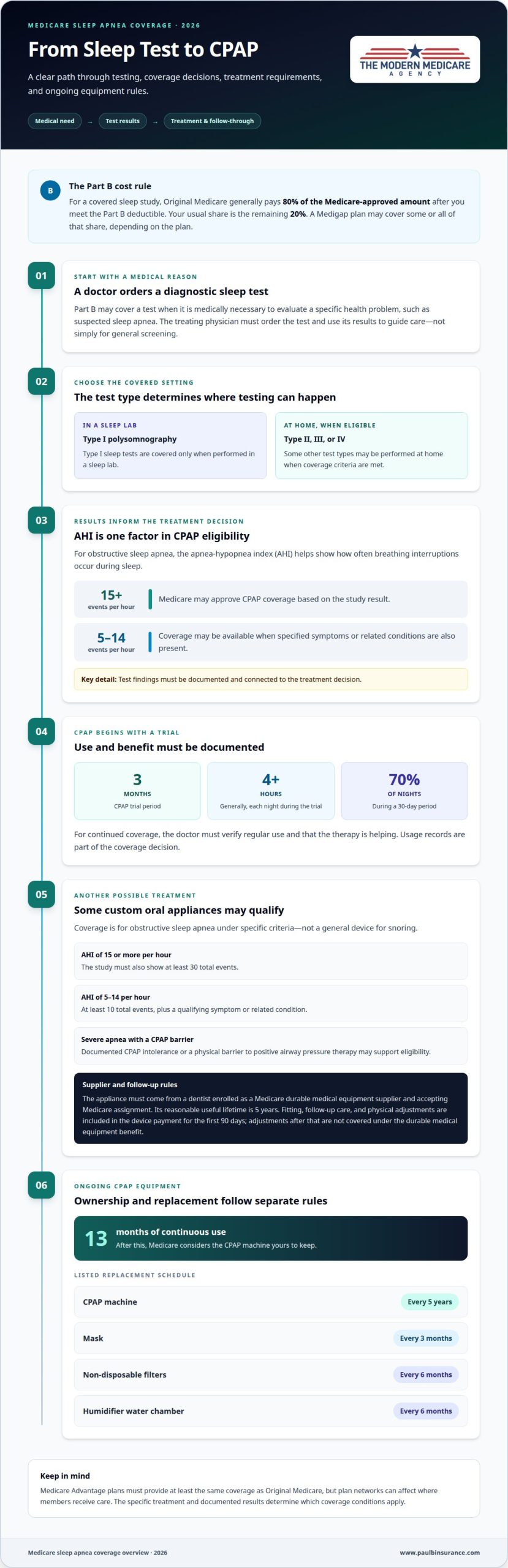
For obstructive sleep apnea, the sleep study’s apnea-hypopnea index, or AHI, can affect CPAP eligibility. According to the Centers for Medicare & Medicaid Services, Medicare may approve CPAP coverage when the study shows an AHI of 15 or more events per hour. For an AHI of 5-14 events per hour, coverage may be available when specified symptoms or conditions are also present. The record needs to connect the test findings with the treatment decision.
CPAP coverage begins with a 3-month trial period. During that trial, Medicare generally requires use for at least 4 hours per night. According to the Centers for Medicare & Medicaid Services, use must also occur on 70% of nights during a 30-day period. Continued coverage requires the doctor to verify regular use and that the therapy is helping. These conditions make usage records part of the coverage decision, not just a measure of treatment routine.
CPAP is not the only possible treatment. A custom oral appliance may qualify for Medicare coverage for obstructive sleep apnea when the study shows at least 15 events per hour and 30 total events. For mild apnea, eligibility may apply with 5 to 14 events per hour and at least 10 total events, plus a qualifying symptom or related condition. A person with severe apnea may qualify if documented CPAP intolerance or a physical barrier to positive airway pressure therapy prevents use.
Medicare requires a covered oral appliance to come from a dentist enrolled as a Medicare durable medical equipment supplier, accepting Medicare assignment. The rules also set a 5-year reasonable useful lifetime for a custom appliance. Follow-up care, fitting, and physical adjustments are included in the device payment for the first 90 days. Adjustments after that period aren’t covered under the durable medical equipment benefit.
After 13 months of continuous use, Medicare considers the CPAP machine the beneficiary’s to keep. That ownership rule is separate from replacement coverage. Medicare’s listed schedule allows a new CPAP machine every 5 years, a mask every 3 months, and non-disposable filters every 6 months. A humidifier water chamber may also be replaced every 6 months.
Medicare’s coverage rules focus on a documented diagnosis, qualifying test results, and continued use when CPAP is prescribed. Medicare Advantage plans must provide at least the same coverage as Original Medicare, though plan networks can affect where members receive care. The treatment being considered determines which coverage conditions apply.
Medicare Part B coverage for diagnostic sleep studies
Part B may cover diagnostic sleep tests when they’re medically necessary and used to guide care. The test must address a specific health problem, such as suspected sleep apnea.
Coverage for Diagnostic Sleep Tests
A diagnostic sleep test records information doctors use to diagnose a sleep disorder and plan treatment. Medicare recognizes Type I, II, III, and IV tests for eligible people. CMS considers specified tests for obstructive sleep apnea reasonable and necessary when a treating physician uses the results. The test must support a medical decision, not serve only as general screening.
The treating physician must order a diagnostic test and use its results to manage the patient’s specific medical problem. For example, a sleep test may help determine whether breathing interruptions point to obstructive sleep apnea and whether CPAP therapy is suitable. Polysomnography is an in-lab test; other test types can be performed at home when coverage criteria are met.
Part B also covers certain oral appliances for obstructive sleep apnea as durable medical equipment. CMS confirmed that these appliances remain in that benefit category for calendar year 2026. Coverage depends on the diagnosis and applicable criteria, so an oral appliance is not simply a general device for snoring. The benefit classification matters because it places eligible appliances under Part B’s medical-equipment coverage rules.
Part B Cost Sharing
Cost sharing is the part of an approved service that the beneficiary pays. After the deductible is met, Original Medicare generally pays 80% of the Medicare-approved amount for a covered sleep study, leaving 20% for the beneficiary. Knowing the deductible and coinsurance helps make the expected share clearer.
A coinsurance percentage differs from a fixed copayment. For a covered sleep study under Original Medicare, the usual patient share is 20% of the approved amount after the deductible, rather than a single flat charge stated for every test. The approved amount and whether the deductible has been met determine how the share applies. Doctor services connected with the study generally have the same 20% Part B share after the deductible.
A Medicare Supplement (Medigap) plan may cover the remaining 20% of eligible sleep-study costs. That may reduce your share of approved expenses, depending on your plan. Review how Medigap coverage fits alongside Original Medicare when planning for diagnostic testing.
In-lab studies and home sleep apnea tests
Medicare may cover sleep testing in a lab or at home when it’s medically necessary. The appropriate setting depends on the test ordered and the symptoms being evaluated.
Comparing In-Lab and Home Testing
In-lab testing takes place in a sleep center, while home testing records sleep-related measurements where you live. The distinction matters because Medicare limits Type I tests to sleep lab facilities, while some other test types may be used at home.
Type I polysomnography monitors at least 16 channels in a sleep lab. Portable Type II monitors have at least 7 channels. Type III monitors have at least 4, including airflow or ventilation, heart rate or ECG, and oxygen saturation. Type IV devices can measure one, two, three, or more parameters, but don’t meet every requirement for a higher category.
A sleep specialist may recommend an in-lab study when symptoms or a suspected sleep disorder call for more detailed monitoring. Home testing may be an option for someone at risk of obstructive sleep apnea. If a home test is inconclusive or more monitoring is needed, Medicare may cover an in-lab study. The test type and setting determine which coverage rules apply.
Coverage for Home Sleep Tests
Medicare may cover a home sleep apnea test when a doctor orders it and it’s medically necessary. Type II, Type III, and Type IV home studies may qualify for eligible people at risk for obstructive sleep apnea. A consumer sleep tracker or unrelated home device isn’t automatically a covered diagnostic test.
Medicare Part B coverage is tied to a diagnostic purpose: the treating doctor uses the test results to manage a specific medical problem. A home test can record signs such as breathing and oxygen changes, helping assess whether obstructive sleep apnea may be present. The results inform treatment decisions, including whether pressure-based therapy should be considered.
Home testing may be less involved than spending a night in a lab, but it isn’t suitable for every situation. If symptoms remain unexplained or the recorded information doesn’t answer the clinical question, more testing may be needed. Medicare may cover an in-lab study when a home test is inconclusive or additional monitoring is needed. This lets the care team seek clearer results instead of treating a limited test as a final answer.
Before testing, the doctor’s order should connect your symptoms, the chosen test, and the medical question. That connection matters for both home and lab studies. The test must be appropriate for diagnosing the suspected disorder, and its findings must help guide care.
Out-of-pocket costs and Medicare coverage percentages
Your share depends on the Medicare-approved amount, whether you’ve met the Part B deductible, and where testing takes place. These factors also affect costs for positive airway pressure equipment.
Approved Costs and Coinsurance
The Medicare-approved amount is the amount Medicare recognizes for a covered service, and coinsurance is your share of that amount. After you meet it, Original Medicare generally pays 80% of the approved amount for a covered sleep study, leaving you responsible for 20%.
The same general 80% Medicare payment and 20% patient share apply to covered CPAP equipment after the deductible. The percentage applies to the approved amount, not necessarily the provider’s full charge. That difference matters: a study’s billed charge and the amount Medicare approves can be different figures, so the patient share is calculated from the approved amount.
Factors Affecting Out-of-Pocket Costs
Several details affect the final bill: whether the sleep study is covered, the test setting, the Medicare-approved amount, and whether you’ve met the Part B deductible. A home sleep study and in-lab polysomnography may have different approved amounts. Medicare local coverage determinations can also vary by region, affecting which services qualify.
These are different estimates, not Medicare-approved amounts. The doctor’s order, test type, location, and coverage status all affect what Medicare recognizes and what you may owe.
Coinsurance and Device Costs
Coinsurance also applies to covered positive airway pressure devices. After meeting the Part B deductible, a beneficiary generally pays 20% of the Medicare-approved amount for CPAP equipment. That retail estimate doesn’t determine the Medicare-approved amount or your specific share.
Medicare Supplement insurance may cover the remaining 20% of eligible sleep-study and CPAP-equipment costs, depending on the plan. Medicare Advantage plans must provide at least the same coverage as Original Medicare, but plan rules and provider networks can affect where members receive care. Check whether the study or equipment is covered under your plan and how its cost-sharing applies. That’s especially useful if the care involves both a sleep test and later breathing treatment.
Medicare coverage for in-lab sleep studies
Original Medicare may cover an in-lab sleep study when it’s medically necessary to diagnose a sleep disorder. Coverage depends on the physician’s order, the reason for testing, and the facility’s Medicare approval.
An in-lab study, often called polysomnography, records sleep and breathing information in a sleep center. Medicare covers Type I sleep tests only when they’re performed in a sleep lab facility. This matters when symptoms suggest obstructive sleep apnea but a home sleep test may not provide enough information. An in-lab study can collect more detailed measurements during sleep.
The physician’s order must connect testing to a specific medical problem. The treating physician orders Medicare diagnostic tests and uses the results to manage that problem. For example, a physician may order an in-lab study when symptoms point to obstructive sleep apnea and the results will guide treatment. Medicare generally doesn’t cover sleep studies as routine screening without clinical signs or symptoms.
The center also matters. Original Medicare sleep studies must take place in a Medicare-approved sleep center, unless the test is an approved home sleep apnea test. A study in a sleep center must still meet medical-necessity criteria. The physician’s reason for ordering it and how the findings will guide care are central to coverage.
Local coverage rules can add detail by region. Medicare local coverage determinations cannot contradict national coverage determinations, but their requirements may vary across jurisdictions. The Medicare local coverage determination for polysomnography and other sleep studies in CGS Administrators’ Jurisdiction 15 took effect on March 5, 2026. This illustrates why coverage criteria can depend partly on where the service is provided.
In-lab testing may be appropriate when home sleep testing is inconclusive or more monitoring is needed. The purpose is to resolve a diagnostic question, not to repeat testing without a medical reason. A physician can use lab results to assess obstructive sleep apnea and determine whether continuous positive airway pressure treatment is appropriate.
For a covered study under Original Medicare Part B, the patient generally pays 20% of the Medicare-approved amount after meeting the annual deductible. The approved amount, deductible status, and any supplemental coverage affect the patient’s share. People enrolled in Medicare Advantage generally need to use doctors in their plan’s network to get the most from their coverage.
The practical takeaway is straightforward: an in-lab study can qualify when a physician orders it for a documented medical need and it takes place in an approved sleep center. The exact local coverage rules may depend on the Medicare jurisdiction and the study’s clinical purpose.
The Modern Medicare Agency: Medicare Advantage Plans
The Modern Medicare Agency helps you compare Medicare Advantage Plans when you’re considering coverage options alongside sleep study and treatment needs. Its independent brokers can also help you assess whether a Medicare Supplement (Medigap) Plan fits your situation. Medicare Advantage plans must cover at least what Original Medicare covers, while plan networks and cost-sharing rules can affect how you access care.
If you’re reviewing coverage or considering a plan change, The Modern Medicare Agency offers personalized guidance to help you understand your options. Contact The Modern Medicare Agency to discuss your Medicare coverage choices.
Make Your Next Coverage Decision With Clarity
Once you understand your care needs, consider which coverage fits the way you want to receive care. Knowing how medicare coverage for sleep apnea studies and devices works can help you ask focused questions as you review your options. Consider how provider networks, plan rules, and your broader health coverage needs fit together.
The Modern Medicare Agency can help you compare Medicare Advantage Plans, Medicare Supplement (Medigap) Plans, and Medicare Part D Plans. Its guidance can help you weigh which coverage path aligns with your needs, without turning a complex decision into guesswork. Take the time you need to consider your options and decide what feels right for you.
If you’re ready to talk through your Medicare choices, contact The Modern Medicare Agency. A thoughtful conversation can help you move forward with greater confidence and a clearer sense of what to consider next.
Frequently Asked Questions
What Are Sleep Studies and Who Needs Them?
Sleep studies record information about sleep, breathing, and movement to help identify a sleep disorder. A physician may order one when clinical signs or symptoms suggest a condition such as obstructive sleep apnea. Testing can help clarify whether interrupted breathing during sleep relates to the symptoms being evaluated. The treating physician uses the results to decide what care may be appropriate.
What is sleep apnea?
Sleep apnea is a disorder involving repeated pauses in breathing during sleep. Those pauses can occur 30 or more times per hour. Obstructive sleep apnea is the type discussed most often in Medicare coverage rules for CPAP and sleep testing. A sleep study measures breathing during sleep and helps show whether apnea is present and how frequently breathing interruptions occur.
Can I get an oral appliance if I cannot tolerate CPAP?
Possibly. Medicare coverage for a custom oral appliance may be available when CPAP intolerance is documented or positive airway pressure therapy is physically unsuitable. For severe obstructive sleep apnea, the record must support that barrier. Coverage criteria also consider sleep-study findings: a qualifying result may show at least 15 events per hour and at least 30 total events. A dentist enrolled as a Medicare durable medical equipment supplier must provide the appliance and accept Medicare assignment.
Can I refer myself for a sleep study or do I need a doctor’s order?
A diagnostic sleep study needs an order from the physician treating your specific medical problem. Medicare’s diagnostic-test rule requires the physician to use the results to manage that problem. You can describe your symptoms and concerns to your doctor, but a self-arranged test may not meet Medicare’s coverage requirements. The order should explain the medical reason for testing and how the results will guide care.
Does Medicare cover CPAP machines?
Yes, Medicare may cover a CPAP machine for obstructive sleep apnea when coverage criteria are met. The treatment begins with a 3-month trial. During the trial, usage records help show whether therapy is being followed and helping. For example, the Centers for Medicare & Medicaid Services generally requires use on 70% of nights during a 30-day period. After 13 months of continuous use, Medicare considers the machine the beneficiary’s to keep.
How do I know if my sleep problems are serious enough for a sleep study?
Medicare eligibility depends on clinical signs and symptoms that suggest a sleep disorder, not simply a wish to monitor sleep. Tell your physician what you’ve noticed, such as concerns about breathing during sleep, and how the problem affects your health. The physician considers your symptoms and whether test results would help manage a specific medical concern. A sleep study can then answer a diagnostic question rather than provide general screening.
What alternatives exist if Medicare denies coverage?
Start by identifying which coverage requirement wasn’t met. The issue may involve the documented medical need, test type, setting, or information supporting treatment. Your physician can review the clinical record and discuss whether another medically appropriate test or treatment fits your situation. For obstructive sleep apnea, a custom oral appliance may be an option when its separate eligibility criteria are met, including documented CPAP intolerance or a physical contraindication.
Will I have to pay anything out of pocket for my sleep study or CPAP equipment?
With Original Medicare Part B, you generally pay the deductible first, then 20% of the Medicare-approved amount for covered sleep studies and CPAP equipment. Your share depends on whether you’ve met it and the approved amount for the covered service. A Medicare Supplement plan may help pay some eligible remaining costs, depending on the plan’s benefits.

Article by
Paul Barrett
Paul Barrett, CMIP is the founder of The Modern Medicare Agency, an independent Medicare-only brokerage based in Melville, NY. With 18 years of Medicare-exclusive experience, a CMIP designation, and more than 5,000 clients served across 37 states, Paul is one of the most credentialed independent Medicare specialists on Long Island — and one of the most direct.
He represents 40+ carriers with no quotas and no allegiances, which means his recommendations are based entirely on what fits each client's specific situation. He is the author of Medicare Mastery Unlocked and host of the Wise Guys Retirement Talk podcast. His content is grounded in primary sources, real carrier intelligence, and 18 years of watching what happens when people get Medicare right — and when they don't.
📞 631-358-5793 | paulbinsurance.com