
Medicare coverage starting at 65 is the federal health insurance program that becomes available to most Americans on the first day of their birthday month, provided they enroll during the correct window. About 90% of Medicare beneficiaries qualify based on age alone, making 65 the defining threshold for senior health coverage in the United States. The decisions you make in the months surrounding your 65th birthday will shape your coverage, your costs, and your peace of mind for years to come. Getting the timing right is not complicated, but it does require knowing the rules before they apply to you.
When does Medicare coverage start at 65?
Medicare coverage start dates follow a specific calendar logic that trips up many people approaching eligibility. The rule is straightforward: coverage starts the first day of the month you turn 65, as long as you enroll during the first three months of your Initial Enrollment Period (IEP). The IEP is a 7-month window that opens three months before your birthday month and closes three months after it.
There is one notable exception. If your birthday falls on the first day of the month, your Medicare coverage actually starts on the first day of the prior month. For example, if you were born on December 1, your coverage begins November 1. This quirk catches people off guard, but it works in your favor.
Enrollment timing within the IEP also affects when coverage kicks in. If you enroll during the fourth, fifth, sixth, or seventh month of your IEP (meaning after your birthday month), your coverage start date shifts forward. The table below shows exactly how this plays out.
| Enrollment month | Coverage start date |
|---|---|
| 1st, 2nd, or 3rd month of IEP | First day of your birthday month |
| Birthday month (4th month of IEP) | First day of the following month |
| 5th month of IEP | Two months after enrollment |
| 6th or 7th month of IEP | Three months after enrollment |
The practical takeaway: enrolling before your birthday month gives you the cleanest, fastest coverage start. Waiting until after your birthday month creates a gap that could leave you uninsured for up to three months.
Pro Tip: Mark your calendar three months before your 65th birthday. That date is the opening of your IEP and the single most important deadline in your Medicare timeline. A full breakdown of every key date is available in the Medicare enrollment periods guide at Paulbinsurance.
How and when to enroll in Medicare at 65
The enrollment process depends entirely on whether you are already receiving Social Security benefits. Those already receiving Social Security are automatically enrolled in Part A and Part B, with coverage beginning the first of the month they turn 65. If you are not yet collecting Social Security, you must enroll manually. This distinction is the single biggest source of confusion among people approaching Medicare eligibility age.

Manual enrollment is straightforward. You can apply online at SSA.gov, call the Social Security Administration at 1-800-772-1213, or visit your local Social Security office in person. The online application takes roughly 10 minutes and is available 24 hours a day. Most people find the online route the fastest.
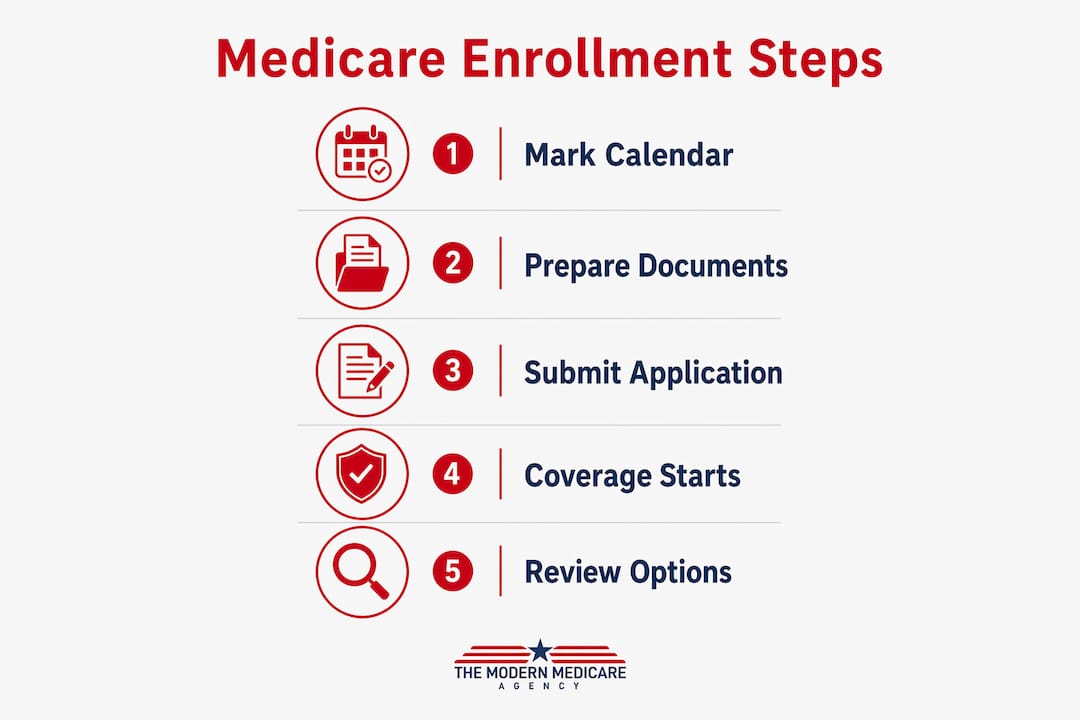
The critical deadline is three months before your 65th birthday. Applying three months early prevents any delay in your coverage start date and gives the Social Security Administration time to process your application before your birthday month arrives. Waiting until your birthday month or later shifts your coverage start date forward, as shown in the table above.
Here is what you need to have ready before you apply:
- Your Social Security number and Medicare card (if you have one)
- Proof of U.S. citizenship or legal residency
- Employment history for the past two years, including employer contact information
- Information about any current health insurance coverage, including policy numbers
- Your bank account details if you want Part B premiums deducted automatically
Missing the enrollment window without qualifying for a Special Enrollment Period results in permanent late penalties and potential coverage gaps. The Part B late penalty adds 10% to your monthly premium for every 12-month period you were eligible but did not enroll. That penalty stays with you for life.
Pro Tip: If your situation involves employer coverage, a working spouse, or any residency complexity, do not rely on general websites alone. Contact a licensed Medicare specialist at Paulbinsurance or call 1-800-MEDICARE for guidance specific to your circumstances.
What options and exceptions affect Medicare coverage starting at 65?
Not everyone follows the standard enrollment path, and Medicare accounts for that. People working past 65 with active employer-sponsored coverage qualify for a Special Enrollment Period (SEP). The SEP allows you to delay Part B enrollment without facing any late penalty, as long as your employer plan counts as creditable coverage.
The SEP opens when your employer coverage ends or when you stop working, whichever comes first. You then have eight months to enroll in Part B without penalty. Missing that eight-month window eliminates the SEP protection and triggers the standard late penalty rules.
Several other scenarios affect how and when Medicare coverage begins:
- Working past 65 with employer coverage: You can delay Part B without penalty using the SEP. Part A is usually still worth enrolling in since it is often premium-free.
- Covered under a spouse’s employer plan: The same SEP rules apply. The coverage must be through active employment, not COBRA or retiree insurance.
- Disability or End-Stage Renal Disease (ESRD): Some people qualify for Medicare before 65 due to disability or ESRD. These individuals follow different enrollment rules.
- Not receiving Social Security at 65: Manual enrollment is required. Automatic enrollment does not apply.
- COBRA or retiree insurance at 65: These do not count as creditable employer coverage for SEP purposes. You must enroll in Medicare during your IEP.
A common misconception is that Medicare enrollment at 65 is always automatic. It is not. Only those already receiving Social Security benefits get automatic enrollment. Everyone else must act. The confusion between automatic and manual enrollment is the leading cause of missed deadlines and coverage gaps among new Medicare enrollees.
Once enrolled, you face another set of choices. Original Medicare (Part A and Part B) is the foundation. From there, you can add a Part D prescription drug plan, a Medigap supplement policy, or switch entirely to a Medicare Advantage plan. Each path has different costs, networks, and coverage rules. Understanding these options before your IEP closes gives you the best chance of choosing a plan that fits your health and budget.
How to avoid gaps and penalties in Medicare enrollment at 65
Avoiding penalties and coverage gaps comes down to one principle: act before your birthday month, not after it. The steps below give you a clear path from where you are now to active, penalty-free coverage.
- Confirm your enrollment status. Log in to your Social Security account at SSA.gov to check whether you are already enrolled or whether manual action is required.
- Identify your IEP window. Count back three months from your birthday month. That is your enrollment start date.
- Decide on Part B. If you have active employer coverage, evaluate whether to delay Part B using the SEP. If not, enroll in Part B during your IEP.
- Choose your coverage path. Decide between Original Medicare with a Medigap policy, Original Medicare with Part D, or a Medicare Advantage plan before your IEP closes.
- Submit your application. Apply online at SSA.gov, by phone, or in person at least three months before your birthday month.
- Confirm your coverage. After applying, watch for your Medicare card in the mail and verify your coverage start date.
The health insurance transition at 65 involves more moving parts than most people expect. Employer plans, COBRA, retiree coverage, and marketplace plans all interact with Medicare in different ways. Knowing which coverage counts as creditable and which does not is the difference between a smooth transition and a costly penalty.
Pro Tip: Do not wait for a letter from Medicare or Social Security to prompt you. If you are not receiving Social Security benefits, no letter will arrive. You are responsible for initiating enrollment.
What benefits does Medicare cover starting at 65?
Medicare coverage at 65 is built on two foundational parts. Part A covers hospital insurance and is premium-free for most people who paid Medicare taxes through their work history. It covers inpatient hospital stays, skilled nursing facility care, hospice, and some home health services. Part B covers outpatient medical insurance, including doctor visits, preventive services, lab tests, and durable medical equipment. Part B requires a monthly premium, which varies based on your income.
Beyond Parts A and B, you have three main options for expanding your coverage. Part D plans cover prescription drugs and are sold by private insurers approved by Medicare. Medigap policies, also called Medicare Supplement Insurance, fill in the cost-sharing gaps left by Original Medicare, covering deductibles, copayments, and coinsurance. Medicare Advantage plans bundle Part A, Part B, and usually Part D into a single plan, often adding extra benefits like vision, dental, and hearing coverage that Original Medicare does not include.
The table below compares Original Medicare and Medicare Advantage side by side.
| Feature | Original Medicare | Medicare Advantage |
|---|---|---|
| Hospital coverage (Part A) | Yes | Yes (bundled) |
| Medical coverage (Part B) | Yes | Yes (bundled) |
| Prescription drugs | Requires separate Part D | Usually included |
| Vision, dental, hearing | Not covered | Often included |
| Provider network | Any Medicare-accepting provider | Network-based (HMO or PPO) |
| Cost structure | Deductibles and coinsurance | Copays with annual out-of-pocket max |
The right choice depends on your health needs, preferred doctors, prescription list, and budget. Original Medicare with a Medigap policy offers the broadest provider access and predictable costs. Medicare Advantage often has lower premiums but restricts you to a network. Neither is universally better. The best plan is the one that fits your specific situation.
Key takeaways
Medicare coverage starting at 65 requires proactive enrollment during a 7-month Initial Enrollment Period, with coverage beginning the first day of your birthday month when you enroll in the first three months of that window.
| Point | Details |
|---|---|
| Coverage start date | Enrolling in months 1 to 3 of your IEP starts coverage on the first day of your birthday month. |
| Automatic vs. manual enrollment | Only Social Security recipients are auto-enrolled; everyone else must apply manually at SSA.gov. |
| Late enrollment penalty | Missing your IEP without a qualifying SEP adds a permanent 10% penalty per year to your Part B premium. |
| Special Enrollment Period | Working past 65 with employer coverage lets you delay Part B without penalty using an 8-month SEP. |
| Coverage options at 65 | Original Medicare, Medicare Advantage, Part D, and Medigap each serve different health and budget needs. |
What I tell every client approaching 65
After nearly two decades helping people enroll in Medicare, the pattern I see most often is not ignorance. It is false confidence. People assume they know how Medicare works because they have heard about it their whole lives. Then they miss a deadline or choose the wrong plan because they were working from assumptions, not facts.
The automatic enrollment myth is the most expensive mistake I see. If you are not collecting Social Security before 65, Medicare will not come to you. You have to go to it. I have spoken with people who went six months without coverage because they assumed a card would show up in the mail. It did not.
The second thing I want you to understand is that the plan you choose at 65 matters more than most people realize. Switching plans later is possible, but it is not always easy. Medigap plans, for example, can require medical underwriting outside of your initial enrollment window in most states. Choosing the wrong plan at 65 and trying to fix it at 68 can cost you significantly more. Take the time now to compare your options with someone who knows the details.
Paulbinsurance exists because this stuff is genuinely complicated, and the stakes are high. I have seen people pay thousands of dollars in unnecessary penalties and out-of-pocket costs simply because no one explained the rules clearly before their birthday month arrived. You deserve better than that.
— Paul
Get personalized Medicare guidance from Paulbinsurance
Choosing the right Medicare plan at 65 is one of the most consequential financial decisions you will make. Paulbinsurance is a team of independent Medicare specialists who have been helping consumers navigate enrollment, plan selection, and coverage decisions since 2007.

Whether you are weighing Medicare Advantage options, comparing Medigap policies, or simply trying to understand your enrollment timeline, Paulbinsurance offers no-pressure, education-first guidance at no cost to you. Independent agents mean no single carrier bias. You get the full picture, not just the plans one company wants to sell. If you want a clear, personalized walkthrough of your Medicare options before your IEP closes, reach out to Paulbinsurance today. The right decision starts with the right information.
FAQ
When does Medicare coverage start for most people?
Medicare coverage starts on the first day of the month you turn 65, provided you enroll during the first three months of your 7-month Initial Enrollment Period. Enrolling after your birthday month delays your start date.
Is Medicare enrollment at 65 automatic?
Enrollment is automatic only for people already receiving Social Security benefits. Everyone else must apply manually through SSA.gov, by phone, or in person at a Social Security office.
What happens if I miss my Medicare enrollment window?
Missing your IEP without a qualifying Special Enrollment Period results in permanent late penalties and potential coverage gaps. The Part B penalty adds 10% to your monthly premium for every 12-month period you were eligible but did not enroll.
Can I delay Medicare if I am still working at 65?
Yes. If you have active employer-sponsored coverage, you qualify for a Special Enrollment Period that lets you delay Part B without penalty. The SEP gives you eight months to enroll after your employer coverage ends.
What is the difference between Medicare Advantage and Original Medicare?
Medicare Advantage plans bundle Part A, Part B, and usually Part D into one plan and often include vision, dental, and hearing benefits. Original Medicare covers hospital and medical services but requires separate Part D coverage and leaves cost-sharing gaps that a Medigap policy can fill.