
Most people under 65 who qualify for Social Security Disability Insurance face a 24-month wait before Original Medicare, Part A and Part B, kicks in, and that wait starts counting from your SSDI entitlement date, not your approval date. Two conditions skip the line entirely: ALS and End-Stage Renal Disease (ESRD). Everyone else needs a bridge plan for those two years.
Here’s what matters right now:
- The clock starts at SSDI entitlement, the date on your Social Security Administration award letter, not the day your claim got approved.
- A few months before coverage starts, Medicare mails your card in advance.
- Your first moves: pull your SSA award letter to confirm the entitlement date, check whether COBRA or employer coverage can carry you through the gap, and look at Medicaid or Marketplace plans through Healthcare.gov if you need coverage now. The Centers for Medicare & Medicaid Services oversees the enrollment rules behind all of it.
Key Takeaways
The 24-month Medicare wait applies to most SSDI recipients under 65, but ALS and ESRD waive or shorten it, and coverage gaps are avoidable with early planning.
| Point | Details |
|---|---|
| Clock starts at entitlement | The 24-month wait begins on your SSDI entitlement date, not your approval date. |
| ALS skips the wait entirely | Medicare starts the same month SSDI begins for people diagnosed with ALS. |
| ESRD has its own timeline | Coverage can start in month 4 of dialysis or month 1 with approved home training. |
| Bridge coverage has real tradeoffs | Medicaid, COBRA, employer plans, and Marketplace policies each carry different costs and Medicare interactions. |
| Report Medicare eligibility promptly | Staying on subsidized Marketplace coverage past eligibility can trigger tax credit repayment. |
| Paulbinsurance guides the transition | Free, no-obligation consultations help confirm entitlement dates and compare Medigap versus Advantage options. |
Table of Contents
- How the Medicare Disability 24 Month Wait Is Calculated
- Does ALS or Kidney Failure Waive the Medicare Wait?
- What Health Coverage Options Exist During the Wait?
- What Choices Do You Make When Medicare Starts?
- Agent Checklist: What to Do Before Medicare Starts
- Why Early Planning Beats Reacting to the Deadline
- How Paulbinsurance Helps You Navigate the Transition
- Frequently Asked Questions
- Sources
How the Medicare Disability 24 Month Wait Is Calculated
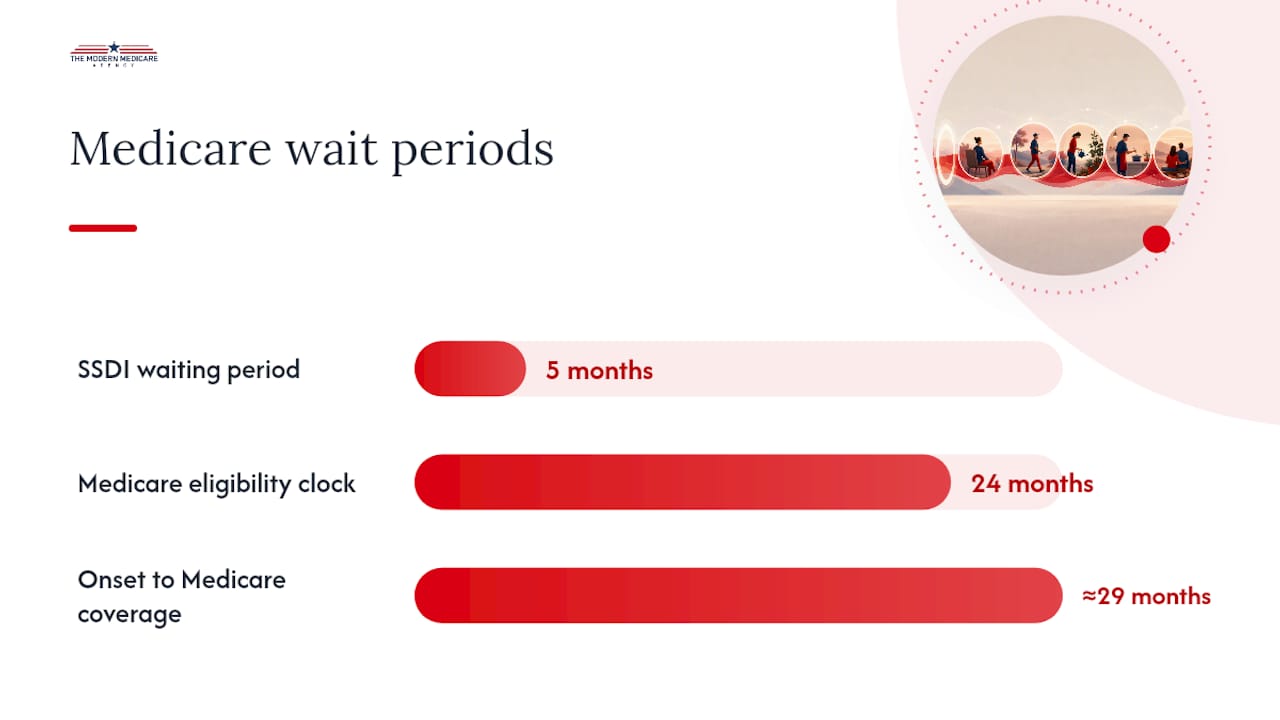
People mix up two different waiting periods, and that mix-up causes real confusion. SSDI itself has a 5-month waiting period before your first disability check arrives. Medicare eligibility is a separate 24-month clock that starts at your SSDI entitlement date, which usually lands right after that 5-month payment delay. So in practice, most people are looking at roughly 29 months from the onset of their disability to their first day of Medicare coverage, though the exact math depends on when SSA determines your disability actually began.
Here’s how it plays out for someone with a straightforward approval. Say your disability onset date is January 2024. SSDI entitlement begins around June 2024, after the 5-month wait. Count forward 24 months from that entitlement date, and Medicare starts July 1, 2026, the first day of the 25th month of entitlement.
A second scenario complicates things in your favor. If SSA determines you had a prior period of disability, some of those earlier months can count toward the 24-month total. The SSA’s own guidance on this is specific: months from a previous disability period may count if your new disability starts within a set window, sometimes 60 months, sometimes 84 months depending on the benefit type involved. That rule alone shortens the wait for a meaningful number of reapplicants who don’t realize it applies to them.
A rough timeline looks like this:
- Month 0: SSDI entitlement date established on your award letter.
- Month 21 to 22: Medicare welcome packet and card mailed automatically.
- Month 24, day 1 of month 25: Original Medicare Part A and Part B coverage begins.
Pro Tip: Find the exact “entitlement date” printed on your SSA award letter, not the approval date, and count 24 months forward from there. That single number is the one figure your future Medicare start date actually depends on, and getting it wrong by even a month throws off every other decision you make about coverage.
Our guide to the SSDI Medicare waiting period walks through more entitlement-date edge cases if your timeline looks unusual.
Does ALS or Kidney Failure Waive the Medicare Wait?
Yes, and these are the only two exceptions that eliminate or dramatically shorten the standard wait. Everyone else, regardless of how severe their condition, follows the standard 24-month timeline.
ALS (amyotrophic lateral sclerosis) gets the cleanest deal in the whole system. Medicare coverage begins the same month your SSDI benefits start, with no waiting period at all. If you’re diagnosed with ALS and approved for SSDI, that’s it, your Medicare card should follow almost immediately after entitlement.
ESRD (End-Stage Renal Disease) works differently and depends on your treatment path:
- If you start regular dialysis, Medicare coverage typically begins on the first day of the fourth month of dialysis treatment.
- If you begin a Medicare-approved home dialysis training program, coverage can start as early as the first month of that training.
- A kidney transplant can also trigger earlier Medicare eligibility, tied to the month of hospital admission for a transplant.
Beyond ALS and ESRD, remember the prior-disability-period rule covered above. If SSA determines your current disability is related to, or recurs within the qualifying window after, a previous period of disability, some of those old months may count toward your 24-month total right now.
Before assuming an exception applies to you, gather a short set of documents:
- Written diagnosis documentation from your treating physician, especially for ALS or ESRD.
- Dialysis start date or home training program enrollment confirmation.
- A copy of any prior SSA disability determination, if you’ve been on disability before.
Call SSA directly to confirm which rule applies to your situation. Confirming this before you assume you’re stuck in the standard 24-month queue can save you two years of unnecessary premium payments elsewhere.
What Health Coverage Options Exist During the Wait?
You’ve got four realistic paths through the gap, and each one interacts differently with your future Medicare enrollment. Picking the wrong one, or picking the right one without documenting it properly, can create headaches later.

Medicaid is often the strongest option if your income qualifies, since eligibility and rules vary by state through Medicaid. It typically costs little to nothing out of pocket, and in many states you can also carry Medicaid alongside Medicare later as a dual-eligible beneficiary, which helps cover costs Medicare doesn’t.
COBRA lets you keep your former employer’s group plan, usually for up to 18 months, but you pay the full premium yourself, often several hundred dollars a month or more. It’s continuous coverage with no new deductible to meet, which matters if you’re mid-treatment for something.
Employer or spouse group coverage works well if you or a family member still has access to a job-based plan. Confirm in writing exactly when that coverage started and when it will end, because Medicare will ask about creditable coverage history when you enroll.
Marketplace plans through Healthcare.gov fill the gap for people who don’t qualify for Medicaid and don’t have COBRA or employer coverage available. Here’s the part people miss: if you’re getting premium tax credits through the Marketplace and you later become eligible for Medicare, you need to report that change promptly. Staying on subsidized Marketplace coverage past your Medicare eligibility date can trigger a requirement to repay those tax credits.
Whichever option you choose, urgent care and emergency coverage don’t pause during this transition, your existing plan (Medicaid, COBRA, employer, or Marketplace) covers emergencies exactly as it would for anyone else. The risk isn’t a coverage gap in an emergency; it’s a documentation gap when Medicare starts.
Pro Tip: Save every enrollment confirmation, COBRA election notice, and employer letter that states your coverage’s effective and termination dates. When Medicare starts, having a clean paper trail with no overlapping or missing dates prevents billing confusion and proves you had continuous creditable coverage the whole time.
For a deeper look at how these options compare for people qualifying through disability, see our guide to Medicare options for disabled individuals under 65.
What Choices Do You Make When Medicare Starts?
Most SSDI recipients don’t have to lift a finger for basic enrollment. SSA and Medicare handle it automatically: once you hit month 24 of entitlement, you’re enrolled in Original Medicare Part A and Part B, with your card arriving roughly three months ahead of your actual start date.
But automatic enrollment doesn’t mean you’re locked into every default setting. A few real decisions land in your lap:
- Declining Part B: if you have credible employer group coverage through active work (yours or a spouse’s), you can decline Part B without penalty and re-enroll later during a special enrollment period. If you don’t have qualifying coverage, declining Part B risks a permanent late-enrollment penalty, so don’t decline it just to save the monthly premium without confirming your other coverage actually qualifies.
- Enrolling in Part D: prescription drug coverage isn’t automatic. You need to actively enroll in a standalone Part D plan or choose a Medicare Advantage plan that includes drug coverage, and missing your window here can mean a late penalty that follows you for as long as you have Part D.
- Medigap availability: this is where under-65 disabled enrollees hit a real wrinkle. Federal law guarantees Medigap access at 65, but for enrollees under 65, guaranteed issue rights vary significantly by state. Some states require insurers to offer Medigap to disabled enrollees; others don’t. Check your state’s specific rules well before your Medicare start date.
In the three months before coverage begins, confirm your current doctors accept Medicare, check whether your prescriptions will be covered under a Part D formulary, and decide whether you’re leaning toward Medigap or Medicare Advantage. Our Medicare supplement guide for disabled enrollees under 65 breaks down the state-by-state Medigap access question in more detail.
Agent Checklist: What to Do Before Medicare Starts
- Confirm your SSA entitlement date by requesting your award letter now. It’s the single number that anchors every other date in this process.
- Check your current coverage’s end date, whether that’s COBRA, an employer plan, or a Marketplace policy, at months 24 through 3 before your Medicare start.
- Evaluate Medicaid eligibility in your state if income is limited; it can eliminate premium costs entirely during the wait.
- Open a Marketplace plan through Healthcare.gov if you have no other coverage option, and flag your future Medicare eligibility so tax credits stay accurate.
- At month 3 to 1 before start, verify your mailing address with SSA so your Medicare card arrives without delay, and start comparing Medigap versus Medicare Advantage options.
- At coverage start, confirm your doctors and pharmacy accept your new plan before your old coverage lapses.
Pro Tip: Call a licensed Medicare agent about 90 days before your Medicare start date, and bring your SSA award letter, current insurance card, and a list of your prescriptions. That single conversation usually prevents the two most common mistakes people make during this transition.
Why Early Planning Beats Reacting to the Deadline
The biggest mistake I see isn’t misunderstanding the 24-month rule itself, it’s not knowing the exact entitlement date on the award letter and assuming Medicare starts “whenever it starts.” That assumption costs people real money, especially when they let Marketplace subsidies run past their Medicare eligibility date and end up owing money back at tax time.
The second pitfall is procrastination on Medigap research for under-65 enrollees. State rules on guaranteed issue vary enough that waiting until month 23 to look into it can leave you with fewer options than you’d have had three months earlier. None of this requires complicated planning. It just requires starting before the deadline forces your hand.
How Paulbinsurance Helps You Navigate the Transition
Figuring out your exact Medicare start date, comparing Medigap against Medicare Advantage as an under-65 enrollee, and timing your Part D enrollment correctly involves more moving pieces than most people want to manage alone, especially while dealing with a disability. That’s where Paulbinsurance fits in.

As independent Medicare agents, Paulbinsurance helps confirm your entitlement date against your SSA paperwork, walks through Medicare Advantage versus Medigap options specific to your state’s rules for under-65 disabled enrollees, and helps you time your Part D enrollment to avoid late penalties. If you’re currently on COBRA or a Marketplace plan, Paulbinsurance can also help you plan the handoff so there’s no coverage overlap or gap when Medicare begins.
Consultations are free and come with no obligation to enroll through us. Bring your SSA award letter, your current insurance card, and a list of your prescriptions, and start by reviewing how Medicare Advantage plans work compared to supplement coverage before your Medicare start date arrives.
Frequently Asked Questions
Does the Medicare disability 24 month wait start at diagnosis or at SSDI approval?
Neither. It starts on your SSDI entitlement date, listed on your award letter, which typically follows the 5-month SSDI payment waiting period.
Can I shorten the 24-month wait if I’ve been on disability before?
Possibly. SSA counts some months from a prior disability period toward your current 24-month total if your new disability began within a qualifying window after the earlier one.
What happens if I don’t have any coverage during the wait?
You’re not automatically covered for anything until Medicare starts, so you need Medicaid, COBRA, employer coverage, or a Marketplace plan to avoid being uninsured during the gap.
Will I automatically get Part D drug coverage when Medicare starts?
No. Part A and Part B enroll automatically, but Part D requires you to actively choose a standalone drug plan or a Medicare Advantage plan that includes drug coverage.
Can I get a Medigap plan if I’m under 65 and disabled?
It depends on your state. Federal law only guarantees Medigap access at 65, so guaranteed issue rights for under-65 disabled enrollees vary by state law.
This article is general information, not a substitute for advice from a qualified doctor. Consult a qualified healthcare professional about your own circumstances before acting on anything here.
Sources
- CMS — Medicare enrollment & renewal (Original Part A & B)
- Healthcare
- SSA — Approval process | Disability benefits
- Medicare