




As your 65th birthday approaches, it’s easy to feel overwhelmed by the flood of mail and the confusing maze of government rules. Questions like, “Did I work enough to qualify?” or “What happens if I miss my deadline?” can quickly turn into real anxiety about making a costly mistake. We believe understanding your medicare eligibility shouldn’t be a source of stress. It should be a clear, straightforward step toward securing your healthcare future.
This guide was created to provide the patient, expert guidance you deserve. We will walk you through the requirements in simple terms, helping you determine exactly who qualifies and when. You’ll get a simple checklist to see where you stand, learn about the critical enrollment periods to avoid penalties, and understand the rules for qualifying based on age, work history, or specific health conditions. Our goal is to replace that confusion with confidence, giving you the peace of mind to know you’re making the right decisions at the right time.
Key Takeaways
- Learn how turning 65 is the first step to qualifying, and discover why your work history is just as important.
- Discover the specific health conditions and disability rules that could allow you to qualify for Medicare years before your 65th birthday.
- Understanding your medicare eligibility is only the first step; knowing your enrollment deadlines is crucial to avoid lifelong penalties.
- Clarify how unique circumstances, like continuing to work past 65, affect your enrollment options and what to do next.
What is Medicare? Understanding the Four Basic Parts
Navigating the world of Medicare can feel overwhelming, but we’re here to provide trusted guidance. At its core, Medicare is a federal health insurance program designed to provide reliable healthcare coverage, primarily for individuals aged 65 or older and some younger people with specific disabilities. Before you can choose a plan, the very first step is confirming your medicare eligibility. This foundational program, with a long and detailed Medicare program history, is broken down into four main parts to cover different healthcare needs. Let’s simplify the jargon and explore what each part does for you.
Part A: Hospital Insurance
Think of Part A as your ‘hospital’ insurance. It is designed to cover costs related to inpatient care. This includes semi-private rooms, meals, and nursing services during a hospital stay. It also helps cover care in a skilled nursing facility (following a qualifying hospital stay), hospice care, and certain home health care services. For most people, Part A is premium-free because they or their spouse paid Medicare taxes for at least 10 years while working. It forms the essential base of your coverage for major medical events.
Part B: Medical Insurance
Part B is your day-to-day ‘medical’ insurance. This part covers a wide range of services and supplies that are medically necessary to treat your health condition. This includes doctor visits, outpatient hospital care, ambulance services, durable medical equipment (like walkers or wheelchairs), and critical preventive services such as flu shots and cancer screenings. Unlike Part A, nearly everyone pays a standard monthly premium for Part B, which can be adjusted based on your income.
Part C & D: Advantage Plans and Drug Coverage
Parts C and D are options offered by private insurance companies that work with Medicare to provide additional choices and benefits. It is essential to understand that your initial medicare eligibility for Parts A and B is required before you can enroll in either of these options.
- Part C (Medicare Advantage): These are “all-in-one” plans that bundle your Part A and Part B benefits into a single, convenient plan. Most Medicare Advantage plans also include Part D prescription drug coverage and may offer extra benefits not covered by Original Medicare, such as vision, hearing, and dental services.
- Part D (Prescription Drug Coverage): This part helps cover the cost of your prescription medications. If you stick with Original Medicare (Parts A and B), you can add a standalone Part D plan to ensure your drug costs are more manageable.
The Primary Path: Medicare Eligibility by Age (Turning 65)
For most Americans, turning 65 is the milestone that opens the door to Medicare. This is the most common path to enrollment, and it’s likely the one you’ve heard about most often. However, a common point of confusion is that age is only one part of the equation. Your medicare eligibility at age 65 also depends on your work history-or that of your spouse.
It’s important to understand that you can sign up for Medicare at 65 even if you are still working and have health insurance through your employer. Getting the timing right is crucial to avoid lifelong penalties, so let’s break down the requirements into simple, clear steps.
The Age 65 Requirement
First and foremost, you must meet the basic age and residency criteria. This is the straightforward part of qualifying. To be eligible when you turn 65, you must meet all of the following conditions:
- You are turning 65, with eligibility typically beginning on the first day of your birthday month.
- You are a U.S. citizen or a legal resident.
- You have lived in the United States continuously for at least five years.
The Work History Requirement (40 Quarters)
This is where your work history comes into play. To qualify for premium-free Part A (Hospital Insurance), you or your spouse must have worked and paid Medicare taxes for a certain amount of time. This is tracked in “work credits,” or what the government calls quarters. You need to have earned 40 quarters, which is equivalent to about 10 years of work. This system is managed by the Social Security Administration, and you can find official details on the Social Security Administration Medicare eligibility page. If you have fewer than 40 quarters, you may still be able to get Part A, but you will likely have to pay a monthly premium for it.
Spousal Benefits: Qualifying Through Your Partner
What if you don’t have the required 40 quarters of work yourself? Don’t worry-many people qualify for premium-free Part A based on their spouse’s work record. This is a key part of the Medicare system designed to support families. You may be eligible if:
- You are married to someone who is at least 62 and has 40 quarters of work.
- You were married for at least 10 years to someone with 40 quarters and are now divorced and single.
- You are a widow or widower who was married for at least nine months to someone with 40 quarters.
Qualifying Under 65: Disability and Special Health Conditions
Many people believe Medicare is only available once you turn 65, but that’s a common misconception. If you are under 65 and have a qualifying disability or a specific health condition, you may be able to get Medicare benefits early. Understanding your medicare eligibility in these situations can feel overwhelming because the rules are quite different from the age-based path. Our goal is to simplify these rules and provide the straightforward guidance you need. Let’s walk through the three main ways you can qualify for Medicare before your 65th birthday.
Eligibility Through Social Security Disability Insurance (SSDI)
The most common path to Medicare under 65 is through Social Security Disability Insurance (SSDI). If you qualify for SSDI, you will be automatically enrolled in Medicare Part A and Part B after you have received disability benefits for 24 months. It’s important to know that this 24-month waiting period doesn’t start from the date you became disabled, but from the month your SSDI payments begin. The rules around this can be complex, but the official Social Security Administration’s guide to Medicare provides a detailed breakdown of the process.
End-Stage Renal Disease (ESRD)
If you have permanent kidney failure that requires regular dialysis or a kidney transplant, you can qualify for Medicare at any age. Unlike SSDI, enrollment is not automatic. You must actively apply for Medicare through the Social Security Administration to receive your benefits. While there is typically a waiting period for coverage to begin, it can vary depending on your specific circumstances, such as whether you are on dialysis or have a transplant scheduled. Taking the step to apply is crucial for this type of medicare eligibility.
Amyotrophic Lateral Sclerosis (ALS or Lou Gehrig’s Disease)
Individuals diagnosed with Amyotrophic Lateral Sclerosis (ALS), also known as Lou Gehrig’s disease, have a special provision that provides faster access to Medicare. If you have ALS, you are exempt from the 24-month waiting period that applies to other disabilities. Your Medicare coverage can begin the very first month you start receiving SSDI benefits, ensuring you get the critical care you need without a long delay. This exception highlights why personalized support is so valuable when navigating your options.
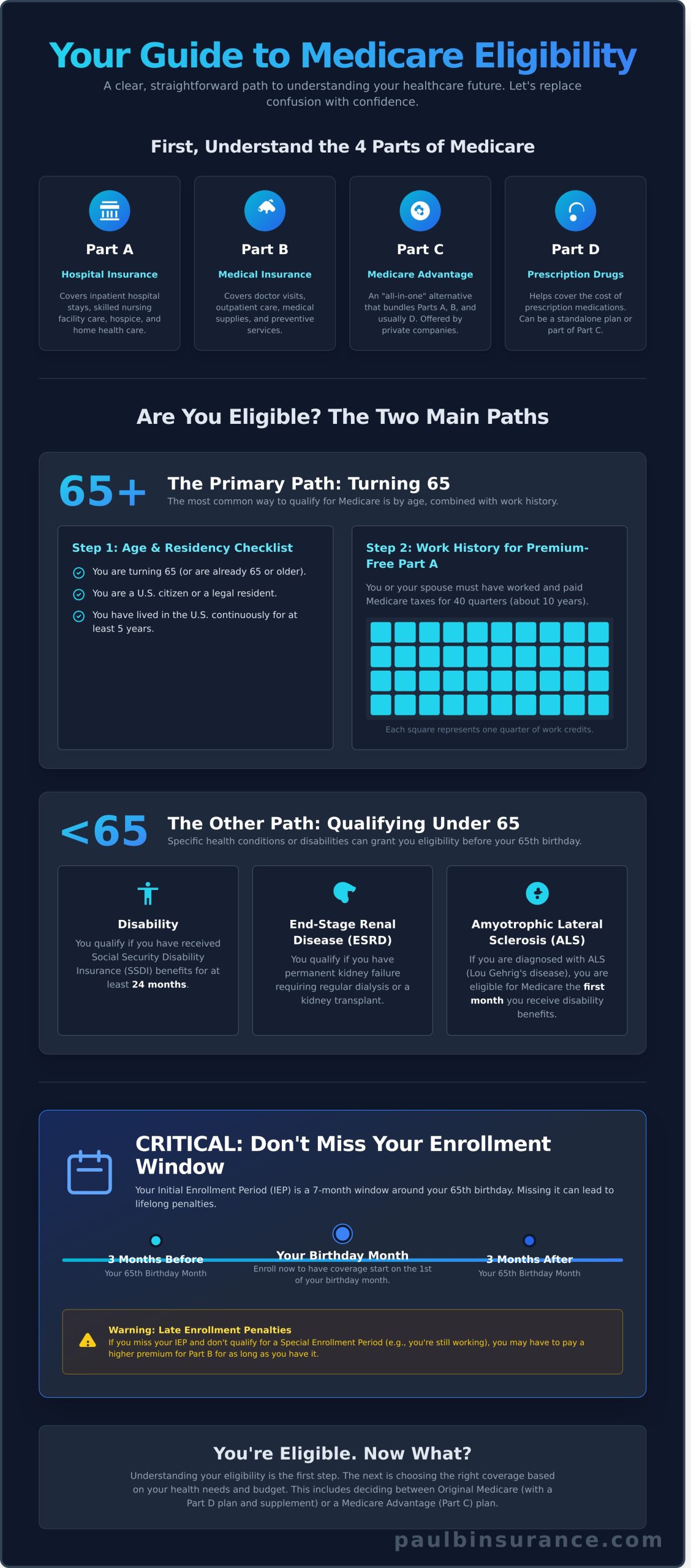
When to Enroll: Your Key Medicare Deadlines
Meeting the Medicare eligibility requirements is a significant milestone, but it’s only the first step. A common and costly mistake is assuming that enrollment is automatic for everyone. Understanding when to sign up is just as crucial as knowing if you qualify. Missing your personal enrollment window can lead to gaps in your health coverage and lifelong financial penalties.
Let’s walk through the key deadlines with clarity, helping you move from confusion to confidence and ensure you get the coverage you need without any costly missteps.
Your Initial Enrollment Period (IEP)
Think of this as your primary window of opportunity to sign up for Medicare. Your IEP is a 7-month period that is unique to you and centered around your 65th birthday. It includes:
- The 3 months before your 65th birthday month
- The month you turn 65
- The 3 months after your 65th birthday month
Enrolling during your IEP is the surest way to get your coverage started on time and, most importantly, avoid late penalties.
Automatic Enrollment vs. Manual Enrollment
You may be enrolled in Medicare Part A and Part B automatically if you’re already receiving benefits from Social Security or the Railroad Retirement Board (RRB) at least four months before you turn 65. If so, your Medicare card will arrive in the mail before your birthday.
However, if you are not yet receiving those benefits, you must sign up manually. You can complete this essential step online through the Social Security Administration’s website. Taking this action is what activates your Medicare eligibility and gets your coverage started.
The Risk of Delay: Late Enrollment Penalties
Delaying your enrollment without having other creditable health coverage (like a plan from your or your spouse’s current employer) can be a serious financial mistake. If you miss your IEP, you may have to pay a late enrollment penalty for Part B and Part D. These aren’t one-time fees; they are added to your monthly premiums for as long as you have the coverage. Timely enrollment is critical to your long-term financial peace of mind.
Navigating these dates and rules can feel like a maze. If you are feeling unsure about your personal deadlines or how to proceed, you are not alone. Confused about deadlines? We can help you navigate them. Our goal is to provide trusted guidance to ensure you enroll correctly and on time.
Special Situations That Affect Your Eligibility and Enrollment
The path to Medicare isn’t always a straight line. Many people find themselves in unique circumstances as they approach age 65, leading to valid questions about their coverage options. We understand that these situations can feel confusing, but rest assured, there are clear rules to help guide you. This section provides the straightforward guidance you need to navigate your specific situation with confidence.
Still Working at 65 with Employer Coverage
If you’re still working and have health coverage through your job, you may be able to delay enrolling in Medicare Part B without facing a late enrollment penalty. However, the rules depend entirely on the size of your employer.
- For companies with 20 or more employees: Your employer’s group plan is considered your primary insurance. You can typically delay Part B and enroll later during a Special Enrollment Period (SEP) when you retire or lose that coverage.
- For companies with fewer than 20 employees: Medicare becomes your primary insurer at 65. You will need to enroll in Part A and Part B during your Initial Enrollment Period to avoid coverage gaps and lifetime penalties.
TRICARE, VA Benefits, and Federal Employee Health Benefits (FEHB)
Having other federal health coverage adds another layer to your medicare eligibility decisions. For most of these plans, especially TRICARE For Life, enrolling in both Medicare Part A and Part B when you first become eligible is essential to ensure your benefits work correctly and you receive maximum coverage. We strongly advise you to contact your specific benefits administrator to understand exactly how your current plan coordinates with Medicare.
Living Abroad or in a U.S. Territory
It’s important to know that Original Medicare generally does not provide health coverage outside of the United States. If you live abroad when you turn 65, you can still enroll, but you will have to pay the monthly premium for Part B (and possibly Part A if you don’t have enough work credits). For residents of Puerto Rico or other U.S. territories, special rules often apply; you may get Part A automatically but will need to sign up for Part B.
Navigating these special circumstances is critical to avoiding costly mistakes. If you have questions about your unique situation, you don’t have to figure it out alone. For trusted, unbiased guidance tailored to your needs, please visit us at paulbinsurance.com.
You’re Eligible for Medicare… Now What?
Congratulations! Taking the time to understand the rules of Medicare is a huge first step. But confirming your medicare eligibility is just the beginning of your journey. Now, you face an important decision: how will you actually receive your healthcare benefits? This choice between two very different paths can feel overwhelming, but you don’t have to figure it out alone. Let’s simplify your options.
Path 1: Original Medicare + Medigap + Part D
This is often considered the traditional path, offering you maximum flexibility and nationwide coverage. It involves combining three separate pieces to build comprehensive protection:
- Original Medicare (Part A & Part B): Your foundational hospital and medical coverage from the federal government, accepted by nearly every doctor and hospital in the U.S.
- A Medigap (Supplement) Plan: A private policy that helps pay for the “gaps” in Original Medicare, such as deductibles and coinsurance, giving you predictable costs.
- A Part D Prescription Drug Plan: A separate, standalone plan from a private insurer to help cover the costs of your medications.
Path 2: A Medicare Advantage Plan (Part C)
A Medicare Advantage plan is an all-in-one alternative offered by private insurance companies approved by Medicare. These plans bundle your Part A, Part B, and usually your Part D prescription drug benefits into a single, convenient package. A key appeal is that many plans include extra perks not covered by Original Medicare, such as routine dental, vision, and hearing care. Most of these plans operate with a local network of providers (like an HMO or PPO).
How an Independent Broker Simplifies Your Choice
The right path is a personal decision based on your unique health needs, budget, and lifestyle. The good news is that you don’t have to make this choice in a vacuum. As an independent brokerage, our loyalty is to you, not to a single insurance company. We provide unbiased, expert guidance by comparing dozens of plans from various carriers to find the one that truly fits your life.
Our personalized support comes at no extra cost to you, ensuring you can move from confusion to confidence. Ready to take the next step with clarity? Schedule your free, no-obligation plan comparison today.
Your Path to Medicare Confidence Starts Here
Understanding Medicare doesn’t have to be overwhelming. As we’ve covered, the journey begins with knowing the key paths to qualification-whether you’re approaching age 65 or meet criteria through disability or special health conditions. The most critical takeaways are to respect your personal enrollment deadlines to avoid penalties and to understand how your unique circumstances affect your options. Confirming your specific medicare eligibility is the foundational step to building a secure healthcare future.
Now that you’re armed with this knowledge, the next step is turning information into a concrete plan. With 18+ years of experience serving over 5,000 clients, our mission is to provide the trusted, unbiased guidance you deserve. We’ll help you compare plans from more than 40 carriers to ensure your choice truly fits your needs and budget, moving you from confusion to confidence. Let’s make sure you’re ready. Schedule a free Medicare eligibility and plan review.
You’ve done the research; now let’s secure your healthcare with peace of mind.
Frequently Asked Questions About Medicare Eligibility
Can I get Medicare if I never worked or paid Medicare taxes?
Yes, it’s possible to qualify for Medicare even without your own work history. You may be eligible for premium-free Part A based on your spouse’s record if they worked and paid Medicare taxes for at least 10 years. This applies if you are currently married, divorced (after at least 10 years of marriage), or widowed. If you don’t qualify through a spouse, you can still enroll at 65 but will have to buy Part A by paying a monthly premium.
What are the income limits to be eligible for Medicare?
There are no income limits that affect your basic medicare eligibility. If you meet the age or disability requirements, you can enroll in Medicare regardless of how much you earn. However, your income can affect how much you pay for your monthly premiums. Higher-income beneficiaries pay a larger monthly premium for Part B and Part D. This is known as the Income-Related Monthly Adjustment Amount, or IRMAA, and is based on your tax return from two years prior.
Do I have to sign up for Medicare at 65 if I have health insurance through my spouse’s job?
This depends on the size of your spouse’s employer. If the company has 20 or more employees, their group health plan is considered the primary payer, and you can typically delay enrolling in Medicare without facing a late enrollment penalty. However, if the employer has fewer than 20 employees, Medicare becomes the primary payer. In this situation, you should sign up for Part A and Part B when you turn 65 to avoid coverage gaps and penalties.
If I get Medicare due to a disability, what happens when I turn 65?
Your Medicare coverage will continue without interruption. The only thing that changes is the reason for your eligibility-it shifts from being based on your disability to being based on your age. Turning 65 is a significant event because it gives you a new Medigap Open Enrollment Period. This is a valuable six-month window where you can buy any Medigap policy sold in your state, regardless of your health history, giving you a fresh chance to get the coverage you want.
How do I prove my work history to qualify for premium-free Part A?
You don’t need to gather pay stubs or old tax documents. The Social Security Administration (SSA) automatically tracks your work credits throughout your career. When you apply for Medicare, the SSA reviews its records to confirm if you have the 40 quarters of coverage (equivalent to about 10 years of work) needed for premium-free Part A. This process is seamless, and your eligibility is determined using their official records of your earnings and tax payments.
Can I be denied Medicare coverage because of a pre-existing condition?
No, you are guaranteed acceptance into Original Medicare (Part A and Part B) regardless of your health status. Federal law ensures that your medicare eligibility cannot be denied due to any pre-existing conditions you may have, such as diabetes, heart disease, or cancer. While private insurance plans like Medigap can sometimes use medical underwriting outside of specific enrollment periods, your core Medicare coverage is always protected and guaranteed once you qualify.