
IEP, AEP, OEP, SEP… If the Medicare ‘alphabet soup’ has your head spinning, please know you are not alone. This confusion can be overwhelming, and it often leads to a paralyzing fear: What if I miss my window and face a penalty? The truth is, understanding your correct Medicare enrollment period is one of the most important steps you can take to protect your health and your savings. But navigating this maze shouldn’t be a source of stress. We are here to bring simplicity and clarity to this process, ensuring you feel guided and secure.
This simple guide is your trusted roadmap to every key date. We will demystify the jargon and walk you through each enrollment period, explaining exactly who it’s for and what you need to do. Our promise is to provide you with the unbiased information you need to make the right choice at the right time. By the end of this article, you will have the confidence to enroll without worrying about costly mistakes and the peace of mind you deserve. Let’s turn that confusion into confidence, together.
Key Takeaways
- Understand your first and most important window to sign up-the Initial Enrollment Period-to start your coverage without a hitch.
- Each medicare enrollment period serves a unique purpose, from the annual chance to switch plans to special windows opened by life events.
- Discover why the one-time Medigap Open Enrollment Period is a critical deadline you cannot afford to miss for guaranteed coverage.
- Learn how to confidently navigate the deadlines to steer clear of permanent late enrollment penalties that can increase your monthly costs for life.
Your First Chance: The Initial Enrollment Period (IEP)
Navigating Medicare can feel overwhelming, but it all starts with one key step. Think of your Initial Enrollment Period (IEP) as your personal “welcome window” to Medicare. It’s a one-time opportunity when you first become eligible, and acting during this time is the single best way to start your journey with confidence. Understanding this first step is crucial for navigating the entire system, and you can get a helpful Medicare program overview to see how it all fits together. Missing this crucial window can lead to frustrating delays and even lifelong financial penalties, but we’re here to make sure that doesn’t happen.
When Is Your IEP?
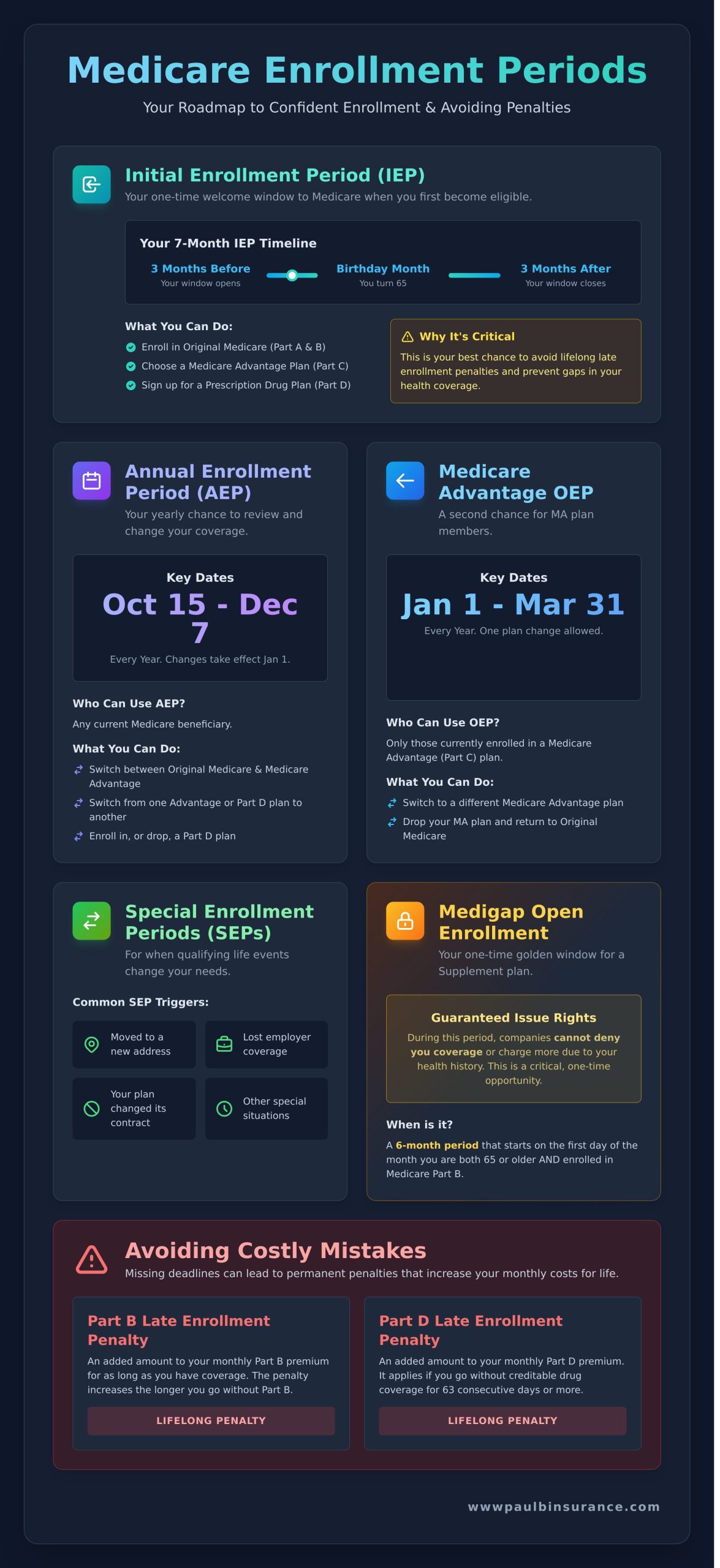
Your IEP is a 7-month period that is centered around your 65th birthday. This gives you a generous amount of time to review your options without feeling rushed. The window includes:
- The 3 months before the month you turn 65.
- The month you turn 65.
- The 3 months after the month you turn 65.
For example: If your birthday is in June, your IEP would start on March 1st and end on September 30th.
What Can You Do During Your IEP?
During your IEP, you have the power to build the foundation of your healthcare coverage for the years to come. This is your chance to make several key decisions and sign up for the parts of Medicare that are right for you. You can:
- Enroll in Original Medicare: This includes Part A (Hospital Insurance) and Part B (Medical Insurance).
- Choose a Medicare Advantage Plan (Part C): These are private plans that bundle Part A, Part B, and often prescription drug coverage (Part D) into one plan.
- Sign up for a Prescription Drug Plan (Part D): If you choose Original Medicare, you can add a standalone plan to cover your medications.
Why Your IEP is So Important
We can’t stress this enough: your IEP is your golden ticket to a smooth start with Medicare. Acting during this specific medicare enrollment period is critical for three main reasons. First, it ensures you have continuous health coverage, preventing any scary gaps as you transition from your previous insurance. Second, it is your best opportunity to avoid the costly Part B late enrollment penalty, which can be added to your monthly premium for as long as you have coverage. Finally, signing up late can mean waiting months for your benefits to actually begin. Getting it right the first time provides peace of mind and financial security.
The Big One: The Annual Enrollment Period (AEP)
If you’ve heard people talk about “Medicare Open Enrollment,” they are most likely referring to the Annual Enrollment Period, or AEP. This is the single most important time of year for current Medicare beneficiaries. Think of it as your yearly health coverage check-up. It’s your dedicated window to review your existing plan and make changes for the upcoming year.
Why is this so critical? Because insurance plans are not set in stone. Each year, companies can adjust their premiums, change their list of covered drugs, or alter their network of doctors and hospitals. The plan that was a perfect fit for you last year might not be the best choice next year. AEP is your opportunity to ensure your coverage continues to meet your specific health and budget needs, preventing costly surprises down the road.
Key Dates to Remember for AEP
This is one medicare enrollment period you don’t want to miss. Mark your calendar with these firm dates: AEP runs from October 15 to December 7 every single year. Any changes you make during this time will take effect on January 1 of the following year. These dates are set nationally, and you can always confirm important deadlines by reviewing the Official Medicare enrollment rules on the government’s website. We highly recommend putting a reminder in your phone or on your wall calendar.
What Changes Can You Make During AEP?
During these crucial weeks, you have the flexibility to make several important adjustments to your coverage. This is your chance to take control and align your plan with your life. You can:
- Switch from Original Medicare (Part A and Part B) to a Medicare Advantage (Part C) plan.
- Switch from a Medicare Advantage plan back to Original Medicare.
- Change from one Medicare Advantage plan to a different one.
- Join, drop, or switch a Medicare Part D prescription drug plan.
How to Prepare for AEP
Preparation is the key to making a confident choice. Before AEP begins, you will receive a letter from your current plan called the ‘Annual Notice of Change’ (ANOC). This document is your roadmap-it details every change for the upcoming year. Be sure to check if your doctors will still be in-network and confirm that your essential prescription drugs are still covered and affordable. Feeling overwhelmed? You don’t have to navigate this alone. Contact The Modern Medicare Agency for a free plan review.
After AEP: The Medicare Advantage Open Enrollment Period (OEP)
Did you choose a Medicare Advantage plan during the fall, only to discover your doctor isn’t in the network or your prescription costs are higher than you expected? It’s a stressful situation, but you aren’t stuck. There is a valuable safety net called the Medicare Advantage Open Enrollment Period (OEP). Think of it as a “do-over” window for those who realize their new plan isn’t the right fit.
However, it’s crucial to understand this is not a second Annual Enrollment Period. The options are more limited, and it’s important to know how this specific medicare enrollment period fits within the broader landscape of the official Medicare enrollment periods. This period is designed to fix a choice you’re unhappy with, giving you one more chance to get your coverage right for the year.
OEP Dates and Eligibility
This period runs every year from January 1 to March 31. To be eligible to make a change, you must already be enrolled in a Medicare Advantage (MA) plan as of January 1. If you are on Original Medicare, this period does not apply to you. Remember this key rule: you can only make one plan change during the OEP, so it’s vital to make it count with trusted guidance.
What You Can (and Can’t) Do During OEP
Understanding your options during the OEP is the key to using it wisely. The rules are very specific, and knowing them can help you avoid costly mistakes. Here’s a simple breakdown of what is and isn’t allowed during this medicare enrollment period:
- You CAN: Switch to a different Medicare Advantage plan. If your current plan’s network, copays, or benefits aren’t working for you, you can move to another MA plan (with or without prescription drug coverage).
- You CAN: Drop your Medicare Advantage plan and return to Original Medicare. If you decide an MA plan isn’t for you, you can disenroll and go back to Part A and Part B. You will also be able to join a standalone Part D Prescription Drug Plan to cover your medications.
- You CAN’T: Switch from Original Medicare to a Medicare Advantage plan. This is the most common point of confusion. OEP is an exit ramp from an MA plan, not an on-ramp to one.
- You CAN’T: Join or switch a standalone Part D plan if you have Original Medicare. Your only opportunity to enroll in a Part D plan during OEP is if you are leaving an MA plan.
When Life Changes: Understanding Special Enrollment Periods (SEPs)
Life doesn’t always follow a neat calendar, and thankfully, Medicare understands that. What happens if you move or lose your job-based insurance outside of the standard medicare enrollment period? You aren’t stuck. This is where a Special Enrollment Period (SEP) provides a crucial safety net.
Think of it as Medicare’s way of adapting to your life’s changes, ensuring you can adjust your coverage when you need it most, not just when the calendar says you can. An SEP prevents you from being locked into a plan that no longer works for your health needs or your location, giving you the flexibility and peace of mind you deserve.
Common Qualifying Life Events for an SEP
While many situations can grant you an SEP, some of the most common qualifying events include:
- Moving: You move to a new address that is outside your current plan’s service area, meaning you need to find a new plan that covers you in your new location.
- Losing Other Coverage: You lose other creditable health insurance, such as coverage from an employer (yours or your spouse’s) or COBRA.
- Your Plan Changes: Your Medicare plan is ending its contract with Medicare or is no longer providing service in your area at the end of the year.
- Gaining or Losing “Extra Help”: You qualify for, or lose, Extra Help-the federal program that helps pay for Medicare prescription drug costs.
How to Use a Special Enrollment Period
Using an SEP is straightforward, but the rules are specific. Unlike the annual open enrollment, your window to act is tied directly to your qualifying life event. Typically, you have 60 days from the date of the event to enroll in a new plan. It’s vital to act promptly and have documentation ready, as you will likely need to provide proof of the event, like a letter from your former employer or proof of your new address.
Determining if your situation qualifies for an SEP can feel like navigating a maze. The rules can be complex, and making a mistake could mean a gap in your coverage. You don’t have to figure this out alone. Not sure if you qualify? An expert can help you figure it out and guide you to the right decision with confidence and clarity.
Medigap’s Unique Rule: The Medigap Open Enrollment Period
Of all the dates and deadlines you’ll encounter in Medicare, this one is in a class of its own. The Medigap Open Enrollment Period is a crucial, one-time-only window that gives you powerful rights. It is completely separate from the annual fall enrollment period and is unique to you.
This personal enrollment window lasts for six months. It automatically begins on the first day of the month that you are both 65 or older and enrolled in Medicare Part B. For most people, this is their best-and sometimes only-chance to purchase a Medigap (or Medicare Supplement) plan without any health-related hurdles.
What Are Guaranteed Issue Rights?
During your Medigap Open Enrollment Period, you are protected by what are known as “guaranteed issue rights.” Think of this as your golden ticket. In simple terms, these rights force insurance companies to play fair. It means that during this six-month window:
- An insurance company cannot deny you coverage for any Medigap policy it sells due to pre-existing health conditions like diabetes, heart disease, or cancer.
- It cannot charge you a higher premium than anyone else your age just because of your health history.
This is a powerful consumer protection designed to give you access to the coverage you need at a fair price, regardless of your past or current health.
What Happens If You Miss This Period?
Letting this six-month window close without acting can be one of the most costly mistakes you can make. Once it’s over, your guaranteed issue rights disappear for most situations. If you decide to apply for a Medigap plan later, you will likely have to go through medical underwriting.
This means you’ll have to answer a long list of health questions, and an insurance company can:
- Refuse to sell you a policy altogether.
- Charge you a much higher premium for the same coverage.
- Impose a waiting period before covering your pre-existing conditions.
Navigating this specific medicare enrollment period correctly is essential for your long-term financial security and peace of mind. To ensure you don’t miss this critical opportunity, getting clear, unbiased guidance is key. If you feel overwhelmed, we are here to help you move from confusion to confidence.
Avoiding Costly Mistakes: Penalties and Pitfalls
One of the biggest sources of anxiety around Medicare is the fear of doing something wrong. What if you miss a deadline? What if you choose the wrong plan? These concerns are valid, especially because mistakes can lead to lifelong financial penalties. These aren’t one-time fees; they are permanent additions to your monthly premiums that can cost you thousands over your lifetime.
Think of this section as your guide to protecting your finances. The good news is that every one of these penalties is completely avoidable with the right knowledge and guidance. You don’t have to navigate this alone.
The Medicare Part B Late Enrollment Penalty
If you don’t sign up for Part B when you’re first eligible, you could face a costly penalty. For each full 12-month period you could have had Part B but didn’t, your monthly premium will increase by 10%. This penalty isn’t temporary-it lasts for as long as you have Part B. The simplest way to avoid this is to understand your unique medicare enrollment period and sign up on time.
The Medicare Part D Late Enrollment Penalty
This penalty applies if you go without creditable prescription drug coverage for 63 consecutive days or more after your initial enrollment window closes. The cost is calculated as 1% of the “national base beneficiary premium” multiplied by the number of months you were uncovered. Like the Part B penalty, this amount is added to your monthly Part D premium for the rest of your life.
How an Independent Broker Helps You Avoid Mistakes
Navigating these deadlines can feel overwhelming, but our job is to provide clarity and confidence. As your independent Medicare advisors, we ensure you never have to worry about late penalties. Here is how we protect you:
- We track your personal deadlines. We identify your specific enrollment window and ensure you know exactly when to act.
- We ensure accuracy. We help you complete and submit all applications correctly and on time, preventing delays or coverage gaps.
- We provide peace of mind. Our ultimate goal is to remove the stress from this process, allowing you to focus on your health, not on confusing paperwork.
Your financial security is too important to leave to chance. Let us handle the deadlines so you can relax.
Your Simple Path to Medicare Confidence
Navigating the maze of Medicare dates can feel overwhelming, but it doesn’t have to be. The most important takeaway is that each medicare enrollment period serves a specific purpose, whether it’s your first chance to sign up during your IEP or the annual window to adjust coverage during AEP. Understanding these key dates-and knowing that life changes can grant you a Special Enrollment Period-is your best defense against gaps in coverage and costly, lifelong penalties.
But you don’t have to figure this out alone. Why risk a costly mistake when expert, unbiased guidance is free? As an independent broker, I provide access to plans from over 40+ trusted carriers, ensuring you find the right fit for your needs, not a sales quota. Ready to move from confusion to confidence? Schedule your free, no-pressure Medicare plan review today.
Your clear, confident path to the right Medicare plan starts now.
Frequently Asked Questions About Medicare Enrollment
What’s the difference between the AEP and the Medicare Advantage OEP?
We know the acronyms are confusing, so let’s simplify it. The Annual Enrollment Period (AEP) from October 15 to December 7 is for almost everyone with Medicare. It’s your chance to switch between Original Medicare and a Medicare Advantage plan, or change your Part D drug plan. The Medicare Advantage Open Enrollment Period (OEP) from January 1 to March 31 is only for people already in a Medicare Advantage plan, giving them one chance to switch to another or return to Original Medicare.
Do I have to re-enroll in my Medicare plan every year?
While your plan will likely renew automatically, it’s a costly mistake to ignore it. Insurers can change your plan’s costs, network, and benefits each year. You’ll get an Annual Notice of Change (ANOC) letter in the fall that details these updates. Reviewing it is essential to ensure your plan still meets your health and budget needs. The AEP is your dedicated time to find a better fit if your current plan is no longer right for you.
Can I change my Medigap plan at any time?
This is a common and critical question. You are only guaranteed the right to buy any Medigap plan during your one-time Medigap Open Enrollment Period, which starts when you’re 65 or older and have Part B. Outside of that protected window, insurance companies can use medical underwriting. This means they can ask about your health history and may deny your application or charge you much higher premiums. Getting this decision right from the start is vital for your peace of mind.
What happens if I miss my Initial Enrollment Period (IEP)?
Missing your IEP can unfortunately lead to lifelong consequences. You will face gaps in your health coverage and will likely be subject to permanent late enrollment penalties for Medicare Part B and Part D. These penalties are added to your monthly premiums for as long as you have the coverage. Understanding your specific medicare enrollment period is the single most important step to steer clear of these easily avoidable and costly mistakes. We can help you get it right.
I’m still working at 65. Do I need to sign up for Medicare?
This depends on your employer’s insurance. If you have “creditable” health coverage from an employer with 20 or more employees (from your job or your spouse’s), you can often delay Part B without a penalty. However, it is absolutely essential to confirm your coverage meets Medicare’s rules. Making an incorrect assumption can lead to significant penalties later on. We provide trusted guidance to help you make a confident decision based on your unique situation.
What is the General Enrollment Period (GEP) and when would I use it?
Think of the General Enrollment Period as a safety net. It runs from January 1 to March 31 each year. You would use this period if you missed your Initial Enrollment Period and you don’t qualify for a Special Enrollment Period (for example, after leaving a job with health coverage). If you sign up during the GEP, your coverage will begin on the first of the following month, but you may still face late enrollment penalties.