




What if you could silence the noise of every insurance commercial and finally feel in control of your healthcare? We know that by July 2026, most seniors have already received over 15 different mailers, each claiming to have the best plan. It’s exhausting to sort through the clutter while fearing a late enrollment penalty that could follow you for life. We built this medicare for dummies 2026 guide to act as your personal roadmap through the noise.
You deserve to understand your benefits without needing a law degree. We promise to break down the complex parts of the system into a simple plan so you can choose your 2026 coverage with total confidence. We’ll compare the costs of Medicare Advantage versus Medigap, explain the new $2,100 out-of-pocket cap for prescriptions, and show you exactly when to sign up so you don’t overpay.
Key Takeaways
-
We strip away the complex jargon to show you exactly how the system works, helping you move from feeling overwhelmed to feeling completely in control of your 2026 coverage.
-
Understand the "Puzzle Pieces" of Medicare, including the vital differences between your hospital coverage and your outpatient medical benefits.
-
Use our medicare for dummies 2026 guide to master the "Pay Now vs. Pay Later" philosophy, allowing you to choose between the predictable costs of a Supplement or the options of Medicare Advantage.
-
Learn how to navigate critical enrollment deadlines and special windows so you can avoid costly, lifelong late penalties.
-
Discover how to build a personalized healthcare strategy that protects your savings and gives you the peace of mind you deserve.
Table of Contents
-
Medicare for Dummies 2026: Why It Feels So Confusing (and How We Make It Simple)
-
The Big Choice: Medicare Advantage vs. Medicare Supplement (Medigap)
-
Enrolling in 2026: Dates, Deadlines, and Avoiding Late Penalties
-
Your 2026 Medicare Strategy: Moving From Confusion to Confidence
Medicare for Dummies 2026: Why It Feels So Confusing (and How We Make It Simple)
Welcome to the Medicare Class of 2026. If you are turning 65 this year, you are joining roughly 4.1 million other Americans who are entering this system alongside you. We know exactly how you feel right now. Your mailbox is likely overflowing with glossy brochures, and your phone probably hasn’t stopped ringing with "urgent" offers. It feels like a chaotic maze because, quite frankly, the system is designed to be complex. This medicare for dummies 2026 guide is our way of handing you a map and a flashlight. We want to move you from a state of total confusion to a place of absolute confidence.
To start your journey, we need to define the basics. What is Medicare? At its core, it is a federal health insurance program that serves over 67 million people as of 2026. While it provides a safety net that is more robust than it was even five years ago, it is not a "set it and forget it" plan. It is a program that requires a specific strategy. If you don’t have a plan, you end up paying for things you don’t need or, worse, missing out on benefits you’ve earned through years of taxes.
We see people get stuck in the "Jargon Trap" every single day. Insurance companies love terms like "Co-insurance," "Deductibles," and "Benefit Periods." These words act like a barrier to keep you from understanding where your money is going. For example, many seniors don’t realize that a 20% co-insurance on a $50,000 surgery can be financially devastating without a secondary plan. We strip all of that noise away. We don’t use "insurance-speak." We use plain English to show you exactly how much a doctor visit will cost and which prescriptions are covered. Our promise is simple: we give you an honest look at your options without the pressure.
The 2026 Medicare Landscape: What’s New?
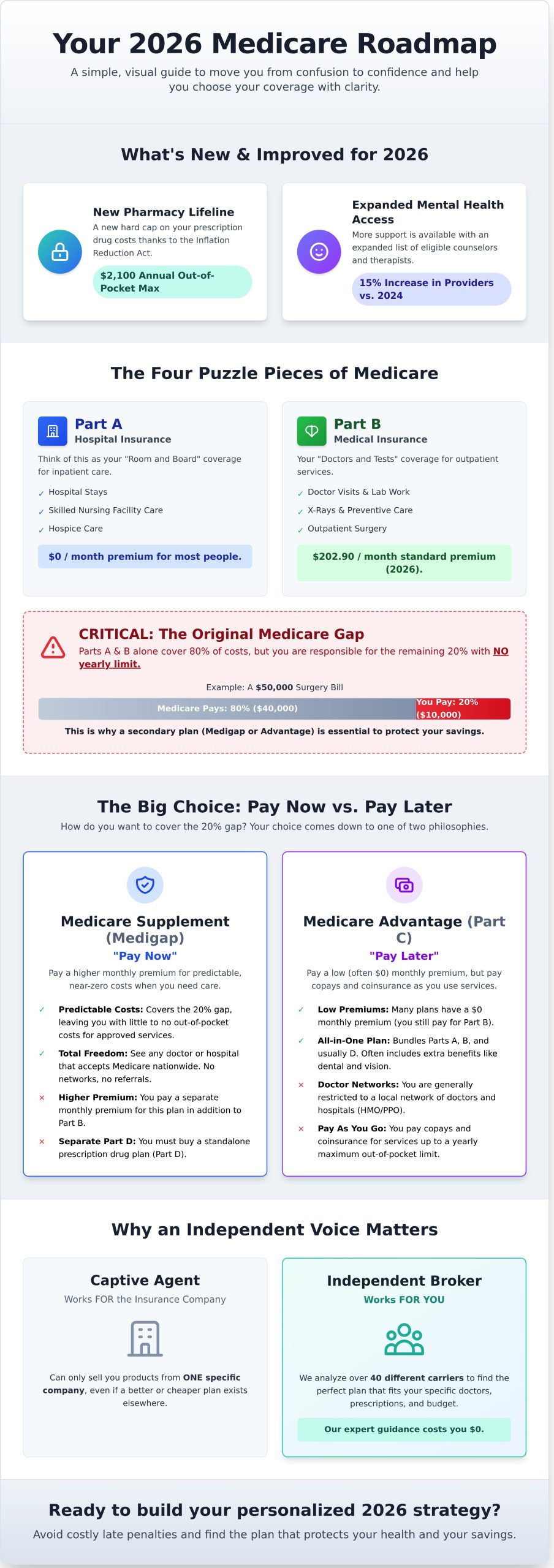
In 2026, the foundation of Medicare Parts A and B remains stable, but the surrounding details have shifted significantly. This is a pivot year for prescription drug savings. Thanks to the final implementation phases of the Inflation Reduction Act, as of January 1, 2026, your out-of-pocket spending for Part D prescription drugs is capped at $2,100. This is a massive win for the 1 in 4 seniors who previously struggled with "donut hole" pricing. We are also seeing a 15% increase in available mental health providers compared to 2024, as Medicare has expanded its list of eligible counselors and marriage therapists to meet rising demand.
Why an Independent Voice Matters
Most people talk to a "captive agent" without realizing it. A captive agent works for one specific insurance company. They can only sell you that company’s products, even if a better deal exists right across the street. We work differently. We are independent brokers, which means we work for you, not the carriers. We analyze over 40 different carriers to find your specific "needle in a haystack" plan. We use a 5-step vetting process to ensure your doctors and medications are all in-network. The best part is the "No-Cost" secret; we are paid a standard commission by the insurance companies, so our guidance costs you $0. You get the same premium you would get by calling the company directly, but you gain a dedicated advocate who will be here for you long after the 2026 enrollment season ends.
The Four Parts of the Medicare Puzzle: A, B, C, and D
We know how easy it is to feel lost when you first look at the different "alphabet" parts of this system. It feels like a giant puzzle with pieces that don’t quite fit together. This medicare for dummies 2026 guide is designed to change that. We want to replace your confusion with total confidence. Once you understand the four basic building blocks, the entire picture becomes clear and manageable.
Original Medicare (Parts A & B)
Think of Part A as your "Room and Board" insurance. It covers your stays in the hospital, skilled nursing facility care, and hospice. For the vast majority of our clients, Part A costs $0 per month. As long as you or your spouse worked and paid Medicare taxes for at least 10 years, you have already paid for this coverage through your career. It is the foundation of your healthcare security.
Part B is your "Doctor and Tests" insurance. This covers outpatient services like office visits, lab work, X-rays, and even some preventive vaccines. In 2026, the standard Part B premium is $202.90 per month. We often hear people ask if they can skip this if they feel healthy. We strongly advise against that. Medical needs are unpredictable; Part B is your safety net. You can verify your specific enrollment window on the Official Medicare Website to ensure you don’t face lifetime late enrollment penalties.
There is one major risk you must understand. Original Medicare alone has a 20% gap. It pays 80% of your medical bills, but you are responsible for the remaining 20% with no yearly limit. If you face a $50,000 surgery, your $10,000 share could be devastating. We focus on finding the right supplemental coverage so you never have to worry about a surprise bill ruining your retirement savings.
Part D: The 2026 Prescription Revolution
This year brings the most significant improvement to prescription coverage in decades. We are now operating under a total "Pharmacy Lifeline" thanks to recent federal updates. In 2026, there is a hard $2,100 out-of-pocket maximum for your covered medications. This change is a game changer for seniors on fixed incomes. Once you spend $2,100 on your prescriptions at the pharmacy, your plan pays 100% of your covered drug costs for the rest of the calendar year.
This update has finally eliminated the "Donut Hole" once and for all. You no longer have to worry about a sudden spike in prices mid-year. However, every plan has a different list of covered drugs. We recommend you learn more about choosing the right Part D plan to make sure your specific medications are on the list before you sign up.
Part C: The All-in-One Alternative
Medicare Advantage, or Part C, is the "All-in-One" alternative to the traditional system. These plans are offered by private companies that we pre-screen for quality. They bundle your hospital, medical, and usually your drug coverage into a single plan. Many of these options include extra benefits like dental, vision, or gym memberships that Original Medicare doesn’t offer. If you feel overwhelmed by all the separate pieces, let’s chat about your options to see if a bundled plan fits your lifestyle and budget.
The Big Choice: Medicare Advantage vs. Medicare Supplement (Medigap)
We often tell our clients that choosing between these two paths is the most critical decision they’ll make this year. It’s helpful to view this choice through a "Pay Now" versus "Pay Later" philosophy. With a Supplement plan, you pay a predictable monthly premium to ensure your medical costs are nearly zero when you actually visit a doctor. You’re paying upfront for peace of mind. On the other hand, Medicare Advantage often feels like a "pay as you go" model. You might enjoy a $0 monthly premium, but you’ll pay copays or coinsurance when you receive care. This Official Guide to Getting Started with Medicare provides the groundwork for how these two paths diverge from Original Medicare.
Our medicare for dummies 2026 guide is designed to help you decide which philosophy fits your personal budget and health needs. In 2026, the stakes are higher because of new legislation that capped out-of-pocket prescription drug costs at $2,100. This change affects how both types of plans are priced, making it more important than ever to look at the total cost of ownership, not just the monthly bill. We want to ensure you don’t feel pressured into a plan that looks cheap on paper but costs you thousands during a health crisis.
Medicare Supplement (Medigap): Total Freedom
Medigap remains the gold standard for seniors who value flexibility and predictable billing. If a doctor or hospital accepts Medicare, they accept your Medigap plan. There are no networks, no referrals, and no "prior authorizations" to worry about. In 2026, Plan G continues to be the most popular choice for new enrollees because it covers 100% of the gaps left by Medicare after you meet the small Part B deductible. For those looking to save about $40 to $60 on their monthly premium, Plan N is a fantastic 2026 favorite that introduces small copays for office visits. This is the ideal path for travelers or those with specific specialists. You can dive deeper into Medigap options here to see the latest rate trends.
Medicare Advantage (Part C): The Extra Perks
Medicare Advantage plans are popular because they bundle your hospital, medical, and drug coverage into one single card. For 2026, many of these plans have expanded their "extra" benefits to include things like $1,500 annual dental allowances, vision hardware credits, and even monthly grocery stipends for qualifying individuals. However, the trade-off is the network. You must use the plan’s specific list of doctors and hospitals, or you may be forced to pay the full bill yourself. Before you sign up, we always verify that your specific medications and preferred specialists are included in the 2026 provider directories. This prevents the "insurance trap" where a plan covers your gym membership but doesn’t cover your heart surgeon. Read our comprehensive Medicare Advantage guide for a full breakdown of how these networks function.
There is no such thing as a "best" plan, there’s only the plan that fits your lifestyle. A person who spends six months of the year in an RV traveling across state lines has vastly different needs than someone who stays close to home and values a free silver sneakers membership. We take the time to listen to your story so we can move you from a state of confusion to total confidence. Using this medicare for dummies 2026 guide is your first step toward a retirement free from insurance anxiety.
Enrolling in 2026: Dates, Deadlines, and Avoiding Late Penalties
The calendar is your biggest ally or your most expensive enemy when it involves Medicare. We know the dates feel like a moving target, but missing them creates a ripple effect that lasts for decades. Think of this medicare for dummies 2026 guide as your personal roadmap to staying on schedule and keeping your money in your pocket. We simplify the jargon so you know exactly how it works.
Your Initial Enrollment Period (IEP) is a seven month window. It begins three months before you turn 65, includes your birth month, and ends three months after. If your birthday is July 15, 2026, your window opens on April 1. Signing up during the first three months ensures your coverage starts the first day of your birth month. Waiting until the end of the window can delay your start date by up to 60 days, leaving you with a dangerous gap in coverage. This medicare for dummies 2026 guide exists to help you steer clear of those costly enrollment mistakes.
What if you’re still working at 65? Over 1.5 million Americans reaching retirement age this year choose to stay on employer health plans. You might qualify for a Special Enrollment Period (SEP). This lets you delay Part B without penalty as long as your company has 20 or more employees. Once you stop working or the insurance ends, you have exactly eight months to sign up for Part B. We help you document this correctly so Social Security doesn’t flag you for a late entry.
Every year, from October 15 to December 7, the Annual Election Period (AEP) arrives. This is your yearly check up. Insurance companies change their costs and drug lists every single January. In 2026, we’ve seen significant shifts in how Part D plans handle the $2,100 out of pocket cap. Using this window to compare your current plan against new options is the only way to ensure you aren’t overpaying by hundreds of dollars in the coming year.
Missing these windows triggers the "Lifetime Penalty." It’s a permanent price hike. For Part B, the penalty is an extra 10% on your premium for every full 12 month period you could have had coverage but didn’t. If you wait three years, you’ll pay 30% more every month for the rest of your life. Part D has a similar penalty of 1% per month. These costs add up fast, often totaling over $5,000 in extra premiums over a standard retirement period.
Turning 65 in 2026? Start Here
We recommend a simple three step approach to your transition. First, contact Social Security at least 90 days before your 65th birthday to begin the paperwork. Second, evaluate if your current employer coverage is "creditable" or if Part B offers better value. Finally, work with us to compare Medigap versus Medicare Advantage. An independent broker gives you access to 15+ carriers, unlike a captive agent who only shows you one company.
The 2026 Dental and Vision Question
Original Medicare has a major blind spot. It doesn’t cover routine cleanings, fillings, or eyeglasses. This leaves 50% of seniors paying out of pocket for basic care. If you choose a Medigap plan, you’ll need a separate policy to protect your smile and sight. We can help you explore our dental insurance plans to find a 2026 option that fits your budget and covers your preferred dentist.
Don’t let the fear of missing a deadline keep you up at night. We are here to help you move from confusion to confidence. If you want to protect your retirement savings from unnecessary penalties, schedule a call with Paul today for a personalized enrollment strategy.
Your 2026 Medicare Strategy: Moving From Confusion to Confidence
You have traveled through the complex details of parts, plans, and enrollment windows. By now, you understand that Medicare isn’t just one single program, but a collection of choices that define your financial and physical health. This medicare for dummies 2026 guide has given you the foundation you need to stop feeling like a spectator in your own healthcare. You now know the difference between a Supplement and an Advantage plan, and you recognize that the 2026 landscape offers new protections, such as the $2,100 annual out-of-pocket cap on prescription drugs. However, knowing the rules is only half the battle. The real work begins when you apply those rules to your specific life.
We believe in the Modern Medicare way. This means we treat your healthcare strategy as if it were our own family’s coverage. We don’t just look at premiums; we look at the fine print that determines whether your favorite specialist is in-network or if your specific prescriptions are on the 2026 formulary. The system is designed to be a maze, but you don’t have to walk it alone. We focus on the "why" behind every choice so you can move forward with total clarity. When you understand the logic of your plan, the stress of the unknown simply disappears.
Attempting to handle this process by yourself is the most common reason seniors face lifelong financial penalties. If you miss your Initial Enrollment Period by even one month, you could face a permanent 10% increase on your Part B premiums for every year you waited. In 2026, the volume of marketing mail and conflicting "advice" from television commercials is higher than ever. Most of these ads are designed to sell a product, not to provide a solution. Trying to DIY your enrollment often leads to picking a plan that looks cheap on paper but costs thousands in hidden gaps. We are here to hold the map and ensure you stay on the right path.
You have got this. The hard part of feeling lost is over because you have taken the time to educate yourself. We are ready to step in as your advocates to make sure the transition is seamless. You deserve to enter this new chapter of your life feeling protected and empowered rather than overwhelmed.
Why Work With Paul Barrett and The Modern Medicare Agency?
We provide unbiased comparisons across 40+ different insurance carriers. This is a critical distinction because we aren’t tied to one company. If a specific carrier changes their rates or drops a provider in 2026, we can show you every other option available in your zip code. Our services are 100% free to you. There are never any hidden fees or consultation charges because the insurance companies compensate us to help you. We also provide year-round support. We don’t disappear once your card arrives in the mail; we stay by your side to handle billing questions or network changes throughout the year.
Next Steps: Your 15-Minute Peace of Mind Call
We invite you to join us for a no-pressure, no-jargon conversation where we can answer your specific questions and look at your unique situation. To make this call as productive as possible, please have a list of your current medications and your preferred doctors and hospitals ready. We will use this data to run a real-time analysis of the 2026 plans to see which ones offer you the most robust coverage. Schedule a Call With Paul today and let us help you turn that lingering confusion into absolute confidence.
Move From Confusion to Confidence Today
Navigating the 2026 Medicare landscape doesn’t have to feel like a second job. We’ve shown you how to decode the four parts of the puzzle and why picking between Medicare Advantage and Medigap is your most critical decision this year. By tracking the 2026 enrollment deadlines, you’ll easily avoid those permanent late penalties that catch so many people off guard. This medicare for dummies 2026 guide is your first step toward a stress-free retirement.
You don’t have to do this alone. Paul Barrett and our team have spent years acting as trusted advocates for seniors in 34+ states. We provide unbiased, independent access to 40+ top-rated insurance carriers; this means we work for you, not the big insurance companies. We’ll help you find a plan that fits your budget and covers your specific doctors. It’s time to stop worrying about the fine print and start enjoying your peace of mind.
Get Your Free, Personalized 2026 Medicare Review
We’re ready to protect your health and your wallet. Let’s make 2026 the year you finally feel certain about your coverage.
Frequently Asked Questions
Is Medicare free once I turn 65 in 2026?
Medicare isn’t entirely free for most people turning 65 in 2026. While Part A costs $0 for those who worked 40 quarters, the standard Part B premium is $192.40 per month this year. You also face a Part B deductible of $257 before your coverage kicks in. We help you budget for these costs so you aren’t surprised by a bill. Our medicare for dummies 2026 guide makes these numbers clear and simple.
What is the $2,100 Part D cap I keep hearing about?
The $2,000 Part D cap is a federal limit on your total out-of-pocket spending for prescription drugs. This rule started in 2025 and remains a core benefit in 2026. You won’t pay more than $2,000 for covered medications at the pharmacy this year. This change protects you from high costs if you take expensive brand-name drugs. We’ve seen this save some clients $3,500 or more compared to older rules from five years ago.
Can I have both Medicare Advantage and a Medigap plan?
You cannot have both a Medicare Advantage plan and a Medigap policy at the same time. It is illegal for a company to sell you a Medigap plan if they know you have an Advantage plan. You must choose one path or the other. We guide you through this choice by comparing the $0 premiums of many Advantage plans against the predictable costs of Medigap. We make sure you don’t double pay for coverage.
What happens if I miss my Medicare enrollment deadline?
Missing your enrollment deadline usually results in a lifetime late enrollment penalty added to your monthly premiums. For Part B, this penalty is 10% for every full 12 month period you could’ve had coverage but didn’t. If you wait three years, you’ll pay 30% more every single month for life. We help you track these specific dates so you stay protected and keep your monthly costs as low as possible for the long term.
Does Medicare cover dental, vision, or hearing aids in 2026?
Original Medicare does not cover routine dental, vision, or hearing aids in 2026. You generally need a Medicare Advantage plan or a separate private policy for these services. About 97% of Advantage plans now offer some level of dental and vision benefits. We’ll show you which plans include $2,500 in annual dental allowances to keep your smile healthy and your wallet full. We simplify these extra benefit choices to remove your stress and confusion.
How do I know if my doctor accepts my new 2026 Medicare plan?
You can verify your doctor’s status by using the Medicare.gov "Find Care" tool or calling the provider’s billing office directly. We recommend calling and asking, "Are you in-network for this specific 2026 PPO plan?" rather than just asking if they take Medicare. Networks change every January 1st. We check these provider lists for you to ensure you keep the doctors you trust without paying expensive out-of-network rates for your medical care.
Is there a difference between a Medicare agent and an independent broker?
An independent broker represents dozens of insurance companies, while a captive agent works for just one. We are independent brokers, which means we work for you, not the insurance giant. A captive agent only offers you their company’s limited options. We compare 30 or more plans to find the specific fit for your budget and your health needs. Our goal is giving you unbiased choices and total confidence in your 2026 coverage path.
What is the "Donut Hole" and does it still exist in 2026?
The "Donut Hole" or coverage gap is officially gone as of January 1, 2025, and remains closed in 2026. This medicare for dummies 2026 guide highlights that you now move directly from your deductible to the $2,100 out-of-pocket cap. You no longer worry about a sudden 25% price hike in the middle of the year. It’s a much simpler system for your pharmacy trips, and we help you track every dollar you spend on health.

Article by
Paul Barrett
Paul Barrett, CMIP is the founder of The Modern Medicare Agency, an independent Medicare-only brokerage based in Melville, NY. With 18 years of Medicare-exclusive experience, a CMIP designation, and more than 5,000 clients served across 37 states, Paul is one of the most credentialed independent Medicare specialists on Long Island — and one of the most direct.
He represents 40+ carriers with no quotas and no allegiances, which means his recommendations are based entirely on what fits each client's specific situation. He is the author of Medicare Mastery Unlocked and host of the Wise Guys Retirement Talk podcast. His content is grounded in primary sources, real carrier intelligence, and 18 years of watching what happens when people get Medicare right — and when they don't.
📞 631-358-5793 | paulbinsurance.com