




Could your spouse’s work history help you qualify for Medicare Part A, even if it doesn’t determine which coverage is right for you? For Medicare for same-sex married couples, marriage may affect eligibility through a spouse’s work record, while enrollment and plan choices remain individual. It’s understandable to have questions about what marriage changes, especially if you’re also considering employer coverage, divorce, or a domestic partnership.
In 2026, it helps to separate three questions: whether you’re eligible, when you should enroll, and which coverage to choose. This guide explains how a spouse’s work history may affect Part A eligibility, how relationship status can matter, and what information to gather before seeking official guidance.
Once you understand the eligibility question, you can compare coverage options at your own pace. An independent Medicare review can help you organize plan questions and compare individual options without pressure.
Key Takeaways
- Learn how medicare for same-sex married couples treats marriage when Social Security assesses eligibility through a spouse’s work history.
- See which details about a current, former, or deceased spouse may be relevant when you ask about Part A eligibility.
- Keep eligibility, enrollment timing, and coverage choices as separate steps so you can address them in order.
- Understand why a domestic partnership may be treated differently from a legal marriage under federal rules.
- Use a Medicare review to organize plan questions and compare individual options with more confidence.
Medicare for Same-Sex Married Couples: What Marriage Can Affect
Can your spouse’s work history help you qualify for Medicare if you haven’t worked enough yourself? It may help with eligibility for premium-free Part A, but marriage doesn’t automatically make either person eligible for Medicare. In 2026, the same federal Medicare rules apply to legally married same-sex couples as to other married couples.
The distinction matters: Medicare coverage belongs to each person, while a spouse’s work record may be relevant when Social Security determines whether that person qualifies for premium-free Part A. The Social Security Administration explains Medicare eligibility and enrollment through its Medicare information. For historical and legal context on marriage recognition, see Same-sex marriage in the United States.
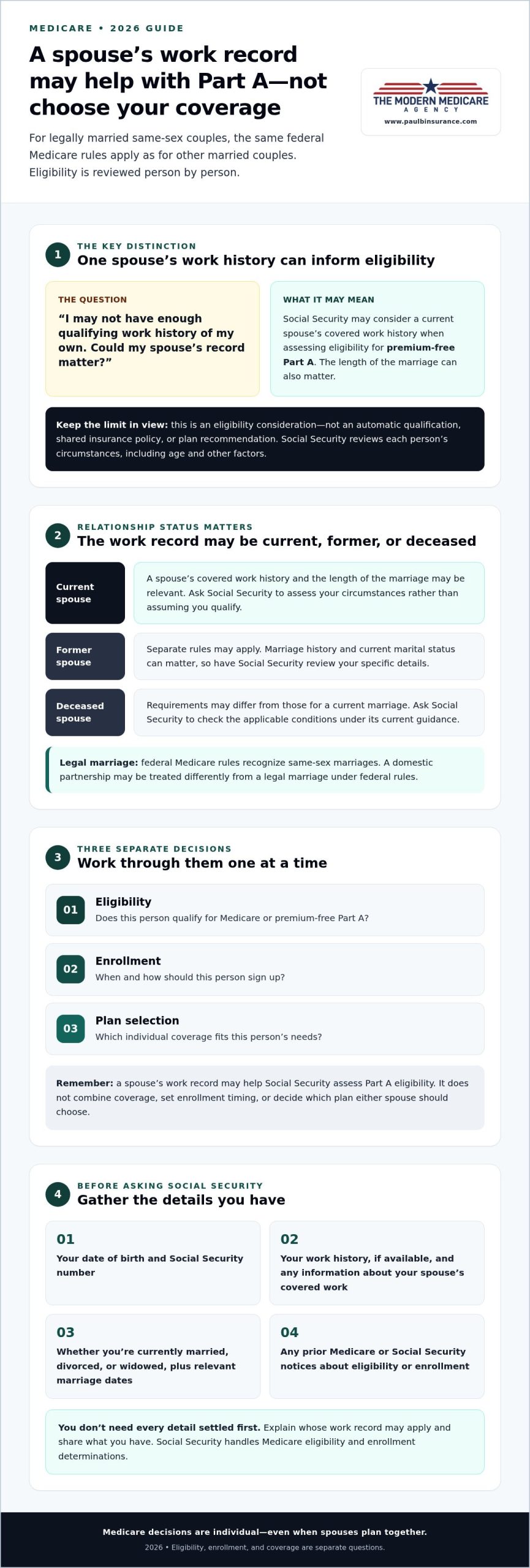
Eligibility means whether a person qualifies for Medicare or a specific part of it. Enrollment is when and how that person signs up. Plan selection means choosing coverage that fits their needs. These steps are connected, but they are not the same decision.
What does marriage change when someone becomes eligible for Medicare?
A spouse’s work history may help someone qualify for premium-free Part A, which covers inpatient hospital care. That is an eligibility question, not a shared insurance benefit. A legal marriage can be relevant to the Social Security Administration’s review, but it doesn’t mean both spouses qualify, enroll, or choose the same coverage. Each person’s circumstances still matter.
For same-sex spouses, federal recognition of marriage means that spousal Medicare rules are not limited to opposite-sex couples. The Supreme Court’s Obergefell v. Hodges decision recognized same-sex couples’ right to marry nationwide. The Supreme Court opinion provides the official legal context. Social Security assesses each person’s eligibility based on their circumstances.
Why does Medicare still treat each spouse as an individual?
Medicare eligibility, enrollment, and coverage are assessed person by person. There isn’t a joint Medicare policy that automatically covers both spouses. For example, one spouse may be ready to review their enrollment while the other is still figuring out how their own work or coverage history affects timing. You can coordinate decisions as a couple, but the decisions remain individual.
That structure can feel confusing when one spouse’s work record may help the other qualify for Part A. Keep two questions separate: whose work history is being considered, and whose Medicare coverage is being arranged? Sorting out those details first can make enrollment and plan comparisons more manageable. Next, consider how work history may affect Part A.
How a Spouse’s Work Record May Affect Medicare Part A
If your own work history doesn’t qualify you for premium-free Medicare Part A, a spouse’s record may be relevant. In 2026, same-sex spouses are considered under the same federal Medicare rules as other legally married couples. The HHS announcement on Medicare for same-sex marriages describes CMS’s policy following the Supreme Court’s marriage ruling.
Work history and plan choice are separate matters. A spouse’s record may help Social Security assess whether you qualify for premium-free Part A, but it doesn’t combine your Medicare coverage with your spouse’s or determine which plan you should choose. Your own eligibility may also depend on your age and other circumstances. Social Security handles Medicare eligibility and enrollment determinations. Its Medicare information is a starting point for understanding the process in 2026.
When might a current spouse’s work history matter?
In general, if you don’t have enough qualifying work history of your own, Social Security may consider a current spouse’s record when assessing eligibility for premium-free Part A. The spouse’s covered work history and the length of the marriage can matter. This isn’t automatic: Social Security reviews each person’s circumstances, including age and other factors that may affect Medicare eligibility. Ask Social Security to assess your record rather than assuming you qualify.
For example, one spouse may have a substantial work history while the other has worked less. The spouse with less work history can ask Social Security whether the other person’s record may help with Part A eligibility. That question doesn’t determine either person’s enrollment timing or plan selection. Address those matters separately for each spouse.
What about a former or deceased spouse’s work history?
Separate rules may apply if the work record belongs to a former spouse or a spouse who has died. The requirements may differ from those for a current marriage, and details such as marriage history and current marital status can matter. Because these situations may involve specific conditions, ask Social Security to review your circumstances under its current guidance rather than relying on a general rule of thumb.
Before you call, gather details that can help make the conversation clearer:
- Your date of birth and Social Security number.
- Your own work history, if available, and any information you have about your spouse’s covered work.
- Whether you’re currently married, divorced, or widowed, and relevant dates such as when a marriage began or ended.
- Any prior Medicare or Social Security notices related to eligibility or enrollment.
Bring what you have. You don’t need to resolve every detail before asking for guidance. Clear information about whose work record may apply can help Social Security explain the next step for your case. Once the eligibility question is clearer, a personal Medicare review can help you organize plan questions and compare individual coverage options.
Same-Sex Spouse, Domestic Partner, or Former Spouse: What’s Different?
Your relationship history can affect which work record Social Security considers when reviewing Medicare Part A eligibility. The rules may differ for a current spouse, a former spouse, a deceased spouse, or a domestic partner. Don’t assume one situation follows the same requirements as another. In 2026, describe your circumstances clearly and ask Social Security how the rules apply to your case.
Relationship status may affect a work-record assessment, but individual eligibility still needs to be established. This is useful to remember when considering medicare for same-sex married couples: federal recognition of same-sex marriage means married spouses are considered under the same applicable Medicare rules, but each person’s circumstances matter. CMS outlined its policy following the Supreme Court’s marriage ruling in its announcement on Medicare for same-sex marriages.
| Relationship situation | Question to verify with Social Security |
|---|---|
| Current spouse | Can my spouse’s work record be considered for my Part A eligibility, and what details affect the review? |
| Former spouse | Do my marriage history and current status meet the rules for consideration of my former spouse’s record? |
| Deceased spouse | Does my situation qualify for a review using my late spouse’s work record, and what records are needed? |
| Domestic partner | How does Social Security classify my relationship for this purpose, and can my partner’s record be considered? |
Does a domestic partnership work the same way as a marriage?
Not necessarily. A domestic partnership and a legal marriage are distinct relationship statuses under federal Medicare and Social Security rules. A domestic partner shouldn’t assume that their partner’s work record will be treated like a spouse’s. Explain how your partnership was established and ask Social Security how it applies to your eligibility question. The agency’s Medicare information is an official starting point.
Can a former or deceased spouse’s record be relevant?
It may be, but these situations can involve different conditions from those for a current spouse. Marriage dates, when a marriage ended, your current relationship status, and the other person’s work history may help Social Security assess your circumstances. Gather what you can, then ask which details matter. The article “Medicare Eligibility: A Clear and Simple Guide for 2026” offers broader context, while Social Security can explain how its rules apply to your personal record.
If you’ve had more than one marriage or a change in relationship status, write down the dates before seeking guidance. This can help you explain your history clearly and keep track of which person’s work record you’re asking about. You don’t need to choose a Medicare plan before clarifying eligibility.
Separate Medicare Eligibility from Enrollment and Plan Choices
Knowing that a spouse’s work record may matter is only one part of the process. It doesn’t enroll you in Medicare or choose coverage for you. In 2026, handle these as separate questions: clarify eligibility, review timing, then focus on coverage. Taking the steps in order can make the process easier to follow.
Does one spouse’s Medicare enrollment automatically enroll the other?
No. Each person needs to understand and manage their own enrollment. A spouse’s eligibility, application, or Medicare card doesn’t establish the other spouse’s enrollment. Even if you plan decisions together, check each person’s situation separately with Social Security or Medicare. Official guidance can help you understand the steps that apply to your circumstances.
One spouse may be ready to address enrollment while the other is still confirming eligibility or reviewing when to sign up. Don’t assume that one person’s timing settles the other’s. Keep separate notes, documents, and questions for each spouse.
How should couples approach individual plan decisions?
Once you understand each person’s eligibility and enrollment situation, compare coverage based on that person’s needs. You don’t have to choose matching coverage. Consider which options each person wants to review, including Medicare Advantage, Medicare Supplement (Medigap), or prescription drug coverage through Part D. These are individual coverage options, not a shared couple’s policy.
If Medicare Advantage is on your list, the Medicare Advantage guide can help you understand that plan type as you compare individual options. For Part D, consider each person’s prescription coverage needs separately and use official Medicare resources to understand applicable enrollment rules. Don’t rely on your spouse’s plan decision as a substitute for reviewing your own.
A practical way to keep the process clear is to follow these steps:
- Confirm eligibility. Ask Social Security how your own work history and, if relevant, a spouse’s record affect your eligibility. Keep the answer tied to the person whose coverage is being reviewed.
- Review enrollment timing. Check with Medicare or Social Security about when and how that individual should enroll. If you have employer or other coverage, explain those details when seeking official guidance.
- Compare individual coverage options. Once eligibility and timing are clearer, review available choices based on each spouse’s needs and preferences. Take time to ask questions before making a selection.
This sequence can make medicare for same-sex married couples easier to understand: marriage may be relevant to eligibility, while enrollment and plan choices still need individual attention. For help organizing plan questions after eligibility is clear, you can request a Medicare review.
Get Clear, Personal Medicare Guidance as a Married Couple
As you consider Medicare choices in 2026, it helps to get organized after separating eligibility questions from enrollment and plan decisions. A Medicare review can help you and your spouse put questions in order, identify useful information, and compare individual plan options. It doesn’t replace an eligibility decision from Social Security or Medicare, but it can help make the choices ahead feel more manageable.
Each spouse should have room to explain their own needs. You may be making decisions as a couple, but your health concerns, prescriptions, preferences, and Medicare details can differ. Discussing them separately helps keep one person’s questions from getting lost.
What can couples prepare before a Medicare review?
Bring the information you already have. You don’t need to resolve every eligibility question before the review. Individual notices, enrollment questions, and relevant work-history details can help organize what to ask Social Security or Medicare. It’s also useful for each spouse to share what matters most when comparing coverage.
- Medicare or Social Security notices for each spouse.
- Questions about eligibility, enrollment timing, or plan choices.
- Work-history information that may relate to an eligibility question.
- Notes about each person’s coverage priorities and concerns.
An independent broker can help organize plan questions and compare available options, while Social Security and Medicare make official eligibility and enrollment determinations. Keeping that distinction clear helps you direct each question to the right place.
How does an independent broker support plan comparisons?
Paul B Insurance, operating as The Modern Medicare Agency, is an independent Medicare broker, not a Medicare plan provider or carrier. The agency offers personalized plan comparisons across 40+ carriers and year-round support. Its initial Medicare review is free and can help you compare individual Medicare Advantage, Medigap, and Part D options while keeping eligibility questions with the appropriate government agency.
The agency’s 5-step Medicare Process is designed to make each step clear:
- Book a free consultation. Set a time to discuss your Medicare questions and what you’d like help understanding.
- Review your needs. Talk through each spouse’s concerns and priorities individually.
- Compare plans. Consider available options in light of each person’s needs.
- Enroll with confidence. Make your own informed choice about coverage and enrollment.
- Receive year-round support. Get help with Medicare questions beyond the initial review.
For medicare for same-sex married couples, the goal isn’t to make every decision together or choose matching coverage. It’s to understand the rules that may apply to each spouse, then compare individual options at a comfortable pace. If you’d like help organizing your plan questions, schedule a free Medicare review.
Take Your Next Medicare Step With Confidence
As you consider Medicare decisions in 2026, you don’t have to settle every question about medicare for same-sex married couples at once. Write down what you still need to learn, keep each spouse’s questions distinct, and take them one at a time. Social Security and Medicare are the authorities for official answers about eligibility and enrollment. For support comparing individual plan options, an independent broker can help you consider your choices without pressure.
Paul B Insurance, operating as The Modern Medicare Agency, has served 5,000+ clients served and brings 18 years of experience to Medicare guidance. A personal review can help turn your questions into a clearer path forward, with your needs at the center of the conversation.
Schedule a free Medicare review to organize your plan questions and compare individual options with support from an independent Medicare broker.
Frequently Asked Questions
Can I use my same-sex spouse’s work record to qualify for Medicare Part A?
Possibly. If your own work record doesn’t qualify you for premium-free Part A, Social Security may consider your legally married spouse’s covered work history. For medicare for same-sex married couples, marriage can make a spouse’s record relevant, but it doesn’t guarantee eligibility. Gather your own and your spouse’s Social Security information, then ask Social Security to assess your case. The decision depends on your circumstances and the applicable rules.
Does Medicare treat same-sex married couples the same as other married couples?
Generally, legally married same-sex couples are considered under the same applicable federal Medicare rules as other married couples. The Centers for Medicare & Medicaid Services described its policy in this announcement on Medicare for same-sex marriages. For current information about your eligibility or enrollment, review Social Security’s Medicare guidance or contact the agency.
Can a domestic partner’s work history help me qualify for premium-free Medicare Part A?
A domestic partnership isn’t automatically treated as a legal marriage for federal spouse-based Medicare assessments. If you’re in a domestic partnership, ask Social Security how it classifies your relationship for this eligibility question and what records it needs. This is especially useful if your relationship status or documents have changed. Don’t assume a partner’s work history applies just because you share a home or finances.
What happens to Medicare eligibility if my spouse dies?
Your spouse’s death doesn’t automatically establish your Medicare eligibility, but separate rules may apply when you ask about a deceased spouse’s work record. Social Security can review your circumstances and explain what conditions and documents matter. Before contacting the agency, gather available information about your marriage, your spouse’s work history, and any changes in your marital status. These details can help clarify what you’re asking the agency to assess.
Does my spouse’s Medicare enrollment automatically enroll me too?
No. Your spouse’s enrollment doesn’t complete your enrollment or determine your timing. Check your own Medicare notices and enrollment status, even if you and your spouse are handling paperwork together. If you’re unsure whether you need to take action, contact Social Security or Medicare with your personal details. Keeping separate records of each spouse’s correspondence can make it easier to track whose question or next step is pending.
Can same-sex married couples choose different Medicare plans?
Yes. Each spouse can review plan options based on their own needs and preferences instead of choosing matching coverage. For instance, one spouse may want to compare Medicare Advantage plans while the other looks into Medigap or Part D options. Each person should review the relevant choices and rules for their own situation. An independent Medicare broker can help you compare individual plan options without assuming both spouses need the same approach.
Should I contact Social Security or Medicare about my spouse’s work history?
Start with Social Security for questions about whether a spouse’s work history may affect your Part A eligibility. Medicare.gov can help with questions about Medicare coverage and program rules. If you’re comparing private plan options, an independent Medicare broker can help organize those questions separately from the official eligibility decision. Explaining whether you’re asking about work history, enrollment, or coverage can help direct your question to the right place.

Article by
Paul Barrett
Paul Barrett, CMIP is the founder of The Modern Medicare Agency, an independent Medicare-only brokerage based in Melville, NY. With 18 years of Medicare-exclusive experience, a CMIP designation, and more than 5,000 clients served across 37 states, Paul is one of the most credentialed independent Medicare specialists on Long Island — and one of the most direct.
He represents 40+ carriers with no quotas and no allegiances, which means his recommendations are based entirely on what fits each client's specific situation. He is the author of Medicare Mastery Unlocked and host of the Wise Guys Retirement Talk podcast. His content is grounded in primary sources, real carrier intelligence, and 18 years of watching what happens when people get Medicare right — and when they don't.
📞 631-358-5793 | paulbinsurance.com