


Medicare fraud isn’t a distant, abstract problem — it’s a direct threat to your wallet, your medical records, and your future coverage. Scammers constantly invent new ways to steal Medicare numbers and bill the federal government for services you never received. Spotting it protects the program’s finances, but just as importantly, it protects you — from corrupted medical records, surprise coinsurance bills, and exhausted equipment benefits you might genuinely need later.
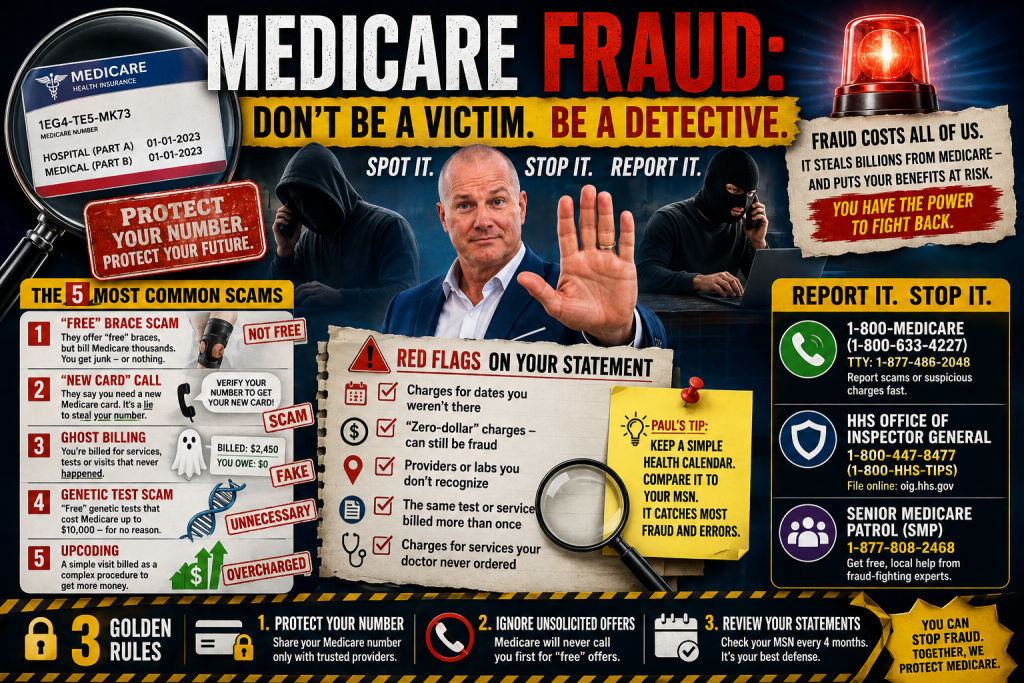
The 5 Most Common Schemes Targeting Beneficiaries
- The “free brace” DME scam. This is widely considered the single most common scheme. TV ads or robocalls offer a “free” or “government-funded” back, knee, or wrist brace. Once they have your Medicare number, they use a complicit or fake prescription to bill Medicare thousands of dollars for premium orthopedic equipment — while you receive something cheap, or nothing at all.
- The “new plastic chip card” call. A caller claims to represent Medicare and says paper cards are being replaced with “chip-embedded plastic” or “metal security cards,” asking you to “verify” your Medicare number to receive one. This is entirely fabricated — Medicare has no such program, and never calls beneficiaries unprompted to ask for your number.
- Ghost billing. A dishonest clinic or lab adds a charge for something that never happened — a complex evaluation, an ultrasound, a specialist consultation — often layered onto a real, legitimate visit so it’s easy to miss. This is only catchable by actually reading your statement.
- The genetic screening kit scam. Fraudulent operators set up “free” cheek-swab test booths at senior centers or call directly, claiming a genetic cancer or medication-response screening is fully covered by Medicare. In reality, they bill Medicare $2,000 to $10,000 for lab panels that were never medically necessary or properly ordered.
- Upcoding. A real doctor bills a routine, brief visit using a code meant for a much more complex evaluation — inflating both what Medicare pays and, often, your own deductible and coinsurance in the process.
Red Flags on Your Statement
Review your quarterly Medicare Summary Notice (MSN) or Explanation of Benefits (EOB) with these specifically in mind:
- A charge for a date you were definitely home or elsewhere — this is the clearest possible sign something’s wrong.
- The “zero-dollar” illusion. A line item can show you owe $0 and still represent a real fraud — scammers frequently write off your cost-sharing specifically so you won’t notice they billed Medicare thousands of dollars behind it. Don’t assume a $0 “you owe” line means the charge is safe to ignore.
- Unfamiliar lab or provider locations — especially in states you’ve never visited.
- Duplicate billing — the identical test or evaluation listed twice on the same date.
- Charges for anything your own doctor never discussed or ordered.
Paul’s Honest Take: That “zero-dollar illusion” point is genuinely the one I’d want every reader to remember above all the others. Most people only scan their MSN for what they owe, and skip past anything showing $0. That’s exactly the habit scammers are counting on.
Where to Report It
1-800-MEDICARE (1-800-633-4227) — the fastest route; TTY users can call 1-877-486-2048. Explain the specific line item or call in detail.
The HHS Office of Inspector General — file securely online at OIG.HHS.gov, or call the OIG Fraud Hotline at 1-800-447-8477 (1-800-HHS-TIPS).
Senior Medicare Patrol (SMP) — a nationwide network of trained volunteers, funded specifically to help beneficiaries fight fraud, at no cost. Call 1-877-808-2468 or visit SMPresource.org to reach your state’s local team for one-on-one help.
Three Golden Rules
- Treat your Medicare number like a credit card number. Only share your 11-character Medicare Beneficiary Identifier with your own doctors, pharmacists, or official plan representatives — never with someone who called or approached you first.
- Never accept medical advice, equipment, or tests from a telemarketer. Medicare does not make unsolicited calls to offer supplies or “free” screenings. Watch specifically for high-pressure phrases like “verify your number to ship your new card” or “your benefits will be suspended if you don’t update your file today” — both are scam scripts, not real Medicare procedures.
- Keep a simple health calendar. Jot down the date every time you actually see a doctor or get lab work. When your MSN arrives, compare it line by line against your own notes — this single habit catches the overwhelming majority of both fraud and honest billing errors.
A Related Warning: Deceptive Sales Tactics During Enrollment
Fraud isn’t only about stolen numbers — it’s worth being alert to aggressive or misleading sales tactics during Medicare’s fall enrollment window too:
- “Cherry-picking” perks — a pitch that leads with attractive extras (like a grocery or gas card allowance) while glossing over a restrictive network or a high out-of-pocket maximum.
- Pre-approval traps — a broker who doesn’t mention that your specific medications or ongoing therapies will require prior authorization under the new plan.
- Vague network promises — “your doctor should accept this plan,” without an actual, specific, line-by-line network check.
This isn’t the same category as outright fraud, but the same instinct applies: verify specifics yourself rather than taking a broad assurance at face value.
Fraud, By the Numbers
If you want the fuller picture behind these warnings — what fraud actually costs, whether enforcement is working, and who’s really behind it — here’s the verified context.
What it actually costs. You’ll see “$60 billion a year” thrown around for Medicare fraud, but it’s worth being precise. The verified GAO figure is that Medicare improper payments — a broader category that includes fraud, but also honest documentation and billing errors — totaled $54.3 billion in 2024. KFF is explicit that improper payments and fraud are not the same thing; a lot of that reflects paperwork problems, not criminal intent. Broken down by program: Medicare Advantage (Part C) had a 6.09% improper payment rate (23.67billion),traditionalfee-for-serviceMedicare(PartsA&B)cameinat6.55%(28.83 billion), and Part D was at 4.00% ($4.23 billion).
Enforcement is genuinely working. In 2023 and 2024, CMS’s data analytics flagged unusual billing spikes from 15 durable medical equipment suppliers who had collectively billed Medicare more than $4.2 billion for urinary catheters that patients never ordered, needed, or received — one case within a broader $11.9 billion in fraudulent payments blocked between FY2022 and FY2024. Total Medicare program integrity savings rose 59% in a single year, from $26.3 billion in FY2024 to a record $41.9 billion in FY2025, with a return on investment of $22.30 saved for every $1 spent — the highest ratio ever recorded.
Most fraud isn’t committed by patients. A July 2026 KFF poll found that 53% of voters correctly attribute Medicare fraud primarily to providers, billing operations, and institutional networks, while only 13% blame individual patients. The same polling found just 36% of voters believe there’s “a lot” of fraud in Medicare at all — suggesting most people underestimate the scale of the problem even while correctly identifying where it mostly comes from.
How much gets tracked each year. Senior Medicare Patrol volunteers handled over 270,000 individual counseling sessions with or on behalf of beneficiaries in the most recent full reporting year, resulting in more than $111 million in expected Medicare recoveries. HHS-OIG permanently excludes corrupt providers from billing federal health programs at a pace of roughly 1,200 exclusions every six months as of early 2026 — annualizing to somewhere in the 2,400–3,600 range, though that pace has actually been declining over the past two years, which OIG attributes partly to reduced staffing. Worth noting: not every fraud statistic circulating online is independently verifiable — treat very precise-sounding numbers with some skepticism unless they cite a specific, checkable government report.
Paul’s Honest Take: Here’s what I want you to take from all these numbers: you’re not the primary suspect, you’re one of the best lines of defense, and the system catching this fraud is getting sharper every year. Calls to 1-800-MEDICARE were literally part of what tipped investigators off to the catheter scheme above. Reading your statement and reporting something that looks off isn’t paranoia — it plugs directly into a detection network that’s demonstrably working.
Frequently Asked Questions
If I report something and it turns out to be an honest mistake, will I get in trouble? No — reporting a suspicious charge in good faith is exactly what these hotlines and SMP exist for. Honest errors get corrected; you’re never penalized for asking.
What if I gave my Medicare number to someone I now think was a scammer? Contact 1-800-MEDICARE right away to flag the potential exposure, and consider requesting a new Medicare number if fraudulent billing is confirmed.
Does Medicare ever call me directly for any reason? Essentially never unsolicited. If you’ve specifically requested a callback or are already working with a Medicare representative on an existing issue, that’s different — but a cold call asking you to “verify” your number is always a red flag.
Can a caregiver or adult child help monitor for fraud on my behalf? Yes, and this is one of the most practical ways to protect an aging parent — with proper account access, a caregiver can review MSNs directly and watch for the same red flags.
Is Medicare Advantage just as vulnerable to fraud as Original Medicare? Yes, though the specific schemes and the document you’d review differ — Medicare Advantage members should scrutinize their Explanation of Benefits (EOB) with the same care Original Medicare beneficiaries give their MSN.
Am I likely to be blamed if fraud happens using my Medicare number? No — the data is clear that the overwhelming majority of Medicare fraud is committed by providers and organized billing operations, not patients. Reporting a suspicious charge protects you; it doesn’t implicate you.
The Bottom Line
Most Medicare fraud isn’t especially sophisticated — it relies on a stolen number, an unsolicited phone call, and a beneficiary who never checks their statement closely. The single most effective thing you can do is genuinely simple: never give your Medicare number to anyone who contacts you first, and actually read your MSN or EOB against your own memory of what care you received. If something looks wrong, report it — the hotlines exist precisely for that, and reporting protects both the program and your own future coverage.
Related Reading
- What Is a Medicare Summary Notice and How to Read It
- The Medicare Card: What It Looks Like and What to Do If You Lose It
- Medicare Appeals: The 5 Levels Explained
- Medicare Assignment: What “Accepting Medicare” Really Means
Sources:
- KFF — Medicare Program Integrity and Efforts to Root Out Improper Payments, Fraud, Waste and Abuse
- Senior Medicare Patrol — SMP Resource Center
- HHS Office of Inspector General — Report Fraud
- Medicare.gov — Protect Yourself from Medicare Fraud
- GAO — Medicare: CMS’s Use of Data Analytics to Identify and Prevent Fraud (GAO-26-107799)
- CMS — Crushing Fraud, Waste & Abuse
- KFF — Public Views on Fraud in Government Health Programs
- ACL/SMP — 2023 Performance Data for the Senior Medicare Patrol Projects
- HHS-OIG — Spring 2026 Semiannual Report to Congress
This article is for educational purposes and reflects current Medicare fraud patterns as of 2026. If you’re looking at a suspicious charge right now or just received a call that felt off, call us at 631-358-5793 — we’re happy to help you figure out next steps. No pressure, no cost.