By Paul Barrett, CMIP | The Modern Medicare Agency | Melville, NY Published: July 2026
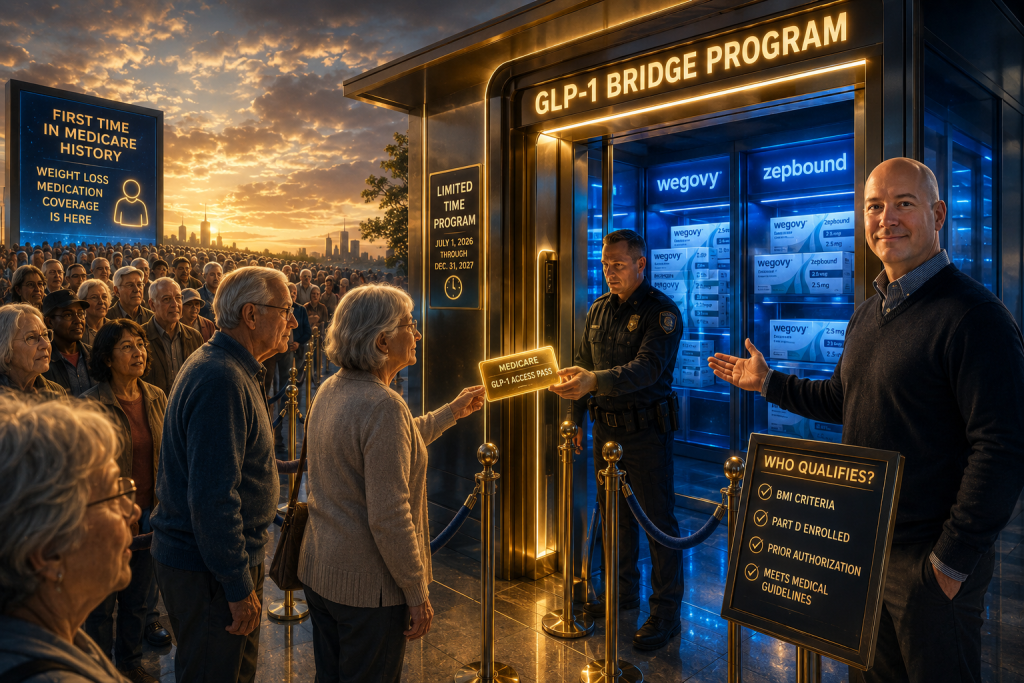
Something historic happened on July 1, 2026.For the first time in Medicare’s 60-year history, the program began helping pay for medications prescribed specifically for weight loss. If you’ve been struggling with obesity and watching friends or family members on Wegovy or Zepbound while your Medicare card sat there useless for this purpose — that changes today.
It’s genuinely good news. But after 18 years of helping people navigate Medicare, I’ve learned that “good news” in this program almost always comes with a list of asterisks underneath it. And this one has several worth knowing before you call your doctor.
Let me give you the honest, complete picture.
What Just Started — and Why It Matters
The program is called the Medicare GLP-1 Bridge. It’s a CMS demonstration project — think of it as a federally authorized pilot program — that runs from July 1, 2026, through December 31, 2027. Eighteen months.
It allows eligible Medicare Part D enrollees to access certain GLP-1 weight loss medications for a flat $50 monthly copay — compared to the cash price of these drugs, which typically runs anywhere from $149 to $699 per month even with manufacturer discounts.
Here’s why this is genuinely significant: federal law currently prohibits Medicare from covering weight loss medications. This hasn’t changed. What CMS did is use a specific legal authority to run a demonstration project outside the normal Medicare Part D coverage rules. It’s a workaround — a legal, deliberate, federally authorized workaround — but a workaround nonetheless.
That distinction matters, and I’ll explain why in a moment.
By the Numbers: The GLP-1 Story in Medicare
This is the data that puts everything in context. Before we get into the program details, I want you to understand the scale of what we’re talking about.
Who is currently on GLP-1 drugs through Medicare:
|
Number |
Annual Cost |
|
|---|---|---|
|
Medicare beneficiaries on GLP-1s for diabetes/cardiovascular (Part D) |
~21.8 million claims in 2024 |
$27.5 billion gross spending |
|
Medicare beneficiaries on GLP-1s specifically for weight loss |
Effectively zero — until July 1, 2026 |
N/A — was illegal |
|
Medicare beneficiaries who qualify for the Bridge program |
3.8 million (KFF estimate) |
$50/month each under Bridge |
|
Medicare beneficiaries who meet BMI criteria but may not qualify due to other restrictions |
9.7 million enrolled in Part D |
— |
|
Medicare beneficiaries estimated overweight/obese overall |
13+ million |
— |
|
Estimated potential eligible population (Novo Nordisk/Eli Lilly estimate) |
15–20 million |
— |
Sources: KFF analysis of 2023 Part D data; CMS 2024 Medicare Part D spending report
The age gap — why this matters:
One of the most striking statistics in the entire GLP-1 story is this: adults aged 50–64 use GLP-1 medications at a rate of 22%. Adults aged 65 and older — Medicare beneficiaries — use them at only 9%. That’s less than half the rate. The reason is almost entirely Medicare’s prior
coverage exclusion. People who age into Medicare at 65 have been losing access to drugs they were already taking — a phenomenon sometimes called the “Medicare cliff” for GLP-1 users.
The spread between studies is wide — $18 billion to $245 billion — because the assumptions differ enormously (drug prices, adherence rates, how long people stay on the drugs, and which downstream conditions are prevented). But the direction of the research is consistent: treating obesity in Medicare beneficiaries reduces spending on diabetes, heart disease, kidney disease, stroke, and joint replacement — all of which are major Medicare cost drivers.
What the Bridge program itself costs:
|
Participation Rate |
Estimated Cost to Medicare |
|---|---|
|
10–25% of eligible 3.8M beneficiaries participate |
$1.3 billion – $3.3 billion total |
|
50–75% of eligible 3.8M beneficiaries participate |
$6.7 billion – $10 billion total |
|
Net price per month per beneficiary (manufacturer deal) |
$245 (beneficiary pays $50, Medicare pays $195) |
Source: KFF analysis, May 2026
Which Drugs Are Covered
Three medications are covered under the Bridge — and only these three:
- Wegovy® (semaglutide) — both the injection and the new tablet form
- Zepbound® KwikPen® (tirzepatide) — the KwikPen formulation only
- Foundayo® (oral semaglutide, FDA-approved April 2026)
What is NOT covered:
- Ozempic® — not included (it’s covered separately through Part D for diabetes)
- Mounjaro® — not included (same — Part D covers it for diabetes)
- Zepbound single-dose vial or single-dose pen — only the KwikPen formulation qualifies
If your doctor has been prescribing you Ozempic or Mounjaro for Type 2 diabetes, that stays exactly where it is — covered through your Part D plan as it always has been. The Bridge is a separate track, specifically for weight management in people who don’t already have a Medicare-covered indication for these drugs.
What the drugs cost without the Bridge:
|
Access Method |
Monthly Cost |
|---|---|
|
Cash price (Wegovy/Zepbound, full retail) |
$1,000–$1,300+ |
|
Manufacturer savings programs |
$149–$699 |
|
GoodRx coupon (Wegovy pill) |
~$149/month |
|
Compounded GLP-1 versions (tirzepatide) |
$200–$400 |
|
Medicare GLP-1 Bridge (starting July 1, 2026) |
$50 flat |
What obesity costs Medicare — and what treating it could save:
This is the number that makes the case for why CMS is doing this at all — and why the CMS director told the Aspen Institute the program is expected to be “a material cost-saver”:
|
Study/Source |
Projected Savings from GLP-1 Weight Loss Coverage |
|---|---|
|
JAMA study (University of Chicago, 2025) |
$18.2 billion in healthcare savings over 10 years from treating 30M eligible beneficiaries |
|
MedRxiv peer-reviewed analysis (2025) |
$175.6 billion to $245.1 billion in gross cost savings to Medicare over 10 years, with diabetes prevalence falling 5.5%–9% |
|
CMS Administrator Dr. Oz statement (June 2026) |
Bridge program expected to be “cost-neutral over 24 months” and a “material cost-saver” when health improvements are included |
|
Congressional Budget Office (prior full coverage estimate) |
Full Medicare obesity coverage would cost $35B over 2026–2034, but savings from prevented conditions would partially offset |
Do You Qualify? The Clinical Criteria
This isn’t available to every Medicare beneficiary. There are specific medical criteria, and your doctor must verify them through a prior authorization process.
To qualify, you must be enrolled in a Medicare Part D plan (standalone PDP or a Medicare Advantage plan with drug coverage), and your provider must attest that you meet one of the following BMI-based criteria when you first started GLP-1 therapy:
If your BMI was 27 or higher when you started a GLP-1, you must also have one of:
- Prediabetes
- Previous heart attack
- Previous stroke
- Symptomatic peripheral artery disease
If your BMI was 30 or higher when you started a GLP-1, you must also have one of:
- Heart failure with preserved ejection fraction
- Uncontrolled hypertension
- Chronic kidney disease (stage 3a or above)
One important detail on BMI timing: Your BMI is evaluated at the time you first started GLP-1 therapy — not necessarily today. If you started Wegovy two years ago with a BMI of 38 and have since lost weight, your prescriber attests to your BMI when therapy began. This protects people who have already been taking these medications and have made real progress.
Who is NOT eligible:
- Beneficiaries already receiving a GLP-1 through Medicare Part D for a covered condition (diabetes, sleep apnea, cardiovascular disease) — the Bridge is specifically for weight management only, and you can’t double-dip
- Beneficiaries in private fee-for-service plans, PACE organizations, or certain other plan types (check with your plan)
- Low-income subsidy (Extra Help) recipients — more on this below
An estimated 3.8 million Medicare beneficiaries meet the eligibility criteria nationally, according to KFF analysis.
How the $50 Copay Actually Works — The Part Nobody Is Explaining Clearly
This is where I need to slow down and be direct with you, because the $50 copay comes with some fine print that materially changes what it means for certain people.
The $50 copay does NOT count toward your Part D deductible.
The $50 copay does NOT count toward your $2,100 annual out-of-pocket cap on prescription drug costs.
The $50 copay is NOT eligible for the Medicare Prescription Payment Plan (the program that lets you spread drug costs over the calendar year).
If you receive Medicare Extra Help (Low-Income Subsidy), your subsidy does NOT apply to Bridge program drugs. You pay the full $50. For someone on a $750/month Social Security income, $50 a month is not a small amount — it’s a real financial decision that deserves honest conversation.
The reason for all of this is structural: the Bridge operates outside the normal Part D benefit. Because it’s not technically a Part D drug, none of the Part D financial protections apply to it. The government is directly funding these drug costs through the demonstration, but the consumer-facing copay protections don’t follow.
This doesn’t make the program bad. For most people, $50/month versus $400–$700/month cash is a life-changing difference. But you deserve to know exactly what you’re signing up for before you start.
How to Actually Get the Medication — The Prior Authorization Process
Here’s what’s important to understand about how the Bridge works operationally, because it’s different from how your Part D plan normally works:
Your doctor does not submit a prior authorization to your Medicare Advantage plan or your PDP. The Bridge operates through a central CMS processor — a single national system that handles all prior authorization requests, claims, and pharmacy payments outside of your normal plan.
Here’s the process:
You talk to your doctor and confirm you meet the clinical criteria
- Your doctor submits a prior authorization request to the CMS central processor (electronically or by fax using the Medicare GLP-1 Bridge PA form)
- Once approved, your doctor sends a prescription to a participating pharmacy
- The pharmacy processes the claim through a specific BIN/PCN code — different from your regular Part D card
- You pay your $50 copay at the pharmacy
Important for both patients and providers: Because this program just launched July 1, many doctor’s offices and pharmacies are still getting up to speed on the new workflow. If your doctor’s office has never processed a Bridge program prior authorization before — which is almost certainly true since it literally started today — there may be some adjustment time. Be patient with your provider’s staff, and make sure they understand the prior authorization goes to the central processor, not to your plan.
The Elephant in the Room: What Happens After December 2027?
I said at the top that this news comes with asterisks. Here’s the biggest one.
The Bridge was originally designed to be exactly that — a bridge. Six months of access while a longer-term program called the BALANCE Model (Better Approaches to Lifestyle and Nutrition for Comprehensive Health — yes, that’s the actual name) was being developed to make GLP-1 coverage permanent in Medicare starting January 2027.
In April 2026, the BALANCE Model was shelved indefinitely. Not enough insurance companies volunteered to participate. A study had found the program would cost insurers billions in the first year, and the voluntary opt-in deadline passed without enough sign-ons. CMS responded by extending the Bridge from 6 months to 18 months — buying time while they figure out what comes next.
What happens in January 2028?
Honestly — nobody knows yet. The options are:
- CMS extends the Bridge further (would require additional legal authority)
- Congress passes legislation making GLP-1 obesity coverage permanent in Medicare (unlikely in the near term given the cost)
- The program ends and beneficiaries lose access to the $50 copay
-
Most GLP-1 research shows that the majority of people who stop taking these medications regain significant weight — sometimes most of what they lost. If you start Wegovy in August 2026 and lose 40 pounds by December 2027, then the program ends and you can no longer afford the drug at cash price — that’s a real medical and financial problem.
I’m not saying don’t participate. I’m saying: go in with eyes open. Have a conversation with your doctor about what a long-term plan looks like, not just the first 18 months.
-
The Part D / Bridge Interaction — Don’t Make This Common Mistake
A few important reminders for people already on GLP-1 medications through Medicare:
If you’re currently taking Ozempic or Mounjaro for Type 2 diabetes through your Part D plan — stay where you are. Those drugs are covered for their approved diabetes indication through your normal plan. The Bridge is not for you and trying to switch tracks could disrupt your coverage.
If you’re currently taking Wegovy or Zepbound for weight loss and paying out of pocket — the Bridge was designed for exactly your situation. Talk to your doctor about getting prior authorization submitted through the new CMS system.
If you’re currently taking Wegovy or Zepbound through an employer plan or commercial insurance and are approaching Medicare eligibility — this is actually one of the biggest concerns in the Medicare/GLP-1 space right now. Many people lose their GLP-1 coverage when they transition to Medicare at 65. The Bridge helps with this — but only for the 18-month window, and only if you meet the clinical criteria.
-
My Honest Assessment
I’ve been helping Medicare beneficiaries make important coverage decisions for 18 years. Here’s what I actually think about the Medicare GLP-1 Bridge:
It’s real, it’s significant, and it helps real people. Three million-plus Medicare beneficiaries who have been managing obesity without pharmaceutical support now have access to clinically proven medications at a price that is actually accessible. That matters. Obesity is connected to more than 200 chronic conditions. Reducing it has downstream effects on heart disease, kidney
-
disease, diabetes, and dozens of other conditions that drive up Medicare costs and reduce quality of life.
The caveats are real too. The program is temporary. The $50 copay doesn’t count toward your financial protections. Extra Help recipients don’t get a break. The prior authorization process is brand new and operationally still being figured out. And there’s no clear path to what happens after December 2027.
What I’d tell a family member: If you’re eligible, talk to your doctor immediately. Get the prior authorization process started. Take advantage of the access while it exists. But don’t make lifestyle or health decisions based on the assumption that this coverage will be there indefinitely — because as of today, it won’t be.
And if you’re not sure whether you qualify, or you have questions about how the Bridge interacts with your current Medicare plan, your Part D coverage, or your existing medications — that’s exactly the conversation I’m here to have.
-
Summary: The GLP-1 Bridge at a Glance
Detail
What You Need to Know
Program dates
July 1, 2026 – December 31, 2027
Monthly copay
$50 flat — regardless of drug or dose
Covered drugs
Wegovy, Zepbound KwikPen, Foundayo only
NOT covered
Ozempic, Mounjaro, Zepbound vial/pen
Counts toward Part D deductible?
❌ No
Counts toward $2,100 OOP cap?
❌ No
Extra Help applies?
❌ No
Who processes the PA?
CMS central processor — NOT your plan
Estimated eligible beneficiaries
~3.8 million nationally
What happens after Dec 2027?
Unknown — no guaranteed extension
Questions? Let’s Talk.
If you or someone you care about might be eligible for the Medicare GLP-1 Bridge — or if you’re not sure how it interacts with your current coverage — I’m happy to walk through it with you. No charge, no pressure, no sales pitch. Just a straight conversation.
Paul Barrett, CMIP The Modern Medicare Agency 📞 631-358-5793 ✉️ medicare@paulbinsurance.com 🌐 paulbinsurance.com 📍 445 Broad Hollow Rd, Melville, NY 11747
Sources:
- CMS Medicare GLP-1 Bridge — Official Program Page
- CMS Medicare GLP-1 Bridge — Information for Providers
- AARP — Medicare $50 GLP-1 Weight Loss Bridge Program
- NPR — Medicare Bridge GLP-1 Drugs $50 Copay
- CBS News — Medicare GLP-1 Coverage Starting July 1
- CNBC — Medicare Obesity Drug GLP-1 Coverage Starting July 1
- CNN — Medicare Will Start Covering Weight Loss Drugs July 1
- Medicare Rights Center — GLP-1 Weight Loss Drug Demonstration
- KFF — What to Know About the BALANCE Model and Medicare GLP-1 Bridge
- KFF — Nearly Four Million Medicare Beneficiaries Could Be Eligible for the Bridge
- KFF Health News — A New Medicare Option for Weight Loss Drugs
- Forbes Health — GLP-1 Statistics and Trends 2026
- AJMC — What You Need to Know Before the Medicare GLP-1 Bridge Goes Live
- JAMA/University of Chicago — Fiscal Impact of Expanded Medicare GLP-1 Coverage (2025)
- MedRxiv — Proposal for Value-Based GLP-1 Agreement in Traditional Medicare (2025)
-
disclaimer: The Modern Medicare Agency is not connected with or endorsed by the United States government or the federal Medicare program. This article is for educational purposes only and does not constitute medical or insurance advice. Medicare program details are subject to change. Consult your physician regarding clinical eligibility and your licensed Medicare broker regarding plan coverage interactions.