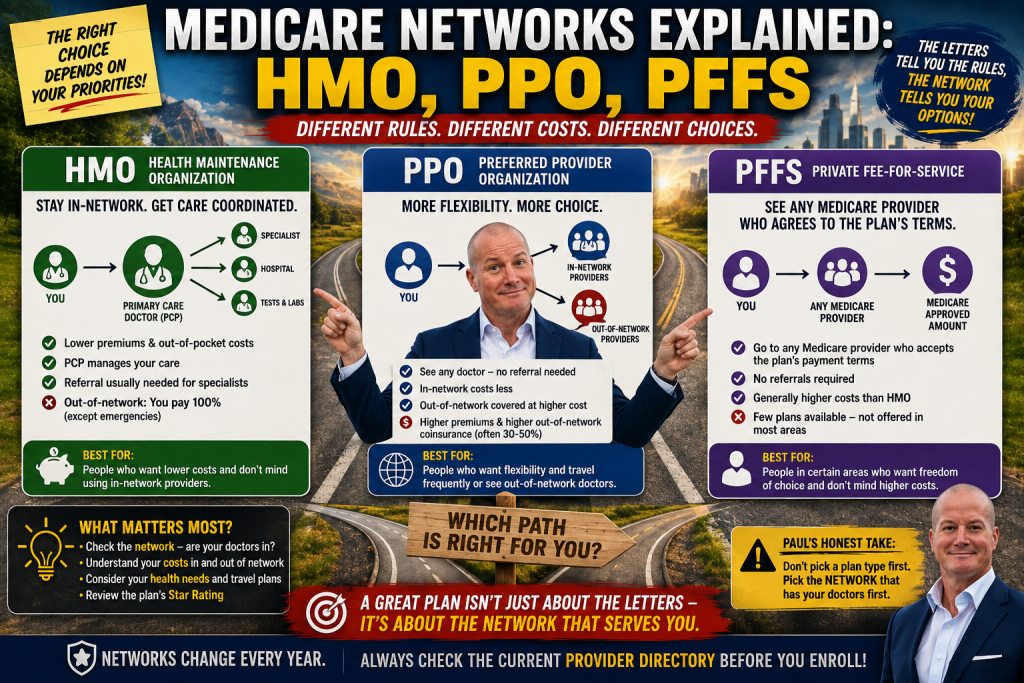
If you’ve started comparing Medicare Advantage plans, you’ve probably run into these letters over and over: HMO, PPO, HMO-POS, and sometimes PFFS. They’re not just fine print — they determine which doctors you’re allowed to see, whether you need a referral, and what happens to your wallet if you step outside the network. Here’s what each one actually means in practice.
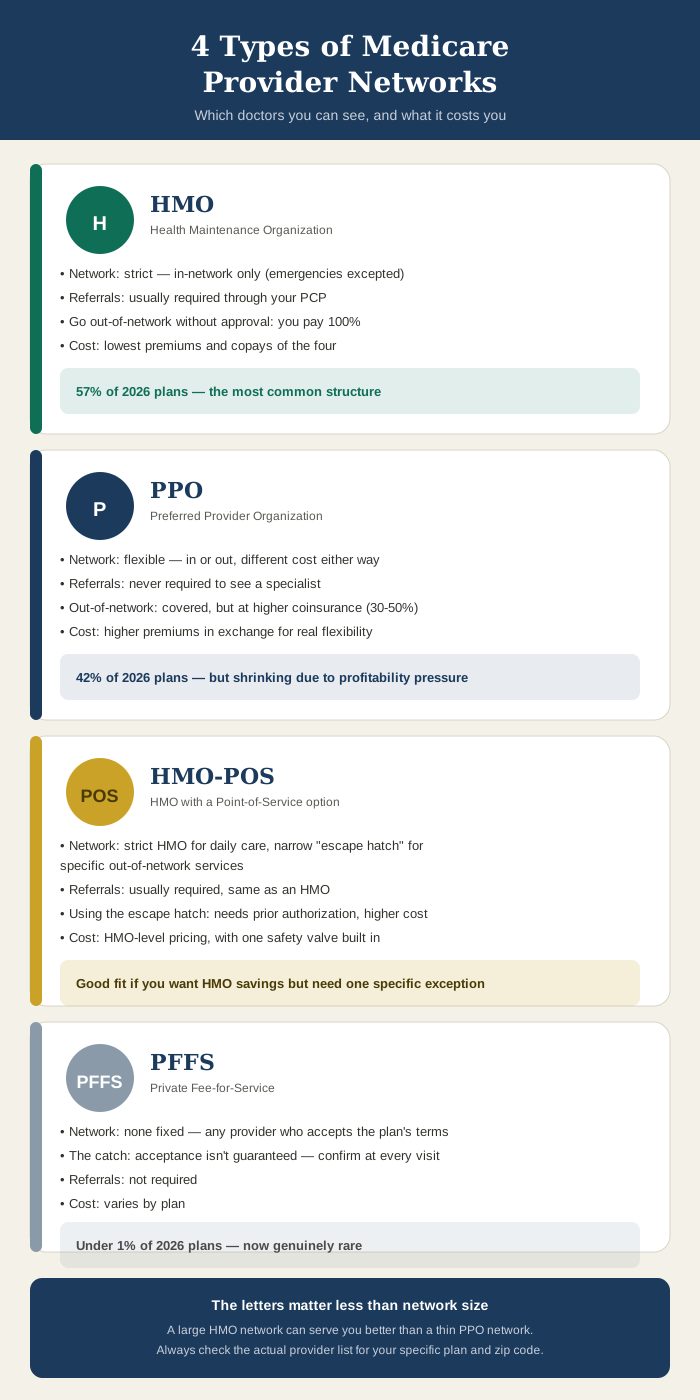
The Four Types at a Glance
The Letters Matter Less Than Network Size
Before going deeper into what each acronym means, here’s the point that actually matters most, and it’s easy to miss: the letters tell you the rules, but they don’t tell you how many doctors you’ll actually have access to.
An HMO with a large, well-built network can genuinely serve you better than a PPO with a thin one — even though the HMO “restricts” you to its network and the PPO technically lets you go anywhere. If that HMO includes thousands of local doctors and specialists, you may never feel restricted at all in practice. Meanwhile, a PPO’s out-of-network flexibility is only as useful as your willingness to pay the higher coinsurance every time you use it — and if its in-network list is small, you could end up paying those higher out-of-network rates constantly just to see anyone convenient.
The same logic applies to HMO-POS plans. The “escape hatch” to go out-of-network sounds appealing on paper, but if the plan’s core network is tiny, that escape hatch is doing a lot of load-bearing work — and you’re relying on it, and its prior-authorization process, far more often than you’d like.
Paul’s Honest Take: This is the thing I wish more people understood before they pick a plan type and stop looking any further. Don’t ask “is this an HMO or a PPO” as your first question — ask “how many doctors near me actually participate in this specific plan.” A large network under a restrictive HMO structure will usually serve you better day-to-day than a small network under a flexible PPO structure. The letters describe the rules of the road; the network size describes how far that road actually goes. Always check the actual provider directory for your specific plan before you enroll, not just the plan type.
HMO: Health Maintenance Organization
HMOs are the most common structure in Medicare Advantage — 57% of all plans offered in 2026 are HMOs, though that share has actually shrunk from 71% back in 2017 as PPOs have gained ground.
How it works: You choose a primary care physician (PCP) from the plan’s network, and that doctor becomes your care coordinator. Need a specialist? Your PCP typically issues the referral. Stay within the network, and this system runs smoothly and affordably.
The catch: Go outside the network for something that isn’t a true emergency, and you’re generally responsible for 100% of the cost — not a higher copay, the entire bill. This is the detail that catches people off guard most, especially if they assumed “out-of-network” just meant “a bit more expensive,” the way it often does with employer insurance.
Why people choose it anyway: HMOs typically carry the lowest premiums and lowest out-of-pocket costs of the three types. If your current doctors are already in-network and you’re comfortable with a coordinated-care structure, an HMO is often the most cost-effective choice available.
PPO: Preferred Provider Organization
PPOs have grown fast — from just 17% of plans in 2017 to 42% in 2026 — largely because they solve the biggest complaint people have about HMOs: rigidity.
How it works: You can see any provider, in-network or out, without a referral. In-network care costs less, as you’d expect, but out-of-network care is still covered, just at a higher cost-sharing rate rather than being your full responsibility.
The trade-off: That flexibility isn’t free — PPO premiums typically run higher than HMO premiums for comparable coverage, and out-of-network coinsurance can run considerably higher than the in-network rate — commonly landing somewhere in the 30–50% range, depending on the specific plan, versus a modest flat copay for staying in-network.
Why people choose it: Frequent travelers, people who split time between two states, or anyone with a specific out-of-network specialist they’re not willing to give up tend to gravitate toward PPOs. Emergency and urgent care are always covered regardless of network status, on either plan type — that part doesn’t change.
Referral Rules Aren’t as Uniform as They Used to Be — Check the Specific Plan
For years, “HMO means you need a referral, PPO means you don’t” was a safe generalization. That’s gotten less reliable — referral requirements have genuinely started varying more by specific plan and carrier rather than following the old, simple HMO-vs-PPO rule. If a referral requirement would be a dealbreaker for you, the smart move isn’t to assume based on the plan type — it’s to confirm directly for the specific plan you’re considering.
Worth watching closely for 2026: some of the largest carriers are actually moving in the opposite direction from a “referrals are disappearing” trend. UnitedHealthcare, for example, is reinstating referral requirements for most of its HMO and HMO-POS members in 2026, explicitly describing it as bringing these plans “back in line with how a traditional HMO was designed to work” — with unreferred claims facing denial starting mid-2026. If referrals matter to you, check this specifically and don’t assume last year’s plan rules still apply this year, even with the same carrier.
Meanwhile, PPOs themselves are shrinking — and it’s about profitability, not popularity. It’s becoming genuinely harder for insurers to run a profitable PPO in Medicare Advantage. The out-of-network flexibility that makes PPOs attractive to consumers is exactly what makes them expensive to operate — carriers lose the cost control that comes from a negotiated, closed network. Going into 2026, PPO plan closures ran at roughly 12% year-over-year, notably outpacing HMO closures, and several major carriers have specifically cited this dynamic as they shift toward favoring HMO and HMO-POS designs going forward. If you’re specifically counting on PPO flexibility, it’s worth confirming your plan is stable rather than assuming it’ll be offered indefinitely.
Paul’s Honest Take: Most people are genuinely unfamiliar with how HMOs and PPOs actually differ, and HMOs carry an outdated stigma from years ago when referrals and gatekeeping were universal. That’s not automatically true anymore — but it’s also not automatically false, and it can change year to year even within the same carrier. The only reliable answer is to check the specific plan you’re looking at, every single year, rather than relying on what you remember about HMOs in general.
HMO-POS: The Hybrid Option
An HMO-POS earns its own section rather than a footnote, because it’s genuinely a distinct choice, not just a variant of an HMO.
How it works: For the vast majority of your care — your PCP, standard labs, local hospital visits — an HMO-POS behaves exactly like a strict HMO: you need a PCP, you need referrals, and you stay in-network. The difference is a deliberate, narrow “escape hatch”: the plan spells out specific circumstances where you’re permitted to go out-of-network — for example, a highly specialized surgery your local network genuinely can’t provide.
The catch: Using that escape hatch typically requires prior authorization from the plan before treatment, and it usually comes with a higher deductible or copay than staying in-network would. Think of it as HMO pricing for daily life, with a narrow safety valve for the rare situation your local network can’t cover — not full PPO-style freedom.
PFFS: Private Fee-for-Service
This one used to be far more common, and it’s worth understanding why it mostly isn’t anymore.
How it works: In theory, a PFFS plan lets you see any Medicare-approved provider who agrees to accept the plan’s payment terms — no fixed network, no referral required. Some PFFS plans layer a network on top anyway; others operate genuinely network-free.
The real catch: Provider acceptance is never guaranteed. Since there’s no contracted network, a provider can simply decline to accept the plan’s terms for a given visit — which means you need to confirm participation before every single appointment, not just once when you enroll. A doctor’s office might accept your PFFS plan’s terms this month and decline them the next time you call, if they’ve decided the reimbursement rate no longer works for them. The honest way to think about it: you’re not asking “are they in my network,” you’re asking “will they say yes today” — every single time.
Why they’re rare today: Federal network-adequacy requirements introduced in the years after PFFS plans first became popular pushed most insurers to convert these plans into standard HMO or PPO networks instead. Today, PFFS plans make up under 1% of the Medicare Advantage market — you’ll likely encounter the term in older materials or occasional niche plans, but it’s rarely anyone’s first or best option in 2026.
Paul’s Honest Take: If you come across a PFFS plan today, it’s worth asking directly why that structure is still being offered in your area — it’s uncommon enough that I’d want to understand the specific reasoning before recommending one over a standard HMO or PPO.
One More Related Term Worth Knowing
Special Needs Plans (SNPs): Not a network type on their own — SNPs are built around specific populations (chronic conditions, dual Medicare/Medicaid eligibility, or institutional care) and can be structured as either HMO or PPO underneath.
The Decision, Simplified
Choose an HMO if:
- You want the lowest possible monthly cost, and you’re comfortable with that trade-off
- Your current doctors and hospital are already in the plan’s network
- You don’t mind seeing your PCP first to get a referral before a specialist visit
Choose a PPO if:
- You want the freedom to see any Medicare-accepting doctor without network restrictions
- You’d rather skip the PCP-as-gatekeeper structure and book specialists directly
- You travel frequently, split time between states, or have a specific doctor you’re not willing to leave
Choose an HMO-POS if:
- You want HMO-level pricing for your everyday care
- There’s a real chance you’ll need one specific kind of specialized care your local network doesn’t offer
- You’re comfortable navigating a prior-authorization step for that one exception, rather than having full PPO-style freedom everywhere
In short: the HMO is best for your wallet, provided you’re willing to follow its network rules. The PPO is best for your peace of mind, provided you’re willing to pay somewhat more for that freedom. HMO-POS splits the difference for people who mostly want HMO savings but need one specific door left open.
One last reminder before you decide: none of this advice matters as much as checking the actual network size and provider list for the specific plan you’re considering, in your specific zip code. A “good on paper” plan type with a thin local network can serve you worse than a “restrictive” plan type with a deep one.
Frequently Asked Questions
Should I pick my plan type first, or check the network first? Check the specific plan’s provider directory first, for your own doctors and local area, before you commit to a plan type in the abstract. A large HMO network can serve you better than a thin PPO network, even though the PPO technically allows more flexibility on paper.
Can I switch between an HMO and a PPO whenever I want? Only during specific windows — the fall Annual Enrollment Period (October 15 – December 7) or the Medicare Advantage Open Enrollment Period (January 1 – March 31), same as switching any Medicare Advantage plan.
Do all HMO plans absolutely require a referral? Not as uniformly as they used to — this now varies by specific plan and carrier rather than following a blanket rule, and it can even change year to year within the same carrier. Always confirm the specific plan’s current referral rules directly rather than assuming based on what HMOs have historically required.
If I’m in a PPO, is out-of-network care the same price as in-network? No — it’s covered, but typically at a meaningfully higher coinsurance or copay than staying in-network. Check the plan’s Evidence of Coverage for the exact out-of-network cost-sharing structure before assuming it’s a minor difference.
Is a PFFS plan ever a good choice? It can be, in specific niche situations — but given how rare and how uncertain provider acceptance can be, it’s worth a direct conversation about why that structure fits your situation better than a standard HMO or PPO before enrolling.
Does my Medicare Advantage MOOP work the same regardless of network type? Yes — the legal out-of-pocket cap applies across plan types, though PPOs often have two separate MOOP figures: one for in-network costs, and a higher combined figure that includes out-of-network spending.
The Bottom Line
HMO, PPO, HMO-POS, and PFFS aren’t just labels — they’re different answers to the same question: how much provider flexibility are you willing to trade for a lower monthly cost? HMOs trade flexibility for savings. PPOs trade some savings for real flexibility. HMO-POS splits the difference with a narrow escape hatch. PFFS, once a middle-ground option, has mostly faded out as federal rules pushed the market toward standard networks. Knowing which trade-off you’re actually comfortable with — and checking actual network size for your specific plan and zip code — is what makes this decision hold up well after you’ve enrolled.
Related Reading
- Original Medicare vs. Medicare Advantage: The Foundational Difference
- What Is a Medicare Star Rating and Should You Trust It?
- Deductibles, Coinsurance, Copays, and MOOP: What’s the Difference?
- Prior Authorization: What It Is and Why It Matters
Sources:
- KFF — Medicare Advantage 2026 Spotlight: A First Look at Plan Offerings
- Medicare.gov — Types of Medicare Advantage Plans
- Oliver Wyman — Medicare Advantage Plans Continue Market Overhauls In 2026
- UHCprovider.com — Referral Requirements for Medicare Advantage HMO/HMO-POS Plans
This article reflects 2026 Medicare Advantage plan structures and is for educational purposes. The right network type depends entirely on your doctors, travel habits, and budget — if you’d like help figuring out which structure fits your situation, call us at 631-358-5793. No pressure, no cost.