
Thinking about a future hospital stay is stressful enough without the added fear of surprise bills and confusing deadlines. Are you worried about making a permanent mistake when you sign up? These anxieties are why getting clear, trusted guidance on Medicare Part A is so important. This is your hospital insurance, and understanding it is the first step toward building a secure healthcare future with confidence.
In this simple guide, we will walk you through everything you need to know for 2026. We’ll break down exactly what is covered, from inpatient care to skilled nursing facilities, and show you how to determine if you qualify for premium-free coverage. We will also provide a clear roadmap for enrollment so you can steer clear of costly penalties. Our promise is to replace that confusion with clarity, giving you a simple plan to secure the benefits you’ve earned.
Key Takeaways
- Uncover the significant coverage gaps in Part A that can lead to unexpected hospital bills and learn how to protect yourself financially.
- Find out if you are one of the 99% of seniors who qualify for premium-free medicare part a for your hospital insurance.
- Pinpoint your critical 7-month enrollment window to secure your benefits and steer clear of costly, lifelong late penalties.
- Discover the key difference between an independent broker and a captive agent to ensure you receive truly unbiased guidance.
What is Medicare Part A? Defining Your Hospital Insurance Foundation
Navigating the different “parts” of Medicare can feel overwhelming, but we’re here to bring you clarity and confidence. Let’s start with the foundation. Think of Medicare Part A as your Hospital Insurance. It is one half of what’s known as Original Medicare, designed to cover major medical events that require you to be admitted to a facility, not your routine doctor visits.
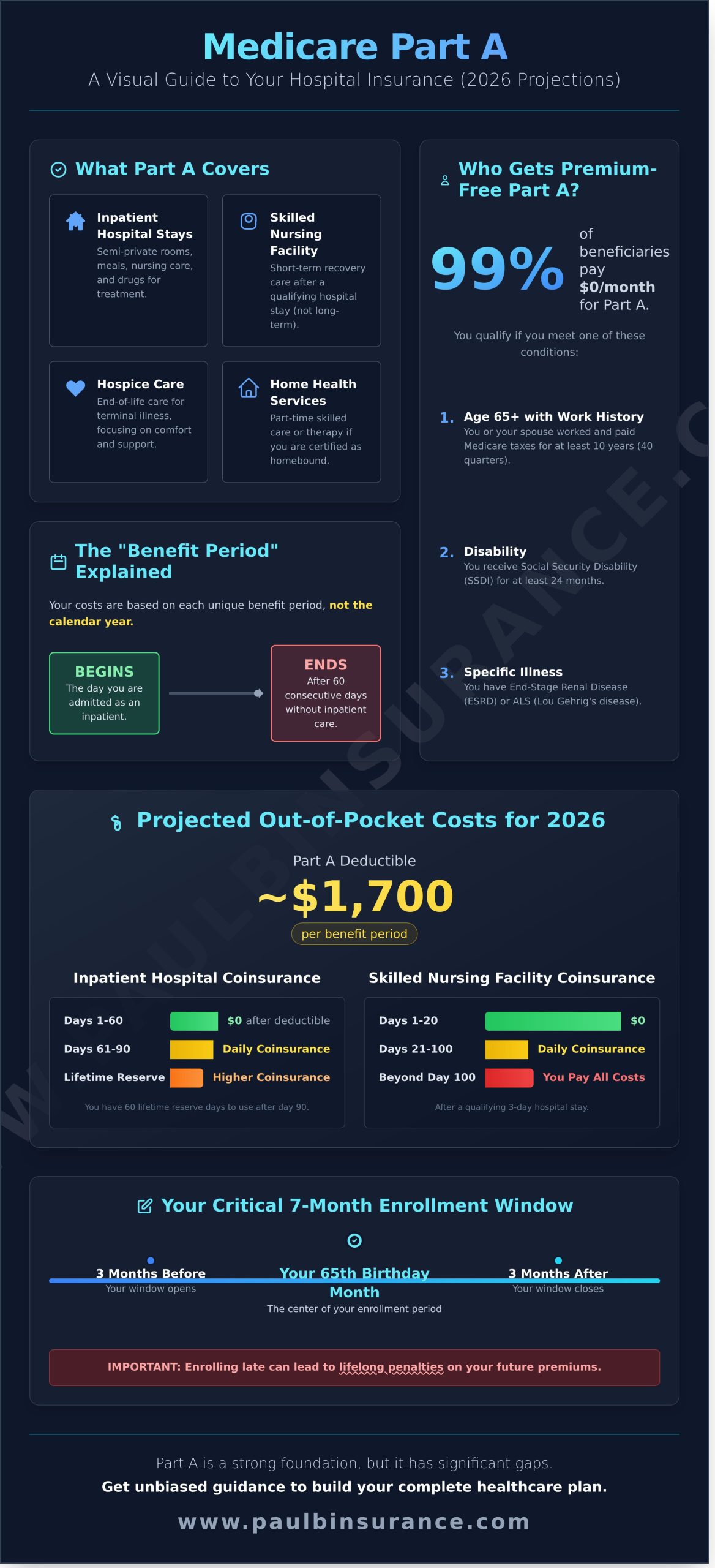
To truly understand What is Medicare Part A, it’s essential to grasp the concept of a “benefit period.” This isn’t tied to the calendar year. A benefit period begins the day you are admitted as an inpatient in a hospital and ends when you haven’t received any inpatient hospital or skilled nursing care for 60 days in a row. Understanding this is key, as your deductibles and coinsurance are based on each unique benefit period, not the year.
The Core Services: What Part A Actually Pays For
Your Part A coverage is your safety net for significant health events. It helps pay for specific, necessary services, including:
- Inpatient Hospital Stays: This covers a semi-private room, your meals, general nursing care, and drugs administered as part of your inpatient treatment.
- Skilled Nursing Facility (SNF) Care: This is for short-term recovery, not long-term custodial care. To qualify, you typically must have a prior inpatient hospital stay of at least three days.
- Hospice Care: For those with a terminal illness, this provides compassionate end-of-life care focused on comfort and support for both you and your family.
- Home Health Services: Covers medically necessary part-time skilled nursing care or therapy if you are certified as homebound by a doctor.
Eligibility: Who Qualifies for Part A in 2026?
Most Americans earn the right to premium-free Part A through their work history. You are generally eligible if you meet one of these conditions:
- You are age 65 or older, and you or your spouse worked and paid Medicare taxes for at least 10 years (which equals 40 quarters).
- You are under 65 but have received Social Security Disability Insurance (SSDI) for at least 24 months.
- You have End-Stage Renal Disease (ESRD) or Amyotrophic Lateral Sclerosis (ALS), also known as Lou Gehrig’s disease.
This coverage is the cornerstone of your healthcare in retirement, earned through years of hard work and contributions.
The Cost of Medicare Part A: Deductibles, Premiums, and 2026 Projections
One of the most common questions we hear is, “How much will this actually cost me?” Navigating the expenses of hospital insurance can feel overwhelming, but we’re here to make it simple. The great news is that for nearly 99% of beneficiaries, Part A is premium-free. If you or your spouse worked and paid Medicare taxes for at least 10 years (or 40 quarters), you will not pay a monthly premium.
For the small percentage who don’t qualify for premium-free medicare part a, you can buy into it. The monthly premium depends on how long you paid Medicare taxes. These costs can be significant, reinforcing the need for careful planning as you approach eligibility.
Projected Costs for 2026: What to Budget For
Even with premium-free coverage, there are out-of-pocket costs. The Part A deductible is a key figure to watch. Based on recent trends, we project the 2026 Part A deductible to be around $1,700. This isn’t an annual deductible; it applies to each benefit period. A benefit period starts the day you’re admitted to a hospital and ends when you haven’t received any inpatient care for 60 days in a row.
- Days 1-60: $0 coinsurance after you pay your deductible.
- Days 61-90: A daily coinsurance payment is required.
- Lifetime Reserve Days: After day 90, you have 60 extra days you can use over your lifetime, but they come with a much higher daily coinsurance.
The Cost of Skilled Nursing: Days 1 to 100
If you have a qualifying hospital stay and need follow-up care in a skilled nursing facility (SNF), Part A helps cover the costs, but only for a limited time. Understanding this timeline is vital to avoid unexpected bills.
- Days 1-20: $0 for you. Medicare covers the full approved amount.
- Days 21-100: You will pay a daily coinsurance. This can add up quickly during a long recovery.
- Beyond Day 100: You are responsible for all costs.
These potential costs are exactly why many people choose a Medicare Supplement (Medigap) plan to fill the gaps. Having a clear financial picture gives you confidence and peace of mind.
The Coverage Gaps: Why Part A Alone is a Financial Risk
One of the most common-and costly-misconceptions is that Medicare Part A covers everything during a hospital stay. This belief can lead to surprise bills and significant financial stress. The truth is, Part A is only one piece of the puzzle, and relying on it alone leaves you dangerously exposed to high costs.
While it’s your hospital insurance, medicare part a was never designed to be your only coverage. Key services are simply not included. For example, you are still responsible for:
- Doctor and Surgeon Fees: The professionals who treat you in the hospital (surgeons, anesthesiologists, specialists) bill under Medicare Part B, not Part A.
- Private Rooms: Unless deemed medically necessary by your doctor, you will pay the difference for a private room.
- Long-Term Care: Part A does not cover custodial care, which includes help with daily activities like bathing and dressing.
The biggest financial risk is the “20% Gap.” After your deductibles, Original Medicare generally pays 80% of most medical costs. You are responsible for the remaining 20% with no annual limit on your spending. A single, serious hospital stay could expose you to tens of thousands of dollars in bills that you must pay out-of-pocket. Thankfully, you can bridge these gaps and protect your savings.
Medigap vs. Part A: Closing the Deductible Hole
These plans work with Original Medicare to pay for the costs it leaves behind. A Medicare Supplement Insurance (Medigap) plan can cover your Part A deductible and coinsurance, often leaving you with zero out-of-pocket costs for a hospital stay. This provides incredible peace of mind, turning unpredictable medical bills into a fixed, manageable monthly premium.
The Medicare Advantage Alternative
Often called Part C, these plans bundle your Part A and Part B benefits into one managed care plan from a private insurer. Instead of unlimited 20% coinsurance, you’ll have a predictable structure of co-pays for services and an annual out-of-pocket maximum that protects you from catastrophic costs. Our complete Medicare Advantage Guide offers a deeper comparison.
How and When to Enroll in Medicare Part A
Understanding enrollment deadlines is one of the most stressful parts of starting Medicare, but it doesn’t have to be. Missing a deadline can lead to lifelong penalties, so let’s walk through the key timelines to ensure you get it right. We’re here to bring clarity and confidence to this crucial step.
Your main window to sign up is your Initial Enrollment Period (IEP). This is a 7-month period that includes:
- The 3 months before your 65th birthday month
- The month you turn 65
- The 3 months after your 65th birthday month
The good news? Many people are enrolled automatically. If you’re already receiving Social Security or Railroad Retirement Board benefits at least 4 months before you turn 65, you’ll be automatically signed up for medicare part a and Part B. Your card will simply arrive in the mail.
Still working and have employer coverage? For most people, it still makes sense to enroll in premium-free Part A, as it can coordinate with your group health plan. However, if you must pay a premium for Part A (which is rare), delaying enrollment without other qualifying coverage can result in a costly late enrollment penalty.
The Special Enrollment Period (SEP)
Life changes can grant you a Special Enrollment Period (SEP), allowing you to sign up outside the standard windows. The most common SEP is for those who continue working past 65 with employer health coverage. When you (or your spouse) stop working or lose that coverage, you typically have an 8-month window to enroll in Medicare without penalty. It’s critical not to miss this deadline.
Step-by-Step: Signing Up via Social Security
If you need to enroll yourself, the Social Security Administration (SSA) makes it simple. You can apply online in under 10 minutes at SSA.gov. You’ll just need basic information, such as your Social Security number and your date and place of birth. This is the process for anyone who is retiring at 65, self-employed, or not yet drawing Social Security benefits.
Navigating these timelines is critical. For trusted, unbiased guidance to ensure you enroll correctly and on time, schedule a simple, no-pressure call with Paul.
Building Your Complete Plan: The Paul Barrett Advantage
You’ve learned the essentials of Medicare Part A, but it’s clear this is just one piece of a complex puzzle. Navigating the crazy maze of Medicare can feel overwhelming, but it’s a journey you don’t have to take alone. The key is having a trusted, independent guide by your side.
Unlike a ‘captive agent’ who works for just one insurance company and can only offer their products, an independent broker like Paul Barrett works for you. This fundamental difference means you receive completely unbiased guidance and access to a wide range of plans from multiple carriers. Our goal isn’t to sell you a policy; it’s to find the right one for your health and budget.
At The Modern Medicare Agency, we turn complexity into clarity with our simple 5-step plan. And our commitment doesn’t end once you enroll. We provide dedicated, year-round support for claims, questions, and annual plan reviews, ensuring you always have an advocate in your corner. We are your resource for all things Medicare, whenever you need us.
Integrating Part D and Dental for Full Protection
While your hospital insurance provides a strong foundation, Original Medicare leaves significant gaps. Most importantly, it doesn’t cover prescription drugs. That’s why a Medicare Part D plan is crucial for protecting your health and finances. We also help you address the ‘big three’ missing items-dental, vision, and hearing-by finding a comprehensive Dental Insurance Plan to complete your healthcare security.
Schedule Your ‘Confusion to Confidence’ Call
Are you ready to build a complete plan with confidence? We invite you to a complimentary, 15-minute introductory call to discuss your unique needs for 2026. Our philosophy is simple: never rushed, never pressured. We are here to listen, educate, and empower you to make the best possible decision for your future.
Click the button below to find a time that works for you and take the first step from confusion to confidence.
Secure Your Future: Moving Beyond Part A with Confidence
Understanding the details of medicare part a is the first crucial step in building your healthcare security for 2026 and beyond. As we’ve seen, it provides a vital foundation for hospital care, but it also comes with significant deductibles and coverage gaps. Relying on Part A alone can leave you financially vulnerable during a health crisis.
Navigating these complexities doesn’t have to be overwhelming. You don’t have to piece this puzzle together by yourself. With trusted, unbiased guidance, you can build a comprehensive plan that protects both your health and your savings, ensuring you avoid costly mistakes.
As an independent brokerage representing over 40 carriers in 34+ states, we provide zero-cost consultations designed to find the perfect fit for you. Let Paul Barrett help you move from confusion to confidence. Schedule a Call with Paul to simplify your Medicare journey today!
Your peace of mind is just one simple conversation away.
Frequently Asked Questions About Medicare Part A
Is Medicare Part A really free for everyone?
Navigating costs can be confusing, but we can make it simple. For most people, Medicare Part A is premium-free. If you or your spouse worked and paid Medicare taxes for at least 10 years (which equals 40 quarters), you will not have to pay a monthly premium. This is a benefit you’ve earned. For those who don’t meet this requirement, a monthly premium will apply, but we can help you understand your specific situation with clarity and confidence.
What is the 2026 deductible for Medicare Part A?
This is a great question that shows you’re planning ahead. Medicare announces the deductibles and other costs for the upcoming year each fall. Therefore, the official 2026 Part A deductible has not been released yet. As your trusted guide, we monitor these announcements closely and will provide clear, up-to-date information as soon as it becomes available. This ensures you are never caught by surprise and can budget with confidence for your healthcare needs.
Do I need to sign up for Part A if I am still working and have insurance?
In most cases, it is wise to sign up for premium-free Part A even if you’re still working. It can coordinate with your employer’s plan and may help cover some hospital costs. However, a critical exception exists: if you have a High-Deductible Health Plan with a Health Savings Account (HSA), enrolling in Part A will prevent you from making further contributions to your HSA. We can provide the guidance you need to avoid this costly mistake.
How long can I stay in the hospital under Medicare Part A?
Medicare Part A covers inpatient hospital stays based on a “benefit period.” For each benefit period, Part A covers up to 90 days. The first 60 days are covered after you pay your deductible, and for days 61-90, you will pay a daily coinsurance. You also have a lifetime reserve of 60 additional days that can be used if you have a hospital stay longer than 90 days. Understanding these details brings peace of mind.
Does Medicare Part A cover surgery?
This is a common point of confusion, and we’re here to provide clarity. Part A, your hospital insurance, covers the costs of the hospital facility for an approved inpatient surgery. This includes your semi-private room, meals, and nursing services. However, the fees for the surgeon and anesthesiologist are typically covered under Medicare Part B (Medical Insurance). Knowing how the parts work together is key to feeling secure in your coverage.
Can I have Medicare Part A without Part B?
Yes, you can enroll in premium-free Part A without enrolling in Part B, which is a common choice for those still working who have creditable medical coverage from an employer. However, it’s crucial to be careful. If you delay enrolling in Part B and do not have other qualifying health coverage, you could face a life-long late enrollment penalty. Our unbiased guidance ensures you make the right choice for your timeline and avoid any penalties.
What happens if I miss my Medicare Part A enrollment deadline?
For the vast majority of people who qualify for premium-free Part A, there is no penalty for enrolling late. However, if you are one of the few who must pay a premium for Part A, missing your enrollment window could result in a late enrollment penalty. This penalty can increase your monthly premium by 10%. We help you understand your specific deadlines so you can steer clear of costly enrollment mistakes and secure your benefits on time.
Does Part A cover stays in a nursing home?
Part A provides limited coverage for care in a Skilled Nursing Facility (SNF), but it does not cover long-term custodial care. For Part A to cover an SNF stay, you must have had a qualifying inpatient hospital stay first. The SNF care must be for rehabilitation, not just assistance with daily activities. Understanding this distinction is vital for planning for future care needs, and we can help you see the full picture clearly.