For years, the fear of hitting the Medicare Part D “donut hole” has been a source of stress and financial uncertainty. If you’ve ever felt anxious watching your prescription costs climb throughout the year, you are not alone. The worry over confusing coverage rules and rising premiums can feel overwhelming, but major, positive changes are on the horizon. Thanks to the Inflation Reduction Act, the entire landscape of prescription drug coverage is being redesigned, and the upcoming medicare part d plans 2026 will look very different, finally bringing predictable costs within reach.
The most significant change is a new $2,000 annual cap on out-of-pocket drug spending, a landmark reform that will provide immense relief. But what does this really mean for your monthly budget and plan choices? Our goal is to provide trusted guidance to move you from confusion to confidence. In this article, we will simplify these massive changes, explain how the new cap works, and give you the clear, straightforward information you need to find the most cost-effective coverage for your specific medications, ensuring you can plan for 2026 with total peace of mind.
Key Takeaways
- Understand how the new $2,000 out-of-pocket spending cap could dramatically lower your prescription drug costs starting in 2026.
- Learn the key differences between standalone plans and Medicare Advantage to choose the most effective medicare part d plans 2026 for your specific medications.
- Discover how the new “smoothing” option can help you manage your prescription costs by spreading them out over the year.
- Identify what qualifies as “creditable coverage” to steer clear of the lifelong Part D late enrollment penalty and other costly mistakes.
The 2026 Medicare Part D Revolution: What’s Changing for You?
For years, navigating your prescription drug coverage has often felt confusing and unpredictable. Medicare Part D, the voluntary drug benefit for people with Medicare, is about to undergo its most significant transformation yet, bringing much-needed simplicity and financial protection. Thanks to the Inflation Reduction Act, the medicare part d plans 2026 will introduce changes that provide unprecedented peace of mind for millions.
These updates represent the biggest overhaul since the Medicare Part D program was first launched in 2006. The goal is clear: to make your prescription drug costs more predictable and affordable, moving you from confusion to confidence in your coverage.
The End of the Coverage Gap (Donut Hole)
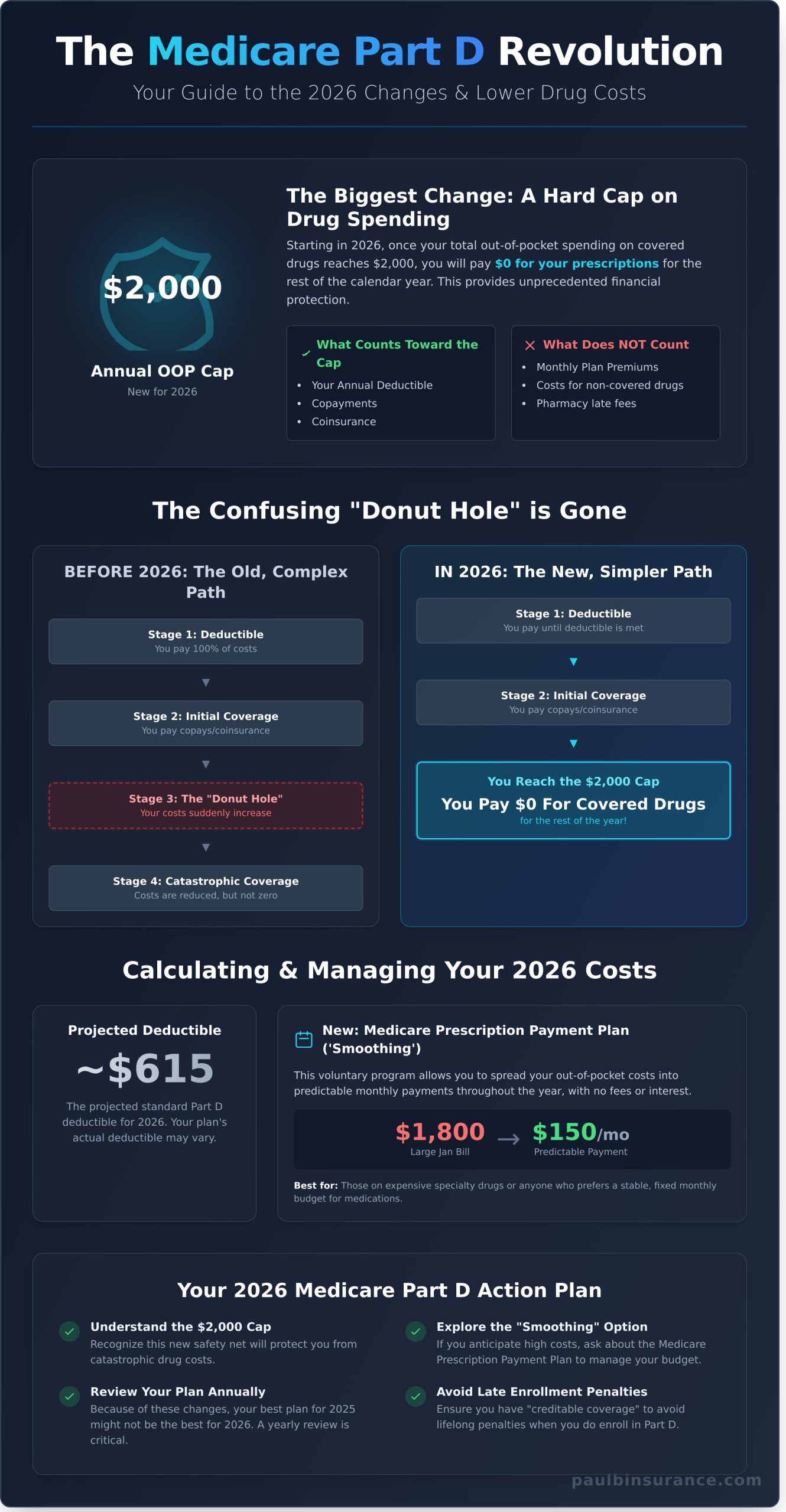
If you’ve been on Medicare for a while, you’ve likely heard of the dreaded “Donut Hole.” This was a complicated coverage phase where your out-of-pocket costs could suddenly spike for the same medications. In 2026, this confusing gap is finally disappearing for good. The new structure simplifies the ‘stages’ of drug coverage into a straightforward and easy-to-understand pathway. The 2026 coverage structure is a three-stage process: Deductible, Initial Coverage, and Catastrophic.
The $2,000 Out-of-Pocket Cap Explained
The most impactful change is the new $2,000 annual maximum on out-of-pocket drug costs. Once your spending on covered drugs reaches this cap, you will pay $0 for the rest of the year. This provides a hard ceiling on your prescription expenses, offering powerful financial protection. Understanding what contributes to this limit is key:
- What counts toward the $2,000 limit: Your annual deductible, copayments, and coinsurance for drugs covered by your plan.
- What does NOT count: Your monthly plan premiums, the cost of non-covered medications, or any late fees charged by a pharmacy.
This cap will be life-changing, especially for beneficiaries who rely on high-cost specialty medications for conditions like cancer, rheumatoid arthritis, or multiple sclerosis, providing them with predictable costs and critical financial relief.
Calculating Your 2026 Costs: Premiums, Deductibles, and ‘Smoothing’
Understanding the costs associated with medicare part d plans 2026 is the most important step in finding the right coverage. While final numbers are confirmed later in the year, we can look at key projections and new programs to help you prepare. For 2026, the standard Part D deductible is projected to be around $615, but your actual costs will depend on your plan’s premium and a new, helpful payment option designed to make budgeting easier.
Navigating these changes can feel overwhelming, but our goal is to provide you with clear, straightforward guidance so you can make decisions with confidence.
The Medicare Prescription Payment Plan
New for 2025 and a key feature for 2026 is the Medicare Prescription Payment Plan, often called ‘cost smoothing.’ This voluntary program lets you spread your out-of-pocket drug costs into predictable, monthly payments throughout the year, with no fees or interest. It’s a powerful tool for anyone on a fixed income who worries about facing a large pharmacy bill early in the year.
- Consider opting-in if you: Take expensive specialty drugs, expect to hit your out-of-pocket maximum, or simply prefer the stability of a fixed monthly budget.
- Paying as you go may be better if: Your prescription costs are consistently low and manageable each month.
Premium Trends for 2026
You may notice that some standalone Part D premiums are projected to rise in 2026. This is happening largely because of the new $2,000 out-of-pocket spending cap, which means insurance carriers are now responsible for a larger portion of drug costs. To manage this increased financial risk, some plans may adjust their premiums. Thankfully, the law also includes a ‘Premium Stabilization’ provision to help limit drastic year-over-year increases.
This is why it’s critical to look beyond just the monthly premium. A plan with a slightly higher premium that covers your specific medications well could save you thousands more than a lower-premium plan that leaves you exposed to high costs. Your best plan from 2025 might not offer the same value in 2026, making an annual review with a trusted expert essential.
PDP vs. Medicare Advantage: Choosing the Right Delivery Method
One of the most important decisions you’ll make is how you get your prescription drug coverage. Do you add a standalone Prescription Drug Plan (PDP) to Original Medicare, or do you choose an all-in-one Medicare Advantage (Part C) plan that includes drug benefits (MAPD)? There is no single right answer, but understanding the trade-offs is key to making a confident choice that fits your health needs and lifestyle.
This decision impacts more than just your drug costs; it affects your choice of doctors, pharmacies, and overall flexibility. Let’s break down the two paths to help you find clarity.
When a Standalone PDP Makes Sense
A standalone Part D plan is often the perfect partner for Original Medicare, especially if you have a Medigap (Supplement) plan. This combination offers the greatest freedom, allowing you to see any doctor or visit any hospital in the U.S. that accepts Medicare, without worrying about networks. Before enrolling, it’s crucial to audit a PDP’s formulary (its list of covered drugs) to ensure your specific medications are included at a favorable tier. Also, pay close attention to the plan’s pharmacy network, as your choice matters more than ever.
- Standard Pharmacies: These are in the plan’s network, but your copays will be higher.
- Preferred Pharmacies: Using these pharmacies can significantly lower your out-of-pocket costs for the exact same prescriptions.
Drug Coverage Inside Medicare Advantage
Medicare Advantage plans bundle your hospital (Part A), medical (Part B), and often your prescription drug (Part D) coverage into a single, convenient plan. This simplicity is a major draw for many. However, this convenience comes with network restrictions for doctors, hospitals, and pharmacies. What happens if your plan covers your medication, but your trusted specialist leaves the network? These are critical questions to ask.
The significant 2026 Medicare changes, especially the new $2,000 cap on out-of-pocket drug costs, make it essential to evaluate the total value of a plan. While the cap applies to all medicare part d plans 2026, you should compare an MAPD’s monthly premium, doctor network access, and extra benefits against its drug coverage. Understanding the complete picture is vital, as we detail in our Medicare Advantage Plans 2026: A Simple Guide.
Avoiding the Part D Late Enrollment Penalty and Other Pitfalls
Navigating Medicare Part D can feel overwhelming, but understanding a few key rules can save you from costly and permanent mistakes. The most significant is the Part D Late Enrollment Penalty (LEP), a lifelong penalty added to your monthly premium for not signing up when you were first eligible.
The penalty is calculated as 1% of the national base beneficiary premium for every full month you were eligible but didn’t have Part D or other creditable drug coverage. This may seem small initially, but it adds up year after year. For example, waiting just two years (24 months) could mean a permanent 24% penalty on your premium. The key to avoiding this is proving you had creditable coverage.
How to Verify Your Current Coverage
Creditable coverage is a prescription drug plan that is considered at least as good as a standard Medicare Part D plan. Common examples include coverage from an employer, the VA, or TRICARE. Each year, your plan provider should mail you a ‘Notice of Creditable Coverage.’ Do not throw this letter away. Keep it as proof in case Medicare ever questions your enrollment timing. If you lose your creditable coverage, you have a 63-day Special Enrollment Period to join a Part D plan without penalty.
The 2026 Enrollment Timeline and Common Mistakes
The biggest mistake we see clients make is assuming their current plan will work just as well next year. Insurers change formularies (the list of covered drugs), premiums, and pharmacy networks annually. Simply letting your plan auto-renew is one of the most dangerous choices you can make when it comes to medicare part d plans 2026.
- Review Early: Start reviewing your plan options in September, well before enrollment begins.
- Key Dates: The Annual Enrollment Period runs from October 15th to December 7th each year.
- Get Help: Don’t try to compare dozens of plans alone. A small change could cost you thousands.
The Annual Enrollment Period is your once-a-year window to switch Part D plans to ensure your medications remain on the formulary for 2026. Making a confident choice requires a clear, unbiased comparison. If you’re feeling unsure, getting personalized guidance can help you avoid these pitfalls. You can learn more about our process at paulbinsurance.com.
Simplifying the Maze: Why Work with an Independent Medicare Broker?
Choosing from the dozens of medicare part d plans 2026 can feel overwhelming. Many people turn to an agent, but it’s crucial to understand who that agent truly works for. A ‘captive agent’ is employed by a single insurance company and can only offer you that company’s products, whether they are the best fit for your needs or not.
An independent broker, like Paul B Insurance, works for you. We are not tied to any single carrier. Instead, we partner with over 40 different insurance companies to find the one plan that perfectly aligns with your specific prescription needs and budget. Our mission is to provide trusted, unbiased guidance that turns your confusion into confidence.
Unbiased Comparisons at No Cost to You
Because we are compensated by the insurance carriers, our expert guidance and personalized support come at no cost to you. We use specialized software to run a detailed analysis of your prescription drug list against every available plan in your area. This data-driven approach ensures we identify the most cost-effective coverage, saving you from costly enrollment mistakes. Why Using a Medicare Broker Is Your Smartest Move is understanding you get an advocate dedicated to your best interests.
Your 5-Step Medicare Process with Paul Barrett
We’ve streamlined the entire process into five simple, stress-free steps designed to find your ideal Part D plan and provide peace of mind for years to come.
- Step 1: The Initial Consultation. A friendly, no-pressure conversation where we listen to your needs and answer your initial questions.
- Step 2: The Drug List Audit. We help you create an accurate list of your medications and dosages-the single most important factor in choosing the right plan.
- Step 3: The Comparison Report. You’ll receive a clear, easy-to-understand report showing your top 2-3 plan options, with all costs clearly outlined.
- Step 4: Enrollment. Once you’ve made a confident choice, we handle all the enrollment paperwork and confirm your new plan is active.
- Step 5: Ongoing Support. Our service doesn’t end with enrollment. When formularies change or you have a question, we are here to help, year after year.
Navigating the world of Medicare Part D plans for 2026 doesn’t have to be a journey you take alone. With a dedicated expert on your side, you can be sure you have the right coverage today and the right support for tomorrow. Contact us to get started.
Your Path to Clarity for Medicare Part D in 2026
The upcoming changes to Medicare Part D can feel overwhelming, but they don’t have to be. The new $2,000 out-of-pocket cap offers significant financial protection, and understanding how to calculate your costs is crucial for maximizing your benefits. Choosing the right plan is more than just a requirement-it’s your key to affordable healthcare and peace of mind.
Navigating the new landscape of medicare part d plans 2026 requires careful consideration, but you don’t have to do it alone. At Paul B Insurance, we specialize in turning confusion into confidence. With over 18 years of experience helping more than 5,000 clients, we provide the trusted, unbiased guidance you deserve by comparing options from over 40 top insurance carriers.
Let us simplify the maze for you. Get Your Free 2026 Part D Plan Review Today and take the first step toward a secure and predictable healthcare future.
Frequently Asked Questions About Medicare Part D
Is there a $2,000 cap on Medicare Part D in 2026?
Actually, the $2,000 out-of-pocket cap on prescription drugs begins in 2025, not 2026. This is a significant change that provides a hard limit on what you will spend on covered medications for the year. Once your personal spending reaches this $2,000 threshold, you will pay $0 for your covered drugs for the rest of the year. This provides crucial financial protection and peace of mind for those with high prescription costs.
How much is the Medicare Part D deductible for 2026?
The official maximum deductible for medicare part d plans 2026 has not yet been announced by the Centers for Medicare & Medicaid Services (CMS). For reference, the maximum deductible allowed in 2025 is $590. It’s important to remember that many individual plans offer lower deductibles, and some even have a $0 deductible for certain drug tiers. We can provide personalized guidance to help you compare these details and find the right fit for your budget.
What happens if I don’t sign up for Part D when I turn 65?
If you don’t enroll in a Part D plan when you are first eligible and you lack other creditable drug coverage (like from an employer plan), you may face a permanent late enrollment penalty. This penalty is added to your monthly Part D premium for as long as you have the coverage. This is a costly mistake we help our clients avoid. Getting trusted guidance during your Initial Enrollment Period is the best way to secure the coverage you need without unnecessary fees.
Will my Part D premiums go up in 2026 because of the $2,000 cap?
That is an understandable and common concern. While the new cap protects you from high out-of-pocket costs, it may cause some insurance carriers to adjust their premiums. However, premiums are influenced by many factors, including drug price negotiations. It’s essential to review your plan options each year during Annual Enrollment to ensure you still have the most cost-effective coverage for your specific medications. We are here to help you navigate these changes with clarity.
Can I change my Medicare drug plan every year?
Yes, you absolutely can, and it’s a wise practice to review your coverage annually. The Medicare Annual Enrollment Period, which runs from October 15 to December 7 each year, is your dedicated time to switch your Part D plan. A plan’s formulary (list of covered drugs), copays, or network of pharmacies can change from year to year. A yearly review ensures your plan continues to meet your specific health and financial needs without any surprises.
Does Medicare Part D cover insulin?
Yes, Medicare Part D plans cover insulin, and there is a significant cost-saving benefit in place. Your out-of-pocket cost for a one-month supply of any covered insulin product is capped at $35. This cap applies throughout all phases of your drug coverage, even before you meet your annual deductible. This provides predictable and affordable access to this life-saving medication for millions of beneficiaries, offering substantial financial relief throughout the year.
What is the ‘smoothing’ option for Medicare drug costs?
The ‘smoothing’ option, officially called the Medicare Prescription Payment Plan, begins in 2025. This program gives you the ability to spread your out-of-pocket drug costs into predictable monthly payments throughout the year. Instead of facing large, unexpected bills at the pharmacy, your costs are divided evenly. This is designed to help with budgeting and ensure you can always afford your medications without financial strain, offering stability and peace of mind.
Do I need Part D if I have a Medicare Advantage plan?
You generally do not need a separate Part D plan if you have a Medicare Advantage (MA) plan. Most MA plans, known as MA-PDs, already include prescription drug coverage. In fact, if you enroll in a standalone Part D plan while on most types of MA plans, you will be automatically disenrolled from your Medicare Advantage plan. It is crucial to check your MA plan’s details to confirm you have drug coverage and avoid making a costly mistake.