



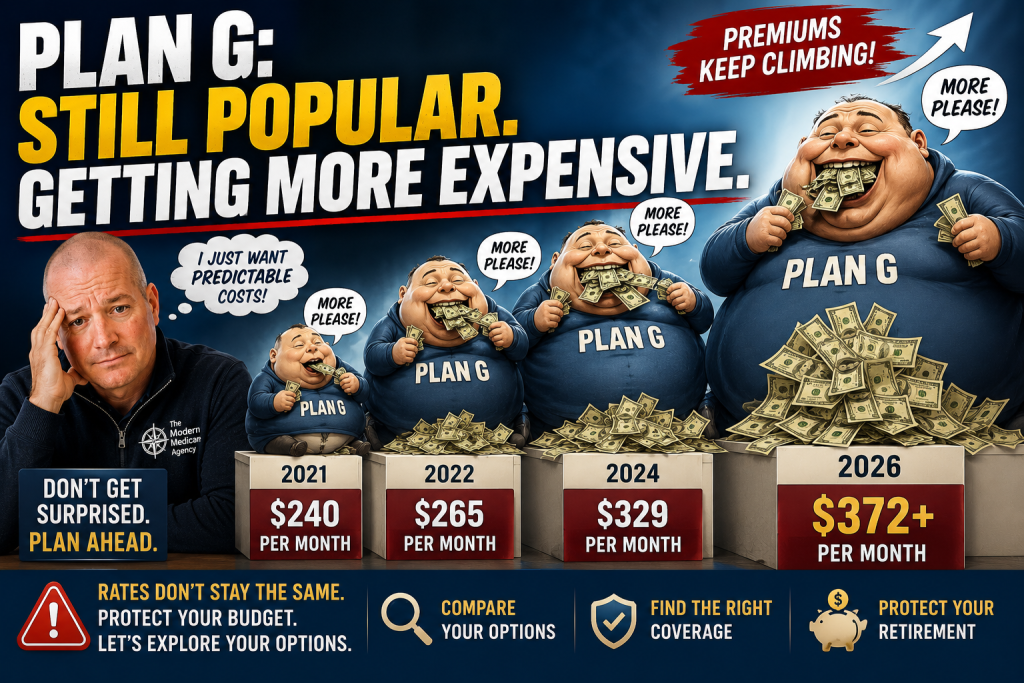
Medicare Supplement Plan G, Explained: What It Covers, How It's Priced, and Why Premiums Keep Climbing
Plan G is the most comprehensive Medigap plan available nationally — but almost every article about it stops at "here's what it covers." This guide goes further: how carriers actually price it, why some premiums grow faster than others, real 2026 numbers, and what's different if you live in New York.
In This Guide
If you've been shopping for Medicare Supplement coverage, you've probably heard Plan G described as the gold standard. That's fair — in most of the country, it's the most comprehensive plan available to anyone newly eligible for Medicare today. But most articles on this topic cover the same three facts (it's comprehensive, it's popular, premiums are rising) and stop there. That leaves out the part that actually determines what you'll be paying five and ten years from now: how your specific policy is priced. Let's go through all of it.
What Plan G Actually Covers
Plan G is a standardized plan, which means a Plan G policy from one insurance company covers exactly the same benefits as a Plan G policy from any other company. The only thing that differs between carriers is price and customer service — not coverage. That's true almost everywhere in the country, with three notable exceptions we'll cover further down.
What Plan G Pays For
- Part A hospital coinsurance, plus an extra 365 days of hospital coverage after Medicare benefits run out
- Part B coinsurance — your 20% share of most doctor and outpatient costs
- The Part A deductible ($1,736 in 2026)
- Skilled nursing facility coinsurance
- Part A hospice care coinsurance or copayment
- The first three pints of blood each year
- Foreign travel emergency care, up to plan limits
The one gap Plan G doesn't fill is the annual Part B deductible — $283 in 2026. Once you've met that single deductible for the year, Plan G effectively picks up the rest. There are no networks to worry about and no referrals required: you can see any doctor or specialist in the country who accepts Medicare, and Plan G pays its share automatically.
The Three Ways Carriers Price Plan G
This is the part most Plan G articles skip entirely, and it matters more than almost anything else in this guide. Two people can buy the exact same Plan G coverage at the exact same starting premium and end up paying wildly different amounts five years later — because of how their specific policy is priced, not because of anything the plan itself covers differently. There are three pricing methods used across the country:
- Community-rated: Everyone enrolled in a given plan pays the same premium, regardless of age. Your premium can still go up over time due to general rate increases (inflation, claims experience, etc.), but it never rises simply because you had a birthday.
- Issue-age-rated: Your premium is based on your age when you first bought the policy and is locked in at that starting point. It can still rise due to general rate increases, but not because you're aging within the policy.
- Attained-age-rated: Your premium is recalculated based on your current age every year. This is the most common method nationally, and it means your premium climbs on two fronts simultaneously — the same general rate increases everyone faces, plus an additional built-in increase purely for getting a year older.
| Pricing Method | Premium Rises With Age? | Where It's Common |
|---|---|---|
| Community-rated | No — same premium for all ages | Required statewide in New York |
| Issue-age-rated | No — locked to your age at purchase | Common in several states |
| Attained-age-rated | Yes — increases every year as you age | Most common nationally |
Here's why this matters in practice: an attained-age-rated policy will often look like the cheapest option when you're 65, precisely because the insurer knows it can raise your rate every single year as you age — on top of the same general increases a community-rated or issue-age-rated policy would also see. A policy that looks like a bargain at 65 can become one of the most expensive options on the market by 78 or 80, even from a carrier that hasn't had a single "bad year" of claims.
I ask every client shopping for Plan G one question most agents never bring up: "how is this specific policy priced?" A cheap attained-age quote at 65 can be a trap if you're planning to keep the policy for 20 years. I'd rather show you the honest long-term picture up front than let you find out on your tenth renewal notice.
Why Plan G Is Called "All-You-Can-Eat" Coverage
Beyond the pricing method, there's a second force pushing Plan G premiums up across the board: how little you notice using the plan. Compare it to Plan N, which typically charges a small copay — often $20 for a doctor visit or up to $50 for an ER visit that doesn't result in admission — every time you use care. With Plan G, once you're past that one annual Part B deductible, there's essentially nothing standing between you and using the plan. No copay to think about at the front desk, no coinsurance bill afterward.
That difference sounds small, but it adds up across an entire risk pool. When a plan removes nearly all cost-sharing, members have very little financial reason to pause before scheduling that extra follow-up visit or specialist consult. Combine that with an aging pool of policyholders who, on average, use more care every year they're enrolled, and you get a plan that consistently pays out more in claims relative to what it collects in premium — which carriers then correct for with larger annual rate increases, on top of whatever your specific pricing method is already doing.
Plan G isn't expensive because insurance companies are greedy. It's expensive because it's designed to remove almost every financial reason to hesitate before using care — and when an entire pool of people stops hesitating, the claims follow. That's simply how the math of insurance works, and anyone promising you a "Cadillac plan" that will always stay cheap isn't giving you the full picture.
The 2026 Rate Increase Numbers
This isn't theoretical. Early 2026 rate filings from the six largest Medigap carriers — Aetna, Blue Cross Blue Shield, Cigna, Humana, Mutual of Omaha, and UnitedHealthcare — showed Plan G increases ranging from just over 12% to more than 26%, with an industry-average increase of roughly 16.8%, according to actuarial firm Telos Actuarial. Some individual carrier filings in specific states ran considerably higher than that range.
| Then vs. Now | What Changed |
|---|---|
| 5 years ago | A rate increase above 10% was considered rare and notable |
| 2022 | Increases among major carriers averaged as low as 5% |
| Early 2026 filings | Increases clustered between 12% and 26%, averaging ~16.8% |
I've broken down exactly which carriers raised rates the most, and by how much, in a companion piece: Medicare Supplement Rate Increases by Company in 2026. For the full context on what's driving this across the industry, see Medicare Supplement Rate Increases in 2026: The Full Story.
New York's Different Rules
If you're on Long Island or anywhere else in New York, this section matters more than the national averages above. New York is one of a small handful of states that requires community rating for every Medigap plan sold in the state — meaning a 65-year-old and an 85-year-old pay the exact same premium for the same plan from the same carrier, regardless of age, gender, or health history. New York also offers year-round guaranteed issue: you can apply for or switch Medigap coverage at any time of year, with no medical underwriting, no health questions, and no ability to be charged more or declined for a pre-existing condition. Most of the country only guarantees this once, during a six-month window around age 65.
That protection is genuinely valuable — but it's also part of why New York premiums run well above the national average. Because every carrier has to accept every applicant at every age, insurers spread the cost of sicker, older enrollees across the entire pool rather than pricing individuals based on their own risk. Based on New York's official 2026 rate filings for the NYC Proper region, Plan G premiums ranged from $372.50 with UnitedHealthcare to $840.28 with Bankers Conseco, depending on carrier — the exact same coverage, a more than two-fold difference in price.
UnitedHealthcare, selling under the AARP brand, controls somewhere in the neighborhood of 70-80% of the entire New York Medigap market — a dominant position that New York's own guaranteed-issue rules actually help reinforce, since it's harder for smaller carriers to compete on price when they can't decline anyone. UHC's approved 2026 Plan G increase in New York was 17.8%, described as the largest single-year increase approved by the state's Department of Financial Services in recent memory, and the carrier has already filed for an additional 11.6% to 13.5% increase for 2027.
Worth knowing separately: in August 2025, AM Best downgraded UnitedHealthcare's financial strength rating from A+ (Superior) to A (Excellent) — still a strong rating, but a real, documented shift tied to broader Medicare Advantage performance issues, not specifically to its Medigap business.
New York's community rating is a genuinely underappreciated feature, not just a reason premiums run high. Because you can switch carriers or plan types at any time without underwriting, you're never locked into a bad decision the way people in attained-age states can be. That flexibility is worth factoring into your decision, not just the sticker price on this year's renewal.
If you're in one of the boroughs or nearby, I've written more localized breakdowns with current carrier-by-carrier pricing: Medigap Plans in Queens, NY, Medigap Plans in Brooklyn, NY, Medicare Supplement Plans in Commack, NY, and a deep dive on UnitedHealthcare/AARP's dominant position in the New York Medigap market.
Your Alternatives If the Premium Is a Strain
None of this means Plan G is a bad choice — for a lot of people, especially those managing ongoing health conditions or who simply want to never think about a medical bill again, it's still the right fit. But it's worth knowing what your alternatives actually look like.
- Plan N. Nearly the same core coverage as Plan G, but with small copays for office visits and ER visits, plus responsibility for any Part B excess charges. Because members share a little of the cost at the point of care, Plan N premiums are typically lower and have historically risen more slowly.
- High-Deductible Plan G. Same comprehensive coverage as standard Plan G, but you pay the first $2,950 (2026 figure, which includes the Part B deductible) in Medicare-covered costs out of pocket before the plan kicks in. Monthly premiums run dramatically lower — I've written a full breakdown here: High-Deductible Plan G: The Complete Guide for 2026.
- Switching carriers, not plan types. Because Plan G benefits are federally standardized, a Plan G from one company is identical to a Plan G from another. If your premium has climbed sharply, it's worth pricing the same exact coverage from other carriers before assuming you have to downgrade your benefits — and in states like New York, you can do this without underwriting, at any time.
I'll be transparent about something most agents won't tell you: High-Deductible Plan G typically pays a lower commission than standard Plan G. I still recommend it when it's the right fit for a client's health and budget, because my job is to find the plan that actually works for you — not the one that pays me the most. If an agent never once mentions HD Plan G as an option, it's worth asking why.
The Three States That Work Differently
Massachusetts, Minnesota, and Wisconsin don't use the standard lettered plan system at all. These three states received a federal waiver decades ago and built their own standardized Medigap structures — Massachusetts offers a Core Plan and Supplement 1/1A, Minnesota offers a Basic Plan and Extended Basic Plan with optional riders, and Wisconsin offers a Basic Plan customized with riders. The coverage is broadly comparable to what Plan G and Plan N offer nationally, but it's built and named differently, so a national "Plan G premium" comparison doesn't translate directly if you live in one of these three states.
Is Plan G Right for You?
There's no universal answer, but these patterns hold true for most people:
- Plan G tends to make sense if: you have ongoing health conditions and want predictable costs, you travel and want the flexibility to see any doctor without networks, or peace of mind matters more to you than shaving a fixed dollar amount off your monthly premium.
- Plan N or HD Plan G tend to make sense if: you're generally healthy, you're comfortable handling small, predictable costs at the point of care, or you'd rather keep more cash in your pocket monthly and accept some out-of-pocket risk.
- A carrier switch (same plan letter) tends to make sense if: you like Plan G's coverage but this year's renewal came in high, and especially if you're in a state where you can switch without underwriting.
About Paul Barrett, CMIP
Paul is the Founder and Principal Agent of The Modern Medicare Agency, a Medicare-exclusive independent broker with 18+ years of experience, licensed in 37 states and representing 40+ carriers. He's helped more than 5,000 clients navigate Medicare and hosts the Wise Guys Retirement Talk podcast.
Quick Answers
What doesn't Plan G cover?
Just the annual Part B deductible — $283 in 2026. After that's met for the year, Plan G covers nearly all remaining Medicare-approved costs.
Why did my premium jump more than my neighbor's, even with the same carrier?
If your policy is attained-age-rated, your premium rises with every birthday on top of the carrier's general rate increase. Two neighbors of different ages on the same carrier and same plan can see very different renewal amounts for exactly this reason.
Will my Plan G premium keep going up like this every year?
No one can promise a specific number, but the underlying pressures — an aging enrollee pool, minimal cost-sharing, and rising medical costs generally — aren't going away. Reviewing your coverage and pricing annually is the best way to stay ahead of it rather than being surprised by a renewal notice.
Should I just switch to Medicare Advantage instead?
That's a much bigger decision with its own trade-offs — networks, referrals, and annual out-of-pocket maximums work very differently. It deserves its own conversation rather than a quick fix for a Medigap premium increase.
Not Sure If Plan G Still Makes Sense for You?
If your Plan G premium jumped this year, let's look at your specific numbers together — how your policy is actually priced, what Plan N or High-Deductible Plan G would cost you, and whether switching carriers on the same plan letter could save you money. No pressure, no sales pitch.
Further Reading & Related Coverage
- Medicare Supplement Rate Increases in 2026: The Full Story
- Medicare Supplement Rate Increases by Company: Who Raised Rates the Most
- High-Deductible Plan G: The Complete Guide for 2026
- UnitedHealthcare/AARP Medigap in New York: The Full Picture
- Medigap Plans in Queens, NY
- Medigap Plans in Brooklyn, NY
- Medicare Supplement Plans in Commack, NY
- Humana's 2027 Medicare Advantage Changes: The Full, Honest Breakdown
- Medicare.gov — Medigap Basics
- CBS News — "Medigap premiums leap, and consumers have few alternatives"