




Navigating the world of Medicare can feel like trying to solve a puzzle with missing pieces. You see an alphabet of options-Plan F, Plan N, and so many others-and it’s easy to feel overwhelmed, worrying about unexpected medical bills and high out-of-pocket costs. If you’re looking for comprehensive coverage that offers real peace of mind, you’ve likely heard about the most popular option available today: Medicare Supplement Plan G.
But is it truly the best choice for you as we look ahead to 2026? You might be wondering if the monthly premium is worth it, or how you can trust that you’re getting the full story. We understand. You deserve clear, straightforward answers, not a confusing sales pitch. In this guide, we’ll cut through the noise to simply explain what Plan G covers, how it compares to other top plans, and give you the unbiased information you need to decide with confidence if it’s the right fit for your healthcare and your budget.
Key Takeaways
- Understand exactly what Plan G covers in real-world terms, giving you a clear picture of your financial protection.
- See a simple side-by-side comparison of Plan G, Plan F, and Plan N to find the right balance of coverage and cost for your needs.
- Discover the main factors that influence your monthly premium so you can budget for your healthcare with confidence.
- Decide if medicare supplement plan g is the best choice for your peace of mind by matching its benefits to your personal priorities.
What Is Medicare Supplement Plan G in Simple Terms?
Navigating the world of Medicare can feel overwhelming, but understanding your options is the first step toward confidence. Original Medicare (Parts A and B) is a great foundation, but it wasn’t designed to cover everything. It leaves “gaps” in coverage, such as deductibles and coinsurance, that you are responsible for paying. This is where Medicare Supplement, or Medigap, plans come in. To understand what Medicare Supplement plans are in simple terms, think of them as a safety net that pays for many of the costs Medicare leaves behind.
Among all the available options, Medicare Supplement Plan G has become the most popular and comprehensive choice for new beneficiaries. The reason for its popularity is its simplicity and robust coverage. In short, Plan G covers everything that Original Medicare doesn’t, except for one small, manageable cost.
Once you meet that single deductible, Plan G pays 100% of your remaining Medicare-approved costs for the rest of the year. This includes:
- Your Part A hospital deductible
- Coinsurance for hospital stays and skilled nursing facility care
- Part B coinsurance or copayments (typically 20% of the cost)
- The first three pints of blood for a transfusion
- Foreign travel emergency care (up to plan limits)
The ‘One Deductible’ Plan Explained
The only out-of-pocket cost you are responsible for with Plan G is the annual Medicare Part B deductible. For 2024, this deductible is $240. You pay this amount once per calendar year for outpatient services like doctor’s visits, lab tests, or specialist appointments. After you’ve paid that first $240, your Plan G kicks in to cover all other approved expenses, leaving you with no more copays or coinsurance for the year.
Why Plan G is the Top Choice for New Beneficiaries
For years, a plan called Plan F was the most comprehensive option. However, due to a change in federal law, Plan F is no longer available to anyone who became eligible for Medicare on or after January 1, 2020. This change has positioned Plan G as the natural successor and the new “gold standard” of Medigap coverage. It offers the highest level of benefits available to new enrollees, providing predictable costs and exceptional peace of mind.
A Detailed Look at Plan G Coverage: What’s Paid For?
When you choose a medicare supplement plan g, you’re selecting one of the most comprehensive options available. Its primary goal is to provide you with financial predictability and peace of mind by covering nearly all the gaps left by Original Medicare. This means you can focus on your health, not on surprising medical bills. Plus, you have the freedom to see any doctor or visit any hospital in the U.S. that accepts Medicare-no network restrictions and no referrals needed.
Let’s break down exactly what Plan G pays for, moving you from confusion to confidence.
Hospital Costs (Part A Gaps)
Plan G provides robust coverage for inpatient hospital care, ensuring a single hospital stay doesn’t become a financial burden.
- Part A Deductible: If you’re admitted to the hospital, you won’t have to pay this large initial deductible. Plan G covers it for you.
- Hospital Coinsurance: For extended hospital stays, Plan G pays the daily coinsurance, including an extra 365 days after your Medicare benefits are used up.
- Skilled Nursing Facility Coinsurance: Your daily costs for a qualifying stay in a skilled nursing facility are covered.
- First 3 Pints of Blood: Should you need a blood transfusion, the cost of the first three pints is paid for.
Doctor & Outpatient Costs (Part B Gaps)
Your regular medical care is also thoroughly covered, protecting you from the most common out-of-pocket expenses.
- Part B Coinsurance: Plan G covers the 20% you would normally owe for doctor visits, lab work, and medical equipment.
- Part B Excess Charges: This is a critical benefit. Some doctors who don’t accept Medicare’s approved amount as full payment can legally charge up to 15% more. Plan G pays this “excess charge” for you. Understanding this distinction is key, and this Plan G vs. Plan F vs. Plan N: A Clear Comparison offers deeper insight.
What Plan G Does NOT Cover
The comprehensive nature of a medicare supplement plan g makes the list of exclusions very short. The main cost you are responsible for is the annual Medicare Part B deductible. Once you meet this deductible for the year, your plan covers 100% of Medicare-approved services. It’s also important to remember that no Medigap plan, including Plan G, covers routine dental, vision, hearing aids, or prescription drugs (which require a separate Part D plan).
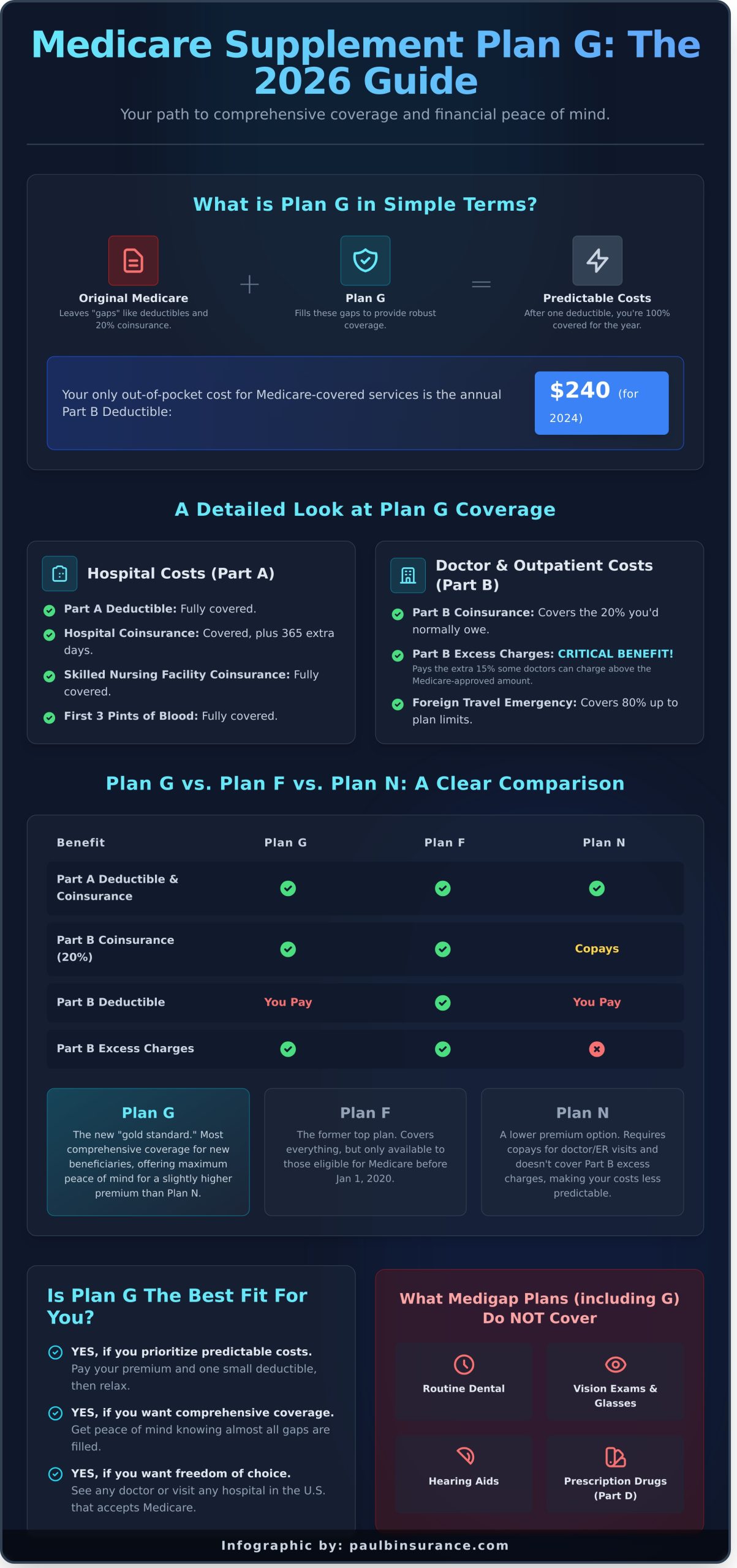
Plan G vs. Plan F vs. Plan N: A Clear Comparison
When you begin exploring your Medigap options, you’ll quickly find that Plans G, F, and N are the most frequently discussed. Understanding the subtle differences can feel overwhelming, but the choice often comes down to your personal budget and how you prefer to pay for your healthcare. Our goal is to provide straightforward guidance, moving you from confusion to confidence.
Each plan’s core benefits are standardized by the government. This means a Plan G from one company has the same basic benefits as a Plan G from another. The main differences are in monthly premiums and your share of the costs. Let’s compare them side-by-side.
Plan G vs. Plan F: The Only Difference
The comparison between Plan G and the now-discontinued Plan F is simple. There is only one difference: Plan F covers the annual Medicare Part B deductible, while Plan G does not. However, Plan F is only available to those who were eligible for Medicare before January 1, 2020. If you are eligible, the choice becomes a simple math problem. If the difference in annual premiums between the two plans is more than the Part B deductible, Plan G is often the more cost-effective choice.
Plan G vs. Plan N: Predictability vs. Lower Premiums
Plan N is a popular alternative for those seeking lower monthly premiums in exchange for more cost-sharing. While a medicare supplement plan g offers more predictable, comprehensive coverage, Plan N requires you to pay for a few things out-of-pocket:
- A copay of up to $20 for some office visits.
- A $50 copay for emergency room visits (if you aren’t admitted).
- Part B excess charges (which Plan G covers).
The choice here is about your comfort with risk. With Plan G, your costs are highly predictable. With Plan N, you save on your monthly premium but may have small, variable medical bills throughout the year.
Side-by-Side Comparison Chart
Here is a simple chart to help you visualize the key differences between these popular Medicare Supplement Insurance plans.
| Feature | Plan G | Plan F | Plan N |
|---|---|---|---|
| Part B Deductible | You Pay | Covered | You Pay |
| Part B Coinsurance | Covered 100% | Covered 100% | Covered 100% |
| Part B Excess Charges | Covered | Covered | Not Covered |
| Copays | None | None | Up to $20 (office), $50 (ER) |
| Monthly Premium | Medium-High | Highest | Lower |
How Much Does Medicare Supplement Plan G Cost?
One of the first questions on everyone’s mind is, “What will this plan actually cost me?” The straightforward answer is that there is no single price tag. While the benefits of every medicare supplement plan g are standardized by the government-meaning a Plan G from one company is identical to a Plan G from another-the monthly premiums are set by the private insurance companies that sell them.
This creates a marketplace where the exact same coverage can have wildly different costs. Understanding what influences these prices is the first step toward finding the best value without the confusion.
Factors That Determine Your Monthly Premium
Insurance companies look at several key factors when calculating your premium. The most significant ones include:
- Location: Your ZIP code is one of the biggest drivers of cost. Rates for the exact same plan can vary significantly from one county to the next.
- Personal Details: Your age when you enroll, your gender, and whether you use tobacco products will also affect your premium.
- Pricing Method: Companies use different models to set rates. Attained-age rated policies (the most common) start lower but increase as you get older. Issue-age rated policies are based on your age at purchase and won’t increase due to age, while community-rated policies charge everyone in a specific area the same premium, regardless of age.
Why Shopping with a Broker Saves You Money
With dozens of companies offering the same plan at different prices, how do you find the best value? This is where unbiased, expert guidance becomes essential. A captive agent who works for a single insurance company can only quote you their price. But an independent broker works for you, not for an insurance company.
Our role is to shop the market on your behalf, comparing rates from numerous highly-rated carriers to find the most competitive premium for your specific situation. This personalized service is provided at no cost to you. We are compensated by the insurance company you choose, so you get trusted advice and the best possible price without paying a fee. It’s the simplest way to ensure you aren’t overpaying for your coverage.
Ready to see what Plan G would cost for you? We can provide clear, side-by-side numbers to help you make a confident decision. Get your free, personalized Plan G quote comparison.
Is Medicare Supplement Plan G the Best Fit for You?
After reviewing the details, the final step is to decide if a medicare supplement plan g aligns with your personal needs. There is no single “best” plan for everyone; there is only the plan that provides the right balance of coverage and cost for you. Your decision often comes down to your financial goals and how much risk you’re comfortable with.
Let’s help you find clarity by looking at a few common profiles. See which one sounds most like you.
Who Should Choose Plan G?
Plan G is often the top choice for individuals who value predictability and comprehensive coverage above all else. You might be a great fit for Plan G if you:
- Want predictable healthcare costs. After paying your monthly premium and the annual Part B deductible, your Medicare-approved costs are covered. This makes budgeting for healthcare simple and stress-free.
- Prefer peace of mind over copays. If the idea of paying a copay for every doctor’s visit is unappealing, Plan G’s comprehensive coverage eliminates those small, recurring costs.
- Value freedom and flexibility. With Plan G, you can see any doctor or visit any hospital in the U.S. that accepts Medicare, with no network restrictions or referral requirements.
When a Different Plan Might Be Better
While an excellent option, Plan G isn’t for everyone. If you’re very budget-conscious and comfortable with some out-of-pocket costs, Plan N could be a better fit due to its lower monthly premium. In exchange, you would pay small copays for certain doctor and emergency room visits. Similarly, if you prefer an all-in-one plan that may include prescription drug coverage and other extras like dental, a Medicare Advantage plan might be worth exploring.
How to Enroll in Your Medigap Plan
The best time to enroll in any Medigap plan is during your Medigap Open Enrollment Period. This six-month window begins the month you turn 65 and are enrolled in Medicare Part B. During this time, you have “guaranteed issue rights,” meaning insurance companies cannot deny you coverage or charge you more due to pre-existing health conditions.
Navigating enrollment periods and comparing the dozens of insurance carriers can feel overwhelming. You don’t have to do it alone. Working with an unbiased expert ensures you can compare all your options clearly and make a decision with confidence. If you’re ready to move from confusion to clarity, we’re here to provide the trusted, personalized guidance you deserve. Visit us at paulbinsurance.com to get started.
Your Path to a Confident Medicare Decision
As we’ve seen, Plan G stands out for its comprehensive coverage, paying for nearly all of your Medicare-approved costs after you meet the single, annual Part B deductible. For many new beneficiaries, it strikes an ideal balance between robust protection and predictable out-of-pocket expenses, making it a powerful tool for managing healthcare costs in retirement.
Understanding these details is the first step, but choosing the right medicare supplement plan g from the dozens of options available can still feel like a challenge. The best plan for your neighbor isn’t necessarily the best one for your unique health needs and budget. This is where personalized, expert guidance makes all the difference.
You don’t have to navigate this maze alone. We’ve helped over 5,000 clients move from confusion to confidence by providing unbiased advice from 40+ top-rated carriers. Our expert guidance and lifetime support come at zero cost to you. Let’s find the right Plan G for you. Schedule your free, unbiased Medicare review today.
Making an informed choice is the key to peace of mind for the years ahead.
Frequently Asked Questions About Medicare Supplement Plan G
What is the difference between Plan G and High-Deductible Plan G?
Standard Plan G requires you to pay the annual Medicare Part B deductible yourself. After that, it covers 100% of its approved costs. The High-Deductible Plan G offers the exact same coverage, but only after you first meet a much larger annual deductible ($2,800 in 2024). This high-deductible option comes with a significantly lower monthly premium, making it a trade-off between your monthly budget and potential out-of-pocket expenses for care.
If I’m eligible for Plan F, should I still consider Plan G?
Even if you are eligible for the discontinued Plan F, it’s wise to compare it to Plan G. The only difference is that Plan F covers the annual Part B deductible, while Plan G does not. Often, the extra premium you pay for Plan F over a year is more than the deductible itself. By choosing Plan G and paying the small deductible out-of-pocket, you could save hundreds of dollars annually. We can help you run the numbers for your specific situation.
Can I switch from my Medicare Advantage plan to Medigap Plan G?
Yes, it is possible to switch, but the timing is critical. Unlike when you first enroll in Medicare, switching from an Advantage plan usually requires you to answer health questions (a process called medical underwriting). An insurance company can deny your application based on your health history. There are special circumstances, called “guaranteed issue rights,” that allow you to switch without underwriting. It’s vital to understand your rights before dropping your current plan.
Do Plan G benefits change from one insurance company to another?
This is a common point of confusion, but the answer is simple: no. All Medigap plans, including the medicare supplement plan g, are standardized by the federal government. This means a Plan G from one company offers the exact same medical benefits as a Plan G from any other company. The only differences you will find are the monthly premium, the company’s financial stability, and its customer service reputation. This is why shopping around with an expert is so important.
When is the best time to enroll in Medigap Plan G to get the best rates?
The absolute best time is during your 6-month Medigap Open Enrollment Period. This personal window starts on the first day of the month you are both 65 or older and enrolled in Medicare Part B. During this protected time, insurance companies cannot use medical underwriting. This means they cannot deny you coverage or charge you more due to your health history. It’s a one-time opportunity to enroll with complete freedom of choice and get the best rate.
Does Plan G cover foreign travel emergencies?
Yes, one of the valuable benefits of a medicare supplement plan g is its coverage for foreign travel emergencies. If you have a medical emergency during the first 60 days of a trip outside the U.S., the plan will pay 80% of your medically necessary costs after you meet a small $250 deductible. There is a lifetime maximum benefit of $50,000 for this coverage, providing significant peace of mind for those who love to travel.