
For years, you’ve likely heard that Plan G is the only safe bet for your health, but in 2026, the “obvious” choice could actually be the one that costs you an extra $400 per year in unnecessary premiums. We understand how overwhelming it feels to stare at a stack of insurance mailers while worrying about unexpected medical bills or the dreaded “excess charges” everyone warns you about. It’s frustrating to feel pressured by captive agents who only represent one company and won’t show you the full picture. You deserve a guide who simplifies the jargon and looks out for your wallet.
That’s why we’ve put together this honest look at medicare supplement plan n vs plan g to help you move from confusion to total confidence. We’ll break down the 2026 costs, coverage gaps, and hidden differences between these two popular options, including how the $257 Part B deductible affects your bottom line. We’re going to compare the real-world costs of small co-pays versus higher monthly premiums so you can decide which plan protects your savings best.
Key Takeaways
- Understand the “90% common ground” shared by these powerhouse plans and how they both protect you from the 20% coinsurance gaps Original Medicare leaves behind in 2026.
- We simplify the medicare supplement plan n vs plan g comparison by revealing the three specific areas where your out-of-pocket costs and “hidden” charges will diverge.
- Identify your “Medicare Personality” to see if the total peace of mind offered by Plan G or the lower monthly premiums of Plan N better fits your health needs and budget.
- Learn how to navigate the 2026 Medigap maze by comparing over 40 different carriers to find the lowest possible rate for your specific zip code.
- Discover our simple process for moving from a state of confusion to total confidence, ensuring you never feel rushed or pressured into a coverage decision.
Medicare Supplement Plan N vs. Plan G: Why These Two Dominate in 2026
Entering the Medicare system often feels like being dropped into a thick forest without a map. We see the stress and confusion this causes every day; it is our mission to clear away that noise. As we look at the options available in 2026, two specific paths stand out for almost everyone we help. Understanding the medicare supplement plan n vs plan g debate is the key to moving from a state of worry to a state of total confidence regarding your healthcare future.
Original Medicare provides a solid foundation, but it has significant financial holes. Think of it like a bridge with missing planks. A Medicare Supplement plan, also known as Medigap, acts as the repairs for those gaps. If you are asking What is Medigap?, it is private insurance designed to pay the costs that Medicare Parts A and B leave behind, such as the 20% coinsurance and various deductibles. We focus on Plan G and Plan N because older options like Plan F have been closed to new enrollees since January 1, 2020. This makes G and N the modern gold standards for reliable coverage.
The 2026 Medigap Landscape
The federal government standardizes these plans to protect you. This means the medical benefits for a Plan G with one insurance company are identical to a Plan G with any other company. The only differences you will find are the monthly premium prices and the company’s reputation for customer service. Because the coverage is locked in by law, you don’t need to worry about hidden fine print. We recommend working with an independent medicare broker to compare these prices. An independent expert looks at every carrier in your specific zip code to ensure you aren’t overpaying for the exact same protection.
Why Plan G and Plan N are the “Final Two”
In our experience helping thousands of seniors, about 95% of clients find their best fit in one of these two options. We rarely suggest plans like K, L, or M because the math usually doesn’t work in the client’s favor over the long term. Here is how the “final two” break down:
- Plan G: This is the comprehensive choice. Once you pay your annual Part B deductible, you have zero out-of-pocket medical bills for Medicare-covered services. It offers total peace of mind for those who want to know their exact costs.
- Plan N: This is the value choice. It features lower monthly premiums in exchange for small copays, such as up to $20 for a doctor visit or $50 for an emergency room trip. It is perfect if you want to save on premiums and don’t mind a little cost-sharing.
We simplify the jargon so you know exactly how your coverage works. You deserve a plan that feels like a safety net, not a source of anxiety. By focusing on these two options, we can help you steer clear of costly enrollment mistakes and late penalties that often plague those trying to go it alone.
The Foundation: What Both Plan G and Plan N Cover for You
We know the Medicare system often feels like a crazy maze. Choosing between medicare supplement plan n vs plan g doesn’t have to be a source of stress. These two plans are actually more alike than they are different. In fact, they share about 90% of the same DNA. Both plans are designed to step in where Original Medicare stops, specifically protecting you from the 20% coinsurance that can otherwise drain your savings.
Whether you choose Plan G or Plan N, you gain the freedom to see any doctor in the United States who accepts Medicare. There are no networks to worry about and no referrals required. This nationwide portability is a cornerstone of the peace of mind we want you to have. You can travel from state to state with the confidence that your coverage travels with you. Understanding these shared benefits is the first step in deciding which path in the medicare supplement plan n vs plan g comparison fits your lifestyle.
Hospital and Medical Protection
Both plans offer rock-solid security for your most expensive medical needs. If you are admitted to the hospital in 2026, both Plan G and Plan N cover your Part A coinsurance and provide coverage for an additional 365 days after your Medicare benefits are exhausted. We want you to focus on recovery, not a stack of hospital bills.
These plans also provide several other essential protections:
- Coverage for the first three pints of blood you might need each year.
- Full coverage for Part B coinsurance (though Plan N has small copays for some visits).
- Coverage for the daily co-payment for skilled nursing facility care for days 21 through 100.
You can see how these benefits align by looking at the official Medicare comparison chart to verify the standardized levels of care.
What These Plans Do NOT Cover
While these plans are powerful, they aren’t “catch-all” solutions. It’s a common mistake to assume Medigap covers every health expense. For instance, neither plan includes dental, vision, or hearing services. You also need to remember that you must keep your Original Medicare Parts A and B as your primary insurance.
In 2026, the Part B deductible, which is projected to be approximately $270, is your responsibility on both plans. Additionally, neither plan includes Medicare Part D prescription drug coverage. You’ll need a separate plan for your medications to avoid late enrollment penalties. We help you piece these parts together so your coverage is seamless. If you feel overwhelmed by the options, you can always view our simple guide to Medigap to clear up any remaining confusion.
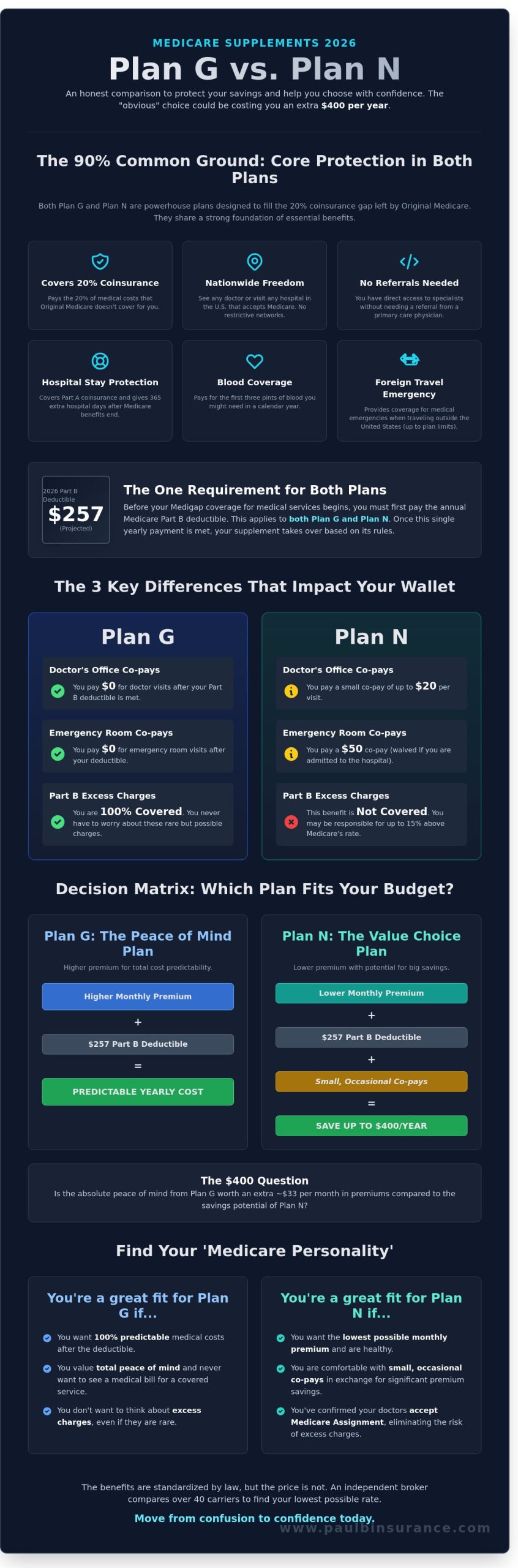
The Crucial Differences: Copays, Excess Charges, and Your Wallet
Choosing between these plans often feels like a puzzle. We want to help you see the full picture so you can decide with confidence. While both plans cover your major medical gaps, the way you pay for smaller services differs. When we look at the medicare supplement plan n vs plan g choice, we focus on where your money goes after you pay the Part B deductible. Plan G offers a “set it and forget it” approach, while Plan N requires a bit more involvement from you in exchange for a lower monthly bill. Understanding the medicare supplement plan n vs plan g cost structure helps you move from confusion to confidence.
The Plan N Copay Structure
Plan N introduces small out-of-pocket costs at the doctor’s office. You’ll pay up to $20 for some office visits, including trips to see specialists. If you head to the emergency room, there is a $50 copay; however, this is waived if the hospital admits you to stay. We often see clients worry about these costs, but it’s helpful to know that telehealth visits and most lab work don’t trigger these copays. You can see how these benefits stack up against other options by viewing the official Medicare comparison chart. If you prefer a plan with zero copays, Plan G remains the standard choice for Medigap coverage.
Part B Excess Charges: Myth vs. Reality
This is often called the “boogeyman” of Medicare. An excess charge happens if a doctor doesn’t “accept assignment,” which means they charge up to 15% more than the Medicare-approved rate. Plan G covers these charges 100%. Plan N doesn’t cover them at all. In 2026, 96% of doctors nationwide still accept Medicare assignment. You can avoid these charges entirely by simply asking your doctor if they accept assignment before your appointment. It’s a simple step that protects your savings without requiring a higher premium.
Premium Savings: The Plan N Advantage
In 2026, we see Plan N premiums running $25 to $45 lower per month than Plan G across major carriers. This adds up to $300 or $540 in annual savings. To find your break-even point, you just divide your annual premium savings by the $20 copay amount. If you save $400 a year but visit the doctor 10 times, you still come out $200 ahead with Plan N. Plan N is a cost-sharing model that rewards those who visit the doctor less frequently. We find that for many healthy seniors, these savings far outweigh the occasional small copay.
Decision Matrix: Is Plan G or Plan N the Right Financial Move for You?
Choosing between these two popular options often comes down to your “Medicare Personality.” We find that most seniors fall into one of two camps. One group values total predictability and wants to know their healthcare costs are capped. The other group prefers to take on a small amount of risk to keep their monthly fixed expenses as low as possible. In 2026, the choice is more than just a math problem; it’s about how you want to feel every time you open your mailbox.
Choose Plan G If…
You should select Plan G if you want the simplest experience Medicare offers. This plan is the gold standard for those who see specialists, such as cardiologists or physical therapists, multiple times a month. In 2026, the Part B deductible is projected at $275. Once you pay that initial amount, you won’t see another medical bill for the rest of the calendar year. We recommend this for clients who want to know their exact maximum out-of-pocket cost and don’t want to worry about small copays at every office visit.
Choose Plan N If…
Plan N is the “Budget Optimizer” approach. It’s a fantastic fit if you’re generally healthy and your medical visits are limited to annual checkups or occasional minor issues. You’ll pay a lower monthly premium than you would with Plan G. In exchange, you agree to pay a copay of up to $20 for doctor visits and $50 for emergency room visits. If Plan N saves you $35 a month in premiums, that’s $420 a year. If you only see the doctor three times, you’re keeping over $300 in your pocket. You just need to verify that your providers accept Medicare assignment to avoid Part B excess charges.
The Underwriting Trap
We often hear clients ask if they can start with Plan N and switch to Plan G if their health declines later. This is a risky strategy that can lead to a dead end. In 2026, most states still require you to pass a medical health questionnaire to switch plans after your initial six-month enrollment window. If you develop a chronic condition like diabetes or heart disease, an insurance company can legally deny your application. We’ve seen many people get stuck in a plan because they didn’t realize that “switching later” isn’t guaranteed. Picking the right plan the first time is vital for your long-term financial security.
We’re here to help you weigh these costs so you can make a choice with total confidence. You can explore your options further in our comprehensive Medigap guide.
Navigating the Medigap Maze: How We Find Your Perfect Match
Choosing between medicare supplement plan n vs plan g shouldn’t feel like a high-stakes gamble. At The Modern Medicare Agency, we act as your personal guide through the 2026 insurance landscape. We use a proprietary 5-step process to move you from confusion to confidence. We start by listening to your specific health concerns, then we educate you on the latest 2026 rules. Next, we run your zip code through our database of over 40 carriers to find the lowest possible rate. We then present a side-by-side comparison and finally assist with a seamless enrollment. Our approach is always “never rushed, never pressured” because we want you to feel empowered, not pushed.
We know the Medicare system feels like a maze in 2026. Rates can fluctuate based on where you live, and what worked for your neighbor might not be the best value for you. By comparing dozens of companies simultaneously, we often find price differences of $40 to $60 per month for the exact same level of coverage. We simplify the jargon so you know exactly how your benefits work before you ever sign a document. Our goal is to remove the anxiety from the process and replace it with the security of a well-informed decision.
Independent Broker vs. Captive Agent
A captive agent is tied to a single insurance company. They can only offer you what that one company sells, even if a better rate exists right across the street. Because we are independent, we offer unbiased guidance. We show you the whole pie, not just one slice. Since Medigap plans are standardized by the government, a Plan G from one carrier provides the exact same medical coverage as a Plan G from another. We make sure you don’t overpay for the same benefits. Our relationship with you lasts longer than a single phone call. We offer year-round support to help you navigate any billing questions or plan changes that arise throughout the year. You can learn more about how these standardized options work on our Medigap options page.
Your Next Steps for 2026
Getting started is the easiest part of your day. You can request a personalized comparison to see exactly how medicare supplement plan n vs plan g looks for your budget this year. When you consult with Paul Barrett or our dedicated team, you’ll find a patient advocate ready to answer every question. We’ll look at your 2026 health needs and find a plan that fits your lifestyle. Medicare stops being a crazy maze the moment you have an expert by your side. You deserve to feel certain about your future and protected from unexpected medical bills. Schedule a Call With Paul to find your best fit and secure your peace of mind for 2026.
Moving From Confusion to Confidence in Your 2026 Coverage
Choosing between medicare supplement plan n vs plan g doesn’t have to be a stressful ordeal. We know that in 2026, Plan G remains the gold standard for those who want zero out of pocket costs after their Part B deductible is met. On the other hand, Plan N is a fantastic way to keep your monthly premiums roughly 20% lower if you’re comfortable with occasional $20 office visit copays. We focus on making these details simple so you can stop worrying about medical bills.
Our team gives you access to over 40 top-rated insurance carriers and uses a proven 5-step process to ensure you aren’t overpaying. As licensed independent brokers, we provide unbiased guidance that puts your needs first. We aren’t tied to any single company, which means we work for you, not the insurance giants. You deserve clarity and a plan that actually fits your budget without any hidden surprises.
Schedule a Call With Paul to Compare 2026 Plans
We are here to protect your future and make sure you feel completely secure in your decision every step of the way.
Frequently Asked Questions
Is Plan G better than Plan N?
Plan G isn’t necessarily better; it simply offers more comprehensive coverage in exchange for a higher monthly premium. For 2026, Plan G covers 100% of your medical bills after you meet the annual deductible. We find that Plan N is often the smarter choice for healthy seniors who don’t mind paying small copays to save roughly $25 to $40 per month on their premiums. This choice provides the same high-quality access to care while keeping more money in your pocket.
Does Plan N cover the Part B deductible in 2026?
No, Plan N doesn’t cover the Medicare Part B deductible. In 2026, every beneficiary must pay the first $257 of their outpatient costs before the supplement starts paying. This is a standard rule for all new Medigap plans sold to those who became eligible for Medicare after January 1, 2020. We help you budget for this one-time annual expense so there aren’t any surprises during your first doctor visit of the year.
How much are the copays for Medicare Plan N?
You’ll pay a copay of up to $20 for every office visit and up to $50 for an emergency room visit that doesn’t result in an inpatient stay. These are the only two types of copays you’ll face with Plan N. When comparing medicare supplement plan n vs plan g, these small costs are the main reason Plan N premiums stay lower and more stable year after year. Most of our clients find these small fees are easy to manage.
Can I see any doctor with Medigap Plan N?
Yes, you can see any doctor or visit any hospital in the United States as long as they accept original Medicare. There aren’t any networks to worry about and you never need a referral to see a specialist. Over 90% of doctors across the country accept Medicare patients. This freedom gives you the confidence to travel or see the best specialists without asking an insurance company for permission first. We want you to have total control over your healthcare.
What are Part B excess charges, and should I worry about them with Plan N?
Part B excess charges are additional fees of up to 15% that a doctor can charge if they don’t accept assignment as full payment. While Plan N doesn’t cover these, they’re extremely rare in 2026. Data shows that 96% of doctors nationwide accept Medicare assignment as full payment. We can help you check your specific doctors to ensure they won’t charge these fees, making Plan N a very safe and affordable option for your budget.
Is it hard to switch from Plan N to Plan G later?
Switching from Plan N to Plan G usually requires you to pass a medical background check in most states. Unless you live in a state with birthday rules like California or Oregon, an insurance company can deny your application based on your health history. We recommend choosing the plan you’re comfortable with long-term. This avoids the stress of being locked into a plan if your health changes significantly in the future and you need more coverage.
Does either plan cover dental or vision care?
Neither Plan N nor Plan G includes coverage for routine dental, vision, or hearing services. These plans are designed strictly to fill the gaps in original Medicare Part A and Part B. To get coverage for cleanings or eyeglasses, we suggest adding a separate stand-alone policy. This keeps your medical coverage simple and ensures you have dedicated benefits for your teeth and eyes without complicating your core health insurance. We can help you find a simple add-on plan.
Why are the premiums different between insurance companies if the plans are standardized?
Even though the benefits for medicare supplement plan n vs plan g are identical across every company, each insurer sets its own prices based on their administrative costs and claims history. One company might charge $130 for Plan G while another charges $175 for the exact same coverage. We use our unbiased tools to compare these rates for you, ensuring you don’t pay extra for the same peace of mind. Our goal is to find you the lowest price available.