



Medicare Plan G vs Plan N
Which Medicare Supplement Plan Is Right for You?
Choosing a Medicare Supplement plan isn’t just about price it’s about how often you use care, how predictable you want your costs to be, and how your coverage may change over time.
Two of the most popular options are Plan G and Plan N. Both offer excellent protection, but they fit different lifestyles, budgets, and long-term needs. Let’s break it down in a clear, simple way so you can choose with confidence.
What Plan G and Plan N Have in Common
Both plans:
- Work with Original Medicare
- Cover the Part A hospital deductible
- Include foreign travel emergency benefits
- Let you see any doctor nationwide who accepts Medicare
- Cover skilled nursing coinsurance
- Do not include prescription drug coverage
The main differences come down to monthly cost, copays, and long-term rate trends.
Coverage Comparison
| Feature | Standard | Ultimate |
|---|---|---|
| Hospital costs (Part A) | ✓ | ✓ |
| Part A coinsurance | ✓ | ✓ |
| Part B coinsurance | ✓ | Yes (up to $20 copay) |
| Part A hospice care coinsurance | ✓ | ✓ |
| Skilled nursing facility coinsurance | ✓ | ✓ |
| Foreign travel emergency | ✓ | ✓ |
| Doctor visits copay | No copays | Up to $20 |
| Emergency room copay | No copay | Up to $50 |
| Part B excess charges | ✓ | ✕ |
| Part B deductible | ✕ | ✕ |
Plan Details at a Glance
Plan G
"Maximum Coverage"
Average Monthly Premium
$165–$200
Varies by age, location, and carrier

What You Pay
Only the Part B deductible ($282 in 2026)

Rate Increase History
~9.0% average annual increases. Richer coverage leads to higher claims and faster rate growth.
Best For:
- Visit doctors often
- Want predictable costs
- Prefer simplicity
- Don't like medical bills
- Budget certainty is a priority
- Specialists who may charge excess fees
Plan N
"Value & Flexibility"
Average Monthly Premium
$130–$165
$20–40/month LESS than Plan G
What You Pay
- Part B deductible ($282 in 2026)
- Up to $20 copay per doctor visit
- Up to $50 copay for ER (waived if admitted)
Rate Increase History
~8.2% average annual increases. Copay structure reduces utilization — more stable rates over time.
Best For:
- Are generally healthy
- Want lower premiums
- Don't mind small copays
- Visit doctors less often
- Want better long-term rate stability
- Doctors accept Medicare assignment (no excess charges)
Why Your First Plan Choice Matters

Many people assume: "I can always switch later."
In most states, changing plans later requires:
- Health questions
- Medical underwriting
- Possible denial
- Higher rates
That's why choosing the right plan from the start is important.
Enrollment Periods

Guaranteed Acceptance
You have guaranteed acceptance when:
- You're 65+
- You have Medicare Part B
- You're within your 6-month Medigap Open Enrollment Period
During this time:
- No health questions
- No denials
- Best rates
State Rules Matter More Than You Think

Guaranteed Issue States
New York, Connecticut, Maine, Massachusetts
- Change plans anytime
- No health questions
- No denials
Plan N is often popular here because flexibility is built in.
Birthday Rule States
California, Oregon, Nevada, Illinois & others
- Yearly window to switch
- No underwriting for same or lower plans
This gives you extra flexibility.

Most Other States
Standard underwriting rules apply
- Switching requires underwriting
Your first decision is more important.
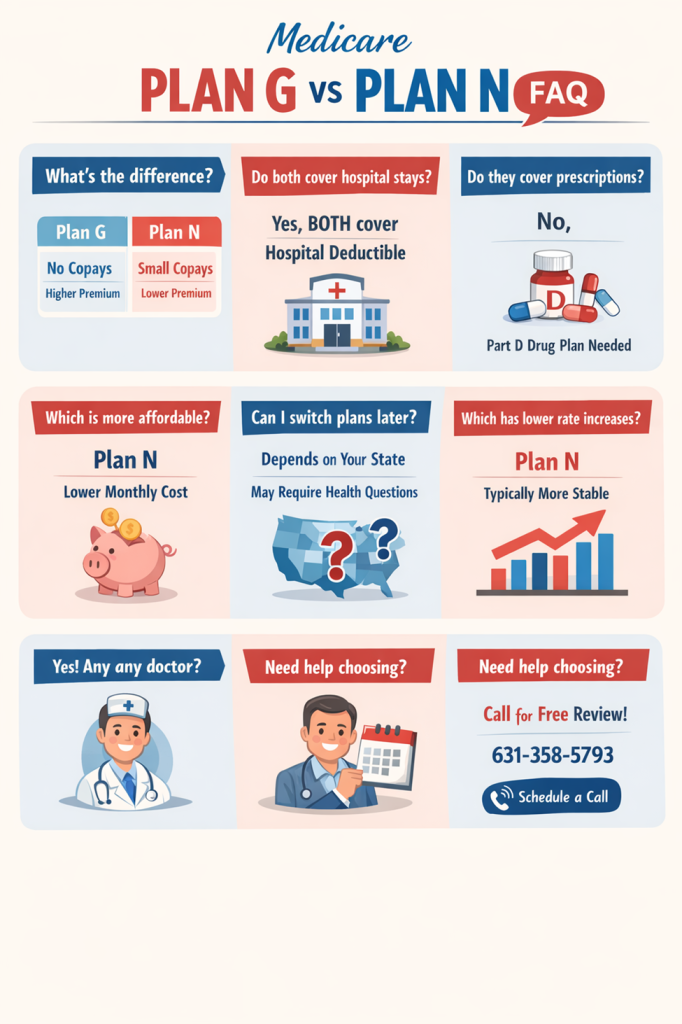
Frequently Asked Questions
Plan G offers more complete coverage with no copays for doctor or emergency room visits. Plan N has lower monthly premiums but includes small copays when you use care. Both plans cover major hospital costs and work nationwide with doctors who accept Medicare.
For many people, yes. Plan G is popular with those who visit doctors often, want predictable costs, prefer simplicity, and don’t like surprise medical bills. If you value peace of mind over the lowest price, Plan G can be a great fit.
Plan N is often chosen by healthier individuals, people who rarely visit doctors, those who want lower monthly premiums, and people comfortable with small copays. It still provides strong hospital protection while keeping premiums lower.
Yes. Both Plan G and Plan N fully cover the Part A hospital deductible and hospital coinsurance. This means major hospital expenses are well protected under either plan.
No. Medicare Supplement plans do not include prescription drug coverage. You’ll need a separate Medicare Part D plan for medications.
That depends on your state and timing. In most states, switching later requires medical underwriting and health conditions can affect approval. In states like New York, Connecticut, Maine, and Massachusetts, you can change plans anytime without health questions. Some states also have Birthday Rules that allow limited annual plan changes.
Medical underwriting means the insurance company can ask about your health. They may review chronic conditions, surgeries, hospitalizations, medications, and mobility issues. Your health can affect approval and pricing.
Your best window is your 6-month Medigap Open Enrollment Period, which starts when you are 65 or older and enrolled in Medicare Part B. During this time: no health questions, no denials, and best rates.
Historically, Plan N has experienced slightly lower rate increases than Plan G in many markets. Plan G’s richer coverage often leads to higher claims, which can result in higher future increases. Plan N typically sees 8.2% average annual increases versus Plan G’s 9.0%.
Not at all. Plan N’s copays are modest: up to $20 for doctor visits and up to $50 for ER visits (waived if admitted). For people who don’t use care often, these costs are usually manageable.
Yes. Both plans allow you to see any doctor nationwide who accepts Medicare — no referrals, no networks.
The right plan depends on your health, your budget, how often you see doctors, your state’s rules, and your long-term goals. A quick review can help you avoid costly mistakes.
Want Help Choosing the Right Plan?
You don’t have to figure this out alone. I’ll help you compare plans, review rate trends, understand state rules, avoid costly mistakes, and choose confidently.
No pressure. Just clear, honest guidance.
