




Wondering what prior authorization in Medicare is? In 2026, it’s a review of certain care or medication before the service is provided. A provider submits the request with supporting medical records, and a reviewer decides whether it meets coverage requirements. It can feel like another hurdle, but understanding how the review works can make the process less confusing.
Prior authorization rules depend on your Medicare coverage and the care or medication involved. Original Medicare generally doesn’t require it for Part A and Part B, although selected services and items do. Medicare Advantage and Part D plans may also require prior authorization.
This guide explains how requests and supporting documentation are reviewed, what may happen after a decision, and when Original Medicare requires prior authorization. You’ll learn what to expect and why the rules differ across Medicare coverage.
Key Takeaways
- Prior authorization rules depend on your Medicare coverage and the care or medication involved. Knowing which type of coverage you have helps clarify what review may apply.
- Requests rely on supporting medical documentation, and missing or incorrect details can slow the review or affect its outcome.
- A decision before care is provided is not always the final payment decision; other claim requirements may still apply.
- Original Medicare generally does not require prior authorization for most Part A and Part B care, but specific services and equipment are exceptions.
- Medicare Advantage and Part D plans may have their own review requirements, so understanding plan rules can help you anticipate the next step.
What Is Prior Authorization?
In 2026, prior authorization is a review of certain care or medication before it is provided. Medicare Advantage and Part D rules can differ, so your coverage type matters.
Medicare Advantage and Part D Authorization
With Medicare Advantage, prior authorization means the plan reviews a provider’s request before certain services. Part D plans may review a prescription before covering it. These requirements can affect when care or medication moves forward. For example, a plan may review a drug if a lower-cost or safer alternative is available.
Medicare Advantage plans must follow traditional Medicare national and local coverage determinations when those criteria exist. They can’t create their own internal coverage criteria in those cases. According to the Centers for Medicare & Medicaid Services, Medicare Advantage plans must provide a 90-day transition period during which new enrollees are protected from prior authorization requirements for certain services.
Reform is also part of the 2026 picture. In June 2025, private health insurers, including Medicare Advantage insurers, committed to begin steps to streamline, simplify, and reduce prior authorization in 2026 and 2027. The commitment concerns changes over those years; it doesn’t mean every plan has identical requirements.
Services and Items Requiring Authorization
Depending on the plan and request, authorization may apply to services, procedures, prescription drugs, or medical equipment. Medicare Advantage plans may require review for specialist visits, out-of-network care, and non-emergency hospital care. Part D plans may review a drug when a safer or lower-cost alternative exists, or when coverage could fall under Medicare Part A or Part B.
Emergency care doesn’t need prior authorization. For urgent care, a patient or provider can request an expedited review. According to the Centers for Medicare & Medicaid Services, a Medicare Advantage plan must make an expedited appeal decision within 72 hours if a doctor deems that waiting may jeopardize the patient’s health.
Medigap policies don’t add prior authorization requirements for services covered by Original Medicare. This helps explain why a Medicare Supplement policy and a Medicare Advantage plan may handle reviews differently.
Checking Authorization Requirements
To find out whether a service needs authorization, check your plan’s coverage documents or ask the plan about the specific service or medication. Your provider can confirm which records are needed and submit the request. For Medicare Advantage, follow the plan’s rules; for Part D, check the drug’s coverage requirements.
If a Medicare Advantage plan denies a request, you may appeal and ask for another review. Your provider can submit additional information, such as records explaining why the requested care is needed. Follow the appeal instructions in the denial notice and include relevant information about the service or prescription.
Submitting requests and supporting medical documentation
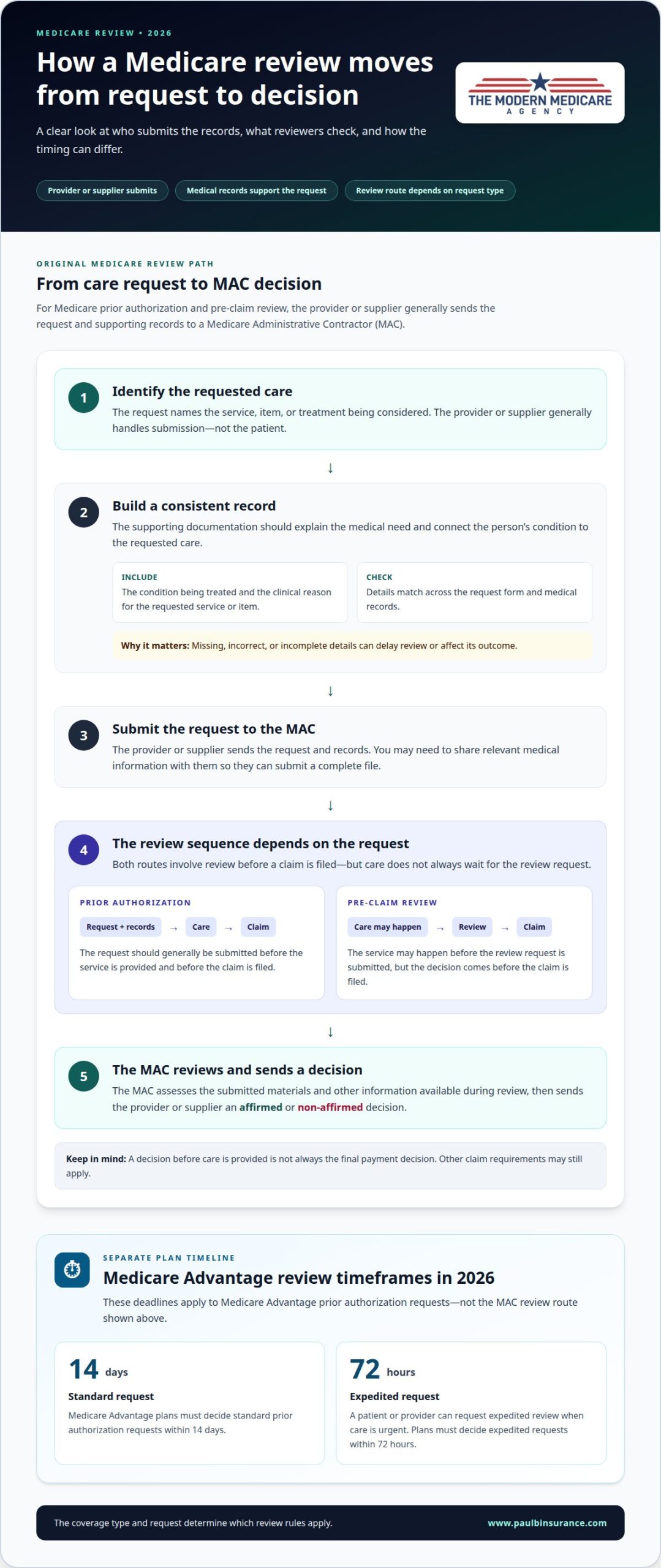
In 2026, a Medicare prior authorization request pairs a service request with records supporting its medical need. The review path depends on the coverage and request type.
Request Types and Review Timeframes
Requests may receive standard or expedited review, depending on how urgently care is needed. In 2026, Medicare Advantage plans must decide standard prior authorization requests within 14 days and expedited requests within 72 hours. A patient or provider can request expedited review when care is urgent.
Original Medicare processing times vary by request type. In 2022, outpatient prior authorization requests took an average of 4.5 days, while durable medical equipment requests averaged 4.7 days. Non-emergency ambulance requests averaged 4.1 days that year. These are historical averages, not a 2026 processing-time promise. The request type and submitted information affect review.
Submitting a Request
For Medicare prior authorization and pre-claim review, providers and suppliers send requests and supporting medical documentation to their Medicare Administrative Contractor, or MAC. A prior authorization request should generally be submitted before the service is provided and the claim is filed. The MAC reviews the materials and sends the provider or supplier an affirmed or non-affirmed decision.
Pre-claim review follows a different sequence: a provider or supplier may provide the service before submitting the review request, but receives a decision before filing the claim. So “before the claim” doesn’t always mean “before care.” The MAC assesses the submitted materials and other information available during review.
Required Information and Documentation
Supporting records should identify the requested service, item, or treatment and explain why it’s medically needed. The provider’s documentation should connect your condition to the requested care. For example, records may describe the condition being treated and the clinical reason for requesting a specific item or service.
Details should also match across the request form and medical records. Incorrect or incomplete information can delay review or contribute to a denial. If a relevant record is missing, the reviewer may not have enough information to assess medical need. Clear, consistent documentation gives the MAC a fuller basis for its decision.
Who Submits the Request
The provider or supplier generally submits the Medicare prior authorization request, not the patient. They send the request and supporting medical documentation to the MAC. You may need to share relevant medical information with your provider, who handles submission and receives the MAC’s decision.
If the decision is non-affirmed, the provider can review the stated reason and submit additional supporting information through the applicable process. Medicare Advantage plans follow their own request processes and instructions. Understanding plan coverage can help put the review in context, and Medicare Advantage plan guidance explains how this coverage works.
How prior authorization works in Medicare
Medicare authorization connects a coverage review to a planned service, item, or treatment. The decision helps determine whether the request meets the rules before the claim is processed.
The Authorization Process in Medicare
For a request that needs review, the reviewer compares the submitted information with coverage rules and checks whether the service is medically necessary. The result may be affirmed or non-affirmed. An affirmed decision supports the request; a non-affirmed decision means the submitted information didn’t support approval.
In some prior authorization processes, a decision and its tracking information are valid for a limited time, but the details depend on the initiative. A provisional affirmation gives the provider or supplier some assurance that payment may be made for the item or service. It isn’t a final payment decision: the claim can still be denied for billing or paperwork requirements checked after submission, or for information that wasn’t available during the review.
The claim stage still matters. The provider must meet the billing and paperwork requirements when filing the claim. A favorable authorization decision applies to the request that was reviewed, but doesn’t replace those later checks. For example, a claim may have a separate billing issue even after the requested service received an affirmative review.
Effects on Coverage, Costs, and Care Access
Can Medicare prior authorization affect coverage, out-of-pocket costs, or access to care? Yes. Authorization may be required for payment, and a plan may deny a claim if required authorization wasn’t obtained, even if the service would otherwise be covered. A denial can affect whether Medicare pays and how much you may have to pay.
Authorization can also affect when a service takes place. Under a prior authorization process, a provider may need to wait for a decision before providing care. This can affect access, especially when the requested service relates to a serious condition or hospital care. The review doesn’t change existing requirements for medical necessity or paperwork.
A denial is a review outcome, not necessarily the end of the process. For Medicare Advantage, a member may appeal and ask for another review, including by providing additional information from the provider. If a doctor determines that waiting may put the patient’s health at risk, a decision on an expedited appeal is required within 72 hours, according to the Centers for Medicare & Medicaid Services.
When a request is affirmed, the provider should still keep the tracking number, called a Unique Tracking Number (UTN), and the decision with the claim record. They shouldn’t treat them as a guarantee of payment. If a request is non-affirmed, the reason given can show what the review didn’t support. Keeping the decision letter, related records, and claim details together helps clarify the next step.
Original Medicare prior authorization requirements
Original Medicare generally doesn’t require prior authorization for Part A and Part B services. Some specific services and items are exceptions, so the requirement depends on what care is requested.
In 2026, a prior authorization requirement is not a general rule for every Original Medicare service. Traditional Medicare beneficiaries can generally see specialists, visit hospitals, and receive care out of state without asking Medicare’s permission. Emergency care doesn’t need prior authorization. A federal review initiative applies only to selected services and items.
Original Medicare began adding prior authorization requirements for some services in 2020. Current initiatives include certain hospital outpatient department services, repetitive scheduled non-emergency ambulance transport, and selected durable medical equipment, prosthetics, orthotics, and supplies. These categories don’t mean every hospital service, ambulance ride, or medical supply requires review.
For example, prior authorization may be required before getting a Medicare-covered power wheelchair or scooter in designated states. The process also applies to certain durable medical equipment items. Whether a request is needed depends on the item and applicable initiative. A prescription drug isn’t automatically subject to Original Medicare prior authorization just because it was prescribed.
Another initiative, the WISeR Model, targets selected services and items considered especially vulnerable to fraud, waste, abuse, or inappropriate use. Examples include certain wound-care skin and tissue substitutes, electrical nerve stimulator implants, knee arthroscopy for knee osteoarthritis, and epidural steroid injections. These are specific clinical categories, not a blanket review of all treatment for those conditions.
Historical approval rates show why the request type matters. In 2022, Original Medicare approved 78.6 percent of outpatient prior authorization requests. It approved 66.9 percent of durable medical equipment requests and 63.2 percent of non-emergency ambulance requests. These figures describe different request groups in 2022; they don’t establish the result for an individual request in 2026.
Prior authorization doesn’t replace existing medical necessity or documentation requirements. The provider still needs to show why the service or item meets Medicare coverage rules. A non-affirmed decision means the submitted information didn’t support approval through that review. It doesn’t create a new clinical standard for the requested care.
Medigap policies don’t add prior authorization requirements for services covered by Original Medicare. Medicare Advantage and Part D are different coverage arrangements, and their plans may require authorization under their rules. Knowing whether you have Original Medicare or another type of coverage helps clarify which requirements apply.
What services, procedures, drugs, and medical equipment require Medicare prior authorization?
In 2026, authorization depends on the Medicare coverage and the specific service, item, or drug. Original Medicare uses limited initiatives, while Medicare Advantage and Part D plans may set plan-specific review requirements.
Original Medicare services and equipment
Original Medicare initiatives apply to selected services, not every procedure or piece of equipment. Examples include certain hospital outpatient department services, repetitive scheduled non-emergency ambulance transport, and certain durable medical equipment, prosthetics, orthotics, and supplies. The specific item or service determines whether an initiative applies.
For power mobility devices, prior authorization is required before obtaining a Medicare-covered power wheelchair or scooter in listed states. The ambulance initiative has a separate trigger: an ambulance company may request authorization before a beneficiary’s fourth round trip in a 30-day period. That rule concerns the listed demonstration, not every ambulance trip.
For hospital outpatient care, the Medicare initiative applies to certain services, not all outpatient procedures. The WISeR Model also targets selected items and services considered vulnerable to fraud, waste, abuse, or inappropriate use. Examples include certain wound-care skin and tissue substitutes, electrical nerve stimulator implants, knee arthroscopy for knee osteoarthritis, and epidural steroid injections.
Medicare Advantage and Part D plan requirements
Medicare Advantage plans may require authorization for inpatient hospital care, skilled nursing facility care, and chemotherapy. They may also review specialist visits or out-of-network care. When traditional Medicare has national or local coverage determinations, a plan must apply those criteria rather than create its own internal criteria.
Part D plans may require approval for a prescription drug when a lower-cost or safer alternative is available. Review may also apply when coverage could fall under Medicare Part A or Part B, depending on the circumstances. The drug’s name alone doesn’t determine whether review is required; the plan’s coverage rules and the prescription circumstances matter.
What the requirement means in practice
Authorization applies to specific services, items, or drugs, not automatically to an entire diagnosis or course of treatment. For example, a covered wheelchair may require review even when other equipment doesn’t. Similarly, a Part D plan may review one medication while covering another without that requirement.
Keep the differences between coverage types in mind. Original Medicare’s limited initiatives differ from Medicare Advantage and Part D plan rules. A Medicare Advantage plan may also require confirmation that ongoing services or medications continue to help. That review can affect continuing care, not just the initial request.
If you’re weighing how plan rules may affect your Medicare coverage, explore your Medicare plan options.
The Modern Medicare Agency
The Modern Medicare Agency helps you compare Medicare coverage options when prior authorization rules raise questions about which plan may fit your needs. Its independent guidance covers Medicare Advantage, Medicare Supplement (Medigap), and Part D plans from multiple carriers, so you can understand how coverage choices differ as you consider your care and prescriptions.
This support can help when you’re weighing plan rules alongside provider access, drug coverage, or the services you expect to use. The agency offers personalized, unbiased guidance so you can make an informed choice without pressure to select a particular plan.
Take Your Next Medicare Coverage Step
Understanding prior authorization in Medicare can help you approach coverage decisions with clearer expectations. Your next step is to connect that understanding to the care and prescriptions that matter to you. Consider how your coverage fits your health needs, preferred providers, and medication routine to make choices with greater confidence.
Plan differences can be difficult to sort through alone. The Modern Medicare Agency offers guidance on Medicare Advantage, Medicare Supplement (Medigap), and Part D plans, helping you compare options in light of your priorities. A free consultation can help you identify what you want to understand before making a coverage decision.
Connect with The Modern Medicare Agency to discuss your Medicare questions. You can take the next step at your own pace, with a clearer sense of what matters to you.
Frequently Asked Questions
What if my health plan has concerns with a proposed treatment or medication?
The plan may ask for more clinical information, suggest an equally safe and effective lower-cost option, or deny the request. For a medication, some plans may ask you to try a less expensive drug first. If that drug doesn’t work or causes side effects, the prescriber can explain why another treatment is needed. If the plan denies the request, follow the appeal instructions and provide relevant supporting records.
What is medically necessary?
Medically necessary care is treatment or a service that meets the applicable coverage requirements for your health needs. Reviewers consider the condition being treated and the clinical information supporting the request. For Original Medicare services, prior authorization doesn’t replace existing medical necessity or documentation requirements. For example, records can explain why a medical item is appropriate for a specific condition and why that option is needed.
When to Submit?
When the applicable process requires prior authorization, submit the request before the service is provided and before the claim is filed. The provider or supplier usually sends it with supporting medical records. If care is urgent, you or your provider can request an expedited review. For Medicare Advantage, the plan’s instructions explain how to request a faster review and what information to provide about the urgency.
What does prior authorization mean in Medicare?
Prior authorization means a review takes place before certain care, equipment, or medication is covered through a specific Medicare arrangement. The reviewer assesses the request and supporting information against applicable coverage criteria. It isn’t a universal requirement for every Medicare service. For example, a plan may review a prescription before covering it, while a different service under the same coverage may not need advance review.
Which Medicare parts and plans require prior authorization?
Original Medicare generally doesn’t require prior authorization for most Part A and Part B care, though selected services and items are exceptions. Medicare Advantage plans may require it for certain services, and Part D plans may require it for some prescription drugs. Medigap doesn’t add authorization requirements for services covered by Original Medicare. The coverage type and specific service or medication determine which rules apply.
How does prior authorization work in Original Medicare compared with Medicare Advantage?
Original Medicare uses limited initiatives for selected services and items, with requests generally reviewed by a Medicare Administrative Contractor. Medicare Advantage plans set authorization rules within Medicare requirements and review requests through the plan. For example, a power mobility item may fall under an Original Medicare initiative, while a Medicare Advantage plan may review another service under its own rules. The applicable process depends on your coverage.
How do you request prior authorization and what documents are needed?
The provider or supplier generally submits the request, not the patient. They include details about the requested care or item and medical records supporting its need. Useful documentation may describe the condition, relevant clinical findings, and why that treatment or equipment was chosen. For a prescription, the prescriber can explain why the requested drug is appropriate, especially if an alternative was tried and didn’t work.
How long does Medicare take to decide a prior authorization request?
Timing depends on the coverage and review type. Medicare Advantage plans must decide standard requests within 14 days and expedited requests within 72 hours. For Original Medicare, historical averages differ by request category: in 2022, outpatient requests averaged 4.5 days, durable medical equipment averaged 4.7 days, and non-emergency ambulance requests averaged 4.1 days. Those Original Medicare figures describe 2022 processing, not a current service guarantee.

Article by
Paul Barrett
Paul Barrett, CMIP is the founder of The Modern Medicare Agency, an independent Medicare-only brokerage based in Melville, NY. With 18 years of Medicare-exclusive experience, a CMIP designation, and more than 5,000 clients served across 37 states, Paul is one of the most credentialed independent Medicare specialists on Long Island — and one of the most direct.
He represents 40+ carriers with no quotas and no allegiances, which means his recommendations are based entirely on what fits each client's specific situation. He is the author of Medicare Mastery Unlocked and host of the Wise Guys Retirement Talk podcast. His content is grounded in primary sources, real carrier intelligence, and 18 years of watching what happens when people get Medicare right — and when they don't.
📞 631-358-5793 | paulbinsurance.com