
Prior authorization means your insurance plan has to approve certain treatments, procedures, or prescriptions before you receive them — not after. It’s one of the most-criticized features of modern health insurance, and also one of the most defended. Understanding both sides, and what’s genuinely changing in 2026, matters more than ever.
Does This Actually Affect You Right Now?
Before diving into the details, here’s the honest, quick answer — because most of what follows involves big policy changes that don’t apply to everyone equally:
- On Medicare Advantage? Yes, prior authorization has always been part of your plan, for at least some services. This isn’t new for you, though the rules around speed and transparency just got meaningfully better in 2026.
- On Original Medicare, outside Arizona, New Jersey, Ohio, Oklahoma, Texas, or Washington? No — prior authorization still essentially doesn’t apply to you. The rest of the country hasn’t seen this change yet.
- On Original Medicare, inside one of those six states? Possibly — but only for 17 specific outpatient procedures (things like spinal injections and nerve stimulator implants), not your everyday care.
- On Medicaid or an ACA Marketplace plan? Yes, and like Medicare Advantage, you should now see faster decisions and a specific reason for any denial.
If none of those apply to you directly today, this is still worth understanding — Medicare rules have a way of expanding once a pilot program proves itself, and this is genuinely one of the more consequential shifts happening in Medicare policy this year.
Why Insurers Actually Use It
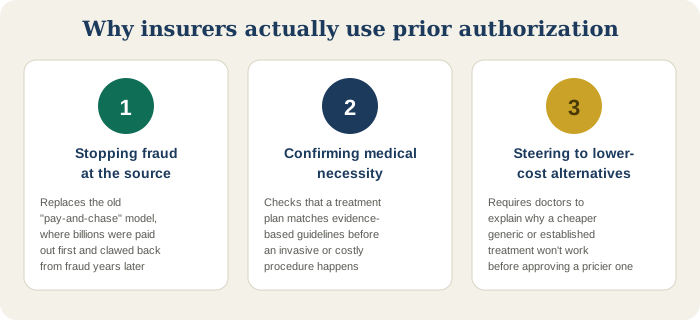
- Stopping fraud at the source. For decades, Medicare largely ran on a “pay-and-chase” model — bills got paid automatically, and fraud investigators tried to claw the money back years later, after criminal billing rings had already made off with it. Prior authorization flips that: it requires proof a service is legitimate before payment happens, not after.
- Confirming medical necessity. Clinical practice varies a lot from doctor to doctor. If someone has mild knee pain, standard guidelines call for physical therapy first — not jumping straight to surgery. Prior authorization is meant to be a checkpoint that asks a doctor to justify skipping the conservative, lower-risk step.
- Steering toward cost-effective alternatives. If a doctor prescribes an expensive brand-name drug when an identical generic exists, prior authorization forces an explanation of why the cheaper option won’t work for that specific patient.
In theory, this also protects you directly: an approval given before a procedure is a form of written confirmation that your plan will pay — reducing the risk of a surprise bill months later for a service the insurer later decides wasn’t “medically necessary.”
The Real Cost to Patients
None of that erases the genuine, well-documented downside.
- Delays that matter medically. Even a standard multi-day wait can allow a condition to worsen while a decision is pending.
- A serious administrative burden. Prior authorization is consistently cited by physicians as their single biggest paperwork headache — enough that many practices now employ staff whose entire job is managing these requests.
- Treatment abandonment. Faced with a prolonged approval process, a meaningful share of patients simply give up on a recommended treatment or prescription entirely, rather than fight the process.
How Often Are Requests Actually Denied?
This is where things get concrete. In August 2026, KFF published the first public analysis of insurer-reported prior authorization data, covering Medicare Advantage, Medicaid managed care, and ACA Marketplace plans.
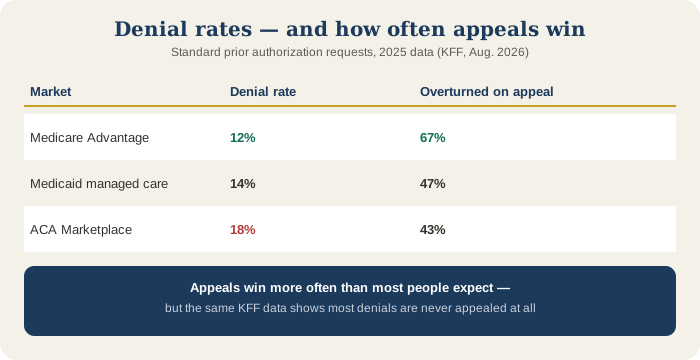
Two things stand out. First, denial rates vary enormously by insurer, not just by market — among Medicare Advantage carriers alone, standard denial rates ranged from 5% (Elevance) to 17% (UnitedHealth Group). Second, and more important for you personally: appeals win far more often than most people expect — 67% of Medicare Advantage denials were overturned when appealed. The catch is that most denials are never appealed at all.
Paul’s Honest Take: That 67% overturn number is the single most important statistic in this whole article. If you or a family member gets a prior authorization denial, don’t treat it as final. The data says you have better-than-even odds of winning if you actually push back — most people just don’t.
The Big 2026 Shift: Faster Deadlines (CMS-0057-F)
A federal rule called CMS-0057-F, finalized in 2024 and operationally effective January 1, 2026, put real teeth into how fast insurers have to respond.
- 72 hours for urgent/expedited requests
- 7 calendar days for standard requests (down from a common 14-day window)
- A specific clinical reason required for every denial — no more generic rejections
- Public reporting of approval and denial metrics, posted on each payer’s own website
Important scope note: this rule applies to Medicare Advantage, Medicaid, CHIP, and ACA Marketplace plans — it does not apply to Original Medicare, and it does not apply to prescription drug prior authorizations (a separate proposed rule, still pending, would extend similar timelines to pharmacy benefits). CMS estimates this rule alone saves roughly $15 billion system-wide over ten years, mostly through reduced administrative waste.
The Landmark Change: Prior Authorization Comes to Original Medicare
For decades, prior authorization was framed almost entirely as a Medicare Advantage problem — Original Medicare let you see any doctor and get treatment with essentially no administrative gatekeeping. That changed in 2026.
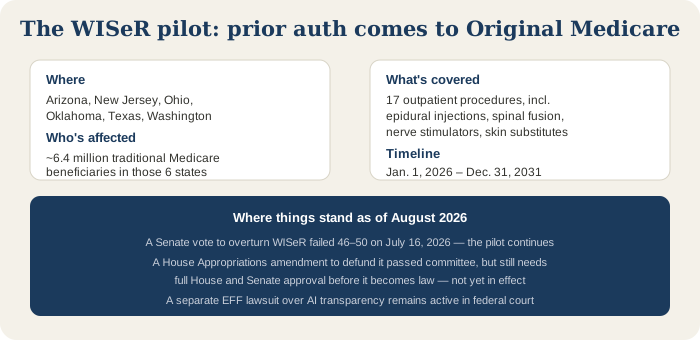
The WISeR Model (Wasteful and Inappropriate Service Reduction) is a CMS Innovation Center pilot that introduces prior authorization — or prepayment review — to traditional Medicare for the first time, in six states, for 17 specific outpatient procedures including epidural steroid injections, spinal fusion, implanted nerve stimulators, and skin substitutes. It launched January 1, 2026 and is scheduled to run through the end of 2031.
The AI element: CMS contracts with private technology vendors that use AI and machine learning to help evaluate requests, working alongside human clinical reviewers. CMS has stated human clinicians retain final say on denials, and providers can request a second clinical opinion.
Where things genuinely stand, as of August 2026 — and this is more contested than most coverage suggests:
- A Senate vote to overturn WISeR failed, 46–50, on July 16, 2026 — meaning the pilot continues as planned, at least for now.
- A House Appropriations Committee amendment to block WISeR’s funding passed committee by voice vote in June 2026 — but this is one step in a long process. It still needs to pass the full House and Senate as part of a broader spending bill before it becomes binding, and a similar effort last year didn’t make it into final legislation.
- The Electronic Frontier Foundation filed a federal lawsuit in March 2026 under the Freedom of Information Act, seeking disclosure of the AI vendors’ contracts, testing data, and performance audits — CMS has not released this information, and the case remains active.
Paul’s Honest Take: I want to be straight with you about this one: WISeR is real, it’s active right now in six states, and it is not currently dead or defunded, despite plenty of headlines that could leave you with that impression. If you’re in Arizona, New Jersey, Ohio, Oklahoma, Texas, or Washington and on traditional Medicare, this is genuinely worth understanding — not because it’s been decisively stopped, but because it hasn’t been.
What This Actually Looks Like for a Patient
To make this concrete, here’s what these processes tend to look like in practice — illustrative scenarios based on the kinds of situations patient advocates and reporters have documented, not specific individuals:
The documentation trap. Someone with years of routine, successful treatment for chronic pain — say, a regular epidural injection — suddenly has that same treatment flagged for prior authorization under a program like WISeR. The request is denied on a technicality: the chart doesn’t contain a specific phrase about how the pain limits daily activities, even though the clinical need is identical to every prior visit. The fix requires an entirely separate appointment just to add that phrase to the record — a real delay for a paperwork issue, not a medical one.
The algorithm disagreement. A patient recovering from a serious event like a stroke is recommended for several weeks of intensive inpatient rehabilitation. An AI-assisted review estimates a shorter stay based on regional averages and initially denies the longer request, pointing the family toward cheaper, lower-intensity care instead. An appeal — often requiring real persistence from family members or a patient advocate — can succeed, but the process itself can eat into a genuinely time-sensitive recovery window.
The step therapy carousel. A patient is prescribed a specific, effective but expensive medication. Instead of approving it directly, the insurer requires “step therapy” — trying and failing on cheaper alternatives first, even when a doctor believes those alternatives are unlikely to work. Months can pass, with real side effects along the way, before the originally-prescribed medication is finally approved.
These scenarios are common enough patterns that patient advocacy organizations and investigative journalists have documented versions of each repeatedly — they’re illustrative of a real, recurring dynamic, not isolated incidents.
How to Protect Yourself
If you or a family member run into a prior authorization hurdle, patient advocates consistently recommend the same handful of steps:
- Request the specific denial reason in writing. Under CMS-0057-F, insurers covered by the rule are legally required to give a plain-language clinical explanation, not a generic rejection. Get a copy.
- Ask your doctor to request an expedited review if a standard wait could genuinely harm you. Insurers covered by the rule must respond to urgent requests within 72 hours.
- Use a peer-to-peer review. If a claim is denied, your doctor’s office can request a direct phone conversation with a clinician employed by the insurer — this can resolve a dispute in a single call rather than weeks of written appeals.
- Actually appeal. Given that Medicare Advantage denials are overturned 67% of the time on appeal, and most people never appeal at all, this single step may be the highest-value thing you can do if you believe a denial was wrong.
Frequently Asked Questions
Does prior authorization apply to Original Medicare everywhere now? No — outside the six WISeR pilot states (Arizona, New Jersey, Ohio, Oklahoma, Texas, Washington) and the 17 specific procedures covered, Original Medicare still does not require prior authorization for most care.
If I live in a WISeR state, does this affect all my care? No — only the 17 specific outpatient procedures on CMS’s list are affected. Routine doctor visits, most hospital care, and the vast majority of Medicare-covered services are unaffected.
Is the WISeR pilot the same as Medicare Advantage prior authorization? No — they’re separate systems. Medicare Advantage plans have long used their own prior authorization rules, covering thousands of services. WISeR is new, narrower in scope, and specific to Original Medicare in six states.
If my request is denied, is that the final answer? Not necessarily, and often not in practice — Medicare Advantage denials are overturned on appeal 67% of the time, though most denials are never appealed at all.
Does the new 72-hour/7-day rule apply to my Part D drug prior authorizations? No — CMS-0057-F specifically excludes prescription drug prior authorizations. A separate rule addressing pharmacy benefit timelines has been proposed but is not yet finalized.
The Bottom Line
Prior authorization is a genuine trade-off, not a pure villain or a pure safeguard. It closes real gaps — fraud, unnecessary procedures, runaway costs — while creating real friction and, sometimes, real delays in care that matters. What’s changing in 2026 cuts both ways: faster legal deadlines and mandatory denial explanations for Medicare Advantage, Medicaid, and ACA plans, alongside prior authorization’s first-ever expansion into Original Medicare through the WISeR pilot — a program that remains legally and politically contested as this is written.
If there’s one thing worth remembering above everything else in this article, it’s this: a denial is not the end of the story. Two-thirds of Medicare Advantage denials get overturned when someone actually appeals — and most people never do. If it happens to you or someone you love, don’t let the paperwork win by default.
Related Reading
- Original Medicare vs. Medicare Advantage: The Foundational Difference
- Medicare Networks Explained: HMO, PPO, PFFS
- Medicare Appeals: The 5 Levels Explained
- What Is a Medicare Star Rating and Should You Trust It?
Sources:
- KFF — Prior Authorization Metrics Provide New Insights into Insurer Practices, but Gaps Remain
- CMS — CMS Interoperability and Prior Authorization Final Rule (CMS-0057-F) Fact Sheet
- Becker’s Hospital Review — House Committee Votes to Defund WISeR Prior Authorization Pilot
- Healthcare Dive — Electronic Frontier Foundation Sues CMS Over Medicare AI Prior Authorization Pilot
- Medical Daily — A Medicare Prior Authorization Pilot Has Run in Six States Since January Without Most Patients Knowing
This article reflects the current status of Medicare and federal prior authorization rules as of August 2026, which is an actively evolving legal and political situation. If you’re facing a prior authorization denial and aren’t sure what to do next, call us at 631-358-5793. No pressure, no cost.