




Last Tuesday, a client named Martha sat at her kitchen table surrounded by five different 2026 Medicare brochures, all promising a monthly premium of zero dollars. She asked us a question we hear every single day: “If it’s free, what am I actually giving up?” It’s a valid worry because we all know that a $0 price tag doesn’t mean the medical care is free. You likely feel overwhelmed by the constant marketing and anxious that a lower premium might mean losing the doctor you’ve trusted for a decade. We understand that stress, and we’re here to move you from confusion to confidence.
In this guide, we’ll weigh the pros and cons of zero premium medicare advantage plans for the 2026 plan year. We’ll explain the trade-offs between low monthly costs and higher co-pays, and we’ll show you how to verify your doctor’s network status before you sign anything. Our goal is to provide the unbiased guidance you need to feel secure in your choice. We’ll walk through the specific out of pocket limits for 2026 and the 5-step process to decide if these plans truly fit your personal budget.
Key Takeaways
- Understand how private insurers use government funding to offer $0 premiums in 2026 and what that means for your monthly budget.
- We break down the pros and cons of zero premium medicare advantage plans so you can spot hidden “pay-as-you-go” costs before they impact your savings.
- Learn to navigate the updated 2026 network rules for HMOs and PPOs to ensure your favorite doctors and specialists remain accessible.
- Compare the predictable monthly costs of a Medicare Supplement against the bundled convenience of an Advantage plan to find your best financial path.
- Discover our 5-step “Confusion to Confidence” process that simplifies the complex 2026 landscape and helps you choose your plan with total peace of mind.
Understanding Zero-Premium Medicare Advantage Plans in 2026
We understand how overwhelming it feels to stare at a stack of mailers for 2026 Medicare plans. It’s easy to wonder if a plan with no monthly cost is too good to be true. When we talk about Medicare Advantage, we’re looking at private insurance alternatives to the government’s Original Medicare program. These are often called Part C plans. To decide if one fits your life, you need to look at the pros and cons of zero premium medicare advantage plans carefully. Our goal is to move you from confusion to confidence, so you can stop worrying about your coverage.
Understanding the pros and cons of zero premium medicare advantage plans starts with knowing where the money comes from. These plans aren’t “free” in the traditional sense. Instead, they represent a different way of funding your healthcare. We simplify the jargon so you know exactly how it works. Our team serves seniors across 34 states, providing the guidance you need to steer clear of costly enrollment mistakes and late penalties.
How Insurance Companies Offer $0 Premiums
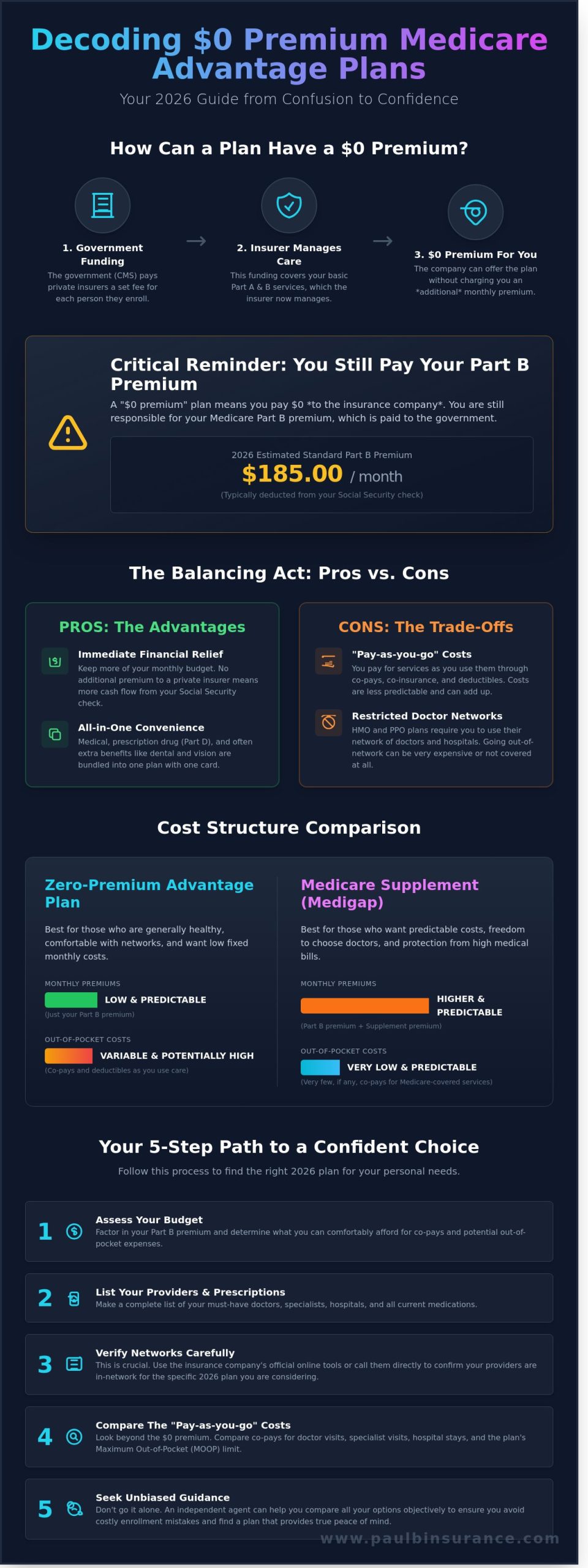
In 2026, over 40 different insurance companies are competing for your business in many regions. This competition is why so many $0 options exist. The government’s Centers for Medicare & Medicaid Services (CMS) pays these private companies a set fee for every person they enroll. As of January 1, 2026, these payments are structured to cover the cost of your basic Part A and Part B services. This funding loop allows the carrier to manage your care and offer extra benefits without charging you an additional monthly bill. While it’s “zero premium” for you, the insurance company still receives a payment from the federal budget to cover your medical needs.
The Essential Role of the Part B Premium
One big mistake people make is thinking they don’t have to pay anything at all. You still have to pay your Part B premium. For 2026, the standard Part B premium is estimated at $185.00 per month, and this is typically deducted from your Social Security check. A zero-premium plan simply means the insurance company isn’t charging you a second fee on top of what you already pay the government. We help seniors navigate these rules because missing this detail can lead to a surprise in your monthly budget. We’re here to make sure you have the full picture, never rushed and never pressured. For a deeper look at your choices, you can read our medicare advantage guide to see how these plans compare to other options.
The Real Advantages: Why Millions Choose $0 Premium Plans
We know that managing a budget on a fixed income can feel like a balancing act. For many of our clients in 2026, the biggest draw of these plans is the immediate boost to monthly cash flow. When you don’t have to pay an extra monthly premium to a private insurance company, you keep more of your Social Security check for groceries, utilities, or visiting grandkids. While you still pay your Part B premium to Medicare, avoiding an additional $150 or $200 monthly bill makes a world of difference. Understanding the pros and cons of zero premium medicare advantage plans starts with recognizing this simple financial relief. We believe that health coverage should provide peace of mind, not a pile of bills that keep you up at night.
The “all-in-one” convenience of these plans is another reason they’ve become so popular. Instead of juggling multiple cards and different companies for your medical and drug needs, everything is housed under one roof. This coordination helps prevent the confusion that often comes with the “crazy maze” of the Medicare system. We simplify the jargon so you know exactly how it works. If you want to see how these plans compare to other options, you can explore our Medicare Advantage Guide for deeper plan specifics.
Bundled Prescription Drug Coverage (Part D)
One of the best parts of these plans is the integrated drug coverage. You don’t need to shop for a separate drug plan or pay a second premium just to get your medications. In 2026, this is more valuable than ever because of the new $2,000 out-of-pocket cap on prescription drugs. This federal limit protects you from high costs if you need expensive specialty medications. We help you check your specific prescriptions against plan lists on our Medicare Part D page to ensure your costs stay low and predictable. It’s one less thing to worry about when you’re looking at the pros and cons of zero premium medicare advantage plans.
Value-Added Benefits: Dental, Vision, and Hearing
Original Medicare has some gaps that can be expensive to fill on your own. Most $0 premium plans include “extras” that save you hundreds of dollars each year. These often include:
- Routine dental exams, cleanings, and X-rays.
- Annual vision tests and a credit for glasses or contacts.
- Hearing aid coverage and professional fittings.
- Allowances for over-the-counter items like vitamins or bandages.
- Gym memberships and fitness programs.
- Transportation to medical appointments.
Instead of buying a separate dental insurance plan, you get these benefits built right into your medical coverage. You carry just one member ID card for everything from your doctor visit to your pharmacy trip. This integrated approach is designed to make your life simpler and more organized. We are here to help you move from confusion to confidence by finding a plan that matches your specific needs. If you’re ready to see your options, feel free to schedule a call with Paul today.
The Trade-offs: Navigating the Cons and Potential Costs
We know that a “free” plan sounds like the perfect solution. However, it is vital to look at the other side of the coin to ensure you aren’t surprised by bills later. Understanding the pros and cons of zero premium medicare advantage plans means looking at how you pay for care when you actually need it. While you aren’t paying a monthly bill to the insurance company, you are essentially choosing a “pay-as-you-go” model. In a zero-premium plan, the insurance company isn’t taking your money upfront, but you are agreeing to share the cost when you actually use medical services.
This cost-sharing usually shows up as copays or coinsurance. For example, in 2026, a simple visit to a specialist might cost you $45, while an outpatient surgery could require a 20% coinsurance payment. You also have to manage the reality of prior authorizations. Recent data from 2025 shows that nearly 99% of Medicare Advantage enrollees are in plans that require insurance company approval before certain procedures or high-cost drugs. This can sometimes lead to delays or extra paperwork that we help our clients manage so they don’t feel overwhelmed.
Understanding Network Limitations
In 2026, your choice of doctor is strictly tied to the plan’s network. Most zero-premium options are HMOs, which usually require you to stay within a specific group of providers and get referrals for every specialist visit. If you see an out-of-network doctor in an HMO, you might be responsible for 100% of the cost. PPO plans offer more freedom, but seeing a provider outside the network often increases your cost-sharing significantly. We use the updated 2026 provider directories to verify your specific doctors are included before we make any recommendations. You can learn more about these differences in our medicare advantage guide.
The Maximum Out-of-Pocket (MOOP) Safety Net
The MOOP is the most important number in any zero-premium plan. It is your ultimate safety net. It represents the absolute maximum you will pay for covered medical services in a single year. For 2026, the federal government has set the mandatory MOOP limit at $9,350 for in-network services, though many of the carriers we represent offer much lower limits, sometimes around $3,900 or $4,500. Once you reach this limit, the plan pays 100% of your covered medical expenses for the rest of the year. We compare these limits across different companies to ensure you have a safety net that protects you from catastrophic medical debt, moving you from a place of confusion to total confidence.
Comparison Guide: Zero-Premium Advantage vs. Medicare Supplement
Deciding between these two options often feels like a tug of war. On one side, you have the zero-premium Advantage plans that keep your monthly bills at a minimum. On the other, you have Medigap plans that offer total predictability. We view this as a fundamental choice between monthly certainty and usage-based costs. When we sit down with you, we weigh these two paths based on your health history and your desire for freedom. It is a choice between paying a little more every month to have no bills later, or paying nothing now and covering costs as you go.
One of the biggest factors we discuss with clients is the freedom of movement. With Medigap plans, you aren’t tied to a local network of doctors or hospitals. In 2026, roughly 90 percent of physicians across the United States still accept Medicare. This means you can see a specialist in another state without asking an insurance company for permission first. We find that this lack of “gatekeeping” removes a massive layer of stress for seniors who travel or want access to top-tier medical centers.
When Zero-Premium Makes Financial Sense
When we analyze the pros and cons of zero premium medicare advantage plans for healthy seniors, the math often works in their favor. If you only visit the doctor once or twice a year for checkups, paying a monthly premium for a Supplement plan might feel like a waste of money. These plans save many of our clients between $1,800 and $2,500 annually in premiums. For a senior on a fixed budget, that is a significant amount of breathing room. Additionally, the “extra” benefits included in 2026 plans, such as $500 annual dental credits or vision hardware allowances, provide value that Original Medicare simply doesn’t offer.
When a Supplement Plan is the Better Investment
A Supplement plan is usually the better investment if you manage chronic conditions like heart disease or diabetes. We often recommend this path for those who want the “zero copay” lifestyle. In 2026, Plan G remains the most popular choice for this reason. Once you pay your annual Part B deductible, which sits around $270 this year, your medical bills are covered at 100 percent. You won’t have to worry about a $350 copay for an outpatient surgery or a $400 daily charge for a hospital stay. It turns your healthcare into a fixed, predictable line item in your budget. If you’re ready to clear up the confusion, schedule a call with us today.
Finding Your Best Path: How We Simplify the Selection Process
We know that looking at 2026 health plans feels like a full-time job. The mailbox fills up with flyers, and the TV commercials never seem to stop. Our goal is to move you from a state of confusion to a place of total confidence. We don’t want you to feel like another number in a giant database. Instead, we act as your personal advocate, filtering through the noise to find the coverage that actually fits your life. Our “Confusion to Confidence” philosophy is built on the idea that Medicare should be simple, not a source of stress.
To make this happen, we use a rigorous 5-step process to evaluate more than 40 insurance carriers. First, we listen to your specific health needs. Second, we verify every single one of your doctors against the 2026 network updates. Third, we run your medication list through our database to find the lowest total cost. Fourth, we compare the extra benefits like dental and vision. Finally, we present you with the top three options that save you the most money. This systematic approach takes the guesswork out of the pros and cons of zero premium medicare advantage plans.
The Power of an Independent Broker
Captive agents are limited because they only sell one brand. If that company’s 2026 rates go up or their doctor network shrinks, that agent still has to sell you that plan. We think you deserve better. As independent brokers, we have no loyalty to the big insurance corporations. Our loyalty is to you. We’ve seen a 14 percent increase in plan changes for the 2026 season, and we’re here to make sure those changes don’t catch you off guard.
We go beyond just picking a plan. We analyze your specific situation against the latest 2026 data. If a carrier dropped your preferred specialist or changed the tier of your heart medication, we’ll find out before you sign anything. Our support doesn’t end on January 1st, either. We provide year-round assistance. If you get a bill that looks wrong or you need help finding a new provider in June, we’re the only call you need to make. We’re your partner for the long haul.
Your Next Steps to Clarity
You don’t have to feel overwhelmed by the pros and cons of zero premium medicare advantage plans anymore. We’ve helped over 3,200 seniors find peace of mind by providing clear, honest guidance. You can move from feeling stuck to feeling empowered with just one conversation. We offer a no-pressure review of your current 2026 coverage to see if there’s a more cost-effective way to get the care you need.
Our “Schedule a Call with Paul” process is designed to be the easiest part of your day. It’s a simple, friendly chat where we answer your questions and look at the facts. There’s no sales pitch and no rush. We’ll give you a straight answer about whether you should stay put or switch to a new plan based on the 2026 numbers. Schedule your free, unbiased Medicare review today.
Take Control of Your 2026 Medicare Journey
Choosing your health coverage for 2026 shouldn’t feel like a gamble. We’ve explored the pros and cons of zero premium medicare advantage plans to help you see that while a $0 monthly bill is attractive, your specific doctor network and co-pay limits matter more than ever this year. You deserve a plan that fits your life, not just your budget. We represent over 40 top-rated carriers across 34 states, so we aren’t tied to one company’s interests. Our “From Confusion to Confidence” 5-step process is designed to strip away the stress and replace it with total clarity. We’ll look at the concrete data together and ensure you don’t face unexpected penalties or coverage gaps. Our team is never rushed and never pressured; we’re here to serve as your personal advocate. We’ll help you compare 2026 out-of-pocket maximums and drug formularies so you can sleep soundly knowing your health is protected.
Schedule a Call with Paul to find your perfect 2026 plan and move forward with total peace of mind today. You’ve worked hard for your retirement, and we’re here to make sure your insurance works just as hard for you.
Frequently Asked Questions
Is a $0 premium Medicare Advantage plan really free?
No, a zero-premium plan isn’t entirely free because you still have out-of-pocket costs when you visit the doctor. While your monthly payment to the private insurance company is $0, you’re responsible for copays like the $45 fee for a specialist visit. We help you look at the total picture. In 2026, most plans have a maximum out-of-pocket limit of $8,300 to protect your savings if a major health event happens.
What is the catch with zero-premium Medicare plans in 2026?
The primary trade-off involves higher costs when you actually receive medical care. When weighing the pros and cons of zero premium medicare advantage plans, you’ll see that lower monthly costs often mean higher deductibles for hospital stays. For instance, a 5-day hospital stay in 2026 could cost you $1,500 out of your own pocket. We make sure you understand these potential expenses before you sign up so there are no surprises.
Do I still have to pay for Medicare Part B if I have a zero-premium plan?
Yes, you must continue paying your monthly Medicare Part B premium to the government. For 2026, the standard Part B premium is projected to be $185.00 per month. This amount is usually deducted directly from your Social Security check. Even with a $0 premium Advantage plan, this federal requirement remains the same for every beneficiary. We’ll help you budget for this fixed cost so you can feel confident in your plan.
Can I keep my own doctor with a zero-premium Advantage plan?
You can keep your doctor only if they’re part of the plan’s specific provider network for 2026. HMO plans usually require you to see network doctors, while PPO plans let you go out-of-network for a higher fee. About 85% of specialists in our local area participate in these networks. We’ll personally check the 2026 directory for you to ensure your favorite physicians are included before you make any changes.
How do zero-premium plans compare to Medigap in terms of total annual cost?
Zero-premium plans save you money on monthly bills, but Medigap offers more predictable costs for major illnesses. A Medigap Plan G might cost $165 monthly in 2026 but covers 100% of your gaps. When comparing the pros and cons of zero premium medicare advantage plans, the Advantage option could save you $1,980 a year in premiums. We’ll calculate your break-even point so you can choose the right path for your budget.
What happens if I need surgery on a zero-premium plan?
If you need surgery, you’ll typically pay a set copayment or a percentage of the total cost. In 2026, a standard outpatient knee surgery might carry a $325 copay under many zero-premium options. We review these summary of benefits documents with you line by line. This ensures you aren’t surprised by a large bill when you’re trying to recover and heal. Our goal is to provide clarity during these stressful times.
Are zero-premium plans only for people with low incomes?
No, these plans are available to everyone on Medicare, regardless of their income level. In 2026, over 55% of all Medicare beneficiaries choose Advantage plans because of the extra benefits they provide. You get dental, vision, and hearing coverage that Original Medicare doesn’t offer. We believe everyone deserves these simple, comprehensive options. We’re here to guide you through the choices so you can find the best fit for your lifestyle.
Can I switch from a zero-premium plan back to Original Medicare later?
You can switch back to Original Medicare during the Annual Enrollment Period from October 15 to December 7 each year. We want you to know that while switching is easy, getting a Medigap supplement later can be difficult. If you’ve been on an Advantage plan for over 12 months, companies in 2026 may check your health history before approving a new policy. We’ll explain these rules clearly so you can avoid costly mistakes.