



Navigating the world of government benefits can feel like trying to solve a puzzle with half the pieces missing, especially when you’re faced with a sea of confusing acronyms. If you’re feeling overwhelmed and unsure where to turn, you are not alone. The stress of not knowing which program you might qualify for-or how it will impact your essential healthcare coverage-is a heavy burden to carry.
That’s why we’ve created this simple, straightforward guide. Our goal is to clear up the confusion surrounding SSI vs SSDI and empower you with the knowledge you need to move forward with confidence. We believe that understanding your options shouldn’t be a complicated or intimidating process.
In the next few minutes, you will gain a clear understanding of the crucial differences between these two vital programs. We’ll break down the eligibility requirements in plain English, show you how each one connects to your Medicare and Medicaid options, and help you identify which path might be the right one for you or a loved one. Let’s turn that confusion into clarity, together.
Key Takeaways
- Understand that Supplemental Security Income (SSI) is a federal safety net based on your financial need, not your work history.
- Discover if you qualify for Social Security Disability Insurance (SSDI), an earned benefit that acts like an insurance policy you’ve paid into.
- The core ssi vs ssdi distinction comes down to one key factor: whether your eligibility is based on your work credits or your current resources.
- Learn about the possibility of receiving both benefits at the same time and find clear, simple guidance on how to begin the application process.
What Is SSI (Supplemental Security Income)? The Basics Explained
Navigating federal support programs can feel overwhelming, but understanding the core purpose of each is the first step toward clarity. When it comes to the ssi vs ssdi discussion, it’s essential to know that they serve different needs. Supplemental Security Income (SSI) is a federal safety net program administered by the Social Security Administration (SSA). Its goal is to provide a baseline income for those who struggle to meet their basic needs for food, clothing, and shelter.
The most important thing to understand about SSI is that it is a needs-based program. This means eligibility is not connected to your work history or whether you’ve paid Social Security taxes. Instead, it is funded by general U.S. Treasury funds. Think of it as a financial support program designed specifically for individuals with limited income and resources who face the greatest need.
Who Qualifies for SSI?
Because SSI is needs-based, the eligibility rules are strict and focus on both your financial status and your personal circumstances. To qualify, you must have very limited income and few resources. In addition to meeting these financial limits, you must be in one of the following categories:
- An adult aged 65 or older
- An adult or child who is blind
- An adult or child who is disabled
The SSA defines “disability” as a medically determinable physical or mental condition that prevents you from doing any substantial work and is expected to last at least one year or result in death.
What Does SSI Provide?
SSI provides a monthly cash payment to help eligible individuals afford their basic necessities. The maximum federal benefit amount is set each year, though your payment may be lower depending on your income and living situation. Some states also add a supplemental payment to the federal benefit, increasing the total support you might receive.
Beyond the direct financial assistance, one of the most critical benefits of SSI is its link to healthcare. In most states, when you are approved for SSI, you automatically qualify for Medicaid coverage, ensuring you have access to essential medical care.
What Is SSDI (Social Security Disability Insurance)? Unpacking the Details
Think of Social Security Disability Insurance (SSDI) not as a government handout, but as an insurance benefit you’ve earned. It’s a program designed to provide you with a safety net if a severe medical condition prevents you from working. Every time you saw FICA taxes deducted from your paycheck, you were paying premiums into this program, which is funded by the Social Security trust fund and administered by the Social Security Administration (SSA).
This work-based requirement is the most significant factor in the ssi vs ssdi distinction. While SSI is based on financial need, SSDI is based on your contribution to the system through your work. For a more detailed legal perspective, the Special Needs Alliance comparison of SSI and SSDI provides an excellent breakdown of how these programs are structured.
Who Qualifies for SSDI?
To receive SSDI, the SSA looks at two key factors: your work history and your medical condition. You must pass both a “work test” and a “medical test.”
- Work History Test: You must have worked long enough and recently enough to have earned sufficient “work credits.” The number of credits you need depends on your age when you became disabled, but it generally requires you to have worked for about one-quarter of your adult life.
- Medical Condition Test: Your health condition must meet the SSA’s strict definition of disability. This means it must be severe enough to prevent you from doing substantial work and is expected to last at least one year or result in death. This medical standard is the same for both SSDI and SSI.
What Does SSDI Provide?
If your application is approved, SSDI provides a steady source of income and a critical pathway to healthcare coverage. The primary benefits include:
- Monthly Payments: You will receive a monthly disability payment based on your average lifetime earnings before your disability began. Because it’s tied to your past income, the payment amount is typically higher than what SSI provides. In some cases, your spouse and children may also be eligible for benefits.
- Access to Federal Health Coverage: This is a crucial benefit. After you have received SSDI payments for 24 months, you will automatically become eligible for federal health insurance coverage, regardless of your age. This provides essential health insurance to cover hospital visits, doctor appointments, and other medical needs.
SSI vs. SSDI: A Simple Side-by-Side Comparison
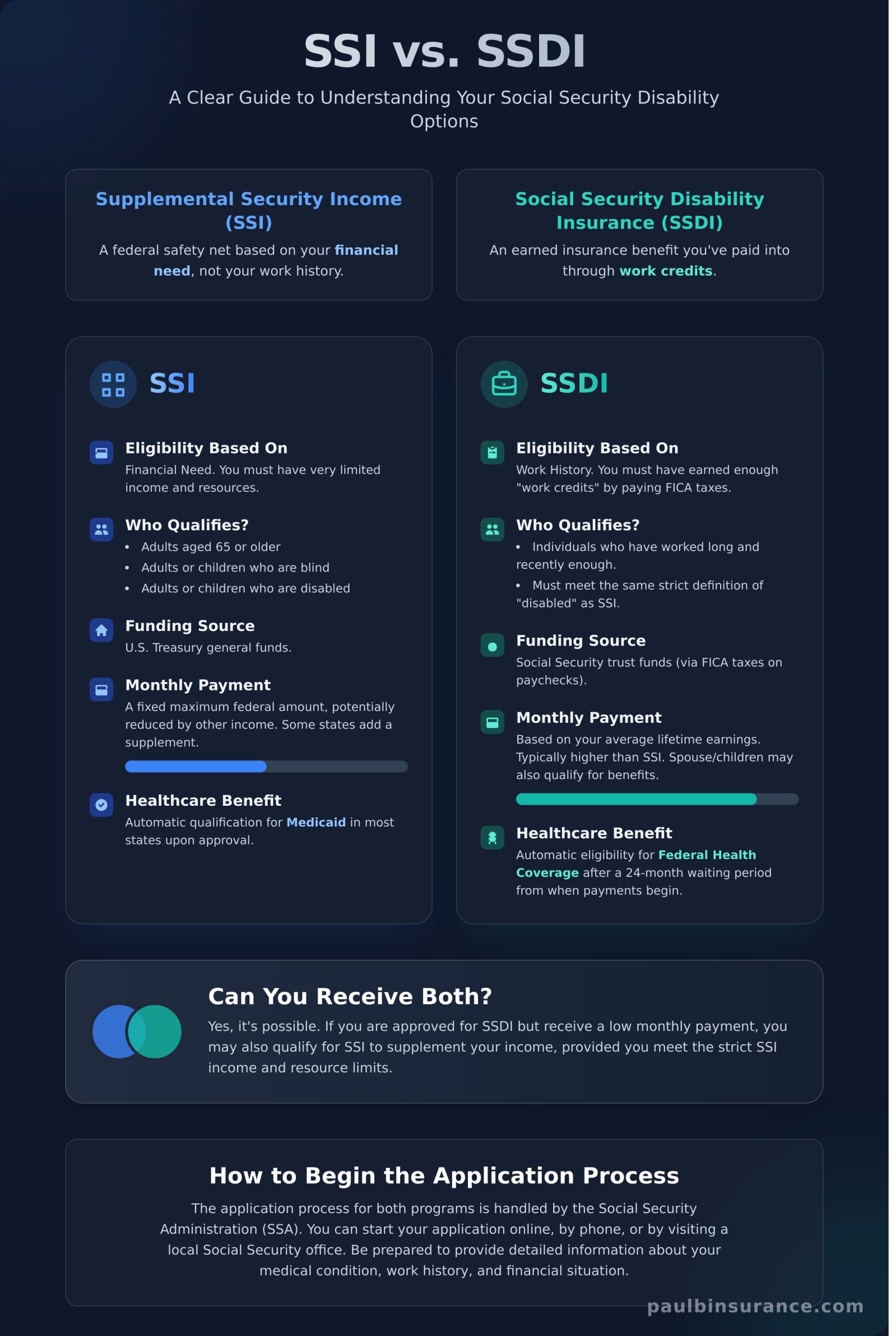
Understanding the difference between Supplemental Security Income (SSI) and Social Security Disability Insurance (SSDI) can feel overwhelming. The names are similar, but the programs are fundamentally different. To bring clarity to the ssi vs ssdi question, we’ve created a straightforward comparison to help you see which program might apply to your situation.
This simple breakdown is designed to give you a clear, at-a-glance understanding before we dive into the details that matter most to your financial and healthcare future.
Comparison Table: SSI vs. SSDI at a Glance
.comparison-table {
width: 100%;
border-collapse: collapse;
margin: 20px 0;
font-size: 1em;
}
.comparison-table th, .comparison-table td {
border: 1px solid #ddd;
padding: 12px;
text-align: left;
}
.comparison-table th {
background-color: #f2f2f2;
font-weight: bold;
}
.comparison-table tr:nth-child(even) {
background-color: #f9f9f9;
}
| Feature | SSI (Supplemental Security Income) | SSDI (Social Security Disability Insurance) |
|---|---|---|
| Main Purpose | Provides for basic needs (food, shelter) based on financial need. | Provides income to individuals who can no longer work due to a disability. |
| Who Qualifies | Based on age/disability AND very limited income and resources. No work history is required. | Based on disability AND having worked and paid enough Social Security taxes. |
| Funding | Funded by general U.S. Treasury funds (general tax revenue). | Funded by the Social Security trust fund (FICA taxes from paychecks). |
| Health Insurance | Typically qualifies you for Medicaid immediately. | Qualifies you for Medicare after a 24-month waiting period. |
| Financial Rules | Strict limits on income, savings, and other assets you can own. | No limits on assets or unearned income, but there are limits on earned income. |
The Core Difference: Work History vs. Financial Need
The most important distinction in the ssi vs ssdi debate comes down to this: SSDI is an earned insurance benefit, while SSI is a needs-based welfare program. Think of it this way:
- SSDI is for workers. Imagine a 58-year-old construction worker who paid Social Security taxes for 35 years but can no longer work due to a severe injury. His work history and tax contributions are what qualify him for SSDI benefits.
- SSI is for those with limited means. Consider an individual who has been disabled since childhood and was never able to build a work history. If they have minimal income and resources, they may qualify for SSI to help cover basic living costs.
The Crucial Link to Medicare and Medicaid
Perhaps the most critical difference for your long-term planning is how each program connects to health insurance. This is not a small detail-it can dramatically affect your access to care.
If you receive SSDI, you will become eligible for Medicare, but only after a 24-month waiting period from your benefit start date. If you receive SSI, you will typically qualify for Medicaid right away. Navigating that 24-month Medicare waiting period can be a source of major stress and confusion. Confused about your future healthcare? We can help you navigate Medicare with confidence.
Can You Receive Both SSI and SSDI at the Same Time?
Yes, you absolutely can. This is a common point of confusion, but it is possible to receive payments from both programs simultaneously through what is known as “concurrent benefits.” This situation typically occurs when you are approved for Social Security Disability Insurance (SSDI) based on your past work, but your monthly payment is less than the full federal benefit rate for Supplemental Security Income (SSI).
In these cases, the needs-based SSI program can step in to provide additional monthly income, ensuring you have the support you need. Understanding this interaction is a key part of the ssi vs ssdi discussion for many applicants.
How Concurrent Benefits Work
The process is designed to create a financial safety net. The Social Security Administration (SSA) will first pay your eligible SSDI benefit. Then, it will add an SSI payment to bring your total monthly income up to the current SSI limit, as long as you meet SSI’s strict financial requirements.
Here is a simple example to clarify:
- Let’s say the maximum federal SSI payment is $943 per month (the rate for 2024).
- Your work history qualifies you for an SSDI payment of $500 per month.
- Because your $500 SSDI payment is below the $943 SSI limit, SSI can add $443 to your monthly income.
- Your total combined payment would be $943 per month.
Keep in mind: To receive the SSI portion, you must still meet the program’s tight restrictions on income, savings, and other personal assets.
Who Is Most Likely to Qualify for Both?
Receiving concurrent benefits is most common for individuals who became disabled after working for a limited time or in low-wage jobs. This often includes people who:
- Have not worked enough in recent years to earn a high SSDI benefit.
- Have significant gaps in their employment history before their disability began.
Fortunately, the application process is often streamlined. When you apply for disability benefits with the SSA, they will automatically check your eligibility for both programs. This helps ensure you receive the maximum support you are entitled to without extra confusion.
Navigating these rules can feel overwhelming. For trusted, personalized guidance on how your disability benefits may interact with your Medicare options, please visit paulbinsurance.com for a clear path forward.
How to Apply and Prepare for the Next Steps
After navigating the complexities of ssi vs ssdi, taking the next step to apply can feel overwhelming. But please know, you don’t have to do it in the dark. The application process, while detailed, is straightforward, and being prepared can make all the difference. The Social Security Administration (SSA) provides three convenient ways to apply for disability benefits: online through their website, by calling their national toll-free number, or by scheduling an appointment at your local SSA office.
The key to a smoother process is gathering your information before you begin. Having your documents organized and ready will not only save you time but also help reduce stress, allowing you to submit a more complete and accurate application from the start.
A Simple Application Checklist
To help you get started, here is a basic checklist of the information you will likely need. Taking a few moments to collect these details can significantly speed up your application.
- Personal Documents: Your original birth certificate (or a certified copy) and your Social Security number.
- Medical Information: A complete list of your doctors, caseworkers, hospitals, and clinics, including their addresses and phone numbers. You should also have a list of all medications you take and the dosages.
- Employment History: A summary of where you have worked over the past 15 years and a brief description of the type of work you did.
From Benefits to Healthcare: What’s Next?
Understanding your eligibility in the ssi vs ssdi debate is the first critical step toward securing your financial future. The next is planning for your healthcare. Generally, qualifying for SSDI will eventually make you eligible for Medicare, while SSI often qualifies you for Medicaid.
As you approach Medicare eligibility, you’ll face another set of important decisions. This transition is a common point of confusion, and mistakes made during enrollment can be costly. Getting trusted, unbiased guidance is essential to protect both your health and your savings.
Navigating your new benefits is just the beginning. When it comes to Medicare, having an expert on your side provides peace of mind. Let us make your transition to Medicare simple and stress-free.
Your Next Steps to Financial Security
Understanding the key differences between Social Security programs is the first step toward securing the support you need. Remember, SSDI is an insurance program based on your work history and contributions, while SSI is a needs-based program for individuals with limited income and resources. Grasping the details of ssi vs ssdi can feel overwhelming, but knowing which path is right for you is crucial as you plan for the future.
Navigating these federal benefits is complex, and it often leads to another critical question: how will this affect your healthcare coverage? You don’t have to figure it out alone. With trusted guidance that has helped over 5,000 clients, Paul provides patient, expert support to simplify your decisions. By offering unbiased advice from over 40 top carriers, he ensures you find the right plan for your unique needs. When it’s time to plan for Medicare, get clear, unbiased guidance. Schedule your free consultation with Paul today.
Take the next step with confidence, knowing an expert is in your corner.
Frequently Asked Questions About SSI and SSDI
What medical conditions automatically qualify for Social Security disability?
While no condition guarantees approval, the Social Security Administration (SSA) maintains a “Compassionate Allowances” (CAL) list to expedite decisions for the most serious conditions. These include certain aggressive cancers like pancreatic or esophageal, amyotrophic lateral sclerosis (ALS), and early-onset Alzheimer’s disease. Having a CAL condition can significantly shorten the review process, but you must still meet all other non-medical eligibility requirements for the specific benefit program you are applying for.
How long does it take to get a decision on an SSI or SSDI application?
Patience is key, as the initial decision process typically takes between three to six months. This timeline can vary depending on how quickly the SSA receives your medical records and the complexity of your case. If your initial application is denied, the appeals process can extend this wait considerably, sometimes for a year or more. It’s important to provide complete and accurate information from the start to help avoid unnecessary delays in the system.
Can I work while receiving SSI or SSDI benefits?
Yes, the SSA provides work incentives, but there are strict income limits. For SSDI, you generally cannot earn more than the “Substantial Gainful Activity” (SGA) amount, which is $1,550 per month in 2024 (or $2,590 if you are blind). For SSI, your benefit amount is reduced as your earnings increase, as it is a needs-based program. Programs like Ticket to Work can help you explore returning to work without immediately losing your benefits.
If I get approved for SSDI, do I have to pay for Medicare after the waiting period?
After you have received SSDI benefits for 24 months, you will automatically be enrolled in Medicare. Most people receive Medicare Part A (Hospital Insurance) premium-free. However, Medicare Part B (Medical Insurance) requires a monthly premium, which is typically deducted directly from your monthly SSDI benefit payment. Understanding these costs is an important part of planning for your healthcare needs while on disability, and we can help you navigate your options.
Does my spouse’s income or savings affect my eligibility for SSI or SSDI?
This is a critical area where understanding the difference between SSI vs SSDI is vital. For SSDI, your spouse’s income and assets do not affect your eligibility because it is an insurance program based on your own work record. However, for SSI, your spouse’s income and resources absolutely matter. Because SSI is needs-based, the SSA will count a portion of your spouse’s assets and income as your own, which could reduce your benefit or make you ineligible.
What is the difference between Social Security retirement and Social Security disability?
The main difference is the qualifying event. Social Security retirement benefits are based on reaching a specific age (typically 62 or older) after a lifetime of working and paying into the system. Social Security Disability benefits (SSDI) are based on your inability to work due to a severe medical condition, regardless of your age, provided you have earned enough recent work credits. Both are earned benefits, but they are triggered by different life circumstances.