What if the most uncomfortable conversation you have this year actually becomes the greatest gift of peace you ever give your partner? It’s completely normal to feel a bit of anxiety when you think about how to talk to your spouse about final expense insurance. You might worry about upsetting them or feel overwhelmed by the rising funeral costs we’re seeing in 2026. Many people procrastinate because the topic feels taboo, but waiting often leads to more stress for the person you love most.
As a dedicated advocate, Paul Barrett and our team believe this conversation is actually an act of deep love and protection. It’s about making sure your partner has a clear plan and financial security during a difficult time. In this guide, we’ll walk through simple ways to start the discussion without the fear. You’ll learn how to navigate the process together, clear up any confusion over insurance terms, and move from a state of uncertainty to a place of shared relief and certainty for your future together.
Key Takeaways
- Understand why addressing rising burial costs in 2026 is a vital step in protecting your spouse’s future quality of life and financial security.
- Learn how to talk to your spouse about final expense insurance by identifying the specific gaps in your current Medicare or life insurance coverage first.
- Discover how to choose a comfortable setting and time for this conversation so your partner feels supported rather than overwhelmed or blindsided.
- Gain access to gentle conversational scripts and empathetic responses that help you navigate common concerns about the sensitive nature of the topic.
- Find out how working with an independent expert like Paul Barrett provides a clear path to certainty by comparing options from dozens of different carriers.
Why Discussing Final Expense Insurance is an Act of Love in 2026
Bringing up the topic of end-of-life planning often feels like a heavy burden. It’s completely normal to hesitate because you don’t want to upset your partner or face your own mortality. But when you look at it through a different lens, learning how to talk to your spouse about final expense insurance is actually a profound act of love. You’re choosing to handle a difficult task now so they don’t have to handle it alone later. It helps to understand what is life insurance in its most basic form: it’s a tool for protection. By starting this conversation in 2026, you’re making sure your spouse’s future remains secure and their grief isn’t complicated by financial panic.
Understanding the ‘Peace of Mind’ Factor
Peace of mind isn’t just a marketing phrase. It’s the quiet relief that comes from knowing your partner won’t have to scramble for funds or make high-stress financial decisions while they’re mourning. Paul Barrett often reminds his clients that this conversation is the missing piece of a complete financial plan. When you know the funeral and final bills are covered, it reduces the daily background stress that many couples feel. You aren’t just buying a policy; you’re buying the certainty that your spouse will be okay. Doing this together actually strengthens your bond because it shows you’re committed to each other’s well-being, even in the long term.
The Reality of Final Costs in 2026
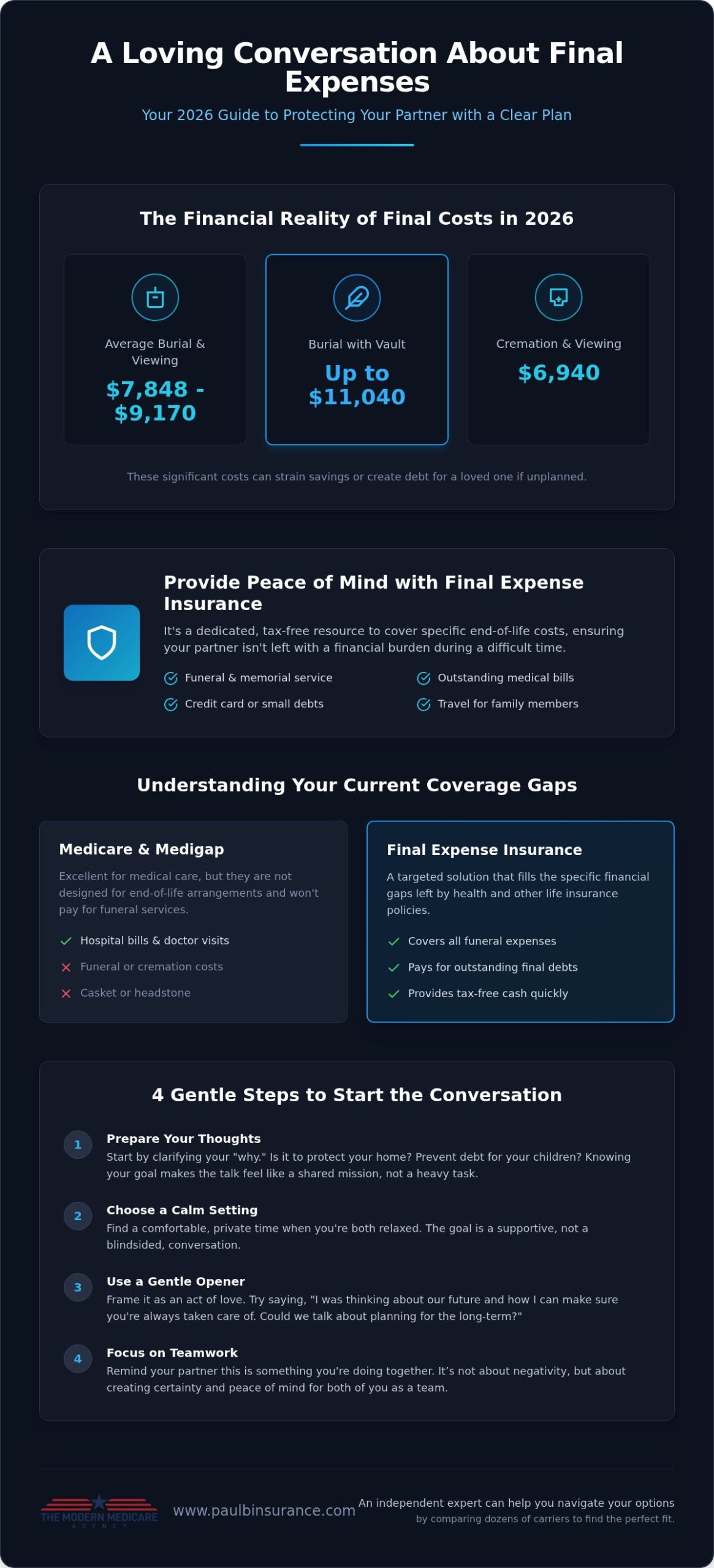
The financial landscape of 2026 makes this planning more critical than it used to be. Funeral costs have seen steady increases, and the average burial with a viewing now ranges from $7,848 to $9,170. If you include a burial vault, that cost frequently reaches $11,040. Even simpler options like cremation with a viewing are averaging $6,940. These aren’t small numbers. Relying on a standard savings account can be risky because those funds might be needed for other emergencies or could be tied up in probate.
Final expense insurance provides a tax-free lump sum that can be used for anything. This includes:
- The funeral or memorial service
- Outstanding medical bills not covered by Medicare
- Small credit card debts or personal loans
- Travel expenses for family members
It’s a targeted solution for a specific problem. Instead of leaving your spouse to dip into their retirement savings, you’re providing a dedicated resource that’s available exactly when it’s needed most.
Preparing for the Conversation: Gathering Your Thoughts
Before you figure out exactly how to talk to your spouse about final expense insurance, you need to feel steady yourself. Jumping into a sensitive topic without a clear plan can lead to unnecessary tension or confusion. It’s helpful to start by writing down your specific goals. Are you trying to ensure your partner can stay in the family home without debt? Or do you just want to make sure your children aren’t forced to pay for funeral costs out of their own pockets? Knowing your “why” makes the conversation feel less like a chore and more like a shared mission to protect your family’s future in 2026.
Assessing Your Current Financial Shield
Many seniors assume their health coverage has them fully protected, but that’s a common misunderstanding. While a Medicare Supplement plan is excellent for handling hospital bills and doctor visits, it won’t pay for a casket, a headstone, or a memorial service. Even the most popular Medicare Advantage plans in 2026 are designed for medical care, not final arrangements. You should also take a moment to look at any existing life insurance you might have. Is it a term policy that might expire soon, or is it permanent? Identifying these gaps now allows you to speak with clarity when you sit down with your partner. You aren’t looking for more “jargon”; you’re looking for where the shield has holes that need mending.
The Role of an Independent Guide
You don’t have to be an expert on burial insurance to have a productive discussion. In fact, admitting you’re still learning can make your spouse feel more like a partner in the process rather than someone being lectured. This is where an independent guide becomes invaluable. Unlike agents who only represent one company, Paul Barrett and his team compare options from over 40 different carriers. This unbiased approach ensures you’re looking at the best possible fit for your health and budget.
Try to keep your goals simple for this first talk. Aim for a shared understanding of the current situation rather than trying to pick a specific policy immediately. When you feel ready to see what options are available for your specific needs, you can connect with a dedicated advocate who can do the heavy lifting for you. Having a professional in your corner removes the pressure and lets you focus on the emotional side of the conversation while we handle the technical research.
Choosing the Right Time and Setting for Your Talk
Timing is more than just a slot on a calendar. It’s about emotional readiness. If you’re wondering how to talk to your spouse about final expense insurance, the first rule is to avoid the “ambush.” Don’t bring it up while your partner is busy with chores, stressed about a bill, or trying to relax after a long day. Instead, try linking it to a routine activity, like your 2026 yearly financial review. This frames the topic as a logical piece of your shared security rather than a sudden, scary emergency. When you plan the time in advance, you give your spouse the chance to enter the conversation with a calm and open mind.
The ‘Walk and Talk’ and Other Low-Pressure Settings
Sitting across a kitchen table can sometimes feel too formal or even confrontational. A “walk and talk” in a local park or a quiet stroll through the neighborhood can naturally lower emotional defenses. Physical movement helps the body process stress, which makes it much easier to discuss sensitive subjects without feeling trapped. You might also find that a relaxed Saturday morning over coffee feels safer than a hectic weekday evening. The goal is to pick a setting where you won’t be interrupted by phones, television, or other family members. By choosing a neutral environment, you signal that this is a safe space for both of you to be honest about your feelings and your future.
Setting the Tone: Warmth Over Worry
The language you use will define the entire experience. Shift the focus away from “planning for the end” and toward “protecting our life together.” Use “we” and “us” to emphasize that you’re a team facing the future side-by-side. You might start with a statement of gratitude. Try saying, “I’m so thankful for the life we’ve built, and I want to make sure we’re both protected no matter what happens.” This approach is rooted in love, not fear.
Avoid using an “emergency” tone that can trigger your spouse’s natural anxiety. Paul Barrett often suggests keeping this first session very short. You don’t need to reach a final decision in fifteen minutes. Simply opening the door to the conversation is a huge victory. You’re building a bridge from a state of uncertainty to a place of shared relief. Keep the focus on how you feel and why you want this protection for each other, and the numbers will feel much less intimidating when you’re ready to look at them together.
Conversational Scripts: What to Actually Say
Finding the right words is often the biggest hurdle. You’ve picked the time and the place. Now, you need to know how to talk to your spouse about final expense insurance without the conversation feeling clinical or morbid. It helps to have a few “soft starters” ready. These scripts are designed to open the door gently, keeping the focus on your partnership rather than just the policy details. By starting with empathy, you turn a difficult topic into a shared goal for your future in 2026.
Three Soft Ways to Open the Discussion
- The Financial Wellness Approach: “I’ve been reviewing our 2026 budget and our current insurance. I want to make sure we’ve closed every gap in our security. Can we talk about a simple plan for final expenses so we’re both protected?”
- The Friend’s Experience Approach: “I was thinking about what happened to our neighbor last month. The stress of those sudden funeral bills was so hard on her family. It made me realize I never want you to face that kind of pressure alone.”
- The Direct Act of Love Approach: “I love you and the life we’ve built more than anything. Part of my job is making sure you’re financially secure no matter what happens. I’d like to look into a small policy to cover our final costs together.”
Handling Objections with Empathy
It’s natural for a spouse to pull back or feel uneasy. If they say, “I don’t want to think about that right now,” you can respond with warmth. Try saying, “I understand. I don’t like thinking about it either. But I’ll have so much more peace of mind knowing this is handled once and for all.” This validates their feelings while gently keeping the focus on the benefit of certainty.
If they worry about the cost, remind them that final expense premiums are specifically designed to be affordable. In 2026, many healthy seniors find coverage that fits comfortably within a fixed monthly budget. Remember that Medicare planning is excellent for your health needs, but it doesn’t address the bills left behind at the end. Framing this as the “missing piece” of your security helps your spouse see the value. You aren’t just spending money; you’re removing a future debt from their shoulders. When you’re ready to see how these pieces fit together, you can speak with a dedicated expert who can guide you through the options without any high-pressure tactics.
Next Steps: Moving from Conversation to Certainty
Starting the conversation is the biggest hurdle, but moving toward a final decision is where the real relief begins. Once you’ve figured out how to talk to your spouse about final expense insurance, you don’t have to navigate the technical details alone. This is the moment where involving a third-party expert like Paul Barrett makes all the difference. We act as a calm guide through a process that can sometimes feel overwhelming. In 2026, our consultations are designed to be purely educational. We’ll look at your specific health situation and budget, then compare over 40 carriers to find the one that treats you best. This isn’t about a high-pressure sales pitch; it’s about giving you the data you need to make a choice that feels right for both of you.
The Value of a Joint Consultation
Having both of you on a call together builds a foundation of trust. It ensures that neither spouse feels left out of the decision-making process. Because we’re independent brokers, we have no loyalty to a specific insurance brand. Our only goal is to protect your family. You’ll likely be surprised by how simple the application process has become in 2026. Most policies don’t require a medical exam. Approval is often based on a few straightforward health questions. This means you can go from uncertainty to a confirmed policy in a very short amount of time. You’ll feel a weight lift off your shoulders the moment you know the coverage is active.
Creating Your ‘Peace of Mind’ Folder
Once the policy is in place, we recommend creating a “Peace of Mind” folder. This is a physical or digital spot where you keep all your vital records. It’s helpful to store your final expense policy right alongside your Medicare Part D and health insurance files. When everything is organized in one place, it removes the panic of searching for paperwork during a crisis.
There is a profound sense of relief that comes with knowing the folder is ready. You’ve successfully moved from a state of distress to one of absolute certainty. You’ve taken a proactive step to serve and protect the person you love most, and that is something worth celebrating. By addressing these needs today, you’re ensuring that your spouse’s future in 2026 and beyond is defined by your love and foresight rather than by financial worry.
Taking the Path Toward Lasting Peace of Mind
You’ve already taken the most important step by deciding to protect your partner’s future. By learning how to talk to your spouse about final expense insurance, you’ve turned a potentially stressful topic into a meaningful act of love. You now have the tools to choose the right setting, use gentle scripts, and address concerns with empathy. This journey is about moving from a state of worry to a place of absolute certainty. You don’t have to carry the technical burden alone in 2026.
Working with an independent expert provides the clarity you deserve. Paul Barrett and our team offer an empathy-first approach, comparing options from over 40 different carriers to find your perfect fit. We provide no-cost, no-obligation educational consultations to ensure you feel empowered, not pressured. You’ve done the hard work of starting the conversation. Now, let us help you finish the plan.
Let Paul Barrett help you and your spouse find peace of mind today. You’ve built a beautiful life together. Securing it is the greatest gift you can give one another.
Common Questions About Final Expense Planning
What is the best age to talk to my spouse about final expense insurance?
The best time to start this conversation is as soon as you reach age 50 or begin your retirement planning. Since premiums are locked in based on your age at enrollment, starting earlier ensures you secure the lowest possible rate. Waiting until you are older or facing health changes in 2026 only makes the coverage more expensive. By acting now, you remove the future financial burden from your spouse while the monthly cost is most manageable.
Is final expense insurance the same as burial insurance?
Yes, final expense insurance and burial insurance are essentially the same product. Both are small whole life insurance policies designed to cover the specific costs associated with the end of life. While some people use different names, the core benefit remains a tax-free lump sum paid directly to your beneficiary. This money helps your spouse pay for a funeral, memorial service, or any remaining medical bills without dipping into their personal retirement savings.
Does Medicare cover any funeral or burial expenses in 2026?
No, original Medicare and Medicare Advantage plans do not cover funeral or burial costs in 2026. Many people are surprised to learn that the Social Security Administration only provides a one-time death payment of $255 to eligible survivors. This amount is nowhere near enough to cover modern funeral expenses, which often exceed $9,000. This gap is exactly why Paul Barrett recommends final expense insurance as a critical secondary layer of protection for seniors.
What if my spouse is totally against the idea of insurance?
If your partner resists, shift the focus from the policy itself to the peace of mind it provides for the survivor. Explain that you aren’t just buying insurance; you are buying them a shield against future financial stress. When you are learning how to talk to your spouse about final expense insurance, it helps to emphasize that this is a final gift of love designed to protect their quality of life after you are gone.
How much final expense coverage do most couples actually need?
Most couples find that a policy between $10,000 and $25,000 provides adequate protection for their needs. This range typically covers a standard funeral with a viewing and burial, while leaving a small cushion for final medical bills or credit card debts. In 2026, we suggest looking at your specific local costs and adding a small buffer to account for future inflation. An independent broker can help you calculate the exact amount that fits your budget.
Can we get final expense insurance if we have health issues?
Yes, you can still get coverage even if you have existing health conditions. Most final expense policies in 2026 do not require a medical exam. Instead, you’ll simply answer a few basic health questions on the application. Even for those with more serious medical histories, guaranteed acceptance options are available. Paul Barrett works with over 40 carriers to ensure we find a company that will accept you and provide the protection your family deserves.
How do I explain the cost of final expense insurance to my partner?
Explain that a small monthly premium today prevents a massive, five-figure bill from falling on your spouse later. You can frame the cost as a predictable utility bill that guarantees a tax-free payout when it is needed most. In 2026, these policies are designed to be affordable for seniors on a fixed income. Comparing quotes from multiple carriers through an independent broker is the best way to show your partner that protection is within reach.
Should we talk to our adult children about this policy too?
Yes, involving your adult children in the conversation can provide an extra layer of relief for everyone involved. Letting them know that you’ve secured a policy ensures they won’t feel responsible for those costs during a time of grief. You can show them where you keep your policy information so they know exactly who to call. Transparency about your 2026 financial planning helps your entire family move forward with a sense of shared certainty.

Article by
Paul Barrett
Paul Barrett, CMIP is the founder of The Modern Medicare Agency, an independent Medicare-only brokerage based in Melville, NY. With 18 years of Medicare-exclusive experience, a CMIP designation, and more than 5,000 clients served across 37 states, Paul is one of the most credentialed independent Medicare specialists on Long Island — and one of the most direct.
He represents 40+ carriers with no quotas and no allegiances, which means his recommendations are based entirely on what fits each client's specific situation. He is the author of Medicare Mastery Unlocked and host of the Wise Guys Retirement Talk podcast. His content is grounded in primary sources, real carrier intelligence, and 18 years of watching what happens when people get Medicare right — and when they don't.
📞 631-358-5793 | paulbinsurance.com