




Trying to understand Medicare Supplement plans can feel like you’re staring at a bowl of alphabet soup. Plan G, Plan N, Plan F… what does it all mean? If you’re feeling overwhelmed by the options and worried about making a costly mistake, you are not alone. The process of finding the best medigap plans can be confusing, but our goal is to bring you clarity and peace of mind.
In this simple 2026 comparison guide, we will walk you through everything you need to know. We’ll break down the key differences between the most popular options, like Plan G and Plan N, in plain English. You’ll learn how to compare costs, understand the value each plan offers, and choose a reputable insurance company that fits your long-term budget. By the end, you’ll have the confidence to select the right coverage, knowing your healthcare needs are securely met.
Key Takeaways
- The “best” Medigap plan is different for everyone; the right choice depends entirely on your personal health needs, budget, and risk tolerance.
- Understand the key trade-offs between Plan G (comprehensive coverage) and Plan N (lower premiums with some cost-sharing) to find your perfect fit.
- Finding the best medigap plans involves looking beyond the most popular options to see if a high-deductible plan could offer significant savings.
- After you pick a plan letter, you must choose an insurance company-and we’ll show you why factors like financial stability are just as important as the monthly premium.
What Does the ‘Best’ Medigap Plan Really Mean?
When you begin searching for the best medigap plans, it’s easy to feel overwhelmed by the sheer number of companies and options. The most important thing to understand is that the “best” plan isn’t a universal answer-it’s the plan that perfectly aligns with your personal health needs, your budget, and your desire for peace of mind.
The good news is that the process is much simpler than it appears. The key is knowing the difference between the plan and the company. Once you grasp this single concept, you can move forward with confidence, knowing you’re making an informed and empowered decision for your healthcare future.
Understanding Standardized Medigap Plans
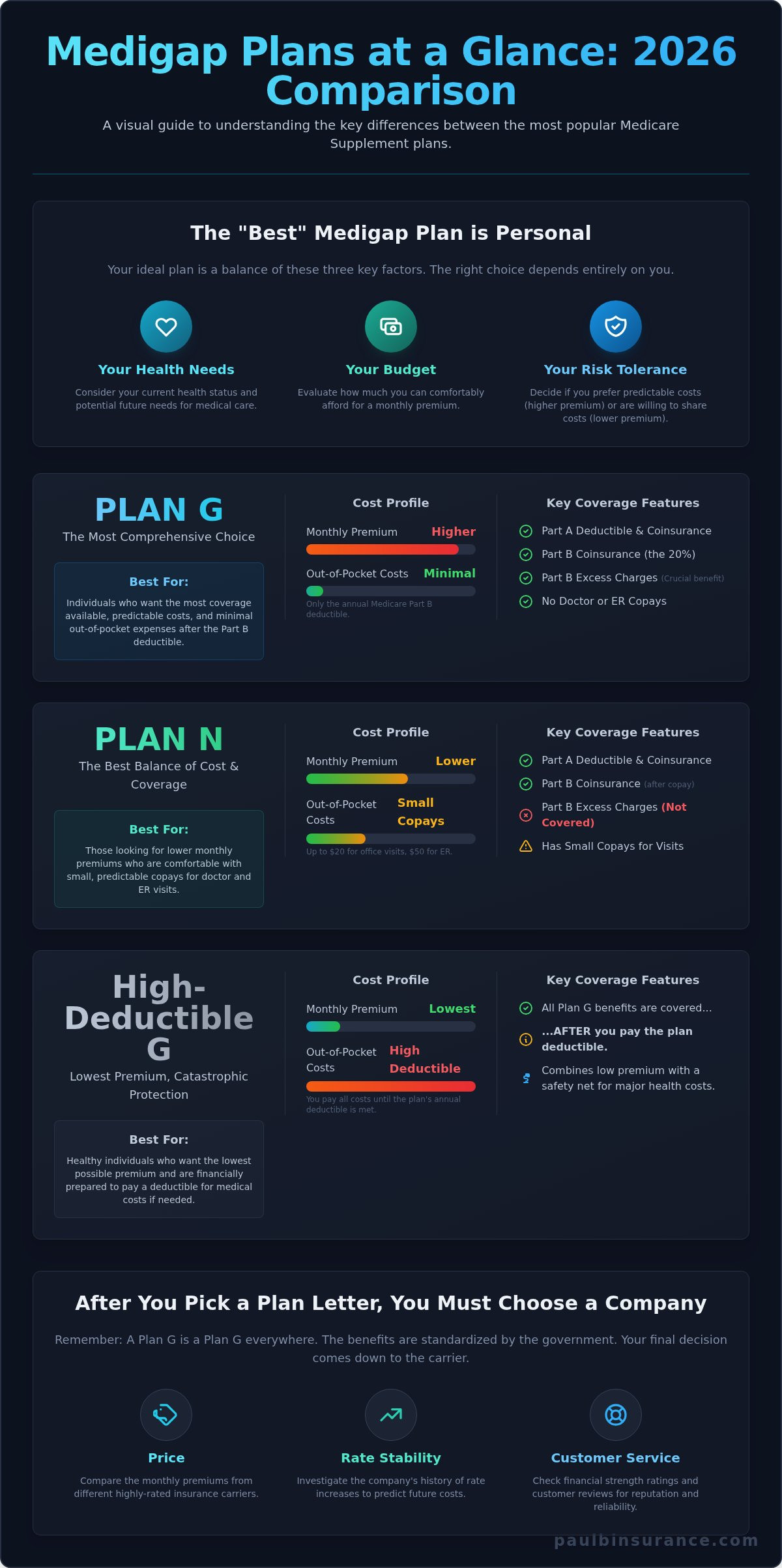
Here’s the secret that cuts through all the confusion: the federal government standardized the benefits for every plan letter. This means that a Medigap (Medicare supplement insurance) Plan G from Company A offers the exact same medical coverage as a Plan G from Company B. The benefits are identical, no matter which insurance carrier you choose. This makes your job much easier. Instead of comparing confusing coverage charts, your decision boils down to three simple factors:
- Price: The monthly premium you will pay.
- Rate Stability: The company’s history of rate increases over time.
- Customer Service: The company’s reputation for helping its members.
Quick Comparison: The Most Popular Medigap Plans
For most people turning 65 or new to Medicare, the choice often comes down to three excellent and popular options: Plan G, Plan N, and the High-Deductible Plan G. This table offers a quick look at how they compare on key out-of-pocket costs after you’ve paid your annual Part B deductible.
| Coverage Feature | Plan G | Plan N | High-Deductible Plan G |
|---|---|---|---|
| Part B Coinsurance | Covered 100% | Covered 100% (after up to a $20 copay for office visits and $50 for ER) | Covered 100% after plan deductible |
| Part B Excess Charges | Covered 100% | Not Covered | Covered 100% after plan deductible |
| Best For | Comprehensive coverage with predictable costs. | Lower premiums in exchange for small, predictable copays. | Healthy individuals seeking the lowest premium and protection against catastrophic costs. |
In-Depth Review: Medigap Plan G, The Most Comprehensive Choice
Navigating the world of Medicare supplements can feel overwhelming, but understanding your options brings peace of mind. For the vast majority of individuals new to Medicare, Medigap Plan G has become the go-to choice, and for good reason. After Plan F was phased out for new enrollees in 2020, Plan G stepped up as the most comprehensive coverage available, offering a powerful combination of protection and predictability.
This plan is designed to cover nearly all of the out-of-pocket costs that Original Medicare leaves behind. Its structure is simple: you pay your monthly premium, and in return, you face very few, if any, medical bills for Medicare-approved services. This makes it a cornerstone when considering the best medigap plans for your healthcare needs.
What Does Plan G Cover?
Plan G provides robust, first-dollar coverage for most of Medicare’s gaps. Once you enroll, you can expect it to handle a wide range of costs, giving you the freedom to focus on your health, not your bills. Its key benefits include:
- Medicare Part A Coinsurance: Covers hospital and skilled nursing facility coinsurance.
- Medicare Part A Deductible: Pays the significant deductible you would otherwise owe for a hospital stay.
- Medicare Part B Coinsurance: Takes care of the 20% that Medicare doesn’t pay for doctor visits and outpatient care.
- Part B Excess Charges: Crucially, it covers costs if your doctor charges more than the Medicare-approved amount, a benefit not included in plans like Plan N.
Who is Medigap Plan G Best For?
Plan G is an excellent fit for anyone who values financial certainty and wants to minimize surprise medical expenses. It is often the right choice for individuals who prefer to pay a predictable, higher monthly premium in exchange for comprehensive backend coverage. If you want to visit your doctor or a specialist without worrying about a copay or coinsurance bill arriving later, this plan provides that stability. It’s also ideal for those whose doctors do not accept Medicare assignment, as it protects you from excess charges.
The Only Out-of-Pocket Cost: The Part B Deductible
The beauty of Plan G lies in its simplicity. Your only major out-of-pocket medical expense for the year is the annual Medicare Part B deductible. For 2024, this amount is $240, though it is subject to change each year. You will pay for your outpatient services until you meet this amount. After that, Plan G covers 100% of your Medicare-approved costs for the rest of the year. While Plan G’s benefits are standardized by law, it’s important to know that state-specific rules and consumer protections for Medigap policies can vary. This straightforward structure makes budgeting for healthcare incredibly easy and is a key reason why so many people feel Plan G is one of the best medigap plans on the market.
Exploring Medigap Plan N: The Best Balance of Cost and Coverage
For many people navigating the Medicare maze, finding the perfect balance between comprehensive coverage and an affordable monthly premium is the ultimate goal. While Plan G often gets the spotlight, Medigap Plan N has quickly become a popular and smart alternative. It offers robust protection against major medical bills while asking you to share a small, predictable portion of the costs. This trade-off often results in significant monthly savings, making it one of the best medigap plans for savvy, budget-conscious seniors.
Think of Plan N as a partnership. You agree to handle minor, occasional costs, and in return, the insurance carrier provides a lower premium. For many, this is a winning strategy that provides both peace of mind and financial flexibility.
What Are the Trade-Offs with Plan N?
Understanding Plan N means understanding its cost-sharing structure. It’s designed to be straightforward, so you are never caught by surprise. With Plan N, you can expect:
- Small Copays: You will pay a copay of up to $20 for some office visits.
- Emergency Room Copay: A $50 copay applies to emergency room visits, but this is waived if you are admitted to the hospital as an inpatient.
- No Part B Excess Charge Coverage: This is the most significant difference from Plan G. Plan N does not cover Part B excess charges.
Who is Medigap Plan N Best For?
Plan N is an excellent fit for many individuals, but it truly shines for those who are relatively healthy and want to keep their fixed monthly costs low. This plan is likely a great choice for you if:
- You are comfortable paying small, occasional copays in exchange for a lower premium.
- You want strong coverage for hospital stays and major medical events.
- You have confirmed your regular doctors and specialists accept Medicare assignment.
Understanding Part B Excess Charges
The term “excess charge” can sound intimidating, but it’s a simple concept. Federal law allows doctors who do not accept “Medicare assignment” to charge up to 15% more than the Medicare-approved amount for a service. This extra 15% is the excess charge. While most Medigap plans are designed to fill in the gaps of Original Medicare, it’s vital to understand the specifics of what Medigaps cover and what they don’t, like this specific charge in Plan N. Fortunately, these charges are rare, and several states even prohibit them, making Plan N an even safer bet for residents there.
Are High-Deductible Plans or Plan F Ever the ‘Best’ Option?
While Medigap Plans G and N are often the top contenders for most people, the search for the best medigap plans doesn’t end there. For some individuals, two other options-High-Deductible Plan G and the now-restricted Plan F-can be the right financial choice. Understanding these plans is key to feeling confident in your decision. Let’s break down who they’re for and how they work, so you can have the complete picture.
High-Deductible Plan G: For the Savvy Saver
A High-Deductible Plan G (HDG) offers the exact same coverage as a standard Plan G, but with a significant difference in how it pays. It’s designed for those who want the lowest possible monthly premium in exchange for taking on more initial out-of-pocket costs.
- Maximum Premium Savings: HDG plans have the lowest monthly premiums available, often saving you over $100 per month compared to a standard Plan G.
- The Deductible Trade-Off: Before the plan pays for any of your Medicare-approved costs, you must first meet a high annual deductible. For 2024, this deductible is $2,800, and it typically adjusts slightly each year.
- Who It’s For: This plan is an excellent fit for healthy, disciplined savers. If you rarely visit the doctor but want robust protection against a major health event, and you have the savings to comfortably cover the deductible if needed, the HDG can be a smart financial strategy.
What About Medigap Plan F?
You may have heard about Medigap Plan F, often called the “Cadillac” plan because it covers everything Medicare doesn’t, including the annual Part B deductible. However, it’s important to understand its current status.
Due to a federal law change, Plan F is only available to individuals who were eligible for Medicare before January 1, 2020. If you became eligible after that date, you cannot purchase a Plan F.
For those who are still eligible, is it the best choice? While covering the Part B deductible sounds great, Plan F premiums are often significantly higher than Plan G’s. Because Plan F is a closed risk pool (no new, younger members can join), its rates tend to increase more steeply over time. Many find that the money saved on Plan G premiums far outweighs the cost of paying the small Part B deductible out-of-pocket each year, making Plan G the more stable and cost-effective option in the long run.
Deciding between these specialized options can feel complicated, but you don’t have to do it alone. For personalized guidance on whether one of these plans fits your unique situation, feel free to contact us for a no-cost consultation. We’re here to bring clarity to your Medicare choices.
How to Choose the Best Medigap Company for You
Once you’ve decided on a Medigap plan letter-like Plan G or Plan N-you have one more critical choice to make: which insurance company will you trust with your coverage? Because all companies offering the same plan letter must provide identical benefits, it’s tempting to simply pick the one with the lowest price. However, the cheapest initial premium rarely tells the whole story.
Finding long-term value and stability means looking beyond that initial monthly cost. To truly find the best medigap plans for your future, we guide our clients to evaluate carriers based on three key factors.
Factor 1: Financial Stability
A Medigap policy is a long-term promise that a company will be there to pay your medical bills for decades to come. A carrier’s financial strength is the foundation of that promise. We look at ratings from independent agencies like A.M. Best, which grade insurance companies on their financial health. We strongly recommend choosing a company with an “A” rating or higher to ensure they have the stability to meet their obligations for years to come.
Factor 2: History of Rate Increases
This is arguably the most important factor for your long-term budget. Some companies attract new customers with artificially low introductory rates, only to implement steep and frequent rate increases down the road. This historical data isn’t easily available to the public, but it’s something we analyze carefully. An independent broker can show you which companies have a proven track record of stable, predictable rate adjustments.
Factor 3: Customer Service and Reputation
When you have a question about a claim or need assistance, you want a company that is responsive, helpful, and easy to work with. While online reviews can offer some insight, an experienced broker has direct, firsthand knowledge of how different companies handle client issues. We know which carriers answer the phone promptly and which ones create frustrating delays, and we steer our clients toward the ones who provide reliable support.
Why an Independent Broker is Your Best Resource
Navigating these factors on your own can feel overwhelming. As an independent agency, our loyalty is to you, not a single insurance company. We provide the clarity and confidence you need to make the right choice.
- Unbiased Analysis: We constantly monitor rates, rate increase histories, and financial ratings for over 40 different carriers.
- Personalized Guidance: We help you find the company that offers the best long-term value for your unique situation and budget.
- Lifetime Support: Our job doesn’t end after you enroll. We’re here to provide support for the life of your policy.
Let us do the complex research so you can feel confident in your decision. Get a free, no-obligation plan comparison today.
Find Your Best Medigap Plan with Confidence
As we’ve seen, the “best” Medigap plan isn’t a one-size-fits-all answer. It depends entirely on your unique health needs, budget, and priorities. For many new to Medicare, Plan G offers the most comprehensive coverage available, while Plan N provides an excellent balance between lower premiums and predictable costs.
But choosing between these options-and more importantly, selecting the right insurance company from dozens of choices-can feel overwhelming. You do not have to navigate this maze alone. With personalized guidance from a trusted expert, you can compare your options from over 40 top-rated carriers to find the best medigap plans for your specific needs.
Join the community of over 5,000 clients we’ve served across 34 states. Let us provide the clarity and support you deserve. Get free, unbiased help finding the best Medigap plan for you.
Making this important decision with confidence is the first step toward a secure, worry-free retirement.
Frequently Asked Questions About Medigap Plans
What is the main difference between Medigap and Medicare Advantage?
The simplest way to understand the difference is that Medigap plans work with Original Medicare, while Medicare Advantage plans are an alternative to it. Medigap policies help pay for out-of-pocket costs that Medicare doesn’t cover, like deductibles and coinsurance. A Medicare Advantage plan replaces Original Medicare, bundling your benefits into a single plan, often with network restrictions. Medigap gives you the freedom to see any doctor nationwide who accepts Medicare, providing predictable costs.
When is the best time to buy a Medigap plan?
Your Medigap Open Enrollment Period is the single best time to enroll. This is a six-month window that begins on the first day of the month you are both 65 or older and enrolled in Medicare Part B. During this protected period, insurance companies cannot deny you coverage or charge you more based on your health history. This is your golden opportunity to secure one of the best Medigap plans without having to worry about medical underwriting.
Can I be denied a Medigap plan?
Yes, it is possible to be denied coverage if you apply outside of your Medigap Open Enrollment Period or another guaranteed issue period. Once that initial window closes, insurance companies can use medical underwriting to evaluate your application. This means they can review your health history and may deny you coverage or charge a higher premium. This is why getting expert guidance on timing your enrollment is so important for your long-term peace of mind.
If I choose a Medigap plan, can I switch to a different one later?
You can apply to switch Medigap plans at any time, but your acceptance is not always guaranteed. Unless you qualify for a special “guaranteed issue right,” you will likely have to answer health questions and go through medical underwriting. This allows the new insurance company to deny your application based on pre-existing conditions. We can help you explore your options and determine if switching to one of the other best Medigap plans is a practical choice for you.
Does Medigap cover prescription drugs?
This is a very common point of confusion, but Medigap plans sold today do not include prescription drug coverage. To cover your medications, you will need to enroll in a separate, standalone Medicare Part D plan. This two-part approach allows you to choose a Medigap plan for your medical needs and a Part D plan that is specifically tailored to the prescriptions you take. This ensures you get comprehensive, personalized coverage without any gaps.
Are Medigap premiums tax-deductible?
In certain circumstances, your Medigap premiums can be tax-deductible. If you itemize deductions, you can include your premiums as a medical expense. However, your total qualified medical expenses for the year must exceed 7.5% of your adjusted gross income (AGI) to be deductible. Because tax laws can be complex and depend on your personal finances, we always recommend consulting a qualified tax professional for trusted and personalized advice on this matter.

Article by
Paul Barrett
Paul Barrett, CMIP is the founder of The Modern Medicare Agency, an independent Medicare-only brokerage based in Melville, NY. With 18 years of Medicare-exclusive experience, a CMIP designation, and more than 5,000 clients served across 37 states, Paul is one of the most credentialed independent Medicare specialists on Long Island — and one of the most direct.
He represents 40+ carriers with no quotas and no allegiances, which means his recommendations are based entirely on what fits each client's specific situation. He is the author of Medicare Mastery Unlocked and host of the Wise Guys Retirement Talk podcast. His content is grounded in primary sources, real carrier intelligence, and 18 years of watching what happens when people get Medicare right — and when they don't.
📞 631-358-5793 | paulbinsurance.com