



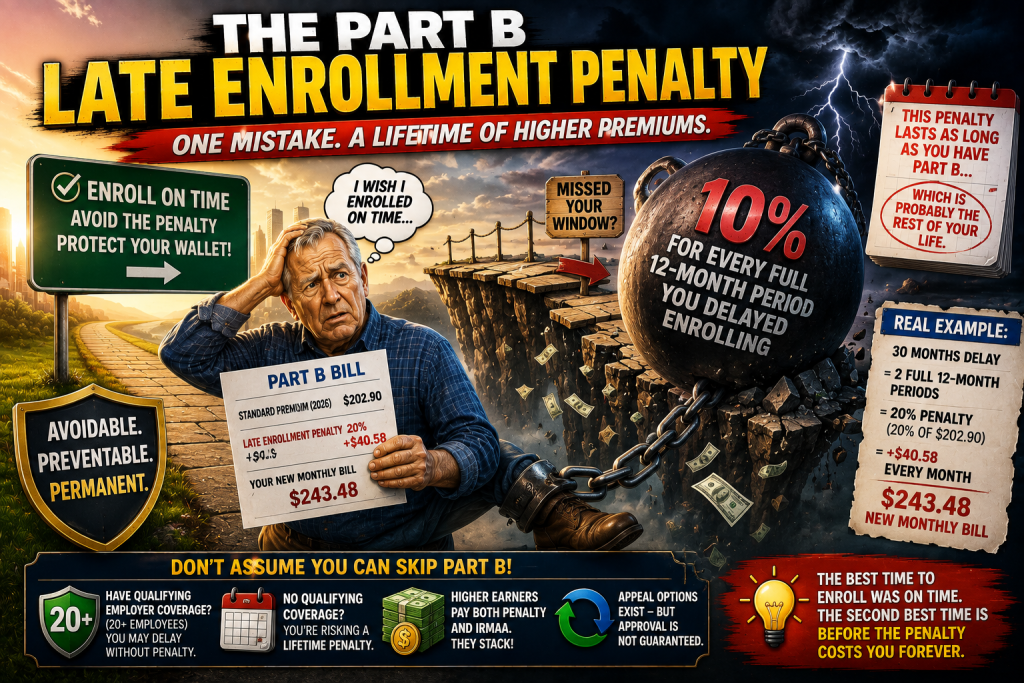
The exact math behind Medicare’s most expensive enrollment mistake — a real worked example, who’s exempt, the one genuine reset that exists, and how to actually appeal if you think you were charged in error.
The Short Answer
The Part B late enrollment penalty is a permanent surcharge added to your monthly premium if you delay signing up for Part B without qualifying coverage to justify the delay. It adds up in a strict, predictable way — 10% for every full 12-month period you went without coverage — and once it’s applied, it generally follows you for as long as you have Part B, which for most people means the rest of their life. Understanding exactly how the math works, and who’s exempt from it, is one of the most financially consequential things you can learn about Medicare.
Key Takeaways
- The penalty is 10% of the current year’s standard Part B premium for every full 12-month period you were eligible but didn’t enroll.
- Partial years don’t count — only complete 12-month blocks trigger the penalty, so an 11-month gap costs nothing while a 13-month gap triggers a full 10%.
- The penalty is calculated using the current year’s premium, not the premium from the year you missed — meaning your dollar penalty rises automatically every time the standard premium goes up.
- The penalty and IRMAA are two separate, independent surcharges. The penalty is calculated against the standard premium, not your IRMAA-adjusted premium — higher earners can face both at once, stacked together.
- This penalty attaches to your underlying Part B enrollment, so it applies whether you choose Original Medicare or Medicare Advantage — switching plans doesn’t remove an already-accrued penalty.
- This is genuinely common: roughly 763,000 people were paying this penalty as of 2019, with an average penalty around 28%.
- Active, qualifying employer coverage from a company with 20 or more employees is the main way to delay Part B without triggering this penalty. COBRA, retiree coverage, VA benefits, and ACA Marketplace plans do not qualify.
- There’s one genuine reset: if you accumulated this penalty under 65 through disability, it’s completely erased once you age into Medicare at 65.
- You can appeal, but the two paths — a standard reconsideration and “equitable relief” — work differently and have different requirements.
How the Penalty Is Calculated
The formula is strict and mechanical:
10% of the current year’s standard Part B premium, for every full 12-month period you were eligible for Part B but didn’t enroll — without qualifying coverage to excuse the delay.
A few details that matter as much as the formula itself:
- The penalty uses the current year’s premium, not the premium from the year you originally missed your window. This means the same “20% penalty” costs more in dollar terms every time the standard Part B premium rises, even though the percentage itself never changes.
- Only full 12-month periods count. If you delayed enrollment by 11 months, your penalty is 0%. Delay by 13 months, and you’re charged a full 10% — the calculation doesn’t prorate partial years.
A Real Worked Example
Say you missed your Initial Enrollment Period and went 30 months without Part B before finally enrolling during a General Enrollment Period.
- Count the full 12-month blocks: 30 months contains two complete 12-month periods, with 6 leftover months that don’t count toward anything.
- Calculate the percentage: 2 periods × 10% = a permanent 20% penalty.
- Apply it to the 2026 standard premium: 20% of $202.90 = $40.58 extra per month.
- Your total monthly Part B premium: $202.90 + $40.58 = $243.48/month.
Here’s what makes this genuinely serious over time: that $40.58 isn’t fixed. As the standard Part B premium rises in future years — and it’s risen in most recent years, including a notably steep jump in 2026 — your 20% penalty recalculates against the new, higher number every single year. The percentage never changes, but the dollar amount keeps climbing right along with everyone else’s premium increases.
A longer delay, for comparison: someone who went 7 full years without Part B would face a 70% penalty — on the 2026 premium, that’s an extra $142.03/month, for a total of $344.93/month, for as long as they have Part B.
The Penalty and IRMAA Are Two Separate, Independent Charges
Here’s a detail worth stating plainly, since it’s a common point of confusion: if you’re a higher earner paying IRMAA, the late enrollment penalty is calculated against the standard Part B premium — not your higher, IRMAA-adjusted premium. The two surcharges are added independently, one on top of the other. So a higher earner facing both charges pays: the standard premium, plus their IRMAA tier, plus the late enrollment penalty percentage applied to the standard premium — three separate pieces stacked together, not one charge inflating another.
This Penalty Applies Even If You Choose Medicare Advantage
It’s worth being direct about something the phrase “Part B penalty” can obscure: this isn’t just an Original Medicare problem. Every path through Medicare — Original Medicare with Medigap, or Medicare Advantage — sits on top of your underlying Part B enrollment, and everyone pays a Part B premium regardless of which path they choose. If you’re carrying a Part B late enrollment penalty, it follows you into a Medicare Advantage plan exactly the same way it would under Original Medicare. Choosing Medicare Advantage doesn’t shield you from a penalty that was already accrued.
This Is Genuinely Common, Not a Rare Edge Case
It’s worth knowing this isn’t some obscure scenario that happens to a handful of unlucky people. According to a Senate Aging Committee data brief, roughly 763,000 people were paying a lifelong Part B late enrollment penalty as of 2019, with the average penalty amounting to about a 28% increase on their monthly premium — well beyond a single year’s delay for the typical affected person.
Paul’s Honest Take: This is exactly why I don’t treat this penalty as a niche warning reserved for unusual situations. Hundreds of thousands of people are living with this surcharge right now, most of them because they simply didn’t realize enrollment wasn’t automatic — not because they made some unusual or careless mistake. If anything, the most common story behind this penalty is genuinely ordinary: someone kept working a little past 65, wasn’t collecting Social Security yet, and assumed Medicare would handle itself the way it does for people who are.
A Real Example of How This Plays Out
I’ve worked with a version of this story more than once. A man retires at 66, having worked part-time without employer health coverage for the last year of his career. He assumed that because he wasn’t actively covered by an employer plan, someone would have told him he needed to sign up for Medicare — nobody did, because nobody’s job is to tell him that. His 7-month Initial Enrollment Period passes unused. He doesn’t realize the mistake until a hospital bill arrives eighteen months later showing he has no coverage at all.
He enrolls during the next General Enrollment Period, roughly 20 months after his IEP ended — one full 12-month period counted, since the leftover 8 months don’t add up to a second one. He now carries a permanent 10% penalty, about $20 a month at 2026 rates, for the rest of his life on Medicare.
Paul’s Honest Take: Nothing about this story involves anyone acting carelessly. It’s exactly what happens when a reasonable assumption — “someone would tell me if I needed to do something” — turns out to be wrong, because Medicare enrollment genuinely isn’t automatic unless you’re already collecting Social Security. This is precisely why I encourage anyone approaching 65, working or not, to have a direct conversation about their specific situation well before their Initial Enrollment Period closes, rather than assuming it will sort itself out.
Help If the Penalty Feels Unaffordable
If cost is a genuine concern, whether you’re currently facing this penalty or trying to avoid one, it’s worth knowing about Medicare Savings Programs (MSPs) — state-run programs for people with limited income and resources. All three main tiers (QMB, SLMB, and QI) cover your ongoing Part B premium, and importantly, all three also cover any late enrollment penalty you owe, not just the standard premium itself. (Full details on income limits and how these programs work are in our [General Enrollment Period guide].)
Paul’s Honest Take: I bring this up because I’ve talked to people who avoided enrolling on time specifically because they were worried about affording the premium — and ended up with a permanent penalty layered on top of costs they might not have had to pay in the first place. If affordability is genuinely part of your hesitation around Medicare, it’s worth checking your MSP eligibility before assuming you’re stuck paying full price either way.
How Long Does It Last?
The Part B penalty is permanent. It doesn’t expire, doesn’t have a maximum, and applies for as long as you’re enrolled in Part B — which, for the overwhelming majority of people, means for life.
The One Genuine Reset: Aging Into Medicare at 65
There’s exactly one real exception worth knowing, and it’s genuinely good news for a specific group: if you qualified for Medicare before 65 through disability and accumulated a Part B late enrollment penalty during that time, the penalty is completely erased once you turn 65. At that point, you become eligible for Medicare based on age instead of disability, and it’s treated as a fresh eligibility basis — the penalty tied to your disability-based enrollment simply doesn’t carry forward.
Paul’s Honest Take: This is one of the more hopeful details in an otherwise unforgiving penalty structure, and I don’t think it gets nearly enough attention. If you or someone you know has been paying a Part B penalty accumulated while on Medicare through disability, that penalty genuinely goes away at 65 — it’s not something you have to fight for or apply to remove. It happens automatically as part of transitioning to age-based eligibility.
What Actually Counts as Qualifying Coverage to Avoid the Penalty
You can safely delay Part B past your Initial Enrollment Period only if you’re covered by a group health plan based on your own or your spouse’s active employment, at a company with 20 or more employees. Once that active coverage ends, you get an 8-month Special Enrollment Period to enroll in Part B penalty-free.
These common forms of coverage do NOT qualify, and relying on any of them instead of enrolling in Part B on time will trigger the penalty:
- COBRA coverage — this is one of the most common and costly mistakes, since COBRA can genuinely feel like “the same coverage” you had while working
- Retiree health insurance plans — even from a former large employer
- VA (Veterans Affairs) healthcare benefits
- ACA Marketplace/Obamacare individual plans
(The COBRA and retiree-coverage traps specifically are covered in much greater depth in our [Medicare Enrollment guide] and [What Is Medicare Part B guide], including real documented cases of people caught by exactly this mistake.)
Paul’s Honest Take: I put this list here deliberately, because every single item on it is something I’ve heard a client assume would protect them, right before finding out it doesn’t. The common thread is that all four of these feel like “real coverage” — and they are, in the sense that they pay medical bills — but none of them satisfy Medicare’s specific definition of active employer coverage. If you’re relying on any of these past your Initial Enrollment Period, that’s worth a direct conversation before the penalty clock keeps running.
How to Appeal If You Think You Were Penalized in Error
There are genuinely two different paths here, and they work differently depending on why you think the penalty is wrong.
Path 1: Standard Reconsideration
If you believe the penalty was calculated incorrectly — for example, you actually had continuous qualifying coverage during some or all of the period in question — you can request a reconsideration using Social Security’s standard reconsideration process (Form SSA-561), generally within 60 days of receiving your penalty notice. You’ll want to gather supporting evidence: a letter from a former employer confirming your coverage dates, pay stubs, or tax records showing health coverage during the disputed period.
Path 2: Equitable Relief
If the reason you missed enrollment was that you received incorrect information from a federal government employee — not a private employer, not an insurance agent, but specifically Social Security or another federal source — you may qualify for a separate process called equitable relief, which can eliminate the penalty and allow immediate or retroactive enrollment.
A few important distinctions between the two: equitable relief has no formal deadline to request it, but also no guaranteed timeline for Social Security to respond, and no formal appeals process if your request is denied. It’s also worth knowing plainly: equitable relief generally does not apply if you were given bad advice by a private employer’s HR department — only misinformation from the federal government itself qualifies.
Paul’s Honest Take: Being unaware that you needed to enroll is, unfortunately, not by itself a successful basis for either kind of appeal — Social Security’s expectation is that the burden is on you to know the rules. Where these appeals genuinely succeed is when there’s real documentation of continuous coverage the penalty didn’t account for, or a clear, provable instance of a federal employee giving you incorrect guidance. If either of those genuinely describes your situation, it’s worth pursuing — but going in with realistic expectations about what these processes can and can’t fix matters too.
Frequently Asked Questions
How is the Part B penalty actually calculated? 10% of the current year’s standard Part B premium for every full 12-month period you were eligible for Part B but didn’t enroll, without qualifying coverage. Partial years under 12 months don’t count.
Does the penalty go away eventually? Generally no — it’s permanent for as long as you have Part B. The one exception is if you accumulated the penalty under 65 through disability; it’s erased automatically when you age into Medicare at 65.
Does COBRA protect me from this penalty? No. COBRA is not considered qualifying coverage for delaying Part B, regardless of how similar it feels to your former employer coverage.
Can I get the penalty removed if I didn’t know I needed to enroll? Generally no — simply being unaware of the requirement isn’t a valid basis for either type of appeal. Successful appeals typically involve proof of continuous qualifying coverage or documented misinformation from a federal government employee specifically.
What’s the difference between a reconsideration and equitable relief? A reconsideration (Form SSA-561, generally within 60 days) is for disputing the penalty calculation itself, such as proving you had coverage the penalty didn’t account for. Equitable relief is a separate process for cases where a federal employee gave you incorrect information, has no formal deadline, but also no guaranteed response time or formal appeal if denied.
Does the penalty amount change over time? Yes — the percentage stays fixed, but it’s recalculated against the current year’s Part B premium every year, so your dollar penalty rises whenever the standard premium does.
Does the penalty apply on top of IRMAA, or does IRMAA replace it? They’re separate, independent charges. The penalty percentage is calculated against the standard Part B premium, not your IRMAA-adjusted premium — a higher earner facing both would pay the standard premium, their IRMAA tier, and the penalty, all stacked together.
Does choosing Medicare Advantage protect me from a Part B penalty? No. The penalty attaches to your underlying Part B enrollment, which every Medicare path relies on, including Medicare Advantage. Switching plans doesn’t remove an already-accrued penalty.
Can Medicare Savings Programs help if I can’t afford the penalty? Possibly. Medicare Savings Programs (QMB, SLMB, and QI) are available to people with limited income and resources, and all three cover not just your ongoing Part B premium but any late enrollment penalty you owe.
The Bottom Line
The Part B late enrollment penalty is genuinely one of the most consequential, permanent financial decisions tied to Medicare — and it’s also one of the most avoidable, since it only applies when someone misses their enrollment window without a valid reason to delay. Understanding exactly how the math works, what actually counts as qualifying coverage, and the one real exception that exists is the best protection against ever facing this penalty yourself.
If you’re approaching a Medicare deadline, weighing whether your current coverage actually protects you from this penalty, or think you may have been charged in error, that’s exactly the kind of conversation I have with clients every day, at no cost to you.
Call 631-358-5793 or visit paulbinsurance.com to set up a time to talk it through.
Paul Barrett, CMIP, is the founder of The Modern Medicare Agency, based in Melville, NY, and has spent 18+ years exclusively helping people navigate Medicare — never life insurance, never annuities, just Medicare. He’s licensed in 37 states, represents more than 40 carriers, and has personally helped over 5,000 clients choose coverage that actually fits their lives.
Figures current as of 2026 and sourced from CMS, Medicare.gov, and Medicare Interactive. Individual circumstances vary — always verify your specific situation before assuming a penalty applies, or attempting an appeal.
Sources
- Medicare.gov — Avoid Late Enrollment Penalties
- Medicare Interactive — Medicare Part B Late Enrollment Penalties
- Medicare Interactive — Appealing the Part B Late Enrollment Penalty
- Medicare Interactive — Equitable Relief
- medicareresources.org — Can I Get a Medicare Part B Late-Enrollment Penalty Removed?
- AARP — How Much Is the Part B Late Enrollment Penalty?
- Senate Special Committee on Aging — BENES Act Data Brief
- Humana — Income-Related Monthly Adjustment Amount (IRMAA)