
Does the mention of Medicare bring to mind a confusing jumble of letters? If you’re feeling lost in the ‘alphabet soup’ of A, B, C, and D, you are certainly not alone. Trying to understand the different medicare parts can feel like navigating a maze, leaving you worried about making a costly mistake with your health coverage. The dense language on official websites often adds to the stress, making a critical life decision feel completely overwhelming.
This guide was created to bring you clarity and peace of mind. We believe that everyone deserves to understand their healthcare options without the confusion. Here, we will patiently break down each part of Medicare-what it is, what it covers, and how it fits into your overall plan. You’ll gain a simple, clear understanding of your two main paths for coverage, empowering you to move forward with the confidence you need to protect your health and your future.
Key Takeaways
- Understand the foundation of your coverage by learning what Original Medicare (Parts A and B) includes and who provides it.
- Discover how private insurance plans like Part C (Medicare Advantage) and Part D can offer more comprehensive benefits beyond the basics.
- Learn how the different medicare parts work together and see how a Medigap plan can help protect you from out-of-pocket costs.
- Clarify your two main paths to Medicare coverage, empowering you to confidently choose the right direction for your healthcare needs.
The Foundation: What is Original Medicare (Parts A & B)?
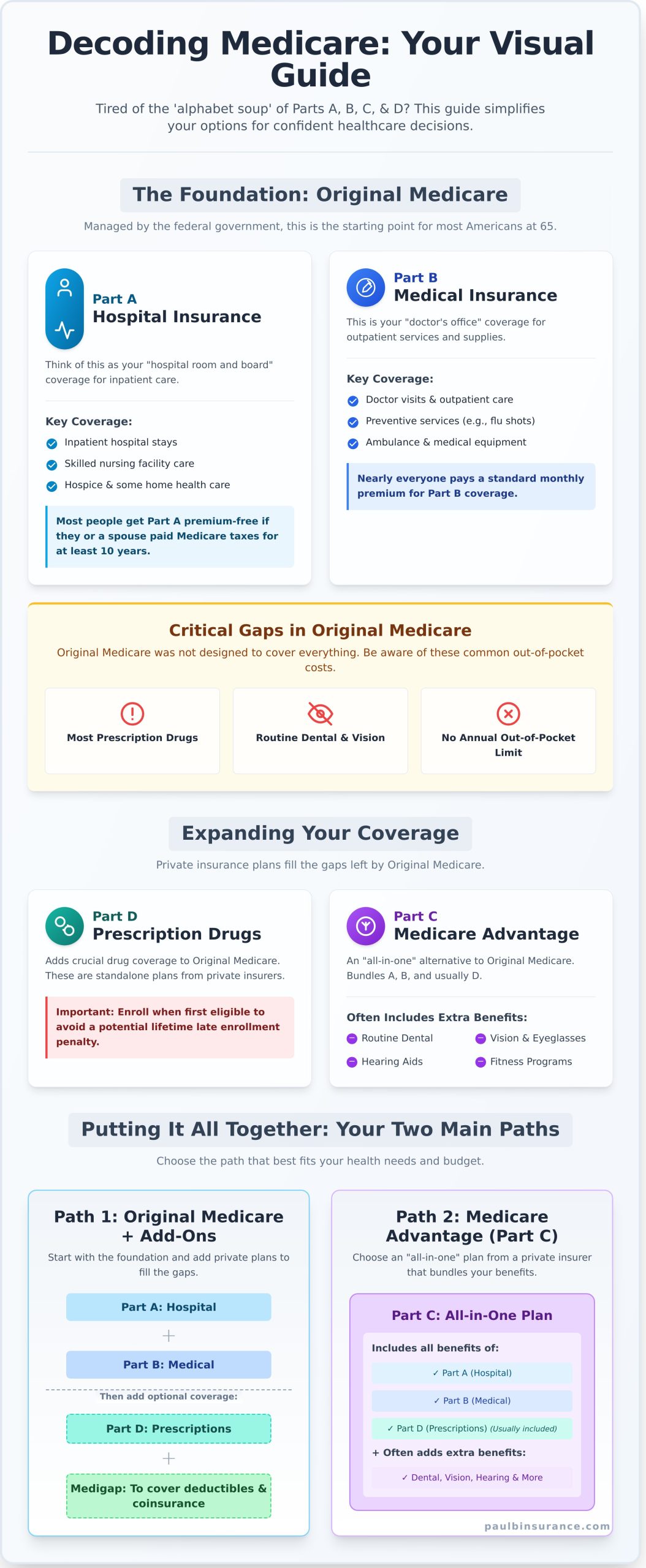
Navigating the world of Medicare can feel overwhelming, but our goal is to provide trusted guidance that turns confusion into confidence. The best place to start is with the foundation: Original Medicare. This is the health insurance program managed directly by the federal government and serves as the starting point for most Americans when they turn 65. This foundational program, detailed on the Medicare (United States) Wikipedia page, is made of two core components. Understanding these original medicare parts is the first step toward building coverage that gives you peace of mind.
Medicare Part A: Your Hospital Insurance
Think of Part A as your ‘hospital room and board’ coverage. It’s designed to help pay for costs when you are formally admitted to a hospital or skilled nursing facility. Its primary focus is on inpatient care, but it also provides coverage for:
- Inpatient hospital stays
- Skilled nursing facility care (following a qualifying hospital stay)
- Hospice care
- Some home health care services
The good news is that for most people, Part A is premium-free. If you or your spouse worked and paid Medicare taxes for at least 10 years, you’ve already earned this essential coverage.
Medicare Part B: Your Medical Insurance
If Part A covers your hospital stay, Part B covers the services you receive from doctors and other healthcare providers. Think of it as your ‘doctor’s office’ coverage. It helps pay for a wide range of medically necessary services and supplies, including:
- Doctor visits and outpatient care
- Preventive services (like flu shots and cancer screenings)
- Ambulance services
- Durable medical equipment (like walkers or wheelchairs)
Unlike Part A, everyone pays a standard monthly premium for Part B, which is often deducted directly from Social Security benefits.
What Original Medicare Doesn’t Cover: The Gaps
This is where many people are surprised. While Original Medicare provides a strong foundation, it was never designed to cover everything. Understanding these gaps is critical to avoiding unexpected and costly medical bills. Key services not covered include:
- Most Prescription Drugs: You’ll need separate coverage (Part D) for medications you take at home.
- Routine Care: Dental, vision, and hearing services are generally not covered.
- Out-of-Pocket Costs: You are still responsible for deductibles, coinsurance, and copayments, and there is no annual limit on what you might have to pay.
These gaps in Original Medicare are precisely why other medicare parts and supplemental plans were created, which we will explore in the next sections.
Expanding Your Coverage: Understanding Parts C & D
While Original Medicare (Parts A and B) provides a strong foundation for your healthcare, many people find it doesn’t cover everything they need. This is where the other medicare parts come into play, offering a path to more comprehensive protection. Think of Parts C and D as ways to fill the gaps and tailor your coverage to your specific health and budget needs.
These plans are offered by private insurance companies that must follow rules set by Medicare. This partnership gives you more choices while ensuring a standard of quality and care. Understanding how these plans work is the next step in moving from confusion to confidence in your healthcare journey. For a trusted overview of how these plans fit together, the official USAGov Medicare Guide provides straightforward government resources.
Medicare Part D: Prescription Drug Coverage
One of the most significant gaps in Original Medicare is prescription drug coverage. Medicare Part D was created specifically to solve this problem. These are standalone plans you can purchase from private insurers to add drug benefits to your Original Medicare. For most people, enrolling in a Part D plan when you first become eligible is crucial. If you delay, you could face a lifetime late enrollment penalty, a costly and avoidable mistake. A Part D plan is your key to managing medication costs and ensuring you can afford the prescriptions you need to stay healthy.
Medicare Part C: The ‘All-in-One’ Medicare Advantage
Medicare Part C, more commonly known as Medicare Advantage, offers a different way to get your benefits. Instead of using Original Medicare, you can choose an “all-in-one” Advantage plan from a private company. These plans are required to cover everything Parts A and B do, and most also bundle in Part D prescription drug coverage.
One of their biggest draws is the inclusion of extra benefits not covered by Original Medicare, such as:
- Routine dental care, including cleanings and X-rays
- Vision exams and allowances for glasses
- Hearing tests and aids
- Fitness program memberships (like SilverSneakers)
It’s important to remember that even with a Part C plan, you must still be enrolled in Medicare Parts A and B and continue to pay your Part B premium.
Filling the Gaps: How Medicare Supplement (Medigap) Works
While Original Medicare (Parts A and B) provides a strong foundation for your health coverage, it wasn’t designed to cover everything. You’re still responsible for out-of-pocket costs like deductibles, copayments, and coinsurance, which can add up unexpectedly. This is where a Medicare Supplement plan, often called Medigap, can provide crucial peace of mind.
Sold by private insurance companies, Medigap policies work alongside your Original Medicare benefits to help pay for those “gaps.” It’s important to understand a key rule right away: you can only have a Medigap plan if you are enrolled in Original Medicare. You cannot have a Medigap policy and a Medicare Advantage plan at the same time.
What Medigap Plans Cover
Medigap plans are standardized and identified by letters (e.g., Plan G, Plan N). While the benefits for each lettered plan are the same regardless of the insurance company, the monthly premiums can vary. These plans help cover your share of costs for services approved by Medicare.
- Part A coinsurance and hospital costs
- Part B coinsurance or copayments
- Blood transfusions (the first three pints)
- Part A hospice care coinsurance
Some plans offer additional benefits, such as coverage for skilled nursing facility care or foreign travel emergencies. However, it’s essential to know that Medigap plans do not include prescription drug benefits. For that, you will need a separate Part D plan. Understanding how these different medicare parts fit together is the key to building comprehensive coverage.
Who is Medigap For?
A Medigap plan is often a great choice for individuals who prefer to stay with Original Medicare, giving them the freedom to see any doctor or visit any hospital in the U.S. that accepts Medicare. If you value predictable healthcare costs and want to protect yourself from large, unforeseen medical bills, a Medigap plan can provide that stability. The costs associated with healthcare gaps, which are well-documented in resources like KFF’s Overview of Medicare, are precisely what these supplemental plans are designed to address. This makes it an ideal option for those who travel frequently or simply want the assurance of a financial safety net.
Navigating these choices can feel overwhelming. Not sure if Medigap is right for you? Get expert advice.
Putting It All Together: Your Two Main Medicare Paths
After learning about the individual medicare parts, it’s easy to feel overwhelmed. But here’s the good news: all those letters and options simplify into two primary paths for your healthcare coverage. Think of it as choosing between building your own customized plan or selecting a convenient, all-in-one package. Understanding these two routes is the key to moving from confusion to confidence.
Path 1: Original Medicare + Add-ons (The “Build-Your-Own” Path)
This is the traditional route offered directly by the federal government. You start with a foundational layer and add pieces to fit your specific needs.
- Foundation: Part A (Hospital Insurance) + Part B (Medical Insurance).
- Optional Add-ons: You can add a standalone Part D plan for prescription drug coverage and a Medicare Supplement (Medigap) plan to help cover out-of-pocket costs like deductibles and coinsurance.
- Key Advantage: The biggest benefit is freedom. You can see any doctor or visit any hospital in the U.S. that accepts Medicare, with no network restrictions or referral requirements.
Path 2: Medicare Advantage (The “All-in-One” Path)
Also known as Part C, this path bundles all your benefits into a single, convenient plan offered by a private insurance company approved by Medicare.
- All-Inclusive: These plans must cover everything Original Medicare (Parts A and B) covers. Most also include prescription drug coverage (Part D).
- Extra Perks: Many plans offer additional benefits not covered by Original Medicare, such as routine dental, vision, and hearing care.
- Key Trade-off: In exchange for simplicity and often lower monthly premiums, you typically must use doctors and hospitals within the plan’s network.
How to Decide Which Path is Right for You
Choosing your path is one of the most important healthcare decisions you’ll make. There is no single “best” answer-only what’s best for you. Start by asking yourself:
- How important is it to keep my current doctors?
- What is my budget for monthly premiums and potential out-of-pocket costs?
- Do I travel often or live in multiple states throughout the year?
- Do I need dental, vision, or hearing benefits included in my plan?
Navigating these choices and comparing the different medicare plans on your own can be a challenge. An independent, unbiased expert can provide the personalized guidance you need to compare both paths and find a solution that truly fits your life. If you’re ready for clear, straightforward support, we’re here to help you make a confident decision.
From Confusion to Confidence: Choosing Your Medicare Path
Navigating the world of Medicare doesn’t have to be a source of stress. As we’ve covered, your journey starts with understanding the foundation: Original Medicare Parts A and B. From there, you have two primary paths-either supplementing Original Medicare with Part D and a Medigap plan or opting for an all-in-one Medicare Advantage (Part C) plan. The key is knowing that choosing the right combination of medicare parts is a deeply personal decision based on your unique healthcare needs and budget.
If you’re still feeling unsure which path is right for you, you are not alone. That’s where trusted, expert guidance can bring clarity and peace of mind. With personalized support and unbiased advice on over 40+ insurance carriers, we’ve helped more than 5,000 clients find the perfect fit. Feeling confused? Let’s make Medicare simple. Book your free, no-obligation consultation today.
You deserve to feel confident in your healthcare coverage, and we’re here to help you every step of the way.
Frequently Asked Questions About Medicare Parts
What is the difference between Medicare and Medicaid?
This is a common point of confusion, and we’re here to provide a clear answer. Medicare is a federal health insurance program primarily for people aged 65 or older and certain younger individuals with disabilities. Your eligibility is based on your work history. In contrast, Medicaid is a joint federal and state program that provides health coverage to people with limited income and resources. Eligibility for Medicaid is determined by your financial situation, not just your age.
Can I have both a Medicare Advantage plan and a Medigap policy?
No, you cannot have both a Medicare Advantage (Part C) plan and a Medigap policy at the same time. In fact, it is illegal for an insurer to sell you a Medigap policy if they know you have a Medicare Advantage plan. These two options work in fundamentally different ways: Medigap supplements your Original Medicare coverage, whereas a Medicare Advantage plan replaces it. We can provide the trusted guidance you need to choose the right path for your healthcare.
Do I have to sign up for all parts of Medicare at once?
You are not required to enroll in all medicare parts simultaneously. For most people turning 65, Part A (Hospital Insurance) is premium-free and enrollment is automatic if you’re receiving Social Security. You can choose when to enroll in Part B (Medical Insurance) and Part D (Prescription Drugs). However, delaying enrollment without having other qualifying coverage can lead to lifelong penalties, so it’s a decision that requires careful, personalized guidance to avoid costly mistakes.
How much do the different parts of Medicare cost?
Costs can vary quite a bit, so let’s simplify it. Most people get Part A premium-free based on their work history. Part B has a standard monthly premium (for example, $174.70 in 2024 for most beneficiaries), which can be higher depending on your income. The costs for Medicare Advantage (Part C) and Part D drug plans depend entirely on the specific private insurance plan you select, as premiums, deductibles, and copays differ from one plan to another.
Do I need Medicare Part B if I am still working and have employer coverage?
This is a crucial question, and the answer depends on the size of your employer. If your company has 20 or more employees, your group health plan is your primary coverage, and you can typically delay Part B without a penalty. However, if your employer has fewer than 20 employees, Medicare generally becomes your primary insurer. In that scenario, you will need to sign up for Part B to avoid coverage gaps and potential late enrollment penalties.
What happens if I don’t sign up for Part D when I’m first eligible?
If you miss your Initial Enrollment Period for a Part D plan and do not have other creditable prescription drug coverage (like from an employer or the VA), you will likely face a lifelong late enrollment penalty. This penalty is calculated based on how long you went without coverage and is added to your monthly Part D premium for as long as you have the plan. This is a common and costly mistake that expert guidance can help you easily avoid.