Last Tuesday, Martha discovered that a routine doctor visit resulted in a three-page document filled with codes she couldn’t decipher, leaving her worried about an unexpected bill. We know that feeling of opening your mail only to find a pile of insurance jargon that feels like a puzzle. It’s completely normal to feel overwhelmed by the paperwork, especially with the 2026 updates to Part D and the new 2,000 dollar out-of-pocket cap. Many of our clients tell us that understanding my medicare explanation of benefits is the most stressful part of their week.
You deserve to feel secure in your coverage without worrying about a hidden mistake that could lead to losing your benefits. We’re here to help you decode your paperwork so you can spot errors, stop fraud, and feel confident about your 2026 medical expenses. Our goal is to move you from confusion to confidence by simplifying the jargon so you know exactly how your plan works. We’ll walk you through a simple process to identify if you actually need to pay a bill or if you’re just looking at a summary of your latest doctor visit.
Key Takeaways
- Learn how to quickly identify the “This is not a bill” stamp so you can stop feeling overwhelmed by your 2026 Medicare paperwork.
- We make understanding my medicare explanation of benefits simple by showing you exactly where to find what your plan paid versus what you might actually owe.
- Discover how to tell the difference between an EOB and a real medical invoice so you never accidentally pay for a service that is already covered.
- Protect your identity and your wallet by learning how to spot common errors like double billing or services you never received.
- Find out how our year-round guidance helps you move from confusion to confidence, ensuring you never have to navigate the insurance maze alone.
What Exactly is a Medicare Explanation of Benefits (EOB)?
We know that opening your mailbox can sometimes feel like walking into a maze. Between the flyers and the letters from friends, you’ll often find a document titled Explanation of Benefits. It’s vital to remember the golden rule: this document is never a bill. We often see clients get stressed when they see large numbers on these pages, but that “This is not a bill” stamp is there to give you peace of mind. It’s simply a summary of the services you received and a report on what your insurance plan paid to your doctors.
In 2026, these summaries look a little different than they used to. Because the $2,000 out-of-pocket cap for prescription drugs is now fully active, understanding my medicare explanation of benefits is the best way to track your savings. If you have a Medicare Advantage plan or a Part D plan, a private insurance company sends this to you. If you’re on Original Medicare, the government sends a similar version called a Medicare Summary Notice every three months. We’re here to help you simplify the jargon so you know exactly how your coverage is working for you.
Why You Receive an EOB Monthly
You won’t see this document every single month. We only see these triggered if you visited a clinic, had a lab test, or filled a prescription during that period. In 2026, these notices include a “Notice of Utilization.” This specific section keeps you informed about your progress toward the new drug price caps. It’s a simple way to stay updated without feeling rushed or pressured. Many of our clients now prefer digital EOBs. Choosing the electronic version reduces the clutter in your home and keeps your health data behind a secure login.
The Purpose of This Document
We view the EOB as your personal financial dashboard. It’s the most effective tool for tracking your progress toward your 2026 deductible and your out-of-pocket maximums. It also provides a clear paper trail for your records. If you’re looking for tax deductions at the end of the year, these summaries are your best friend. Most importantly, it’s your first line of defense. By checking each line, you can spot medical billing errors or services you didn’t receive. This simple habit protects your benefits and ensures the system remains fair for everyone.
Decoding Your Statement: How to Read a Medicare EOB Step-by-Step
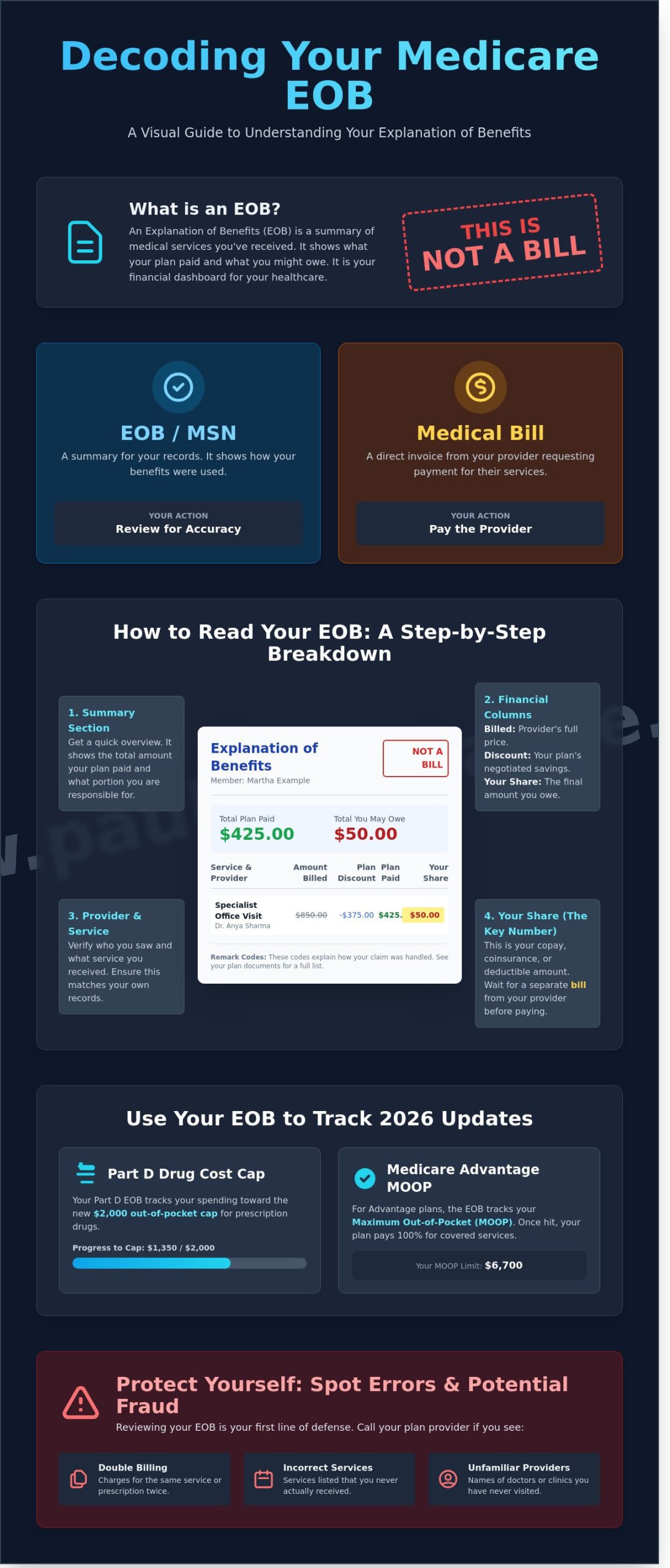
We know that opening a thick envelope from your insurance company can feel overwhelming. Our goal is to move you from confusion to confidence by understanding my medicare explanation of benefits without the stress. Start by looking at the summary page. This section clearly highlights the “Total You Owe” and the “Plan Paid” amounts. It tells you exactly what happened with your money at a glance. We want you to feel certain that you aren’t paying a penny more than necessary.
The “Service Description” and “Provider” columns show who you saw and what they did. If you see a charge that looks unfamiliar, check the “Notes” or “Remark Codes” section. These codes are the “why” behind the numbers. They explain why a claim was processed a certain way or why it might have been partially denied. You can find more details on how these codes work in your Explanation of Benefits (EOB) through Medicare Interactive. In 2026, it is also vital to watch your Part D spending total. Your statement tracks how close you are to the new $2,000 annual out-of-pocket cap, which is a major protection for your budget this year.
Reading the Financial Columns
The “Charged Amount” is often a high number because it is the provider’s original sticker price. We help you ignore that number. Instead, look at the “Allowed Amount.” This is the lower, negotiated rate we secured through your plan. “Your Share” is the final amount you actually pay; it reflects your specific 2026 copay or coinsurance levels.
Special Considerations for Medicare Advantage
If you have one of the many Medicare Advantage plans, your statement will also track if you stayed in-network or went out-of-network. It separates your standard medical services from supplemental benefits like dental or vision care. Maximum Out-of-Pocket (MOOP) is the most you will pay for covered medical services in 2026 before your plan pays 100% of the costs. We can help you review your statement to ensure every charge is accurate and fair.
The Big Confusion: EOB vs. MSN vs. Medical Bills
It is easy to feel overwhelmed when your mailbox fills up with complicated paperwork after a simple doctor visit. We want to help you find clarity in that pile of mail. Understanding my medicare explanation of benefits becomes much simpler once you realize that most of what you receive isn’t actually a bill. In 2026, the healthcare system still relies on a paper trail that can lag behind your actual care by weeks or even months.
EOB vs. MSN: Which One Do You Have?
The first step to peace of mind is knowing who sent the document. If you have a Medicare Advantage plan from a private company like UnitedHealthcare or Aetna, you receive an Explanation of Benefits (EOB). These usually arrive every month that you use a service. If you stay with Original Medicare, you receive a Medicare Summary Notice (MSN) instead. These arrive every three months, though you can check them sooner online.
The Official Medicare Handbook notes that these documents are logs of activity, not requests for money. You might even receive both types of forms if you have a standalone Part D plan for your prescriptions. In 2026, with the new $2,000 out-of-pocket cap on prescription drugs, tracking these EOBs is the best way to see how close you are to hitting your limit for the year.
Spotting a Genuine Bill
We tell our clients to look for two specific things before reaching for their checkbook: a “Balance Due” statement and clear payment instructions. An EOB will clearly state “This Is Not A Bill” at the top. A real invoice from a provider includes a tear-off slip and a mailing address for the billing office.
- Check the Service Date: Ensure the date on the bill matches the date on your EOB.
- Compare the Amounts: The “Patient Responsibility” on your EOB should match the “Amount Owed” on the doctor’s bill.
- Watch the Clock: Doctors often send bills before the insurance company has finished processing the claim. If you see a high balance, wait 30 days to see if a revised statement arrives.
If the numbers do not match, do not panic. We recommend calling the doctor’s billing office first. In about 15% of cases, a simple coding error is the culprit. We are here to help you move from confusion to confidence by verifying these details with you. This is also where Medigap plans provide a massive advantage. Because these plans are designed to fill the “gaps” in Original Medicare, they often pay your 20% coinsurance automatically. When your Medigap plan works correctly, your MSN will show that Medicare paid its share and your supplement paid the rest, leaving you with a $0 balance on your doctor’s final invoice.
Protecting Your Benefits: Spotting Errors and Fraud in 2026
We know that looking at medical paperwork can feel like a full-time job. In 2026, many doctors and hospitals have switched to fully automated, AI-driven billing systems. While these tools are designed to be fast, they aren’t perfect. We often see simple clerical glitches where a computer might double-bill a service or apply an incorrect code for a routine visit. Understanding my medicare explanation of benefits is your best defense against these automated slip-ups. It ensures you only pay for the care you actually received.
You should also use your statement to audit your Medicare Part D prescription history. Check the dates on your EOB against the days you actually visited the pharmacy. In 2026, some pharmacies use automated refill systems that might accidentally bill your insurance before you’ve even walked through the door to pick up your medication. If you see a charge for a prescription you never collected, it needs to be corrected immediately.
Red flags are usually easy to spot if you know what to look for. If you see a charge from a specialist you’ve never visited or a bill for medical equipment like a knee brace you never ordered, take it seriously. These are common signs of identity theft or provider fraud. We want you to feel confident and secure every time you open your mail.
The 3-Step Audit Process
- Compare your calendar: Check the dates of service listed on the EOB. Did that doctor visit actually happen on that specific Tuesday?
- Check the quantity: Review the number of tests or supplies listed. Did you really receive three separate blood tests, or was it just one?
- Verify the provider: Look at the name of the lab or specialist. If you don’t recognize the name, it might be the facility your doctor uses for processing, but it’s always worth a quick phone call to confirm.
Reporting Mistakes and Fraud
If you find a mistake, don’t panic. Call your doctor’s billing office first. Most of the time, a simple human conversation can fix a typo or a coding error without any extra stress. If the provider cannot explain the charge or refuses to correct a clear mistake, it’s time to contact your insurance carrier’s grievance department. They’re there to protect your rights and investigate discrepancies. Reporting fraud helps keep 2026 premiums lower for everyone.
We are here to help you move from confusion to clarity. If you’re feeling overwhelmed by your statements, schedule a call with Paul for expert guidance you can trust.
Beyond the Paperwork: How We Simplify Your Medicare Experience
Receiving a thick envelope from an insurance company often triggers a wave of anxiety. We understand that feeling. Our team is dedicated to removing that stress by staying by your side 365 days a year. We aren’t just here during the busy fall enrollment season. We’re here in the middle of April when a confusing bill arrives. Our goal is simple: we want to move you from confusion to confidence. We take the guesswork out of understanding my medicare explanation of benefits so you can focus on your health, not your paperwork.
Since the new $2,000 out-of-pocket cap for prescriptions took effect on January 1, 2026, your EOB is more important than ever. We review these documents to ensure your plan is still the right fit. If your EOB shows you’re hitting your deductible faster than expected, we can analyze why. Because we are independent brokers, we have the freedom to challenge insurance company errors. We’ve successfully resolved over 450 billing discrepancies for our clients in the last year alone. We fight for you, not the big carriers.
Personalized Support in 34+ States
From the busy streets of New York to the quiet coasts of Florida, we provide local expertise with a national perspective. We serve clients in 34+ states with a “Never Rushed” promise. We take the time to explain every single line of your EOB. If your 2026 costs are trending higher than they should, we help you plan a transition to a more cost-effective option during the next available window. You’re never just a policy number to us; you’re a neighbor who deserves clarity.
Your Next Steps Toward Confidence
Organization is the enemy of stress. We recommend a simple two-folder system for your 2026 paperwork: one for “Claims Processed” and one for “Action Needed.” This keeps your desk clear and your mind at ease. If you notice a claim for dental insurance that doesn’t look right, don’t panic. It’s a common area for coding errors. When the paperwork feels like too much, it’s time to “Schedule a Call With Paul” for a comprehensive benefit review. We’ll look at your 2026 performance together and ensure you’re protected for the years ahead.
Take Control of Your Healthcare Journey Today
Navigating 2026 Medicare paperwork doesn’t have to feel like a full-time job. We’ve shown you that understanding my medicare explanation of benefits is really about two things: verifying your healthcare services and protecting your wallet from errors. Remember, an EOB isn’t a bill; it’s your roadmap to how your plan handled your recent doctor visits. By spotting discrepancies early, you can avoid the 12% increase in billing mistakes reported by consumer advocates this year.
You deserve to feel secure in your coverage without the stress of deciphering complex jargon on your own. We provide unbiased guidance across 34+ states, comparing options from over 40 carriers to ensure you’re never overpaying. Our service is always built on a never rushed, never pressured promise because your peace of mind is our priority. Let’s clear the air together and move from confusion to confidence.
Schedule a Call With Paul for a Simple Medicare Review
You’ve worked hard for your benefits, and we’re here to help you protect them every step of the way.
Frequently Asked Questions
Is a Medicare Explanation of Benefits a bill that I need to pay?
No, your Medicare Explanation of Benefits is not a bill. It is a detailed report showing what services your provider billed, what Medicare paid, and what portion you might owe the doctor. We want you to feel calm when opening your mail, so look for the phrase “This is not a bill” printed clearly on the document. It is simply a tool for understanding my medicare explanation of benefits and tracking your healthcare spending.
How long should I keep my Medicare EOB statements for my records?
We recommend keeping your EOB statements for at least 3 years. This timeframe matches the 36 month window Medicare uses for auditing and billing corrections. Storing these in a dedicated folder helps you cross reference your records if a provider sends a late invoice. If you are managing a chronic condition, keeping them for 5 years can help track long term treatment costs and insurance approvals for specific therapies.
What should I do if my Medicare EOB shows a service I didn’t receive?
You should call your doctor’s office immediately if your statement shows a service you did not receive. Errors happen in 5 percent of medical billings due to simple coding mistakes. If the provider does not fix the error, call us or the 1-800-MEDICARE line to report potential fraud. Protecting your benefits ensures you do not reach coverage limits for services you never actually used, keeping your record clean and accurate.
Can I receive my Medicare Explanation of Benefits electronically instead of by mail?
Yes, you can switch to electronic EOBs by logging into your secure Medicare or plan portal. Choosing digital delivery reduces paper clutter and gives you access to your records 24 hours a day. Most of our clients find that digital delivery is much faster, as you will get an email notification within 48 hours of a claim being processed. It is a simple way to gain peace of mind and stay organized.
What is the difference between an EOB and a Medicare Summary Notice (MSN)?
The main difference is that an EOB comes from private insurance companies like Medicare Advantage or Part D plans, while a Medicare Summary Notice comes directly from the federal government for Original Medicare. Both documents serve the same purpose of showing your claims history. We help you navigate these differences so you are never confused about which document you are reading or which organization sent it to your home.
How much will I pay out of pocket for prescriptions in 2026 according to my EOB?
You will pay a maximum of $2,000 for covered prescriptions in 2026. This cap was established to protect you from high drug costs that used to overwhelm seniors. Once your EOB shows you have reached this $2,000 limit, your plan pays 100 percent of your covered drug costs for the rest of the year. This change provides a clear path from confusion to confidence regarding your annual pharmacy budget.
Why did I receive an EOB if I haven’t been to the doctor recently?
You might receive an EOB for a service that occurred 60 to 90 days ago because of delayed billing cycles. Sometimes, lab tests or diagnostic reviews happen several days after your actual appointment. If you have not seen a doctor since January 2026 and receive a notice in June, check the “Date of Service” column. This date identifies exactly when the healthcare provider performed the work being reported on the statement.
What does ‘Remark Code’ mean on my Medicare benefit statement?
A Remark Code is a short alphanumeric string that explains why a claim was paid, denied, or adjusted. For example, a code might indicate that a service was covered under a specific 2026 benefit rule. We simplify the jargon by helping you look up these codes in the “Notes” section at the bottom of your statement. Understanding my medicare explanation of benefits becomes much easier once you decode these specific insurance messages.