
On June 12, 2026, Sarah realized her boxes were packed for her move to Florida, but she had no idea if her heart medication would be covered at a pharmacy in her new zip code. She sat at her kitchen table wondering, “what happens to my medicare if I move to another state?” and felt the heavy weight of the unknown. We know that moving is one of life’s most stressful events. The last thing you need is the fear of losing your doctor or facing a late enrollment penalty because of a missed deadline.
It’s perfectly normal to feel overwhelmed by the different rules for Medigap and Medicare Advantage in a new region. We’re here to replace that anxiety with a clear, simple plan that protects your health and your budget. We’ll explain exactly how your coverage transitions and the specific steps you must take to ensure you never lose your benefits. This guide provides a 2026 timeline for switching plans and confirms that your Original Medicare stays with you, no matter where you call home. You can move with confidence, knowing your healthcare is secure.
Key Takeaways
- Understand why Original Medicare travels with you while your private Advantage or Part D plans are tied to your specific county’s service area.
- Discover exactly what happens to my medicare if I move to another state and how to use the 2026 Special Enrollment Period to switch plans without a gap in coverage.
- Learn the specific rules for keeping your Medigap policy when crossing state lines to ensure your supplemental benefits remain secure.
- See how we help you simplify the jargon and compare dozens of carriers in your new area to avoid costly enrollment mistakes and late penalties.
Understanding How Moving Affects Your Medicare Coverage in 2026
Moving to a new home brings enough stress without the added worry of healthcare gaps. We know that staring at a stack of boxes is hard enough without wondering, what happens to my medicare if I move to another state in 2026? The good news is that we are here to clear the fog and make this transition simple. While your address is changing, your access to quality care does not have to. We want to ensure you feel confident and protected as you settle into your new community.
It helps to remember that the Medicare program is a federal system managed by the government. This means your core benefits stay with you regardless of which state you call home. However, there is a big difference between federal benefits and private insurance contracts. In 2026, your new zip code is the most critical piece of information for your coverage. It determines your specific service area, which impacts your private plan options like Medicare Advantage or Part D drug coverage. These plans are often built around local networks of doctors and pharmacies.
Your very first priority is notifying the Social Security Administration (SSA) about your move. We recommend doing this as soon as you have a confirmed new address. This simple step ensures your records are updated for the 2026 benefit year and that you don’t miss any vital mail. You can update your information quickly through your personal “my Social Security” account online or by calling their official toll-free line. Taking this step early helps you steer clear of enrollment mistakes later on.
What Stays the Same When You Cross State Lines
If you have Original Medicare, your ability to see any doctor in the U.S. who accepts Medicare patients remains exactly the same. Your Part A and Part B premiums are also consistent because they are set by federal guidelines each year. For 2026, you will keep using your current red, white, and blue Medicare card. Your unique ID number stays with you for life. Unless you are moving from a state-specific assistance program, your basic monthly costs for federal Medicare won’t change just because you crossed a state border.
What Changes When You Enter a New Service Area
The landscape shifts when we look at private insurance options. Medicare Advantage plans often have localized networks of providers. If you move out of your plan’s service area, you will likely need to choose a new plan that covers your new city. Similarly, Part D drug plans vary by region. A pharmacy that was a “preferred” location in 2025 might be out-of-network at your new address in 2026. Additionally, Medicare Supplement insurance pricing and regulations vary by state. Some states offer different protections for switching plans without a medical exam. Understanding what happens to my medicare if I move to another state means looking closely at these local rules to maintain your peace of mind.
Medicare Advantage and Part D: Navigating Geographic Service Areas
Medicare Advantage (Part C) and Part D prescription plans are built around where you live. Unlike Original Medicare, which is national, these private plans contract with specific networks of doctors and pharmacies in your local county. If you are wondering what happens to my medicare if I move to another state, the short answer is that your current plan likely cannot go with you. When you move out of your plan’s designated service area, the insurance company will automatically disenroll you. This is not a penalty. It is just how the system is structured to ensure you have access to local care providers.
In 2026, we see more seniors than ever moving to be closer to family or find better climates. This transition requires a careful look at your network. Your favorite doctor in your current city might not be “in-network” once you cross state lines. We recommend checking the provider directory for any new plan before you commit. This simple step prevents the shock of a high bill for an out-of-network visit later on. We want you to move with the confidence that your healthcare remains stable.
Moving Within the Same State vs. Moving to a New State
A move doesn’t have to be across the country to trigger a change. Even moving one county over within the same state can mean your current Medicare Advantage plan is no longer available. Most Part D drug plans are also region-specific. If you move to a new state, you will almost always need to select a new Part D plan. You can use our 2026 Medicare Part D guide to compare the local options in your new zip code. We want you to feel certain that your new coverage is as strong as the old one.
Managing Your Medications During the Transition
We know that keeping your prescriptions filled is a top priority. In 2026, federal rules allow for a one-time, 30-day “transition fill” of your current medications when you join a new plan. This gives you a month to work with your new doctor to verify the formulary. Since the $2,000 out-of-pocket cap for Part D is now fully active this year, choosing a plan with the right “preferred pharmacies” in your new neighborhood is essential for saving money. If you feel overwhelmed by these choices, you can talk with a trusted expert to find the best local fit for your specific medications.
The Special Enrollment Period: Timing Your Move Without Losing Coverage
Moving to a new home is a massive task. Between packing boxes and saying goodbye to neighbors, your health insurance shouldn’t be another source of stress. We want you to know that Medicare recognizes this life change. When you move out of your plan’s service area, it triggers a Special Enrollment Period (SEP). This is a specific window of time that allows you to switch plans or return to Original Medicare without any red tape. Understanding how this window works is the most important part of knowing what happens to my medicare if I move to another state.
For the 2026 calendar year, the timelines remain very strict. You generally have 60 days to choose a new plan. If you notify your insurance carrier before you move, your SEP lasts for three months: the month before you move and the two months after. This is the best way to ensure you have no gap in protection. If you wait until after you have already unpacked in your new home, your 60-day window starts the moment you notify your plan or the day you moved, whichever is later. We always suggest acting early. Timing is everything when it comes to keeping your doctor visits affordable.
Acting within this window protects you from the Part D Late Enrollment Penalty. If you go more than 63 days without “creditable” drug coverage, Medicare adds a permanent fee to your monthly premium. We don’t want you to pay more for the rest of your life just because of a hectic move. By using your SEP, you bypass these penalties and keep your costs predictable.
Your Move Timeline: A Month-by-Month Checklist
- One month before: Start researching the best Medicare Advantage plans available in your new zip code. Plans vary wildly by county, so we recommend checking which doctors in your new town are in-network.
- The week of the move: Contact the Social Security Administration (SSA) to update your address. You should also call your current insurance carrier to give them your official move date.
- One month after: Confirm your new coverage is active by checking your member portal. This is the perfect time to schedule your first “Welcome” visit with a local primary care physician to establish your care.
What If You Miss the Window?
Missing your 60-day SEP window is a risky move. If you don’t pick a new plan in time, you might fall back to Original Medicare (Part A and Part B) without any drug coverage or a supplemental policy. This leaves you responsible for the 20% coinsurance that Original Medicare doesn’t cover. Even worse, you might be locked out of private plan options until the next Annual Enrollment Period, which runs from October 15 to December 7, 2026. This could leave you exposed to high medical bills for several months. The SEP is your safety net to prevent a lapse in 2026 coverage.
Moving with a Medigap Plan: What You Need to Know About State Rules
Medigap plans, also known as Medicare Supplement insurance, offer a level of flexibility that Advantage plans simply cannot match. Because these plans don’t rely on provider networks, they’re much more portable. You can generally take your current Medigap policy with you to any state in the country. As long as you stay enrolled in Original Medicare, your supplement plan will continue to pay its share of the bills at any doctor who accepts Medicare. This portability is a huge relief for many seniors in 2026 who want to maintain their consistency of care during a big move.
While you can keep your plan, you might find that your monthly premiums change. Insurance companies often adjust their rates based on the local cost of healthcare in your new zip code. We often see clients ask, “what happens to my medicare if I move to another state if I find a cheaper plan there?” The answer is that you can apply for a new plan, but you might have to answer health questions unless you have a specific legal right to switch. We help you look at the math to see if switching saves you money or if staying put is the safer bet.
Guaranteed Issue Rights: Your Protection When Moving
A “Guaranteed Issue” right is your best friend during a move. This rule prevents insurance companies from denying you coverage or charging you more because of pre-existing conditions. If you’re moving out of a Medicare Advantage plan’s service area, you have a 63-day window to buy a Medigap plan without a medical exam. This is often called a “Trial Right” if you’re returning to Original Medicare after trying an Advantage plan for less than a year. In 2026, these protections remain the gold standard for protecting your health and your wallet.
Some states offer even better protections. If you’re moving to New York, Connecticut, or Massachusetts, you’ll find unique state laws. These states often allow you to switch or buy plans year-round regardless of your health history. We simplify these complex rules so you can move with confidence, knowing your “what happens to my medicare if I move to another state” concerns are handled by experts who understand the local laws of your new home.
Comparing Costs in Your New State
How an insurance company sets its prices can drastically change your budget. In 2026, most states use one of three rating systems: Community Rated, Issue-Age Rated, or Attained-Age Rated. In a “Community Rated” state, everyone pays the same premium regardless of age. In “Issue-Age” states, your cost is based on how old you were when you first bought the policy. Understanding these nuances is vital before you sign any paperwork. We recommend a full review of Medicare Supplement insurance options in your new state at least 30 days before your move date.
Working with an independent broker is the smartest way to compare these costs. Unlike a captive agent who only represents one company, we look at the entire market. We compare the 2026 rates of dozens of carriers to find the best value for your specific situation. This unbiased guidance ensures you don’t overpay for the exact same coverage you had back home. We’re here to make sure your transition is smooth, ethical, and entirely transparent.
Ready to see how your Medigap costs will change in your new state? Schedule a free consultation with us today to get a personalized 2026 comparison.
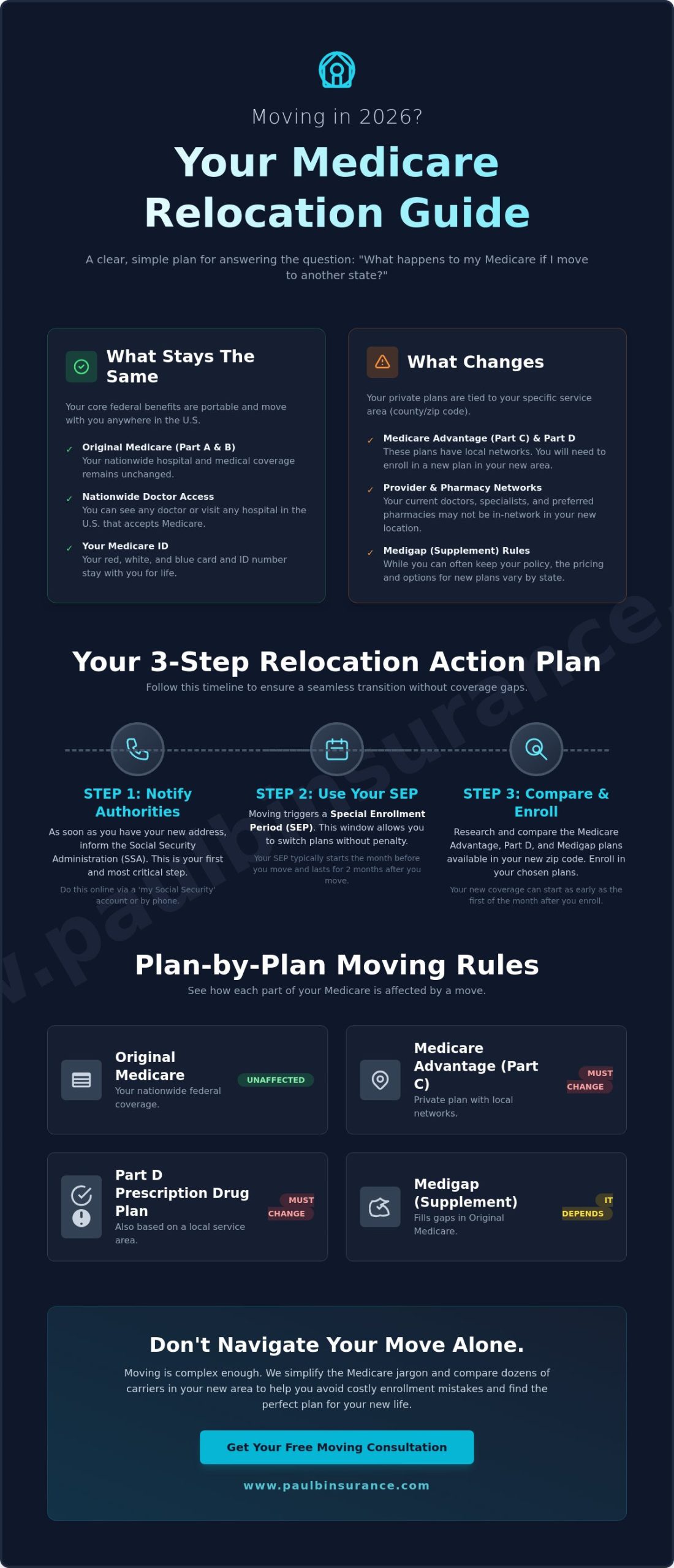
How We Help You Smooth Your Medicare Transition to a New State
Moving is one of the most stressful life events. In 2026, the complexity of healthcare rules can make a relocation feel impossible. We take that weight off your shoulders. As an independent brokerage licensed in over 34 states, we don’t work for the insurance companies; we work for you. We simplify the jargon so you know exactly how your coverage works before you even cross the state line. We compare options from more than 40 carriers to ensure your new plan fits your budget and your lifestyle perfectly.
Our 5-step process is designed to move you from confusion to confidence during your move:
- Initial Discovery: We learn about your health needs and your specific moving timeline.
- Provider Check: We verify if your current doctors or preferred local hospitals are in-network in your new zip code.
- Prescription Review: We run your 2026 medications through the latest plan formularies to avoid pricing surprises.
- Plan Comparison: We present the top three options side-by-side so you can see the real value.
- Seamless Enrollment: We handle the paperwork to ensure there are no gaps in your coverage while you’re on the road.
Many clients call us panicked, asking what happens to my medicare if I move to another state, and we’re able to calm those fears immediately with facts and a clear plan. Our year-round support means we’re still here to help with billing questions or coverage issues long after your moving truck has left the driveway.
Unbiased Guidance Across State Lines
Moving means more than just a new address. It means finding new doctors who accept your coverage. We don’t just look for the lowest monthly premium. Instead, we focus on the total cost of care, including your specific 2026 prescriptions and specialists. Our “never rushed” consultations mean we stay on the phone until every question is answered. You won’t find the high-pressure tactics of a captive agent here. We provide the clarity you need to understand what happens to my medicare if I move to another state without the headache or the sales pitch.
Schedule a Call With Paul for a Seamless Move
Your 2026 Medicare review should happen before you pack your first box. We invite you to a personalized, no-pressure phone call to discuss your relocation. Whether you’re looking into a Medigap plan or a Medicare Advantage plan, we’re here to help you find the right fit. Getting started is easy and takes just a few minutes of your time. You handle the boxes and the bubble wrap; we’ll handle the Medicare. Let’s make sure your healthcare is the easiest part of your move.
Take the Next Step Toward Your New Home With Confidence
Moving to a new state in 2026 is a significant milestone, but we know the insurance paperwork can feel like a heavy burden. You’ve learned that your Medicare Advantage or Part D plan likely won’t follow you across state lines because of geographic service areas. Understanding what happens to my medicare if I move to another state is mostly about timing your Special Enrollment Period correctly to avoid any gaps in care. We also explored how Medigap protections vary by state, which is vital for your healthcare budget. You don’t have to navigate this maze alone. We are licensed in 34+ states and provide unbiased access to more than 40+ insurance carriers. Our proven 5-step process takes you from confusion to confidence, ensuring your transition is seamless and stress-free. We’ll handle the complex jargon while you focus on settling into your new community. We are here to protect your health and your peace of mind every step of the way.
Schedule a Call With Paul to simplify your Medicare move
We look forward to helping you start this new chapter with total clarity and security.
Frequently Asked Questions
Do I need to get a new Medicare card if I move to a different state?
No, you do not need to get a new Medicare card because your red, white, and blue card is valid in all 50 states. Your unique 11 character Medicare Number stays exactly the same regardless of where you live in the country. We recommend updating your address through the Social Security website as soon as you have your new zip code. This ensures your 2026 Medicare Summary Notices reach your new mailbox without any delays.
How long do I have to change my Medicare plan after I move?
You generally have a two month window to switch your coverage through a Special Enrollment Period. This period starts either the month before you move or the month you notify Medicare, and it lasts for two full months after you arrive at your new home. If you miss this 60 day deadline, you might have to wait until the Annual Enrollment Period in October 2026. We help you track these dates so you don’t face gaps.
Can I keep my current Medicare Advantage plan if I move to a neighboring state?
You usually cannot keep your current Medicare Advantage plan because these plans are tied to specific service areas and county lines. If you move outside your plan’s network, you must choose a new one available in your new zip code. About 95 percent of people moving to a neighboring state find that their current plan isn’t offered in their new county. We can help you compare the 2026 options in your new neighborhood.
What happens to my Medigap policy if I move to a state where that plan isn’t offered?
You can typically keep your Medigap policy because these plans are guaranteed renewable and follow you nationwide. However, your monthly premium will likely change to reflect the healthcare rates in your new state. If you have a Medicare Select plan, which uses specific provider networks, you may need to switch to a standard Medigap policy. We ensure you understand what happens to my medicare if I move to another state so your coverage remains stable.
Will my prescription drug costs change when I move to a new state in 2026?
Your prescription drug costs will likely change because Part D plans are managed on a regional basis. In 2026, the national base beneficiary premium is adjusted annually, and local plan availability varies significantly by state. You might find that your current medications fall into different cost tiers in your new location. We review your specific prescriptions against the 2026 formularies in your new state to prevent any expensive surprises at the pharmacy counter.
Do I have to notify Medicare before I move or can I wait until I arrive?
You should notify Social Security about your move as soon as possible, ideally three to four weeks before you leave. While you can wait until you arrive, telling them early allows your Special Enrollment Period to begin sooner. This proactive step helps you secure a new plan that starts the first day of the month you move. We guide you through this notification process to make your transition from one state to another completely seamless.
What is a “Trial Right” and how does it help me if I move?
A Trial Right is a special protection that lets you switch from a Medicare Advantage plan back to Medigap without answering health questions. This applies if you joined Medicare Advantage for the first time and decide to move within your first 12 months of enrollment. It’s a powerful tool because it guarantees you can get a Medigap policy even with pre-existing conditions. We use these rights to give you total confidence during your 2026 relocation.
Can an independent broker help me if I am moving from New York to Florida?
Yes, an independent broker is your best resource when moving from New York to Florida. Since we aren’t tied to one insurance company, we compare all 2026 plans available in Florida to find your best match. Moving to the Sunshine State involves different regional networks and pricing structures than the Northeast. We simplify this complex transition by handling the research, so you can focus on your move while we secure your peace of mind.

Article by
Paul Barrett
Paul Barrett, CMIP is the founder of The Modern Medicare Agency, an independent Medicare-only brokerage based in Melville, NY. With 18 years of Medicare-exclusive experience, a CMIP designation, and more than 5,000 clients served across 37 states, Paul is one of the most credentialed independent Medicare specialists on Long Island — and one of the most direct.
He represents 40+ carriers with no quotas and no allegiances, which means his recommendations are based entirely on what fits each client's specific situation. He is the author of Medicare Mastery Unlocked and host of the Wise Guys Retirement Talk podcast. His content is grounded in primary sources, real carrier intelligence, and 18 years of watching what happens when people get Medicare right — and when they don't.
📞 631-358-5793 | paulbinsurance.com