




That moment when a formal-looking envelope from your insurance company arrives can be stressful. Your mind might immediately jump to the worst-case scenario: a large, unexpected bill. But before you panic, take a closer look. More often than not, what you’re holding is an Explanation of Benefits, or eob, and the most important thing to know is that it is not a bill. We understand that the codes, columns, and medical jargon can feel overwhelming, leaving you more confused than when you started. It’s a common feeling, but you don’t have to navigate it alone.
In this simple guide, we’ll provide the trusted guidance you need to finally understand your Medicare costs. We’ll show you exactly how to read your EOB with confidence, verify that every detail is accurate, and know what steps to take if you find a mistake. Our goal is to move you from confusion to confidence, turning that piece of paper from a source of stress into a powerful tool for managing your healthcare. Let’s get started.
Key Takeaways
- First and foremost, understand that your Explanation of Benefits is a helpful summary of your care and costs-it is not a bill.
- Learn how to confidently read each section of your eob to see exactly what your plan covered and what portion you are responsible for.
- Find out the crucial difference between an EOB and a Medicare Summary Notice (MSN) and which one you should expect to receive.
- Get a simple action plan to use every time you review your benefits, helping you spot potential errors and stay in control of your healthcare costs.
What Is an Explanation of Benefits (EOB) and Why Do You Get One?
After a visit to the doctor, it’s common to receive a document in the mail from your insurance company that can look confusing at first glance. Before you worry, take a deep breath. This document is your Explanation of Benefits, and its purpose is to provide guidance, not to demand money.
Simply put, an Explanation of Benefits (EOB) is a summary statement that your health insurance plan sends you after processing a claim from a doctor, hospital, or other healthcare provider. It details what the provider billed, what your insurance plan paid, and what portion you are responsible for. It’s a transparent breakdown of how your benefits were applied to that specific service. The single most important thing to remember is this: an EOB is NOT a bill.
EOB vs. a Medical Bill: The Key Difference
Understanding the distinction between these two documents is key to avoiding confusion and potential overpayment. Your EOB comes directly from your insurance provider, such as your Medicare Advantage plan. A medical bill, on the other hand, comes from the healthcare provider who performed the service. Your EOB gives you a preview of what you might owe, but the bill from your doctor’s office is the official request for payment. Always wait to receive the final bill before paying anything.
Why Reviewing Your EOB is So Important
While it isn’t a demand for payment, your eob is a powerful tool for managing your healthcare journey. Taking a few moments to review it carefully helps you stay in control of your medical expenses and ensures you’re getting the full value of your benefits. It provides the clarity and confidence you need to navigate your healthcare costs.
- Track your spending: It gives you a clear picture of your out-of-pocket costs for each service.
- Catch potential errors: You can verify that you were only billed for services you actually received and spot any potential mistakes before you pay.
- Confirm your benefits: It shows you that your insurance plan is covering services correctly according to your policy.
- Monitor your progress: It helps you keep an eye on how much you’ve paid toward your annual deductible and out-of-pocket maximum.
How to Read Your EOB: A Section-by-Section Breakdown
At first glance, an Explanation of Benefits can feel overwhelming. With its columns of numbers and insurance-specific terms, it’s easy to feel confused. However, we’re here to provide the straightforward guidance you need. While the design may vary between insurance companies, every eob contains the same essential information to help you understand your healthcare costs.
Think of it as a receipt that details what your doctor billed, what your insurance plan covered, and what portion is left for you. It is crucial to remember this is not a bill. For those on Medicare, understanding the distinction in an EOB vs. Medicare Summary Notice is also key, as they serve similar informational purposes. Let’s walk through the four main parts of a typical EOB document, step by step.
Section 1: Patient & Claim Information
This is the “who and when” of your claim. It serves as a quick checkpoint to ensure all the basic details are correct before you dive into the numbers. Always take a moment to verify this information.
- Your Details: Confirm that your name, address, and policy or member ID number are accurate.
- Claim Number: This unique number is your primary reference. Keep it handy if you need to call your insurer or provider with questions.
- Provider & Dates: Check that the doctor or facility name and the date(s) you received care are correct.
Section 2: Service Details & Provider Charges
Here, you will find an itemized list of the services you received. Next to each service, you’ll see a column often labeled ‘Amount Billed’ or ‘Total Charges.’ Don’t be alarmed by this number-it represents the full, undiscounted price your provider charged for the service. Think of it as the starting price tag before your insurance plan’s savings are applied.
Section 3: How Your Plan Covered the Costs
This section shows your insurance plan in action. It breaks down how the ‘Amount Billed’ was reduced to a more manageable figure. You’ll typically see terms like:
- Plan Discount: Also called ‘Network Savings,’ this is the pre-negotiated discount your insurer has with in-network providers. It’s a key benefit of your plan.
- Amount Paid by Plan: This is the specific dollar amount your insurance company paid directly to the provider on your behalf.
- Not Covered: Any services or charges that your plan denied. There is usually a reason code explaining why it was not covered.
Section 4: Your Responsibility (What You May Owe)
This is the bottom line. This final part of your eob clearly summarizes the amount you should expect to be billed for. It calculates your share of the cost after all discounts and payments have been made.
- Deductible: The portion of the bill that was applied to your annual deductible.
- Copay/Coinsurance: Your fixed fee or percentage-based share for the service.
- Total Patient Responsibility: This is the final amount you owe. Always compare this figure to the actual bill you receive from your provider to ensure they match.
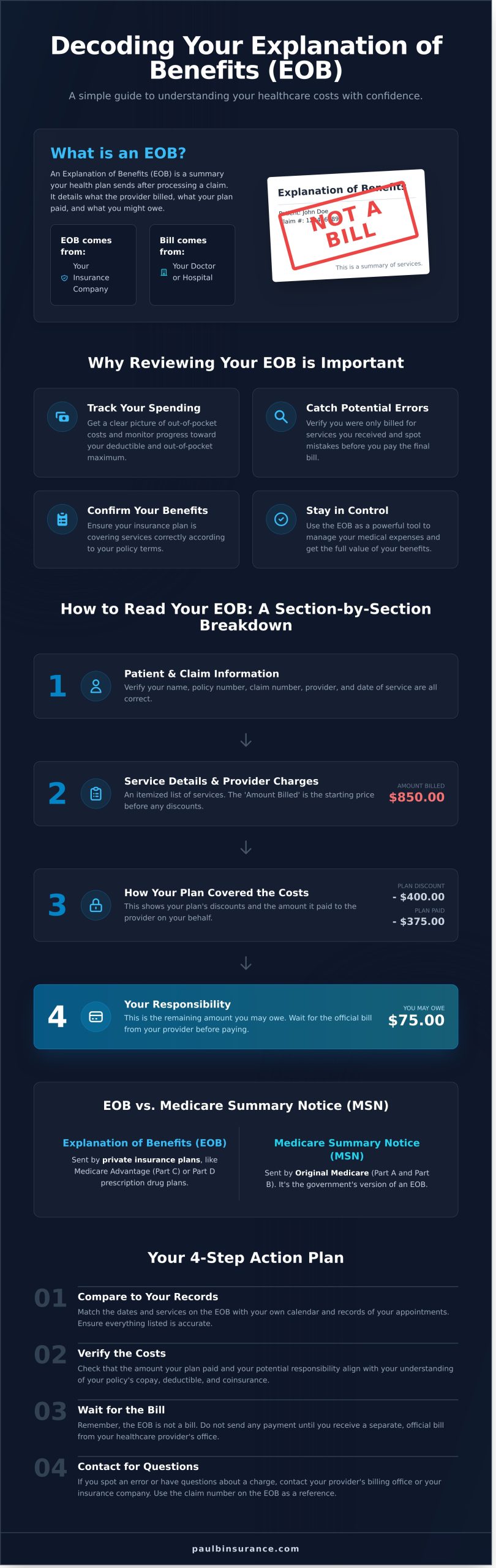
EOB vs. Medicare Summary Notice (MSN): A Crucial Distinction
Navigating Medicare paperwork can feel overwhelming, and one of the most common points of confusion is the difference between an Explanation of Benefits (EOB) and a Medicare Summary Notice (MSN). While they look similar and serve the same basic function, the document you receive depends entirely on your type of Medicare coverage. Understanding this distinction is a simple but powerful step toward managing your healthcare with confidence.
Think of it this way: both documents summarize your recent medical services and how much your plan paid. The key difference is who sends the document and which part of Medicare it covers.
When You Receive an EOB
An Explanation of Benefits, or EOB, comes directly from a private insurance company. You will receive an EOB if you are enrolled in a private plan, such as:
- A Medicare Advantage (Part C) Plan
- A standalone Medicare Part D (Prescription Drug) Plan
This document details how your private plan’s benefits were applied to a recent doctor’s visit, medical procedure, or prescription fill. Because it comes from your specific plan, understanding its details is essential for tracking your copayments, deductibles, and coinsurance. If you have questions about this statement or need help interpreting it, you should contact your private insurance provider directly.
When You Receive a Medicare Summary Notice (MSN)
The Medicare Summary Notice (MSN) is the version for beneficiaries with Original Medicare (Parts A and B). This document is sent directly from Medicare, not a private company, and you will receive it every three months. It provides a quarterly list of all your Part A (hospital) and Part B (medical) services and supplies that were billed to Medicare. Functionally, the MSN serves the same purpose as an eob-it helps you track your claims, spot potential billing errors, and see what you may owe.
At-a-Glance Comparison: EOB vs. MSN
| Characteristic | Explanation of Benefits (EOB) | Medicare Summary Notice (MSN) |
|---|---|---|
| Sent By | Your private insurance company | Medicare |
| For Coverage Type | Medicare Advantage (Part C) & Part D | Original Medicare (Part A & B) |
| Frequency | After a claim is processed | Every three months (Quarterly) |
| Primary Purpose | Summarizes private plan claims | Summarizes Original Medicare claims |
Your 4-Step Action Plan After Receiving an EOB
An Explanation of Benefits can feel like just another piece of mail. But we encourage you to think of it as a routine health check-up for your medical finances. By turning this document into an active tool, you can move from confusion to confidence, ensuring you only pay for the care you actually received. Here is a simple, 4-step plan to help you take control.
Step 1: Open and Review It Promptly
Don’t let insurance paperwork pile up on the counter. The best time to review your EOB is as soon as it arrives, while the details of your recent doctor’s visit are still fresh in your mind. A quick, initial check can prevent major headaches later. Look for these key items:
- Verify Personal Details: Is your name, policy number, and other information correct?
- Check Provider and Dates: Does the EOB list the correct doctor or facility and the right date of service?
- Confirm Services: Most importantly, did you actually receive all the services listed?
Step 2: Compare It to Your Medical Bill
Your provider’s bill will usually arrive separately from your EOB. Once you have both documents, it’s time to compare them side-by-side. The most important number to find is the Total Patient Responsibility on your EOB. This amount should perfectly match the total due on the bill from your doctor or hospital.
If the numbers don’t match, pause. Don’t pay the bill just yet. An incorrect bill is much easier to resolve before you have sent a payment.
Step 3: Check for Common Errors
Mistakes happen, and your EOB is your first line of defense in catching them. Carefully scan the document for some of the most common billing errors that can cost you money. Be on the lookout for:
- Duplicate charges for a single service or procedure.
- Charges for medical services you did not receive.
- Incorrect billing codes that may have resulted in a denial.
- A service listed as “not covered” when you believe your plan should cover it.
Step 4: File It for Your Records
Once you’ve confirmed everything is accurate and have paid your portion of the bill, don’t just toss the paperwork. It’s wise to keep the EOB and the corresponding paid bill together in a file. We recommend holding onto these records for at least one year. If you deduct medical expenses on your taxes, you may need to keep them even longer.
Thankfully, many insurance plans now offer digital access to your eob documents, making storage simple and clutter-free.
Following these steps transforms your Explanation of Benefits from a confusing summary into a powerful tool for managing your healthcare costs. If this process uncovers a problem that feels overwhelming, remember that you don’t have to navigate it alone. For trusted, expert guidance on your Medicare questions, please visit us at paulbinsurance.com.
What to Do If You Find an Error on Your EOB
Finding a mistake on your Explanation of Benefits can feel stressful, but don’t worry. Errors happen, and they are often simple to resolve. The key is to address the issue calmly and methodically. Think of your eob as a starting point for a conversation, not a final, unchangeable bill. Most discrepancies can be corrected with a phone call or two, and taking these simple steps can save you from paying for services you shouldn’t have to cover.
Here is a straightforward, step-by-step process to follow if you suspect an error.
First, Contact Your Doctor’s Billing Office
Many errors are simple clerical mistakes that originate with your healthcare provider. A wrong service code or a typo can cause a claim to be processed incorrectly. Your doctor’s office can often fix the issue and resubmit the claim to your insurance plan. Before you call, be sure to have this information ready:
- Your Explanation of Benefits (EOB)
- The bill from your provider
- Your insurance card
Next, Call Your Insurance Plan
If your provider’s office confirms the claim was submitted correctly, the issue may be with how your insurance plan processed it. This is often the case for disagreements about what your plan covers. Use the member or customer service phone number on your insurance card to get in touch. When you call, be sure to reference the specific claim number listed on your EOB to help the representative find your information quickly.
Understanding the Appeals Process
If your insurance plan denies a claim and you believe it should have been covered, you have the right to appeal their decision. Your denial letter or EOB will include specific instructions on how to start the formal appeals process, including deadlines you must meet. This process ensures your case gets a second look. Navigating appeals can be tough. We can help you understand your plan’s rules.
From EOB Confusion to Medicare Confidence
Your Explanation of Benefits is more than just another piece of mail; it’s a powerful tool for managing your healthcare costs. Remember, it’s a summary, not a bill. By taking a few moments to review each section and check for accuracy, you can catch potential errors early and ensure you’re only paying what you owe. Understanding your eob is a crucial step in taking control of your Medicare journey and avoiding costly surprises down the road.
But we know that even with a guide, this paperwork can feel overwhelming. If you’re looking for clarity, you don’t have to navigate it alone. With trusted, unbiased guidance, we have helped over 5,000 clients move from confusion to confidence. You’ll get year-round support for all your Medicare questions, so you always have an expert on your side.
Feeling confused by your Medicare paperwork? Schedule a free, no-obligation plan review today. Take the first step toward peace of mind.
Frequently Asked Questions About Your EOB
How long should I keep my EOBs and MSNs?
This is a very common question. We recommend keeping your EOBs and Medicare Summary Notices (MSNs) for at least one year to cross-reference with medical bills and ensure there are no discrepancies. Some people prefer to keep them for up to three years, especially if they are deducting medical expenses on their taxes. Once you’ve confirmed all bills are paid correctly and the tax year has passed, you can typically shred them securely for your peace of mind.
Can I get my Explanation of Benefits online instead of by mail?
Yes, absolutely. Most insurance companies now offer a secure online portal where you can access your Explanation of Benefits documents. Opting for online statements is a great way to reduce paper clutter and ensure you can find a specific document whenever you need it. Simply log in to your insurer’s website or mobile app to check your account settings and switch to paperless delivery. It provides convenient and immediate access to your claims history.
What does it mean if a service is ‘denied’ or ‘not covered’ on my EOB?
Seeing a service marked as ‘denied’ or ‘not covered’ can be worrying, but it simply means your plan has determined that specific service isn’t a payable benefit under your policy terms. This could be for many reasons, from needing prior authorization to the service not being deemed medically necessary. Your first step should be to call your insurance provider. They can provide a clear reason and offer guidance on the appeals process if you disagree with the decision.
Does the EOB show how much I have left to pay on my annual deductible?
Yes, in most cases, your EOB will provide a helpful summary of where you stand with your annual deductible. Look for a section often labeled ‘Deductible Status’ or ‘Plan Accumulators.’ This area shows how much you’ve paid toward your deductible so far and the remaining amount you’re responsible for before your plan’s full benefits kick in. It’s a very useful feature for tracking your out-of-pocket spending throughout the year and avoiding surprises.
Is there a difference between an EOB and a Superbill?
While they both relate to medical billing, they serve different purposes. An EOB comes from your insurance company *after* they process a claim, explaining what they paid and what you owe. In contrast, a Superbill is an itemized receipt you get from your healthcare provider. You would typically use a Superbill to submit a claim yourself, which is common when you see an out-of-network provider and need to seek reimbursement from your insurer.
What should I do if I get an EOB for a service I don’t recognize?
If you see a service on your EOB that you don’t recognize, it is important to act promptly. First, call your doctor’s billing office to ask for clarification, as it could be a simple coding error. If they can’t resolve it, contact your insurance company’s anti-fraud hotline immediately. Reporting a suspicious charge helps protect you and the healthcare system from costly errors and potential fraud. Don’t ever hesitate to ask for help investigating.