




Could a simple piece of paper sitting in your mailbox right now be the only thing standing between you and a permanent, lifelong financial penalty? Many people who continue working past age 65 assume their current insurance is enough, only to find out too late that Medicare disagrees. It’s stressful to manage employer paperwork while trying to understand what is creditable prescription drug coverage and how it impacts your future costs. You deserve to feel confident that your current choices won’t come back to haunt your retirement budget.
We understand that the transition to Medicare often feels like walking through a minefield of technical rules and strict deadlines. You shouldn’t have to guess whether your plan is “good enough” or worry about a monthly penalty based on the 2026 national base beneficiary premium of $38.99. This guide is designed to remove that anxiety by giving you a clear, step by step path to protection. We will explain exactly how to verify your coverage, how the critical 63 day rule works, and how the new $2,100 out of pocket cap for 2026 makes Part D more valuable than ever before. By the time you finish reading, you will have a concrete plan to secure your peace of mind and protect your savings for the years ahead.
Key Takeaways
- Understand what is creditable prescription drug coverage and why it serves as a quality benchmark to protect your rights to affordable medicine.
- Learn how the 63-day rule works so you can avoid the lifelong late enrollment penalty that stays with you for as long as you have Medicare.
- Discover how to identify the “Notice of Creditable Coverage” letter, your most vital document for proving you had adequate insurance while working.
- Identify which employer or union plans typically meet the standard and when it makes financial sense to switch to a Part D plan.
- See how the new $2,100 out-of-pocket cap in 2026 changes the math when comparing your current coverage to Medicare options.
Understanding the Basics: What Does Creditable Actually Mean?
“Creditable” might sound like a term from a bank loan, but in the world of Medicare, it’s actually a promise of quality. If you’ve been wondering what is creditable prescription drug coverage, think of it as a government-verified seal of approval. It essentially means that your current insurance plan is expected to pay out, on average, as much as a standard federal drug plan would. This isn’t just a technicality; it’s a vital designation that protects your right to join Medicare later without being punished for the delay. It ensures your health insurance meets a specific standard of protection so you aren’t left with massive bills at the pharmacy.
The ‘As Good As’ Standard Explained
To qualify as creditable, your current plan must meet a specific financial threshold set by the Centers for Medicare & Medicaid Services. The government compares your insurance against the standard Medicare Part D benefit. If your plan’s coverage is at least as good as that standard, it’s labeled “creditable.” This comparison looks at your deductibles, the types of drugs covered, and how much you pay at the pharmacy counter. You don’t need a calculator or an actuarial degree to figure this out. Your insurance provider is legally required to perform this calculation and tell you the results in writing every single year.
Why Creditable Coverage is Your Financial Shield
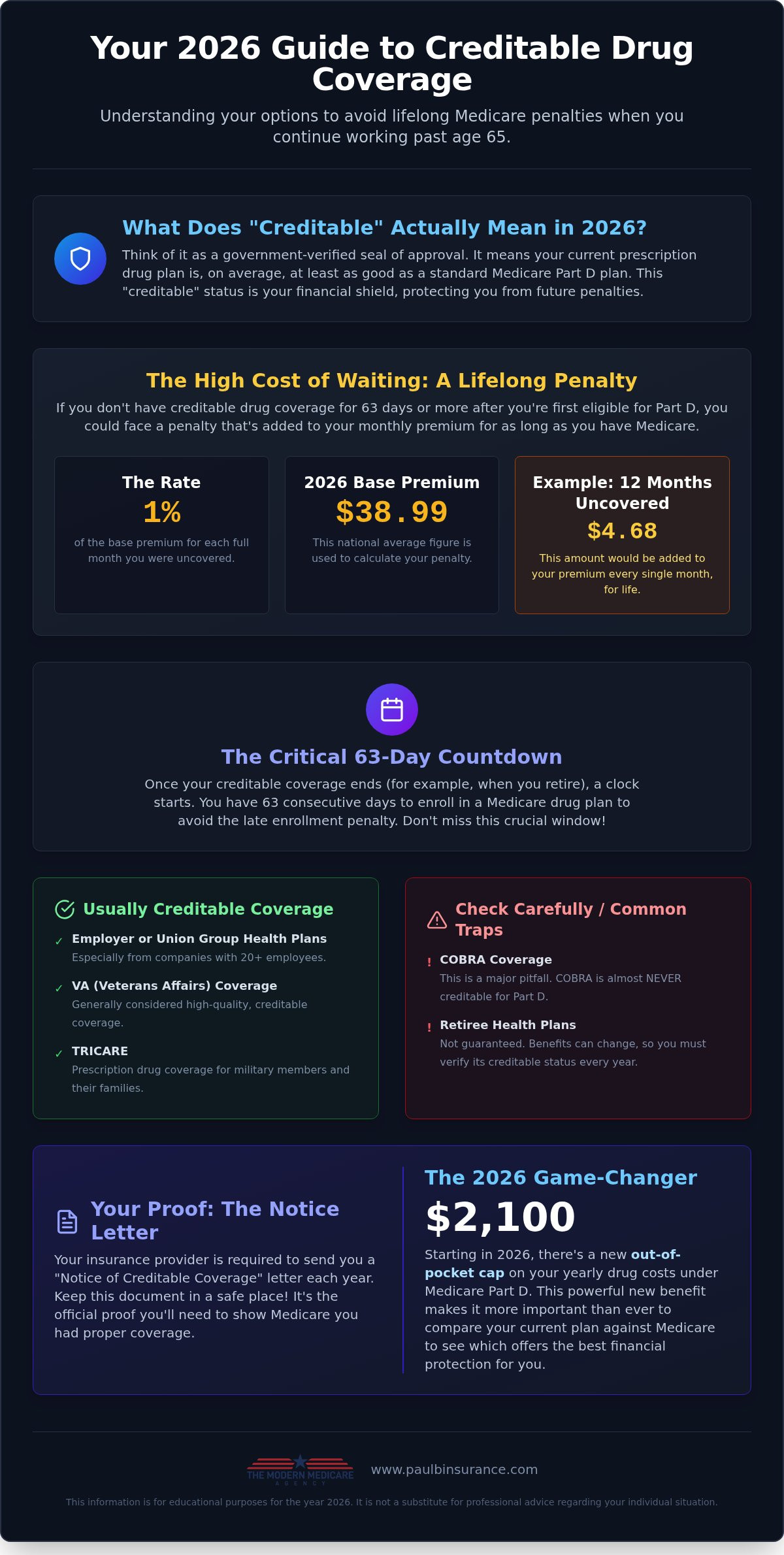
The real value of this designation is the protection it offers your wallet. Medicare requires most people to have some form of prescription drug insurance once they turn 65. If you choose to keep your employer plan instead of joining Medicare Part D, you must prove your coverage was creditable to avoid a late enrollment penalty. This penalty is lifelong. It’s calculated as 1% of the national base beneficiary premium, which is $38.99 in 2026, for every month you went without proper coverage. Having a creditable plan acts as a shield. It allows you to stay on your current insurance with total peace of mind, knowing you won’t face higher premiums when you eventually transition to Medicare.
For your 2026 planning, this is especially important because the standard for what counts as “good coverage” has changed. With the new $2,100 out of pocket cap on drug costs, Medicare is more robust than ever. We’re here to help you verify that your current plan still measures up to these improved standards so you can make an informed, stress free decision about your health care journey. Keeping track of the 63 day rule is much easier when you know your current coverage is already working to protect your future.
Where Does Creditable Coverage Come From? Sources in 2026
Employer and Union Group Health Plans
If you or your spouse are still working for a company with 20 or more employees, your group health plan is likely creditable. These plans are the “heavy hitters” of the insurance world. However, there are two common traps to watch out for. First, COBRA coverage is a frequent source of confusion. While COBRA allows you to keep your health benefits after leaving a job, it is almost never considered creditable for drug coverage. If you rely on COBRA for more than 63 days after turning 65, you might face those lifelong penalties we want to help you avoid. Second, retiree health plans are not guaranteed to be creditable. Because these plans often change their benefits to save costs, you must check your status every year. If you feel uncertain, you can compare your current benefits with a standard Part D plan to see how they stack up.
VA Benefits, TRICARE, and Other Federal Programs
Veterans and military families often have access to some of the strongest prescription benefits available. An Overview of the Medicare Part D program shows that VA prescription benefits are almost always considered creditable. This is excellent news because it means you can often delay Part D without any penalty. TRICARE for Life also works harmoniously with Medicare, providing a reliable safety net. Similarly, coverage through the Indian Health Service (IHS) is recognized as meeting the necessary standards. These programs offer a sense of security, but it’s still wise to keep your official “Notice of Creditable Coverage” on file just in case Medicare ever asks for proof of your history.
Don’t forget to look at the coverage for your dependents as well. If your spouse is also approaching 65, their eligibility for these benefits can impact your joint planning. If you aren’t sure what is creditable prescription drug coverage regarding your specific plan, reaching out to an independent guide can help you verify your status before a deadline passes. Protecting your future shouldn’t be a guessing game. We’re here to make sure you have the facts you need to move forward with confidence.
The High Cost of Waiting: Why Creditable Coverage Matters
The term might feel like insurance jargon, but understanding what is creditable prescription drug coverage is really about avoiding a permanent tax on your health. If you don’t have this specific type of coverage after your initial Medicare window closes, the government applies a financial penalty. This isn’t a one-time fine. It’s a monthly surcharge added to your drug plan premium for as long as you have Medicare. Paying more every single month for the exact same coverage as your neighbor can be deeply frustrating. It’s an unnecessary financial leak that we want to help you plug before it even starts.
Calculating the Part D Late Enrollment Penalty
The math behind the penalty is straightforward but unforgiving. Medicare calculates the fine by taking 1% of the “national base beneficiary premium” and multiplying it by the number of full months you lacked creditable coverage. For 2026, the national base beneficiary premium is confirmed at $38.99. This number is the foundation for all penalty math across the country.
Let’s look at a concrete example. If you retired and went without a drug plan for 24 months, your penalty would be 24% of that base premium. In 2026, that adds about $9.40 to your monthly bill. While $9 might not sound like a fortune, remember that the base premium usually increases every year. As that national average goes up, your 24% penalty goes up right along with it. It’s a growing “forever” cost that stays on your record for life. This is why verifying your coverage now is so critical for your long-term budget.
The 63-Day Gap Rule
Medicare provides a small safety net known as the 63-day rule. This is the maximum amount of time you can go without what is creditable prescription drug coverage before the penalty clock starts ticking. Think of it as a grace period for your transition. If you leave an employer plan on June 1st, you must have a new Medicare drug plan or other creditable coverage in place by August 2nd. If you reach day 64 without coverage, the penalty is triggered for every month you were without it, including those first two months of the gap.
Tracking these dates is the most vital part of your Medicare transition journey. We always suggest starting your search for a Medicare Part D plan at least two months before your current insurance ends. This simple step ensures your new plan is active the moment your old one stops. Staying safely within that 63-day window removes the anxiety of future penalties and lets you focus on enjoying your retirement. You shouldn’t have to pay more for your prescriptions just because of a calendar error.
How to Prove Your Coverage: The Notice of Creditable Coverage Letter
Think of the Notice of Creditable Coverage as a formal receipt for your health insurance. It’s the only physical proof that answers the question what is creditable prescription drug coverage for your specific plan. This document is your safety net. It confirms that your current insurance meets Medicare’s standards, which protects you from those lifelong penalties we discussed earlier. Without this letter, you might find it difficult to prove your history to Medicare when you eventually decide to enroll in a drug plan. It’s much easier to save a letter today than it is to track down years of records later in life.
When and How You Receive the Notice
You don’t have to go hunting for this information. Every year, your insurance provider is legally required to send you this notice by October 15th. This date is important because it falls right before the Medicare Open Enrollment period begins. You should also expect to receive this letter if you join a new plan or if your current plan makes a significant change to its benefits.
Many people accidentally throw this letter away because it often arrives in a plain envelope or as a single page inside a thick benefits booklet. It might look like junk mail, but it’s actually your most valuable piece of retirement paperwork. Always look for a heading that explicitly states “Important Notice About Your Prescription Drug Coverage and Medicare.” If you haven’t received yours by late October, call your plan’s administrator or your company’s HR department. They’re required to provide it to you upon request.
Storing and Using Your Proof
We recommend creating a dedicated “Medicare Folder” in your home filing system. Every year you continue to work past age 65, add the new Notice of Creditable Coverage to this folder. When you finally decide it’s time to transition to Understanding Medicare Part D, your new insurance company will ask for proof that you had prior coverage. Having these letters ready will allow them to waive any late enrollment penalties immediately.
If you’ve already lost a previous year’s letter, don’t panic. You can usually request a replacement from your former employer or insurance carrier. However, keeping the originals is the best way to ensure a stress free transition. If you’re looking at a letter right now and aren’t sure what is creditable prescription drug coverage based on the language they’ve used, we can help. You can talk to an independent expert who can review your notice and give you the clarity you need to move forward with confidence. Knowing your paperwork is in order is the first step toward true peace of mind.
Transitioning to Medicare: Making the Move from Employer Coverage
Timing Your Part D Enrollment
A common pitfall for many retirees is confusing the timelines for Part B and Part D. The government gives you an eight month Special Enrollment Period to sign up for Part B without a penalty. However, your window for prescription drug coverage is much smaller. You must enroll in a drug plan within 63 days of losing your employer insurance. If you wait for the full eight months allowed for Part B, you will likely trigger a Part D penalty that lasts forever. This is why timing your exit is so critical for your long term savings.
To ensure a smooth handover, we recommend following this simple checklist:
- Request your final Notice of Creditable Coverage from your HR department 30 days before you leave.
- Compare your current employer drug benefits against the new 2026 Part D options to see which offers better value.
- Submit your Medicare enrollment paperwork at least one month before your employer coverage ends to avoid any gap.
How a Medicare Broker Simplifies the Process
You don’t have to walk this path alone. An independent guide can help you look at the 2026 landscape with total clarity. Because we have access to over 40 different carriers, we can provide an unbiased look at whether your current “creditable” plan is actually the most cost effective choice for your needs. Sometimes, moving to a Part D plan early can save you money, especially with the new $2,100 out of pocket cap on drug costs that takes effect in 2026. We help you weigh these options without any high pressure tactics.
We take the burden of paperwork off your shoulders. We help you gather your proof of coverage and ensure it’s filed correctly with your new plan provider. Learning Why use a Medicare Broker can be the difference between a confusing transition and a confident one. Our mission is to protect your retirement budget and give you the peace of mind you’ve worked so hard to earn. By verifying what is creditable prescription drug coverage before you make your move, you can step into your future with total certainty.
Secure Your Future with Confidence and Clarity
Your journey toward Medicare doesn’t have to be defined by stress or fear of the unknown. By now, you understand that your annual Notice of Creditable Coverage is more than just another piece of mail; it’s your primary defense against lifelong penalties. You also know that while Medicare offers flexibility, the 63-day window for prescription drug enrollment is a firm boundary that requires careful timing. Understanding exactly what is creditable prescription drug coverage gives you the power to make decisions that protect both your health and your retirement savings.
You don’t have to manage these complex rules alone. Our team provides personalized support across 34+ states and offers independent advice from over 40 carriers to ensure you get the best fit for your specific needs. We offer no-cost consultations for Medicare planning to help you move from a state of uncertainty to one of total peace of mind. Let Paul and his team verify your coverage and find the right 2026 plan for you. You’ve worked hard for your retirement, and we’re here to help you protect it every step of the way.
Common Questions About Creditable Drug Coverage
Is my current employer drug coverage creditable for Medicare?
Most large employer group plans meet the standard, but you must verify this through your annual “Notice of Creditable Coverage.” Your employer is legally required to tell you if your plan is at least as good as Medicare’s standard. If you haven’t received this notice by mid-October, contact your HR department or benefits administrator. They can provide a written statement confirming your plan’s status for the upcoming year.
What happens if I lose my Notice of Creditable Coverage letter?
You should contact your plan administrator or former employer immediately to request a replacement copy. They are required to keep these records and provide them to you upon request. Keeping these documents is vital because Medicare may ask for proof of what is creditable prescription drug coverage years after you retire. Having a physical or digital copy ready ensures you can waive any potential late enrollment penalties without delay.
Does COBRA count as creditable prescription drug coverage?
No, COBRA is almost never considered creditable for Medicare Part D purposes. While it allows you to keep your health insurance after leaving a job, it rarely meets the government’s quality standard for drug coverage. If you rely on COBRA for more than 63 days after your initial Medicare eligibility, you will likely face a lifelong penalty. It’s usually safer to transition to a Part D plan immediately upon leaving work.
Can I have both employer drug coverage and Medicare Part D at the same time?
Yes, you can have both, but it’s rarely the most cost effective choice. These plans will coordinate benefits to determine which insurance pays for your medications first. However, some employer plans will automatically terminate your coverage if you enroll in Medicare Part D. You should always speak with your benefits manager or an independent guide before adding a Medicare plan to ensure you don’t accidentally lose your work based benefits.
How much is the Part D late enrollment penalty in 2026?
The penalty is calculated as 1% of the national base beneficiary premium for every full month you lacked proper coverage. For 2026, the national base beneficiary premium is confirmed at $38.99. If you went 12 months without coverage, you would pay an extra 12% of that base premium every month. This amount is rounded to the nearest $0.10 and added to your monthly drug plan bill for as long as you have Medicare.
Do I need creditable coverage if I don’t take any prescription medications?
Yes, you still need to maintain coverage to protect your future budget. Medicare’s rules regarding what is creditable prescription drug coverage apply even if you are perfectly healthy and take no pills. If you wait until you actually need expensive medications to sign up, you’ll be hit with a permanent penalty. Securing a low cost Part D plan or keeping a creditable employer plan acts as an insurance policy against future costs.
Is VA drug coverage always considered creditable?
Yes, prescription benefits provided through the VA are almost always considered creditable by Medicare. This is excellent news for veterans because it allows you to delay Part D enrollment without any fear of future penalties. You can choose to keep just your VA benefits or add a Part D plan if you want more flexibility at local retail pharmacies. This dual coverage can provide a robust safety net for your health needs.
What if my insurance company changes my plan’s creditable status mid-year?
If your plan’s status changes from creditable to non-creditable, your provider must notify you immediately. This change triggers a Special Enrollment Period, which gives you a window to join a Medicare Part D plan without a penalty. You don’t have to wait for the fall open enrollment period to make this move. This protection ensures you aren’t punished for changes made by your insurance company that are outside of your control.

Article by
Paul Barrett
Paul Barrett, CMIP is the founder of The Modern Medicare Agency, an independent Medicare-only brokerage based in Melville, NY. With 18 years of Medicare-exclusive experience, a CMIP designation, and more than 5,000 clients served across 37 states, Paul is one of the most credentialed independent Medicare specialists on Long Island — and one of the most direct.
He represents 40+ carriers with no quotas and no allegiances, which means his recommendations are based entirely on what fits each client's specific situation. He is the author of Medicare Mastery Unlocked and host of the Wise Guys Retirement Talk podcast. His content is grounded in primary sources, real carrier intelligence, and 18 years of watching what happens when people get Medicare right — and when they don't.
📞 631-358-5793 | paulbinsurance.com