
Last Tuesday, a client named Martha called us in a panic because her move to a new state meant her favorite cardiologist was no longer covered. She felt trapped until the fall open enrollment, but she didn’t realize that a move is exactly the kind of event that triggers a fresh start. If you’re facing a similar transition, you’re likely asking: what is the medicare special enrollment period for life changes and how does it work for me?
We understand that life doesn’t always follow the Medicare calendar. It’s natural to feel anxious about losing your doctor or facing a late penalty, especially with the 2026 Part B premium now at $202.90. Our goal is to remove that stress by showing you exactly how these windows work. We’ll walk through the qualifying events, explain the difference between the two month and eight month deadlines, and give you a clear path to keep your coverage seamless. You deserve a plan that fits your life today, not the life you had last year. Let’s move from confusion to confidence together.
Key Takeaways
- Learn exactly what is the medicare special enrollment period for life changes and how it acts as a safety valve when your life doesn’t fit the standard calendar.
- Identify common life events, like moving to a new area or losing your job’s health plan, that let you update your coverage immediately.
- Master the difference between the 2-month and 8-month enrollment windows to avoid missing your deadline or paying late penalties.
- Follow a simple, step-by-step process to gather the right documents and confirm your eligibility without the stress.
- Gain the peace of mind that comes from knowing your transition will be handled by experts who keep your coverage seamless.
What Is a Medicare Special Enrollment Period (SEP)?
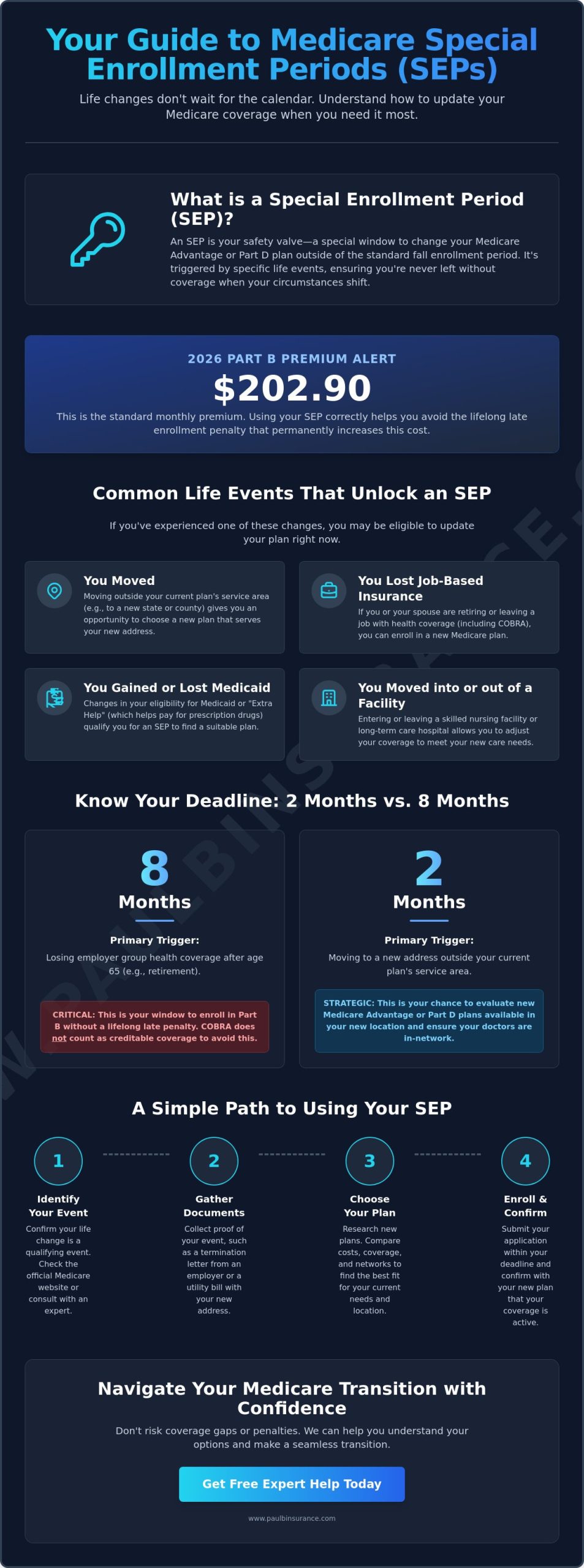
A Special Enrollment Period (SEP) is a specific window of opportunity that opens when your life changes in a way that affects your health coverage. We like to think of these periods as safety valves for when your life doesn’t fit into a neat calendar box. While most people wait for the standard fall window to make updates, an SEP allows you to join, switch, or drop Medicare Advantage or Part D plans right when you actually need to. If you are asking what is the medicare special enrollment period for life changes, it’s your legal right to adjust your insurance based on major life events rather than waiting months for the next enrollment cycle.
In 2026, these rules remain strict to ensure the system stays stable, but they’re designed to be fair for anyone facing a genuine transition. We see many seniors feel overwhelmed by the complexity of these rules, but we’re here to simplify the process. Whether you’re moving to a new state or losing your employer coverage, these windows ensure you aren’t left without the care you deserve. We take the guesswork out of the timing so you can focus on your life, not your paperwork. It’s about giving you control when your circumstances shift unexpectedly.
The Difference Between SEPs and Standard Enrollment
Most folks believe the Annual Election Period in the fall is their only chance to change their plan. It’s a common misconception that can lead to unnecessary stress. SEPs provide a crucial layer of protection against gaps in your medical or drug coverage. This flexibility is vital because your health needs don’t always align with a January 1st start date. Knowing that Medicare accounts for real-life shifts provides a sense of security. We help you navigate your Medicare Part B enrollment to ensure your transition is seamless and your coverage remains uninterrupted during these pivotal moments.
Why 2026 Is a Critical Year for SEPs
This year brings significant updates to Part D prescription drug plans, making it more important than ever to have the right coverage. If your current plan’s costs have shifted or your medications are no longer on the preferred list, an SEP could be your ticket to a more affordable option. Utilizing an SEP is the primary way to avoid the lifelong Part B late enrollment penalty if you’re transitioning from employer coverage. We help you identify if your specific situation qualifies under the 2026 guidelines, such as the new Part B standard monthly premium of $202.90. Our team ensures you understand our Medicare Advantage options so you can choose a plan with confidence and clarity.
Common Life Changes That Trigger a Special Enrollment Period
Life moves fast. Sometimes it moves you to a completely different state. Other times, it moves you out of the workforce and into a well-earned retirement. Understanding what is the medicare special enrollment period for life changes starts with identifying the specific event that qualifies you for a new window. These triggers aren’t just bureaucratic hurdles. They’re protections designed to ensure you always have access to the doctors and medications you need, even when your circumstances shift unexpectedly.
Common triggers include:
- Moving to a new address outside your current plan’s service area.
- Losing employer-based insurance or COBRA coverage.
- Gaining or losing Medicaid or “Extra Help” eligibility for drug costs.
- Moving in or out of a skilled nursing facility or long-term care hospital.
Relocation: Moving Your Life and Your Coverage
Moving is stressful enough without worrying about your health insurance. If you move across a county line or to a new state, you usually have a 2-month window to pick a new plan. This happens because most Medicare Advantage plans are tied to specific zip codes. If you leave that area, your old plan can’t follow you. This is a strategic moment to decide if you want to stay with a similar plan or switch to a different type of coverage entirely. You can explore our Medicare Advantage guide to see how service areas might affect your choices in 2026.
Employment Transitions: Retiring After Age 65
If you worked past 65 and stayed on a group health plan, your 8-month window begins the month your employment or coverage ends. It’s a common mistake to think COBRA counts as “creditable” coverage to avoid Part B penalties. It doesn’t. To avoid the $202.90 Part B premium becoming even more expensive due to late fees, you must act quickly. Many of our clients use this transition to move from a group plan to a Medicare Supplement plan for more predictable costs and broader doctor access. If you’re feeling overwhelmed by these dates, we can help you find a simple path to your new coverage.
Involuntary Plan Changes
Sometimes the change isn’t your choice. A plan might stop serving your zip code or leave the Medicare program entirely. In 2026, if Medicare terminates your plan’s contract due to poor performance ratings, you’re granted an SEP to find a higher-quality replacement. When you deal with involuntary changes, knowing what is the medicare special enrollment period for life changes gives you the power to protect your healthcare access. You have the right to a plan that works, and we simplify the jargon so you can make that switch without the headache. If you’ve received a notice that your plan is changing, you can schedule a call with us to review your options and stay protected.
The Timeline: Understanding the 2-Month vs. 8-Month Rule
Timing is everything in the Medicare system. If you miss a window by even a single day, you can’t just call and fix it the next morning. Most of the anxiety we see comes from this ticking clock. When people ask us what is the medicare special enrollment period for life changes, they’re usually looking for a specific date to circle on their calendar. In 2026, the rules generally split into two main timelines: a short 2-month window for most life events and a longer 8-month window specifically for those leaving the workforce.
Missing these deadlines isn’t just a paperwork headache. It can lead to a lifetime of late enrollment penalties that get added to your monthly premiums forever. For example, the standard Part B premium is $202.90 in 2026. If you miss your window, that number could climb significantly higher for the rest of your life. We recommend starting your research at least 30 days before your change occurs. This head start gives us enough time to compare plans and ensure your new coverage begins the moment your old coverage ends.
The 2-Month “Life Event” Window
For most situations, like moving to a new home or losing Medicaid, the clock starts ticking the day the change happens. You generally have 63 days to choose a new plan. This 2-month rule is applied strictly to Medicare Advantage and Medicare Part D plans. If you moved on June 1st, you would need to have your new plan selected by the end of July to ensure you don’t have a gap in your prescription drug coverage. We help you track these dates so you can focus on unpacking your boxes instead of worrying about your insurance.
The 8-Month “Employment” Window
This window is reserved for those who are “working past 65.” It’s longer because the government recognizes that transitioning out of a long-term career is a major life shift. While 8 months sounds like a long time, the stakes are much higher for Part B. If you wait until the end of this window to enroll, you risk a “gap month” where you have no primary insurance at all. We work with you to coordinate your Medicare start date with your last day of work. This coordination ensures that your transition is seamless and that you never have to pay a medical bill out of pocket because you were stuck between two different systems. We simplify the jargon so you know exactly which window applies to your specific retirement date.
A Step-by-Step Guide to Using Your Special Enrollment Period
Moving from the basic question of what is the medicare special enrollment period for life changes to actually starting your application can feel like a heavy lift. We’re here to lighten that load. Following a clear, methodical path ensures you don’t miss a deadline or leave yourself without the doctors you trust. Here is our simple 5-step process to guide you through your transition with total peace of mind.
- Step 1: Confirm your qualifying event and your specific deadline. Whether it’s a move or retirement, knowing your exact end-date for current coverage is vital.
- Step 2: Gather proof of your life change. This might be a letter from your employer or a utility bill from your new residence.
- Step 3: Compare new plans available in your new area. A move to a different county in 2026 might mean your old Medicare Advantage plan is no longer the best fit.
- Step 4: Submit your application. We help you handle the paperwork through the proper channels, whether that’s Social Security or a private carrier.
- Step 5: Verify your enrollment. We’ll help you confirm everything is active so you receive your new ID cards before you need your first appointment.
Documentation You Will Need
Having the right papers ready makes the process move much faster. If you’re retiring, you’ll need a “Certificate of Creditable Coverage” from your former employer. This document proves you had health insurance that was at least as good as Medicare, which helps you avoid those lifetime Part B penalties. For those moving, keep a copy of your new lease, a voter registration card, or a recent bank statement showing your new address. Having your documentation ready prevents application delays. If you’re unsure if your paperwork is sufficient, you can schedule a call with us to review your documents together.
Avoiding Common SEP Mistakes
We’ve seen many folks wait until their current coverage completely ends before they start shopping for a new plan. This is a risky move that can lead to a gap in care. You should ideally start looking 30 to 60 days before your change happens. It’s also a mistake to assume every life shift qualifies for an SEP. Simply wanting a cheaper plan or a different set of benefits isn’t a qualifying event. You must have a specific trigger, like a move or loss of coverage. Finally, always check that your current medications are covered by the new plan’s 2026 formulary before you sign anything. Small details in Part D coverage can make a big difference in your monthly budget. We simplify the jargon so you know exactly how these details affect your wallet.
Navigating the Medicare Maze with Confidence
The Medicare system in 2026 is a maze. Between the $202.90 standard Part B premium and the various rules for supplemental coverage, it’s easy to feel lost. You don’t have to walk this path alone. We simplify the jargon so you know exactly how your change affects your care and your budget. Our goal is to act as your dedicated advocate, ensuring you stay protected during every life transition. We help you steer clear of costly enrollment mistakes and late penalties that could impact your Social Security check for years to come.
When life throws you a curveball, you need a guide who listens. We understand the anxiety that comes with a move or a retirement. We counter that stress with clarity and a calm, patient approach. You aren’t just another number in a database to us; you’re a person who deserves a plan that fits your life perfectly. By focusing on your unique needs, we transform a complex regulatory hurdle into a strategic window to optimize your healthcare for 2026 and beyond.
Independent Broker vs. Captive Agent
Having options is the key to finding the right fit. A captive agent works for a single insurance company and can only offer you plans from that one source. This limits your choices and might leave you with a plan that isn’t the best value. We are independent brokers. This means we have access to over 40 different carriers. We provide unbiased comparisons that the standard government tools often miss. Our support is year-round. We don’t just help you during your SEP window; we stay by your side to answer questions and adjust your coverage as the years go by.
From Confusion to Confidence
Our mission is to move you from a state of being overwhelmed to a state of being empowered. We use a logical 5-step process to ensure no detail is overlooked. We never rush you. We never pressure you into a decision. We believe that an educated client is a confident client. If you’re still exploring how your specific life event fits into the bigger picture, you can review our Medicare Advantage guide to see how different plan structures work in 2026. Understanding what is the medicare special enrollment period for life changes is just the beginning of your journey toward peace of mind. We are here to make sure you reach that destination with total confidence.
Take Control of Your Healthcare Transition Today
A major life event doesn’t have to mean a major headache for your health insurance. You now know that these enrollment windows are safety valves designed to protect your access to doctors and affordable care. Understanding exactly what is the medicare special enrollment period for life changes ensures you don’t miss your chance to secure the right plan before those strict 2-month or 8-month deadlines pass. By staying ahead of the paperwork and verifying your 2026 plan options early, you can keep your coverage seamless and your stress levels low.
We’re here to help you navigate this complex system with total clarity. Our team provides unbiased guidance from over 40 different carriers, and we’re licensed in more than 34 states to support you wherever your move takes you. We act as your dedicated advocates to simplify the 2026 Medicare maze so you can focus on your new chapter. Don’t let confusion lead to costly penalties or gaps in care. Schedule a Call With Paul to secure your coverage today. You’ve got this, and we’re with you every step of the way.
Common Questions About Medicare Special Enrollment Periods
Can I change my Medicare plan if I move to a different state?
Yes, moving to a new state is a qualifying life event that triggers a 2-month window to update your coverage. Since most Medicare Advantage plans are tied to specific zip codes, your current plan likely won’t follow you across state lines. This is a great time to explore our Medicare Supplement options to see if a plan with nationwide access fits your new lifestyle better. We help you coordinate this switch so your new coverage starts the day you arrive at your new home.
What happens if I miss my Special Enrollment Period window?
If you miss your window, you generally have to wait until the next Annual Enrollment Period, which runs from October 15th to December 7th. Waiting can be costly because you might face a 10% lifetime late enrollment penalty for Part B for every 12-month period you were eligible but didn’t enroll. In 2026, with the Part B premium at $202.90, those penalties can add up quickly. We work closely with you to track your specific deadlines so you never have to pay more than necessary.
Does losing my job at age 67 qualify me for a Special Enrollment Period?
Losing employer coverage at age 67 definitely qualifies you for a fresh enrollment window. When people ask what is the medicare special enrollment period for life changes as it relates to retirement, we explain that you actually get two different timelines. You have 8 months to sign up for Part B without a penalty, but you only have 2 months to join a Medicare Advantage or Part D plan. We recommend starting the transition 30 days before your last day of work to ensure you don’t have a single day without coverage.
How long do I have to sign up for Medicare after my COBRA coverage ends?
You must sign up for Part B within 8 months of your employment ending, regardless of when your COBRA coverage stops. A common and expensive mistake is assuming COBRA counts as “creditable” coverage for Part B. It doesn’t. If you wait 18 months for COBRA to end before calling us, you’ll likely face a permanent late enrollment penalty and a gap in your healthcare. We simplify this jargon to help you transition directly from your group plan to Medicare without the COBRA trap.
Can I get an SEP if my doctor leaves my Medicare Advantage plan network?
Usually, a doctor leaving a plan’s network does not trigger a Special Enrollment Period. You generally have to wait until the fall to switch plans if your favorite physician is no longer covered. However, if your plan makes a massive change to its network that affects a large percentage of its members, Medicare might grant an exception. We can review your current doctor list and help you find a plan with a stable network to minimize these kinds of disruptions.
Is a change in income a qualifying life event for Medicare?
A change in income is not a qualifying life event that allows you to switch your Medicare plan. While a lower income might reduce your IRMAA surcharges or qualify you for “Extra Help” with drug costs, it doesn’t open a new window to change your Advantage or Medigap plan. If your income has dropped, we can help you apply for cost-saving programs that could lower your $283 Part B deductible or your monthly premiums without needing a full plan change.
Do I need to provide proof of my life change to enroll?
Yes, you will need to provide documentation to verify that your life change actually happened. For a move, you might use a utility bill or a voter registration card from your new address. If you’re retiring, you’ll need a signed form from your employer confirming you had group coverage. Having these documents ready prevents delays in your application. We help you gather the right paperwork so your enrollment goes through smoothly the first time.
What is the best way to ensure no gap in coverage during a move?
The most effective way to avoid a gap is to choose your new plan at least 30 days before you move. You can set your new coverage to begin on the first day of the month you move into your new home. This ensures that your old plan covers you until you leave and your new plan takes over the moment you arrive. We specialize in these seamless transitions, providing what is the medicare special enrollment period for life changes expertise to keep your healthcare continuous and stress-free.

Article by
Paul Barrett
Paul Barrett, CMIP is the founder of The Modern Medicare Agency, an independent Medicare-only brokerage based in Melville, NY. With 18 years of Medicare-exclusive experience, a CMIP designation, and more than 5,000 clients served across 37 states, Paul is one of the most credentialed independent Medicare specialists on Long Island — and one of the most direct.
He represents 40+ carriers with no quotas and no allegiances, which means his recommendations are based entirely on what fits each client's specific situation. He is the author of Medicare Mastery Unlocked and host of the Wise Guys Retirement Talk podcast. His content is grounded in primary sources, real carrier intelligence, and 18 years of watching what happens when people get Medicare right — and when they don't.
📞 631-358-5793 | paulbinsurance.com