




The plan that seems simplest may not be the one that best fits your care. If you’re asking, “What questions should I ask my doctor about Medicare?” start with the prescriptions, services, and specialists you rely on. Then find out how Original Medicare and Medicare Advantage handle access to that care.
It’s understandable to feel unsure. Your doctor knows your health needs, but your plan’s rules affect where you can receive care and what it covers. Clear questions can help you distinguish the two and identify what to review.
In this guide, you’ll find practical questions about prescription drugs, upcoming care, referrals, provider networks, and costs. You’ll also learn what to ask when comparing Original Medicare with Medicare Advantage, including whether your doctors and specialists participate in a plan’s network. Your doctor can help identify the care you need and discuss treatment options. For plan-specific benefits and network rules, the plan’s materials can help fill in the details. With both perspectives, you can make a more informed choice for your needs in 2026.
Key Takeaways
- Bring a current list of prescription and over-the-counter medicines to your appointment, including any side effects you’re experiencing.
- Ask which services your care may involve and how coverage can differ between Original Medicare and Medicare Advantage.
- If you travel, ask how your plan handles routine care away from home and what to do if you need urgent or emergency care.
- Before choosing a Medicare Advantage plan, ask whether your doctors and specialists participate and whether referrals are required.
- Compare how each option handles prescriptions, provider access, and out-of-pocket costs so you can focus on the coverage that fits your needs in 2026.
1. Are my prescription drugs covered by Medicare?
Bring a complete medication list, including prescriptions, over-the-counter medicines, vitamins, and supplements. Tell your doctor the dose, when you take each medicine, and any side effects. For example, mention dizziness after starting a prescription or trouble swallowing a tablet. These details help your doctor assess whether a medicine still suits your needs and discuss possible alternatives.
Ask, “Is this medicine on my plan’s formulary, and is there a covered alternative?” A formulary is a plan’s list of covered prescription drugs. Formularies differ, so a medicine your doctor prescribes may not receive the same coverage under every plan. Ask whether the drug’s name, strength, or form affects coverage, and whether a similar treatment could meet your needs.
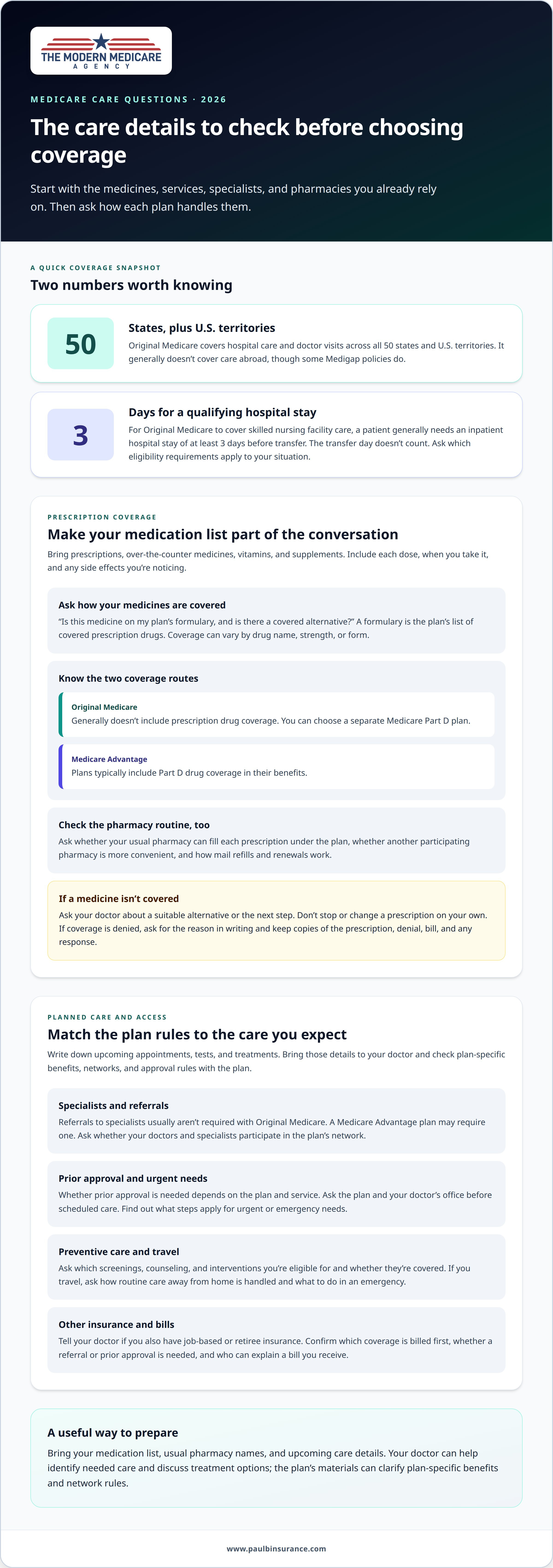
Medicare Part D provides prescription drug coverage. Original Medicare generally doesn’t include prescription drug coverage, so people can choose a separate Part D plan. Medicare Advantage plans typically include Part D drug coverage in their benefits. Ask your doctor which medicines you’re likely to need, then compare those names with each plan’s formulary. A Medicare Part D plan may help cover prescriptions alongside Original Medicare.
Pharmacy choice matters, too. Ask whether your regular pharmacy can fill each prescription under your plan and whether another participating pharmacy would be more convenient. If you use mail delivery, ask how refills and renewals work. Bring the names of your usual pharmacies so you can discuss your actual routine, not just your medication list.
Ask how your plan handles medicines that need extra approval or have limits. If a prescription isn’t covered, ask your doctor whether another medicine on the formulary could meet the same treatment goal. Don’t stop or change a prescription on your own. Instead, explain the coverage concern and any side effects, then discuss a safe next step with your doctor.
Medicare drug coverage can also affect what you pay over the year. Ask how your medicines are covered and whether your plan’s preferred pharmacy options matter. The answer depends on the specific drug and plan.
If Medicare or your plan denies coverage, ask for the reason in writing. Your doctor can explain the medical need or suggest an appropriate alternative. For a billing problem, compare the bill with your plan’s explanation of the service, then follow the instructions on the plan’s notice. Keep copies of the prescription, denial, bill, and any response.
Before leaving, repeat the agreed medication plan in your own words. Confirm which prescriptions to continue, whether your doctor will submit supporting information, and what to do if symptoms worsen or an emergency arises. A clear plan connects your treatment needs with your Medicare coverage and pharmacy routine.
2. Does my Medicare plan cover the services I need?
Make a list of planned appointments, tests, and treatments, then ask how your Medicare plan covers each one. Original Medicare covers hospital care and doctor visits across all 50 states and U.S. territories. Original Medicare generally doesn’t cover care abroad, though some Medigap policies do. For a trip outside the country, ask how your insurance would handle routine care and what to do during an emergency.
Ask about skilled nursing facility care before a hospital discharge makes the question urgent. For Original Medicare to cover this care, a patient generally needs an inpatient hospital stay of at least three days before transfer. The transfer day doesn’t count. Ask your care provider which eligibility requirements apply to your situation.
Use a Welcome to Medicare Visit or Annual Wellness Visit to discuss preventive care for the coming year. Ask which screenings, counseling, and interventions you’re eligible for and whether they’re covered. Medicare covers basic preventive care and screening services. Mentioning a specific concern, such as a change in vision, helps your primary care provider connect the discussion to appropriate preventive services.
For prescription drug costs, ask how your plan covers the medicines your treatment may involve, including any restrictions or approval steps. Bring the names of your regular pharmacies and ask whether they can fill your prescriptions under the plan. Both drug coverage and pharmacy access matter to your care. If a recommended medicine isn’t covered, ask your doctor about a suitable alternative and the next step.
If you have job-based or retiree insurance alongside Medicare, tell your doctor and ask how each plan should be billed. Confirm which coverage is billed first, whether referrals or prior approval are needed, and who can explain any bill you receive. The answer depends on your coverage arrangement, so include the plan names when discussing a scheduled test or specialist visit.
With Original Medicare, referrals to specialists usually aren’t required, while a Medicare Advantage plan may require one. Whether prior approval is needed depends on the plan and service, so ask the plan and doctor’s office before scheduled care. For urgent or emergency needs, ask what steps apply and where to seek care under your plan.
When your care includes specialists, tests, or travel, compare those needs with the plan’s rules. A Medicare Advantage plan’s coverage and referral rules can help frame what to ask about network access and approvals. Bring the answers to your next appointment, so you and your doctor can discuss care with fewer surprises.
3. What Should I Ask My Doctor About Medicare?
Ask your doctor how a recommended service may affect your out-of-pocket expenses, then compare the answer with your plan documents. A premium is what you pay to keep coverage active. A deductible is what you pay for covered care before the plan begins sharing costs. Copayments are set amounts for services, while coinsurance is a percentage. These terms describe different expenses, so ask which apply to a planned test, visit, or treatment.
According to the Centers for Medicare & Medicaid Services, after meeting the Part B deductible, people with Original Medicare generally pay 20% of the Medicare-approved amount for Part B services. Ask whether a service falls under Part B and what amount Medicare approves.
Ask how the deductible applies to your hospital care and what costs to expect. Ask your doctor whether a planned hospital service is inpatient care, since that can affect which Medicare part applies. A hospital stay under observation differs from an inpatient admission, so clarify your status with the care team.
Ask for an estimate of your share before scheduled care. For example, ask whether a specialist visit has a copayment, whether a test is subject to the deductible, and whether coinsurance applies afterward. Some Medicare plans charge only a copayment for primary care visits before you meet the deductible. The plan’s rules and the service you receive determine which cost applies.
If you have Medicare Advantage, ask about the plan’s yearly out-of-pocket limit for covered services. Ask which expenses count toward that limit and which services or providers affect your share. Original Medicare doesn’t have an annual out-of-pocket maximum, so ask how you can manage costs across the year.
A Medicare Supplement plan can help pay certain out-of-pocket costs associated with Parts A and B, such as deductibles, copayments, and coinsurance. Ask how a supplement would fit alongside Original Medicare and which expenses it may help address. Keep the plan name and service details handy so your questions about treatment focus on your actual coverage.
Before you leave, write down the expected service, the Medicare part involved, and each cost-sharing term your doctor mentions. Then ask the plan to explain any estimate you don’t understand. A clear breakdown helps you distinguish premiums from visit costs and see how one treatment may affect your budget for 2026.
4. Checking Medicare Advantage network participation
Before choosing a Medicare Advantage plan, ask whether your primary care doctor, specialists, preferred hospital, and nearby clinics are in its network. Original Medicare has no provider networks, and almost all doctors and hospitals in the United States accept it. Medicare Advantage plans may require you to use network providers for routine care, so confirm participation for the specific plan you’re considering for 2026.
Does your doctor accept Original Medicare or Medicare Advantage plans? Almost all U.S. doctors and hospitals accept Original Medicare, while Medicare Advantage participation depends on the plan’s network. Ask the doctor’s office about the exact plan name, not just whether it accepts Medicare. Online directories can be outdated, so confirm directly with the office before enrolling.
Check each specialist separately. Your primary care doctor may participate even if a specialist or hospital you rely on does not. Ask the office to confirm the plan’s network for routine visits, tests, and referrals. Medicare Advantage plans generally have lower costs for in-network care; out-of-network visits may mean higher out-of-pocket expenses.
Ask how your doctor coordinates care with Medicare specialists and hospitals. Find out who sends referrals, shares test results, and follows up after a hospital visit. For example, confirm whether your primary care office receives a specialist’s notes and knows whom to contact about a new treatment. Medicare Advantage plans may have referral rules, so ask how those fit your care.
Ask about urgent and emergency care, too. Original Medicare and Medicare Advantage plans are required to cover emergency and urgent care nationwide without restrictions. For planned visits while away from home, ask how the plan treats routine care and which network providers are available at your destination. This distinction can help prevent confusion during travel.
Where can you get local Medicare enrollment help and compare plans accepted by your doctor? An independent Medicare broker can help compare available Medicare Advantage plans against your doctors and hospitals. Bring the exact provider names, locations, and plan options. Ask the broker to review network participation for each plan, then confirm the specific plan with the doctor’s office before enrolling.
Before choosing a plan, list your essential providers and the hospitals you would want for planned care. Compare those names with each plan, confirm directly with the offices, and ask about referral requirements and out-of-network costs. A clear provider list makes it easier to weigh network access alongside premiums and other plan features.
5. Comparing Original Medicare with Medicare Advantage
For 2026, compare how each option fits your doctors, prescriptions, travel, and likely care. Medicare Parts A and B together are called Original Medicare. Medicare Advantage plans must cover at least the same Part A and Part B benefits, but may organize access and extra benefits differently. Start by asking your doctor which services you expect to use and which providers deliver them.
Original Medicare has no provider networks. Medicare Advantage plans may require you to use in-network doctors for routine care. List your primary care doctor, specialists, and preferred hospital, then compare those names with each plan. Ask the doctor’s office about the exact plan, since participation can differ between Medicare Advantage plans.
Consider how you want to manage prescriptions. Original Medicare doesn’t include prescription drug coverage, so people may choose a separate Part D plan. Medicare Advantage plans may include prescription coverage with their other benefits. Ask your doctor which medicines are part of your care, then consider whether the plan’s drug coverage and pharmacy choices fit your routine.
Look beyond the monthly premium when comparing costs. Original Medicare doesn’t have an annual out-of-pocket maximum. Medicare Advantage plans have a yearly limit for covered services, and some plans may set lower limits. Ask which expenses count toward the plan’s limit and how costs could change if you receive care outside its network. Your expected visits and treatments make the comparison more personal.
Ask about access rules before settling on either option. Some Medicare Advantage plans require you to choose a primary care doctor and get a referral before seeing a specialist. Others let you see specialists without choosing a primary care doctor or getting a referral. If you see several specialists, ask how each plan handles visits and care coordination.
Medicare Advantage may include benefits beyond Parts A and B, such as prescription, vision, hearing, or dental coverage. Compare those benefits with services you expect to use rather than choosing based on a benefit you may not need. Ask your doctor which screenings, specialist visits, or treatments matter most to your care in the coming year.
To make the comparison clear, write down your must-have providers, medicines, and likely services. Then weigh network access, referral rules, extra benefits, and how each option handles costs. If you want help reviewing Medicare Advantage options alongside your doctors and care needs, compare Medicare Advantage plan choices.
The Modern Medicare Agency
The Modern Medicare Agency helps you compare Medicare coverage options against the care you and your doctor discuss. If you’re weighing provider access, prescription coverage, or out-of-pocket costs, its independent guidance can help you understand how Medicare Advantage, Medicare Supplement (Medigap), and Part D plans differ. Bring your questions and priorities, such as keeping a particular doctor or covering regular prescriptions, to make the discussion relevant to your needs in 2026.
When you’re ready to review your options, contact The Modern Medicare Agency to discuss your Medicare questions.
Take Your Next Step With Confidence
Your next conversation can turn uncertainty into a practical plan. Before your next appointment, write down the decision you need to make, the care you expect, and what matters most to you. If you’re still asking what questions should I ask my doctor about Medicare, focus on what could affect your choice, such as keeping a trusted provider or planning for ongoing treatment. Ask your doctor to explain the care involved, then use those details to compare Medicare options.
You don’t have to make that comparison alone. The Modern Medicare Agency can help you review plan choices in light of your priorities and the questions you’re bringing to your doctor. Take the time you need to understand the trade-offs and choose a path that feels right for your circumstances in 2026.
Start a conversation with The Modern Medicare Agency when you’re ready to explore your options. A clear next step can make Medicare decisions feel more manageable.
Frequently Asked Questions
Does my Medicare plan cover the services I need?
Coverage depends on the service, your plan, and how care is provided. Before a scheduled appointment, ask what the service is called, where it will take place, and whether another provider will be involved. Those details help you ask a more precise coverage question. If a service is part of a treatment plan, ask your doctor what alternatives may be available if your plan handles it differently.
What should I ask my doctor about Medicare?
Ask how your health needs could shape your coverage choices. If you’re wondering what questions you should ask your doctor about Medicare, start with the care you expect, including ongoing treatment, specialist visits, and medicines you take regularly. Ask what services your doctor anticipates and whether your care may involve other clinicians. Before leaving, repeat the next step in your own words so you can follow the plan at home.
Where can I ask questions about Medicare?
Your doctor can explain your health needs and care options, while your plan can explain its benefits and payment rules. For help comparing Medicare plans, The Modern Medicare Agency offers personalized guidance. Match each question to the person who can answer it: bring treatment concerns to your doctor, benefit questions to the plan, and comparison questions to a Medicare broker. That keeps each conversation focused and useful.
Are my prescription drugs covered by Medicare?
Prescription coverage depends on whether you have a Part D plan or a Medicare Advantage plan that includes drug coverage. If your doctor prescribes a new medicine after a hospital visit, ask whether it replaces an existing prescription or should be taken alongside it. Then ask how the medicine fits your plan’s coverage. Share any side effects or difficulty taking it before changing your medication routine.
Not sure where to start?
Start with the decision that feels most urgent, such as keeping a doctor, managing a new diagnosis, or understanding a prescription. Write it down and bring it to your next appointment. Ask your doctor to explain the care involved in plain language, then direct plan-benefit questions to your insurer. You don’t need to solve every Medicare question in one conversation; a clear first step can guide the next one.
What Medicare questions should I ask my doctor before enrolling?
Before enrolling, ask which doctors, specialists, and facilities are likely to be involved in your care. If you have a planned procedure or regular specialist visits, ask what follow-up care may be needed and who would provide it. Use that information when comparing plan options. Also ask whether your doctor expects changes to your care routine, since continuity may matter when weighing access and coverage.
Is my doctor in network with my Medicare Advantage plan?
Network participation depends on the specific Medicare Advantage plan. Give the doctor’s office the plan’s full name and ask whether the doctor participates in that exact option. If you see clinicians at more than one location, ask about each office and affiliated facility. Plan directories can change or lag behind, so confirming directly with the office can help you make a better-informed enrollment decision.
How can I check whether Medicare covers a test, treatment, or prescription?
Start by getting the exact name of the test, treatment, or medicine from your doctor. Ask what clinical purpose it serves and whether it is part of a broader care plan. Then ask your plan how that specific service or prescription is handled, including any approval steps. For a prescription, provide the drug’s exact name and form. Specific details make it easier to get an answer that applies to your situation.

Article by
Paul Barrett
Paul Barrett, CMIP is the founder of The Modern Medicare Agency, an independent Medicare-only brokerage based in Melville, NY. With 18 years of Medicare-exclusive experience, a CMIP designation, and more than 5,000 clients served across 37 states, Paul is one of the most credentialed independent Medicare specialists on Long Island — and one of the most direct.
He represents 40+ carriers with no quotas and no allegiances, which means his recommendations are based entirely on what fits each client's specific situation. He is the author of Medicare Mastery Unlocked and host of the Wise Guys Retirement Talk podcast. His content is grounded in primary sources, real carrier intelligence, and 18 years of watching what happens when people get Medicare right — and when they don't.
📞 631-358-5793 | paulbinsurance.com