
Last Tuesday, a client named Sarah discovered that her HR department’s advice about COBRA actually put her at risk for a lifetime Medicare penalty. She was planning to retire in August 2026, but she felt paralyzed by the conflicting information about what to do when my employer health plan ends at 65. We know exactly how Sarah feels. It’s completely normal to feel overwhelmed by the mountain of mail and the fear of making a mistake that lasts a lifetime. You deserve a transition that’s simple, clear, and focused on your specific needs rather than a generic corporate checklist.
We’re here to provide a stress-free roadmap that ensures you have no gaps in coverage and no surprise bills. We’ll simplify the rules so you can keep your doctors and understand exactly how your 2026 Medicare plan fits your retirement budget. This guide outlines the exact steps to move you from confusion to confidence as you leave the workforce behind.
Key Takeaways
- Take a deep breath as we show you how to use your Special Enrollment Period to move from work-based insurance to Medicare without stress or coverage gaps.
- We outline the specific steps for what to do when my employer health plan ends at 65, including how to secure the essential proof of coverage from your employer.
- Learn why COBRA is not a substitute for Medicare and how avoiding this common misconception protects you from lifelong late-enrollment penalties.
- Compare the two main paths for your 2026 coverage-Medigap and Medicare Advantage-to find the perfect fit for your unique health needs and budget.
- Use our simple transition checklist to time your applications perfectly, giving you the confidence that your healthcare is secure from day one of retirement.
Understanding the Special Enrollment Period (SEP)
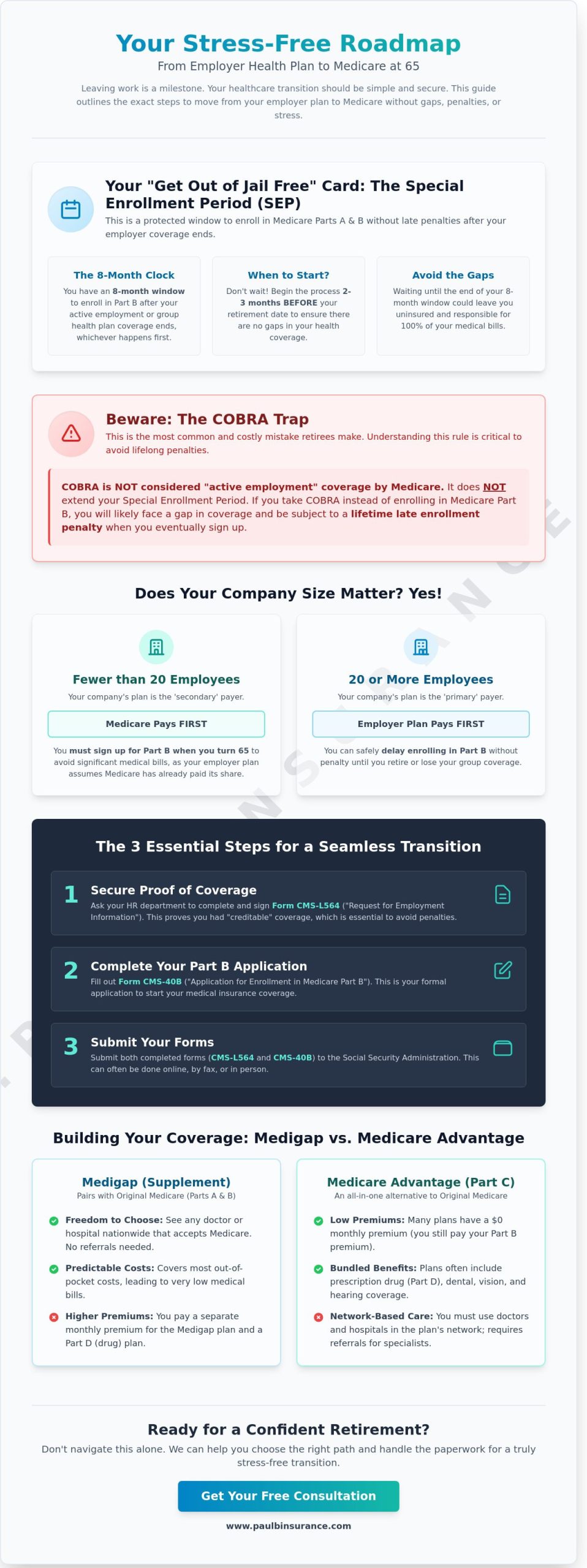
We know that the transition from a long-term employer health plan to retirement can feel like stepping into a dense fog. The paperwork is thick, the deadlines are tight, and the fear of making a mistake is very real. If you are wondering what to do when my employer health plan ends at 65, the most important concept to grasp is the Special Enrollment Period (SEP). We often describe the SEP as your “get out of jail free” card. It is a specific protection provided by the federal government that allows you to sign up for Medicare (United States) without facing the standard late enrollment penalties that catch many people off guard.
This period is designed to give you a safe passage from one form of coverage to another. In 2026, the rules remain clear; if you have “creditable” coverage through an employer, you don’t have to jump into Medicare the second you turn 65. However, once that employment or coverage ends, a clock starts ticking. We are going to walk through every date and deadline together so you can move forward with total confidence. Our goal is to remove the anxiety from this process and ensure you never feel rushed or pressured into a decision.
The 8-Month Clock: When Does It Actually Start?
The 8-month window is the duration of your Special Enrollment Period, but its starting point can be a bit confusing. This clock begins the very month after your employment ends or the month after your group health plan coverage ends, whichever of those two events happens first. We want to be very clear on this point; you shouldn’t wait until the eighth month to take action. If you delay until the end of the window, you might find yourself with a gap in coverage, leaving you responsible for 100 percent of your medical costs during that time.
We recommend starting your transition at least two or three months before your work coverage terminates. This gives us enough time to review your options and ensure your new plan is active the day your old one expires. The SEP serves as the critical bridge between your working years and your retirement security. To keep your transition smooth, keep these facts in mind:
- The window is 8 months long for Part B enrollment.
- COBRA coverage does not count as “active” employment coverage and won’t extend your SEP.
- Retiree health plans also do not count as creditable coverage for delaying Part B.
The 20-Employee Rule and Medicare Eligibility
Company size plays a massive role in how we handle your enrollment. If your employer has fewer than 20 employees, Medicare usually acts as the “primary” payer. This means your small business health plan is only designed to pay after Medicare pays its share. If you don’t sign up for Part B immediately at age 65 in this scenario, you could be left with massive unpaid medical bills because your employer plan will assume Medicare already paid 80 percent of the cost.
For those at companies with 20 or more staff members, the employer plan typically stays “primary.” In this case, you can often delay Part B until you actually retire. Understanding these nuances is the best way to steer clear of costly enrollment mistakes. For a deeper look at how these rules apply to your specific birth year and situation, you can review our Medicare Eligibility: A Clear and Simple Guide for 2026. We are here to simplify the jargon so you know exactly how the system works for you.
The Three Essential Steps to Start Your Transition
Take a deep breath. You’ve worked hard for decades, and moving to Medicare should be a celebration of your next chapter, not a source of anxiety. We’ve designed a clear path to move you from confusion to confidence. When you’re figuring out what to do when my employer health plan ends at 65, the secret is to stay ahead of the calendar. In 2026, the process is streamlined, but it still requires a few specific moves to ensure you don’t lose a single day of protection.
Our goal is to make this transition invisible to your doctors and your pharmacy. We follow a proven three step process to get you enrolled correctly the first time. First, we secure proof that you’ve had health insurance through your job. Second, we pick the exact date your new coverage starts. Finally, we submit your application to the Social Security Administration. We’re here to handle the heavy lifting so you can focus on your retirement plans.
Gathering Your Paperwork Without the Stress
To avoid late enrollment penalties in 2026, you need two specific forms. The first is Form CMS-40B, which is your actual application for Part B. The second is Form CMS-L564. This is the “Request for Employment Information.” Your HR department must sign this to prove you had group coverage since you turned 65. We suggest sending this to your employer at least 90 days before your planned retirement date. HR departments can sometimes be slow, so giving them a clear deadline helps. As your broker, we can review these forms before you submit them to ensure every box is checked correctly. This simple review prevents the Social Security Administration from kicking your application back for corrections.
Choosing Your Effective Date
Timing is the most critical part of knowing what to do when my employer health plan ends at 65. You want your Medicare Part B to start the very first day of the month your employer coverage ends. For example, if your work insurance stops on June 30, 2026, your Medicare should begin on July 1, 2026. This eliminates any “coverage gap” where you might be responsible for 100 percent of your medical costs. It is important to understand Medicare’s rules for working past 65, especially regarding severance packages. Many people don’t realize that severance pay or COBRA does not count as “active employment” coverage. If you rely on those instead of starting Part B, you could face permanent lifetime penalties. We recommend submitting your paperwork 60 days in advance. This gives the government ample time to process your request and mail your new red, white, and blue card.
We know the paperwork feels like a lot, but you don’t have to do it alone. If you feel unsure about which secondary coverage will best fit your 2026 budget, you can look at how Medigap plans work to fill the holes in original Medicare. We provide unbiased guidance to ensure you feel secure in every choice you make. If you want a partner to walk through these steps with you, schedule a call with Paul today to get started.
Beware the COBRA Trap: Why It Is Not a Medicare Substitute
Understanding exactly what to do when my employer health plan ends at 65 is the first step toward protecting your retirement savings. Many of our clients feel a sense of relief when they see a COBRA offer in their mailbox. It looks familiar. It’s the same doctor network and the same coverage you’ve had for years. However, this familiarity is exactly what makes COBRA a dangerous trap for those entering the Medicare system.
The biggest misconception we encounter is the belief that COBRA counts as “active employment” coverage. In the eyes of the Social Security Administration, it does not. Medicare requires you to have insurance based on current employment to delay Part B without a penalty. Since COBRA is continuation coverage, it doesn’t grant you a Special Enrollment Period later. If you stay on COBRA and miss your initial window, you might find yourself locked out of Medicare until the next enrollment season, all while your old plan potentially refuses to pay your claims.
We want to help you move from confusion to confidence. While COBRA and Medicare can technically work together, it’s rarely a good idea. In most cases, COBRA becomes the secondary payer. This means it only pays after Medicare pays its share. If you don’t have Medicare Part B because you thought COBRA was enough, you could be responsible for 80% of your medical bills out of pocket. We don’t want you to learn this the hard way.
The High Cost of the COBRA Mistake
The financial consequences of choosing COBRA over Medicare are permanent. For the year 2026, the projected standard Medicare Part B premium is $198.00 per month. If you delay Part B for just 12 months while on COBRA, you’ll face a lifetime 10% penalty. That is an extra $19.80 added to your bill every single month for as long as you have Medicare. If you wait two years, that penalty doubles. These costs add up to thousands of dollars over the course of your retirement. We simplify the jargon so you know exactly how to avoid these unnecessary fees.
What if You Already Signed Up for COBRA?
If you already signed up for COBRA and realized it was a mistake, don’t panic. We can help you triage the situation. If you are unsure what to do when my employer health plan ends at 65, your first priority is checking if you are still within your 8-month Special Enrollment Period. If that window has closed, you must use the General Enrollment Period, which runs from January 1 to March 31 each year. During this time, you can sign up for Part B, and your coverage will begin the first of the month following your application.
To fix a COBRA mistake before it gets more expensive, we recommend a Medicare Broker consultation. We provide unbiased guidance to help you transition to a plan that actually protects you. Our goal is to ensure you are never rushed and never pressured while we steer you clear of these costly enrollment mistakes.
Building Your New Coverage: Medigap vs. Advantage
We know that looking at your options feels like staring at a maze. Knowing what to do when my employer health plan ends at 65 starts with understanding your two main options. Original Medicare, which consists of Parts A and B, covers about 80% of your medical costs. It’s a solid foundation, but leaving that 20% unprotected can lead to big bills. You have two main paths to choose from to fill those holes. Neither choice is “wrong.” There is only the right choice for your specific health needs and budget. We’re here to help you find it without the stress.
Path A: Medicare Supplement (Medigap)
Medicare Supplement plans, often called Medigap, work alongside Original Medicare. They step in to pay that remaining 20% of costs that Medicare doesn’t cover. This includes things like deductibles and co-insurance. One of the best times to act is during your 6-month Medigap Open Enrollment Period. This window starts the month you’re 65 and enrolled in Part B. During this time, insurance companies cannot deny you coverage or charge you more based on your health history. You can learn more about how this works at What Is Medicare Supplement Insurance?.
Path B: Medicare Advantage (Part C)
Medicare Advantage is an all-in-one alternative to Original Medicare. These plans are offered by private companies and include everything in Parts A and B. Many plans in 2026 also include dental, vision, and hearing benefits that Original Medicare lacks. When you are deciding what to do when my employer health plan ends at 65, we recommend looking closely at the provider network. In 2026, many Advantage plans have specific doctor networks that require you to stay within their group for the best rates. We always check to see if your favorite doctors are included before you sign up. You can read our Medicare Advantage Plans: A Simple Guide for a side-by-side comparison.
Don’t Forget the Drugs: Part D
If you choose a Medigap plan, you’ll also need a standalone Part D plan for your prescriptions. This is a huge deal in 2026 because of the $2,000 out-of-pocket cap on drug costs. This cap provides a massive safety net for anyone with high medication expenses. We help you compare these plans so you don’t get stuck with a late enrollment penalty later. Check out Medicare Part D Explained for the full breakdown of how we protect your wallet at the pharmacy counter.
We want you to feel confident in your decision. If you’re still feeling stuck, schedule a call with us to clear up the confusion and find your perfect plan.
Your 2026 Medicare Transition Checklist
Transitioning from a group plan to Medicare doesn’t have to feel like a second job. We know the stress that comes with losing familiar coverage. If you are wondering what to do when my employer health plan ends at 65, the secret is a structured timeline. First, verify your official retirement date with HR at least 90 days out. This date determines your Special Enrollment Period and ensures you don’t have a single day without coverage. In 2026, the standard Part B premium is projected to be around $190 per month, so budgeting early helps avoid surprises.
- Submit your Part B application: Do this 2 to 3 months before your work coverage ends to avoid delays.
- Review your medications: Ensure your current prescriptions are on the 2026 formulary for your chosen plan.
- Check your providers: Confirm your specialists still participate in the networks you are considering.
- Enroll in Part D: Even if you don’t take many meds, you need Medicare Part D to avoid a lifetime late enrollment penalty.
A Month-by-Month To-Do List
3 Months Out: The Education Phase. This is when we help you learn the difference between Medigap and Medicare Advantage. We look at the 2026 out-of-pocket maximums to see which path fits your budget. 2 Months Out: The Application Phase. We guide you through the Social Security website to file your Part B paperwork. This prevents the common mistake of missing the enrollment window. 1 Month Out: The Selection Phase. We finalize your plan choice. You’ll receive your new ID cards before your first day of retirement.
Why Working With an Independent Broker Makes It Simple
We believe you deserve choices, not a sales pitch. A captive agent only shows you one company. We compare over 40 different carriers to find the one that actually serves your needs. Our guidance is unbiased and comes at no cost to you. We simplify the jargon so you know exactly how your benefits work. Our goal is to move you from confusion to confidence. You won’t feel rushed or pressured here. We are your advocates, protecting you from costly enrollment mistakes. Understanding what to do when my employer health plan ends at 65 becomes easy when you have a partner by your side. Let us handle the complex paperwork while you focus on enjoying your retirement.
Moving From Confusion to Confidence in 2026
Transitioning away from a long-term company plan can feel overwhelming, but you’ve already taken the first step by learning the rules for 2026. We’ve seen how critical it is to navigate your Special Enrollment Period correctly so you avoid those lifelong Part B penalties. We also know that while COBRA might seem like an easy bridge, it’s often a costly trap that doesn’t count as creditable coverage for Medicare. You deserve a plan that fits your life, whether that’s the stability of Medigap or the all-in-one approach of a Medicare Advantage plan.
Figuring out exactly what to do when my employer health plan ends at 65 is easier when you don’t have to do it alone. We offer unbiased guidance by comparing options from over 40 insurance carriers. Our team provides expert help in more than 34 states, and our approach is always the same: you’ll never feel rushed or pressured. We’re here to simplify the jargon and protect your future.
Schedule a Call With Paul to simplify your transition to Medicare
You’ve worked hard for your retirement, and we’re ready to help you protect it with confidence.
Frequently Asked Questions
Is there a penalty if I don’t sign up for Medicare at 65 because I’m still working?
No, you won’t face a late enrollment penalty as long as you have “creditable” coverage through an employer with 20 or more employees. In 2026, the Social Security Administration confirms that this group health coverage allows you to delay Part B without any stress. Once that job ends, you’ll have an 8 month window to sign up. We help you verify your company size so you can avoid a lifetime 10 percent surcharge.
Can I keep my employer health plan and still get Medicare Part A?
Yes, most people can keep their employer plan and enroll in Medicare Part A simultaneously. Since you’ve likely paid Medicare taxes for at least 40 quarters, Part A has a $0 premium in 2026. It acts as secondary insurance, often helping cover hospital costs that your workplace plan might leave behind. It’s a simple way to add a layer of protection while you continue working and building your savings.
What happens to my Health Savings Account (HSA) once I enroll in Medicare?
You must stop all contributions to your Health Savings Account the month your Medicare coverage begins. If you’re wondering what to do when my employer health plan ends at 65, remember that the IRS requires a six month “lookback” period when you sign up for Medicare after age 65. To avoid tax penalties in 2026, we recommend stopping HSA contributions at least six months before you apply for Part A or Part B.
Does COBRA count as creditable coverage for Medicare Part B?
No, COBRA does not count as creditable coverage for Medicare Part B enrollment. Many retirees mistakenly believe COBRA allows them to delay Medicare, but the 8 month Special Enrollment Period only triggers when active employment ends. If you rely on COBRA and miss your window, you could face a permanent 10 percent premium penalty. We’ve seen this mistake cost seniors thousands of dollars, so we always advise transitioning to Medicare immediately.
How long do I have to sign up for Medicare after my job ends?
You have exactly eight months to sign up for Medicare after your employment or group health coverage ends, whichever comes first. This is known as a Special Enrollment Period. However, most of our clients choose to enroll during the first month to ensure there is no gap in their healthcare. In 2026, missing this window means waiting until the General Enrollment Period, which runs from January 1 to March 31 each year.
What if my spouse is younger and covered under my employer plan?
Your younger spouse will lose their coverage under your employer plan once you retire and transition to Medicare. Since Medicare is individual insurance, it doesn’t offer family or spousal plans. In 2026, your spouse might need to look at the Health Insurance Marketplace or COBRA until they turn 65. We can help you compare these costs to find the most affordable way to keep your loved ones protected during this transition.
Do I need to sign up for Medicare if I have retiree health insurance?
Yes, you almost always need to sign up for Medicare Part A and Part B if you have retiree health insurance. Most retiree plans in 2026 are designed to pay secondary to Medicare, meaning they won’t cover your claims until Medicare pays its portion first. If you don’t enroll in Part B, your retiree plan might leave you responsible for 80 percent of your medical bills. We’ll review your specific benefits to ensure you’re covered.
How much will Medicare Part B cost me in 2026?
The standard Medicare Part B premium for 2026 is projected to be approximately $190.00 per month, though the final amount depends on your specific income from two years prior. If your modified adjusted gross income exceeded $106,000 as an individual in 2024, you may pay an Income Related Monthly Adjustment Amount. We provide a clear breakdown of these costs so you can budget with total confidence and peace of mind for the year ahead.

Article by
Paul Barrett
Paul Barrett, CMIP is the founder of The Modern Medicare Agency, an independent Medicare-only brokerage based in Melville, NY. With 18 years of Medicare-exclusive experience, a CMIP designation, and more than 5,000 clients served across 37 states, Paul is one of the most credentialed independent Medicare specialists on Long Island — and one of the most direct.
He represents 40+ carriers with no quotas and no allegiances, which means his recommendations are based entirely on what fits each client's specific situation. He is the author of Medicare Mastery Unlocked and host of the Wise Guys Retirement Talk podcast. His content is grounded in primary sources, real carrier intelligence, and 18 years of watching what happens when people get Medicare right — and when they don't.
📞 631-358-5793 | paulbinsurance.com