




We’ll explore the real reasons behind the negative reputation of some Medicare Advantage plans and show you how to avoid the common pitfalls.
The ‘Zero-Dollar Premium’ Lure: Understanding the Real Costs
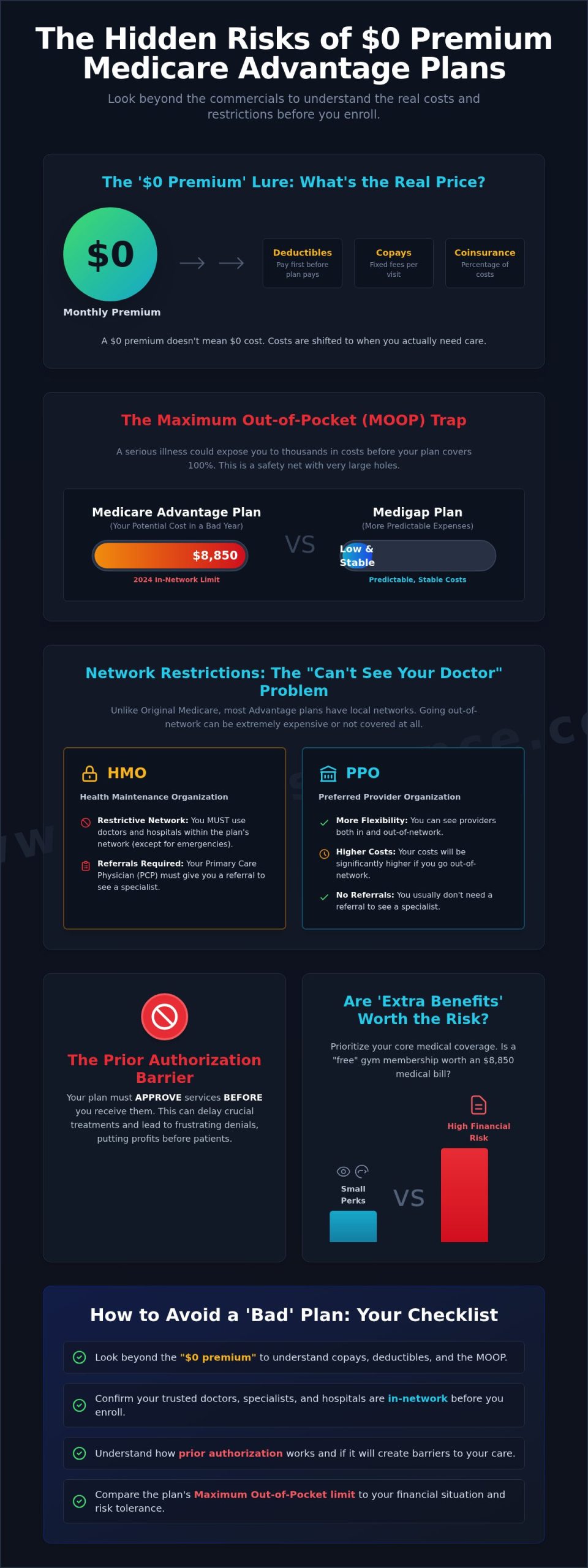
The most common hook for Medicare Advantage plans is the $0 monthly premium. For anyone on a fixed income, this sounds incredibly appealing. But as many beneficiaries discover, the true cost of a plan isn’t what you pay per month—it’s what you pay when you actually need medical care.
These plans operate on a trade-off: in exchange for that low or zero-dollar premium, you agree to pay a larger share of the costs when you visit a doctor, go to the hospital, or need a procedure. For those who are healthy, this can work out fine. But an unexpected illness or injury can lead to a sudden and significant financial burden.
Copays, Coinsurance, and Deductibles
When you start using your plan, you’ll encounter three key types of costs:
- Copay: A fixed dollar amount you pay for a service. For example, you might pay a $50 copay every time you see a specialist.
- Coinsurance: A percentage of the cost you pay for a service. If your plan has a 20% coinsurance for a hospital stay, you’re responsible for 20% of the total bill.
- Deductible: The amount you must pay out-of-pocket for your healthcare before your plan starts to pay its share.
For someone who needs frequent care, these costs can add up much faster than the predictable monthly premium of a different type of plan.
The Maximum Out-of-Pocket (MOOP) Trap
Every Medicare Advantage plan has a Maximum Out-of-Pocket (MOOP) limit. This is a crucial safety net designed to protect you from catastrophic costs. Once your spending on copays, coinsurance, and deductibles reaches this limit, the plan pays 100% for your covered services for the rest of the year.
Here’s the trap: this "safety net" can be very high. For 2026, the legal MOOP limit for an in-network plan is $9,250. A serious illness, like a cancer diagnosis or a major surgery, could easily push you to that limit, leaving you with a bill for thousands of dollars. This stands in stark contrast to the predictable costs of Original Medicare paired with a Medigap plan, which often leaves you with little to no out-of-pocket expenses for covered services.
Are the ‘Extra Benefits’ Worth the Risk?
Advantage plans often bundle attractive extra benefits like dental, vision, hearing, and gym memberships. These perks are heavily featured in advertising and are genuinely useful for many people.
However, it’s essential to weigh these benefits against the potential risks. Is a "free" gym membership worth being locked into a narrow network of doctors? Is a small dental allowance worth the risk of a $9,250 bill if you get sick? For most people, the core medical coverage—your access to doctors and hospitals when you need them most—should always be the top priority.
Network Restrictions: The ‘You Can’t See Your Doctor’ Problem
One of the most common and deeply felt fears about Medicare Advantage plans is the risk of losing access to a trusted doctor. Unlike Original Medicare, which allows you to see virtually any doctor or hospital in the country that accepts Medicare, most Advantage plans are built around provider networks.
If you see a provider who is "out-of-network," the costs can be astronomically high, and in many cases, the service may not be covered at all. These networks can also change, sometimes from one year to the next, forcing you to find a new doctor or hospital at a moment’s notice.
HMO vs. PPO: What Network Rules Mean for You
You’ll typically encounter two main types of networks:
- HMO (Health Maintenance Organization): These plans are usually more restrictive. You must use doctors, specialists, and hospitals within the plan’s network (except in an emergency). You also typically need to choose a Primary Care Physician (PCP) and get a referral from them before you can see a specialist.
- PPO (Preferred Provider Organization): These plans offer more flexibility. You can see both in-network and out-of-network providers, but you will pay significantly more if you go out-of-network. You generally don’t need a PCP or referrals to see specialists.
Prior Authorization: The Barrier to Care
Prior authorization is a process where your insurance plan must give permission before you can receive certain medical services, tests, or prescriptions. The plan reviews the request to determine if it is "medically necessary."
This process is a major source of frustration for both patients and doctors. It can cause significant delays in receiving necessary care, and sometimes, the plan may deny a procedure that your doctor believes is essential for your health. This creates a stressful barrier between you and the treatment you need.
What if Your Doctor or Hospital Leaves the Network?
It’s a legitimate fear: you’ve chosen a plan specifically because your trusted cardiologist is in-network, but halfway through the year, they leave. When this happens, you are forced to find a new, in-network specialist. For anyone managing a chronic condition or complex health issue, this disruption can be incredibly difficult and damaging to your continuity of care.
The ‘Deny, Deny, Deny’ Fear: How ‘Managed Care’ Works
Medicare Advantage plans are a form of "managed care." They are run by private insurance companies that receive a fixed amount from the government for each member they enroll. The company’s goal is to manage the cost of that member’s care to stay below that fixed amount, which is how they make a profit.
This business model can create a fundamental conflict. While your doctor’s primary goal is your health, the insurance plan’s goal is to control costs. This friction can sometimes feel like your plan is actively working to deny you the care your doctor recommends.
Utilization Management and Claim Denials
To control costs, plans use a process called "utilization management," which includes tools like prior authorization and reviews of claims. They analyze services to ensure they meet the plan’s definition of "medically necessary." While this is meant to prevent waste, government reports and studies from organizations like KFF have shown that some plans have high denial rates for certain services, even when that care should have been covered under Medicare rules. This places the burden on you, the patient, to fight for the care you need.
Navigating the Stressful Appeals Process
If your plan denies a service or claim, you have the right to appeal the decision. However, this process can be complicated and overwhelming. It involves strict deadlines, paperwork, and potentially multiple levels of review. Trying to navigate this bureaucratic maze while you are sick is an enormous challenge, and it’s a situation where having a knowledgeable advocate on your side is invaluable.
Unpredictable Changes Each Year
A plan that works perfectly for you this year might be a terrible fit next year. Every year during the Annual Enrollment Period, insurance companies can change their plans’ networks, drug formularies, copays, and MOOP limits. This means you must review your coverage every single year to avoid unpleasant surprises. Many people forget to do this and are automatically re-enrolled into a plan that no longer meets their needs.
So, Are All Medicare Advantage Plans a Bad Choice?
After reading about all these potential pitfalls, it’s easy to think so. But the honest answer is no, Medicare Advantage plans are not inherently "bad" for everyone.
A plan only becomes a "bad" plan when it’s a mismatch for an individual’s specific health needs, financial situation, and priorities. The key is to understand the trade-offs you are making and to choose a plan with your eyes wide open.
Who Might Be a Good Fit for an Advantage Plan?
- Individuals who are relatively healthy and don’t expect to need frequent or complex medical care.
- People who are comfortable with the rules of an HMO or PPO and have verified that their trusted doctors are in the network.
- Those on a very tight budget who need a $0 premium and are willing to accept higher out-of-pocket costs when they need care.
When is Original Medicare + Medigap a Safer Bet?
- Individuals with chronic health conditions (like heart disease, COPD, or cancer) who require ongoing, specialized care.
- People who value total freedom and want the ability to see any doctor or specialist in the U.S. that accepts Medicare, without needing referrals.
- Those who prefer predictable, stable healthcare costs and want to minimize their out-of-pocket expenses when they get sick.
The Critical Mistake: Choosing a Plan Without Unbiased Guidance
The single biggest danger in Medicare is enrolling in a plan based on a flashy TV commercial, a mailer, or a single feature like a dental benefit. The complexity of these plans makes it incredibly easy to overlook a critical detail in the fine print—a detail that could cost you thousands of dollars and compromise your care.
You don’t have to navigate this complicated decision alone. An independent expert can help you compare all of your options side-by-side to find the right fit.
Get a free, unbiased plan comparison.
How to Avoid a ‘Bad’ Plan and Make a Confident Choice
You can move from a state of fear to one of confidence by taking a few proactive steps. Use this checklist to protect yourself and evaluate any plan you’re considering.
Step 1: Always Verify Your Doctors and Prescriptions
Never take an agent’s or a marketing mailer’s word for it. Call your doctors’ offices directly and ask the billing department, "Do you participate in the [Full Plan Name] network for 2026?" Then, use the plan’s official online drug formulary tool to check that all of your specific prescription drugs are covered and see which "tier" they fall on, as this determines your copay.
Step 2: Look Beyond the Premium to the MOOP
The monthly premium is the least important number. The Maximum Out-of-Pocket (MOOP) is the most important. Compare the MOOP between different plans and ask yourself the tough question: "If I have a terrible health year, could I comfortably afford to pay this amount?"
Step 3: Check the Plan’s Star Rating
Medicare uses a Star Rating system (from 1 to 5 stars) to measure the quality and performance of Medicare Advantage plans. These ratings are based on factors like member satisfaction, customer service, and quality of care. As a general rule, be very cautious of any plan rated below 4 stars.
The Safest Step: Partner With an Independent Broker
The best way to avoid the pitfalls is to work with an expert who has your best interests at heart. An independent broker doesn’t work for one specific insurance company; they work for you. They can compare dozens of plans from different carriers to find the one that truly aligns with your health needs, budget, and doctor preferences. This expert guidance is your best defense against making a costly mistake.
Frequently Asked Questions
Can I switch out of a Medicare Advantage plan if I don’t like it?
Yes, but only during specific times. The main opportunity is the Annual Enrollment Period (AEP) from October 15th to December 7th each year. There is also an Open Enrollment Period from January 1st to March 31st where you can switch from one Advantage plan to another or go back to Original Medicare. Special circumstances can also grant you a Special Enrollment Period.
Are Medicare Advantage PPO plans safer than HMO plans?
PPO plans offer more flexibility because they allow you to see out-of-network providers, which can be a safety net. However, you will pay significantly more for that out-of-network care. An HMO may have a lower MOOP, but it’s more restrictive. Neither is inherently "safer"; the best choice depends on your personal priorities for cost versus flexibility.
Do I still have to pay my Medicare Part B premium with an Advantage Plan?
Yes. A Medicare Advantage plan (Part C) replaces your Original Medicare (Part A and B) coverage, but you must continue to be enrolled in Part A and Part B and pay your monthly Part B premium to the government.
Why do doctors seem to dislike Medicare Advantage plans?
Many doctors and their office staff find the administrative burdens of Advantage plans, such as prior authorizations and navigating different network rules, to be frustrating and time-consuming. Some also feel that these "managed care" rules interfere with their ability to make the best treatment decisions for their patients.
What happens if I need to go to a hospital in an emergency and it’s out-of-network?
By law, all Medicare Advantage plans must cover emergency care at any hospital in the United States. You cannot be charged more for visiting an out-of-network emergency room than an in-network one.
Are all the TV commercials for Medicare Advantage plans trustworthy?
You should be very skeptical of them. These commercials are designed to sell you on the most appealing features, like $0 premiums and extra benefits, while glossing over the important details like networks, prior authorizations, and high out-of-pocket costs. They are not a reliable source for making an informed decision.
Ready for Clarity and Confidence?
Navigating the maze of Medicare options can be overwhelming, but you don’t have to do it by yourself. Get personalized, expert guidance to ensure you choose a plan that protects both your health and your finances.
Schedule a free, no-pressure call with Paul to find the right plan for you.
- Unbiased guidance from over 40 carriers
- Serving clients in more than 34 states
- Personalized, year-round support

Article by
Paul Barrett
Paul Barrett, CMIP is the founder of The Modern Medicare Agency, an independent Medicare-only brokerage based in Melville, NY. With 18 years of Medicare-exclusive experience, a CMIP designation, and more than 5,000 clients served across 37 states, Paul is one of the most credentialed independent Medicare specialists on Long Island — and one of the most direct.
He represents 40+ carriers with no quotas and no allegiances, which means his recommendations are based entirely on what fits each client's specific situation. He is the author of Medicare Mastery Unlocked and host of the Wise Guys Retirement Talk podcast. His content is grounded in primary sources, real carrier intelligence, and 18 years of watching what happens when people get Medicare right — and when they don't.
📞 631-358-5793 | paulbinsurance.com