
What if the Medicare plan that protected your savings last year is the very one that leaves you with a $2,200 out-of-pocket surprise in 2026? With the final drug cost caps from the Inflation Reduction Act now fully in effect, many seniors are finding that their old coverage simply doesn’t fit the new rules. We understand that the constant stream of aggressive phone calls and "urgent" mailers makes you feel pressured and overwhelmed. It is frustrating to worry about making a permanent mistake that could cost you thousands in late penalties or lost doctor access. You deserve a plan that works for your unique needs, and you need a trusted advocate who will be there when you have a question three years from now.
Think of a captive agent like a clerk at a brand-name shoe store. They can only sell you that one brand, even if the shoes don’t fit your feet comfortably. An independent broker is more like a personal shopper for your health. We don’t work for the insurance companies; we work for you. While a captive agent offers just one flavor of insurance, we compare plans from 40 or more different carriers to find your perfect match. This comparison-based approach applies beyond Medicare, and you can discover more about Individual Health Insurance Quotes for other types of private coverage. This independence ensures that your needs always come before any company’s bottom line.
We’re here to simplify this process and help you move from confusion to confidence. By knowing the right questions to ask a medicare broker, you can quickly separate the unbiased experts from the captive agents who only offer a handful of choices. This guide provides 21 essential questions to ensure your advisor is looking out for your health and your wallet. We’ll show you how to vet an independent broker so you can secure a plan that covers your specific prescriptions and keeps your favorite doctors within reach for the long haul.
Key Takeaways
-
We explain the critical difference between independent brokers and captive agents so you can secure unbiased advice that puts your needs first.
-
Discover the top questions to ask a medicare broker to ensure they represent a wide range of carriers and have the freedom to find your perfect fit.
-
Understand how to navigate the 2026 Medicare landscape, including how the new Part D out-of-pocket caps will impact your prescription costs.
-
Identify the exact steps to confirm your preferred doctors and specialists remain in-network before you commit to a new plan.
-
Explore our proven 5-step process designed to lead you out of the "Medicare maze" and toward a future of total confidence and security.
Table of Contents
-
Vetting Your Advisor: Questions About Independence and Ethics
-
Diving into the Details: Questions About Coverage, Costs, and Doctors
-
Planning for the Future: Questions About Long-Term Support and Part D
-
Finding Your Partner in the Medicare Maze with The Modern Medicare Agency
Why Working with a Medicare Broker Makes Sense in 2026
Starting your Medicare journey in 2026 feels different than it did even two years ago. We see the stress on people’s faces when they look at the stacks of mail and the endless TV commercials. The system has become a maze of new regulations and shifting plan benefits. Our mission is to move you from a state of confusion to a place of total confidence. We do this by acting as your personal guide through the entire process, ensuring you understand every choice before you make it. We simplify the jargon so you know exactly how your coverage works.
A Medicare broker is an independent professional who helps you compare private insurance options like Medicare Advantage and Supplement plans. If you are looking for a comprehensive overview of Medicare and how the basic parts work, the history of the program is a great place to start. However, the real challenge lies in picking the specific 2026 plan that fits your doctors and your budget. We take the weight off your shoulders by doing the heavy lifting for you, analyzing the fine print that often gets missed.
You might wonder what this level of expert guidance costs. The answer is simple: nothing. We provide our services at no cost to you. We are compensated by the insurance companies, which means you get professional advice, enrollment help, and year-round support without writing us a check. Because our goal is your long-term satisfaction, we focus on finding the right fit rather than making a quick sale. One of the first questions to ask a medicare broker when you meet them is how many carriers they actually represent, as this affects your range of choices.
The Difference Between an Agent and a Broker
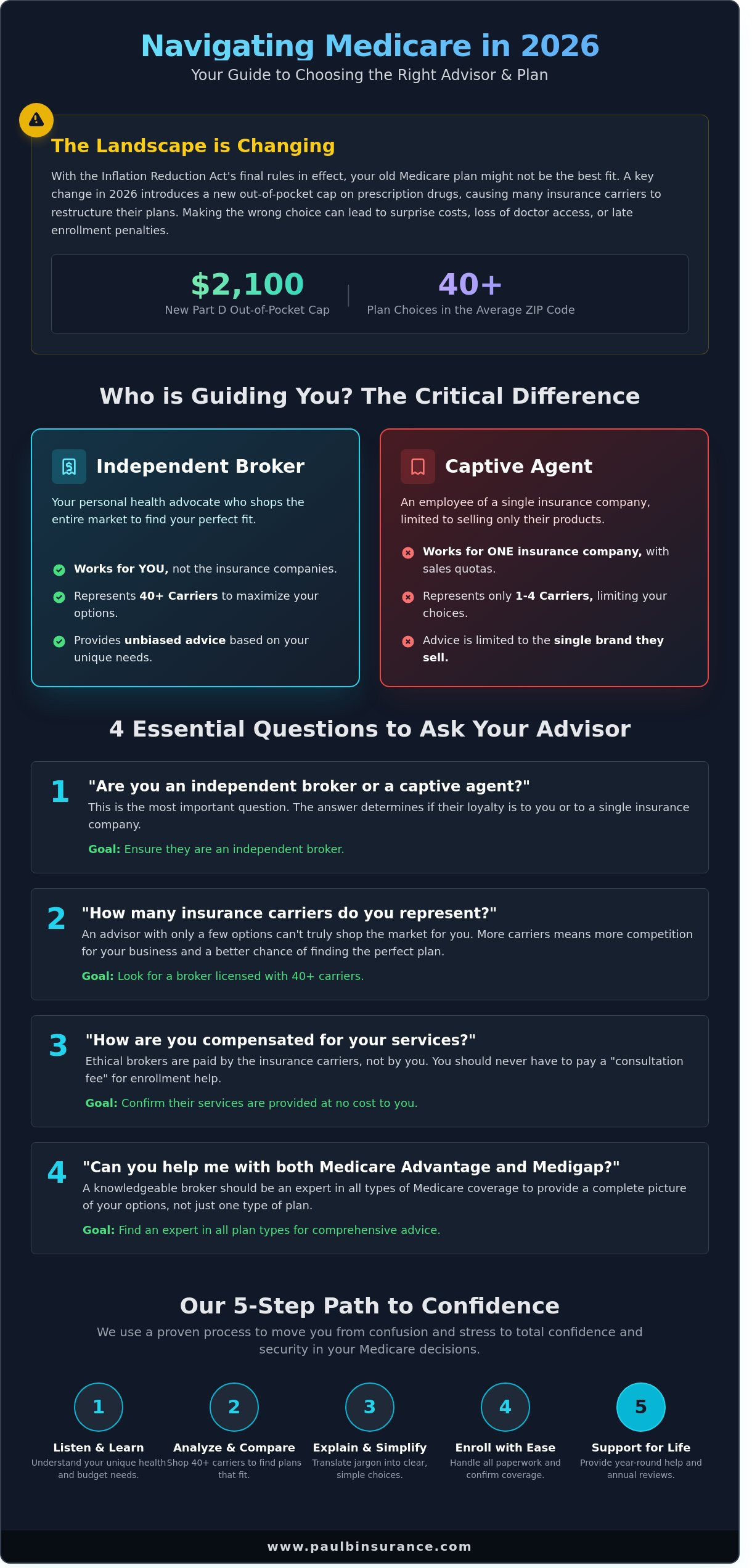
Think of a captive agent like a clerk at a brand-name shoe store. They can only sell you that one brand, even if the shoes don’t fit your feet comfortably. An independent broker is more like a personal shopper for your health. We don’t work for the insurance companies; we work for you. While a captive agent offers just one flavor of insurance, we compare plans from 40 or more different carriers to find your perfect match. This independence ensures that your needs always come before any company’s bottom line.
The 2026 Medicare Environment
The 2026 calendar year brings specific challenges, especially with the final implementation of the $2,100 out-of-pocket limit on prescription drugs. These changes have caused many carriers to restructure their 2026 plan designs and premium costs. A broker serves as your primary filter for the latest CMS updates, translating complex federal rule changes into simple steps you can actually use. We pride ourselves on jargon-free explanations that make sense. Knowing the right questions to ask a medicare broker about these 2026 shifts will help you avoid late enrollment penalties and coverage gaps that could cost you thousands later on.
Vetting Your Advisor: Questions About Independence and Ethics
Choosing the right person to guide you through the Medicare maze is the most important step you’ll take this year. In 2026, the average beneficiary has over 40 different plans available in their specific zip code. That is a lot of noise to filter through. You need to know if the person sitting across from you is a dedicated advocate or just a salesperson for a single company. We want you to feel safe. We want you to feel heard. That starts with knowing the right questions to ask a medicare broker before you share any personal health information.
The first thing to clarify is their professional status. Ask them directly: "Are you an independent broker or a captive agent?" This distinction changes everything about the advice you receive. Understanding the difference between a Medicare broker and agent is vital because it determines the breadth of your options. A captive agent works for one specific insurance company. They are often required to meet sales quotas for that brand. An independent broker works for you. We represent dozens of different companies, which allows us to shop the entire market to find the best fit for your budget.
You should also ask about their compensation. "How are you compensated for your services?" is a fair and necessary question. In 2026, the standard Part B premium is projected to be $202.90 per month. You shouldn’t have to pay an additional consulting fee on top of your premiums. Most ethical brokers are paid a commission by the insurance carriers. This ensures our guidance comes at no extra cost to you. If an advisor tries to charge you a "consultation fee" for basic enrollment help, it is often a sign to look elsewhere for assistance.
Understanding Their Portfolio
Having access to a wide variety of carriers is not just a luxury; it is a financial necessity. We believe a broker should be licensed with at least 40 different insurance carriers to truly serve your interests. If an advisor only works with three or four companies, they are effectively ignoring 85% of the market. You should also ask, "Can you help me with both Medicare Advantage and Medigap?" A broker who only sells one type of plan is a significant red flag. They might be biased toward a specific product because of higher commissions or limited licensing. We provide unbiased comparisons because we want you to have the plan that actually works when you visit the doctor.
Transparency and Trust
Trust is built through a clear, repeatable process. Ask your advisor, "What is your specific process for choosing a plan for me?" You want to hear them describe a "needs-based analysis." This means they should ask for your list of medications, your preferred specialists, and your typical monthly healthcare usage. If they start by showing you "top-selling plans" before asking about your heart medication or your knee surgeon, they are not prioritizing your health. We believe in a "never rushed, never pressured" consultation. Our goal is to move you from confusion to confidence by showing you a side-by-side comparison of every plan in your area. This includes plans we might not even represent. You can explore our transparent consultation process to see how we protect our clients from making costly enrollment mistakes. We take the time to explain the fine print so you can sleep better at night.
Diving into the Details: Questions About Coverage, Costs, and Doctors
We know the Medicare system can feel like a crazy maze that leaves you feeling overwhelmed. Our mission is to move you from confusion to confidence by looking at the fine print together. In 2026, the stakes are high because costs and networks change every single year. You deserve a partner who is never rushed and never pressured. We simplify the jargon so you know exactly how your plan works before you make a commitment.
One of the most vital questions to ask a Medicare broker involves your medical team. We will verify if your current primary care doctor and specialists are in-network for 2026. This is not a simple one-time check. Networks are fluid; data shows that roughly 15% of providers may shift their plan affiliations annually. We take the time to contact your "must-have" hospitals to confirm they still accept the specific plan you are considering.
Prescription drug costs are another area where we provide much-needed peace of mind. For the 2026 plan year, the $2,100 out-of-pocket cap on Part D medications is a major protection for seniors. We will run your specific list of medications through the 2026 formularies to see which tier they fall into. This step helps you steer clear of costly enrollment mistakes at the pharmacy counter. To ensure you cover every base, it’s beneficial to come prepared with a list of specific questions to ask a Medicare broker during your consultation.
We also look closely at the Maximum Out-of-Pocket (MOOP) limits. For 2026, the standard MOOP for in-network services on many Advantage plans is approximately $9,250. We help you understand that this is your financial safety net. It represents the absolute most you would pay for covered medical services in a calendar year. We also check for extra benefits like dental, vision, and hearing. By 2026, about 98% of Advantage plans include these extras, but the actual dollar amounts for things like frames or root canals vary wildly.
Comparing Plan Structures
We often hear the question: "Should I choose Medicare Supplement insurance or an Advantage plan?" We explain the trade-off in simple, clear terms. Supplement plans usually have higher monthly premiums but lower costs when you visit a doctor. Advantage plans often have $0 premiums but require co-pays for each visit. You can read our Medicare Advantage Guide for a full breakdown of these options.
Specific Benefits and Networks
Travel is a major concern for many of our clients. We will look at what happens if you travel outside your service area during 2026. Most plans cover emergencies anywhere, but routine care might be restricted to local providers. If the plan’s dental coverage is too thin for your needs, we can explore standalone dental insurance plans. We want you to feel certain that your hospitals are included so you never feel stranded.
Planning for the Future: Questions About Long-Term Support and Part D
Your health needs don’t stay the same forever. A plan that works perfectly today might feel like a burden next year if your prescriptions change or your favorite doctor leaves the network. We want you to feel secure knowing your coverage evolves with you. When you’re looking for the right partner, there are specific questions to ask a medicare broker regarding your future stability. We believe in building a relationship that lasts much longer than a single enrollment window. Our goal is to remove the anxiety of the unknown and replace it with a clear, long-term strategy.
Mastering Prescription Drug Costs
One of the most vital steps we take is asking, "Can you run my drugs through the Medicare Part D plan finder?" This isn’t just a suggestion; it’s a necessity for your financial health. As we move through 2026, the landscape of drug costs has changed for the better. The $2,100 annual out-of-pocket cap is now fully active. This means once you spend $2,100 on covered prescriptions at the pharmacy, your plan pays 100% of your covered drug costs for the rest of the year. We help you calculate exactly when you might hit that cap based on your specific medications. Medicare plans update their list of covered drugs and cost-sharing tiers every single January to reflect new medical guidelines and manufacturer pricing. We track these shifts so you don’t have to worry about a life-saving medication suddenly becoming unaffordable.
The Value of Year-Round Advocacy
You should always ask your broker, "Are you here for me after I sign the application?" Many people feel abandoned once the initial paperwork is done, but we stay by your side. If you receive a confusing bill in the mail or a claim is unexpectedly denied, we take over the "paperwork headaches" for you. We act as your personal advocate to resolve disputes with insurance carriers. This year-round support is what separates a dedicated independent broker from a captive agent who only represents one company. We also conduct an annual review for every client during the Open Enrollment period from October 15 to December 7. We proactively notify you if your current plan is changing its costs or provider network for the following year. This process takes you from confusion to confidence, ensuring you never face the insurance system alone. We handle the technical details so you can focus on your health.
We simplify the jargon so you know exactly how your coverage works. Schedule a call with Paul today to ensure your 2026 drug coverage is fully optimized for the $2,100 out-of-pocket cap.
When you consider questions to ask a medicare broker, remember that you’re interviewing a long-term partner. You deserve someone who is never rushed and never pressured. We provide unbiased guidance because we work for you, not the insurance companies. If your medications change in the middle of the year, you don’t have to panic. You simply call us, and we’ll analyze how that change fits into your current formulary. This level of personal service ensures that you’re always protected from costly enrollment mistakes and late penalties. We’re here to make the complex simple and the stressful manageable.
Finding Your Partner in the Medicare Maze with The Modern Medicare Agency
Choosing your health coverage is one of the most significant financial decisions you will make this year. You have reviewed the essential questions to ask a medicare broker, but the most important part of the process is finding a person who actually listens to your answers. We founded The Modern Medicare Agency because we saw too many seniors feeling pressured by aggressive call centers or limited by agents who only represent a single company. Paul Barrett started this agency with a simple mission: to serve as your dedicated advocate. We don’t just sell plans; we build shields around your retirement and your health.
In 2026, the Medicare landscape has changed significantly with new out-of-pocket limits and updated Part D structures. We help you make sense of these shifts using our proven 5-step "Confusion to Confidence" process. First, we listen to your specific health needs. Second, we analyze your current doctors and medications. Third, we compare options across our massive network. Fourth, we handle the entire enrollment to ensure you avoid late penalties. Finally, we stay by your side for yearly reviews. This methodical approach removes the guesswork and replaces it with a clear, logical path forward.
We believe your experience should be personal. You aren’t a number in a database to us. When you work with our team, you get a relationship that is never rushed and never pressured. We take the time to ensure you feel empowered. Our goal is for you to hang up the phone feeling a sense of relief you haven’t felt since you started looking at Medicare options. We treat your healthcare as if it were our own family’s coverage.
Why Choose The Modern Medicare Agency?
We provide a level of choice that most local agents simply cannot match. Because we are independent and licensed in 34 states, we aren’t beholden to any single insurance company. We represent over 40 different carriers. This independence is your greatest advantage because it ensures our recommendations are completely unbiased. If a plan doesn’t fit your budget or your doctor network, we move on to the next one until we find the "best fit" for your life.
-
Jargon-Free Guidance: We translate complex insurance terms into plain English so you know exactly how your plan functions.
-
Broad Market Access: With 40+ carriers, we find the competitive rates that captive agents often miss.
-
Lifetime Advocacy: Our support continues long after your card arrives in the mail; we help you solve billing issues and plan changes every year.
Your Next Steps to Peace of Mind
Taking the first step is often the hardest part, but we make it simple. You can schedule a no-obligation consultation with Paul to get direct answers to your questions to ask a medicare broker. This call is about education, not a sales pitch. We want to hear about your concerns and show you how the 2026 plan changes might affect your current coverage. It’s the fastest way to stop the "information overload" and start feeling secure about your future.
To make our first conversation as productive as possible, please have a few items ready. Grab a list of your current primary care doctors and specialists, along with a list of your daily medications and their dosages. Having this data ready allows us to run an instant, accurate comparison across all 34 states we serve. We look forward to helping you move from a state of worry to a state of total confidence.
Ready to get started? Schedule a Call with Paul today and let us take the stress out of your Medicare journey.
Take the Next Step Toward Medicare Clarity
Navigating the 2026 Medicare landscape doesn’t have to feel like a second job. We’ve shown you how to identify an ethical advisor and why checking doctor networks is vital for your 2026 coverage. Armed with the right questions to ask a medicare broker, you can now distinguish between a captive agent and a true advocate. We provide unbiased access to 40+ insurance carriers, which means we work for you, not the big insurance companies. Our team is licensed in over 34 states, offering a wealth of nationwide expertise while maintaining a personal, "never rushed" approach focused on your education.
We want to help you avoid costly 2026 enrollment mistakes and find the peace of mind you’ve been searching for. Our 5-step process takes you from confusion to total confidence. You deserve a plan that protects your health and your savings without the high-pressure sales tactics. Let us simplify the jargon and build a strategy that fits your life perfectly. You’ve worked hard for your retirement; let’s make sure your healthcare reflects that. Schedule a Call With Paul for a Confusion-Free Medicare Review today. We’re ready to help you secure your future with confidence.
Frequently Asked Questions
Do I have to pay a Medicare broker for their help?
You don’t pay us a single penny for our guidance because insurance companies compensate us directly. This means your monthly premium stays exactly the same whether you sign up through our office or go directly to the carrier. In 2026, we continue to provide this service at no cost to ensure you receive unbiased help without any financial pressure. We focus on your specific needs, not a paycheck.
Is it better to go through a broker or buy directly from an insurance company?
It’s better to use a broker because we compare 15 or more different insurance companies to find your best fit. If you go directly to one carrier, they can only sell you their own products. We act as your advocate, scanning the 2026 market to ensure you don’t miss out on lower premiums or better networks available elsewhere. This is one of the most important questions to ask a medicare broker.
Can a Medicare broker help me if I already have a plan?
We can absolutely help you even if you’re already enrolled in a plan. Every year during the Annual Enrollment Period, which runs from October 15 to December 7, we review your current coverage against the updated rates and drug lists for 2026. If your current plan increased its deductible by $20 or dropped your preferred doctor, we help you switch to a more stable option. You’re never stuck in a bad plan.
What is the difference between an independent broker and a captive agent?
An independent broker represents multiple carriers, while a captive agent is an employee of a single insurance company. We choose the independent path because it allows us to be completely unbiased. A captive agent must sell you their company’s plan even if a competitor offers a $30 lower monthly premium. We work for you, not the big insurance corporations. This ensures you always have the power of choice in your corner.
How does a broker stay updated on the 2026 Medicare changes?
We stay updated by completing rigorous AHIP certification and specific carrier training every single year. For 2026, we tracked the new $2,100 out of pocket cap on prescription drugs mandated by the Inflation Reduction Act. Our team spends over 40 hours each summer studying these legislative shifts so you don’t have to worry about the fine print. We’re never rushed and never pressured when explaining these updates to you.
What happens if the plan my broker recommends changes its network next year?
If your plan changes its network, we step in immediately to find a new solution during the next enrollment period. Over 12 percent of Medicare Advantage plans changed their provider networks for the 2026 season. We track these shifts for our clients every year. If your primary doctor or specialist is no longer covered, we’ll move you to a plan that keeps your healthcare team intact. You’ll never be left without coverage.
Can a broker help me with Medicare Supplement (Medigap) plans?
We help you navigate all available Medigap options, from Plan G to Plan N, to find the best value. Because these plans are standardized by the government, the coverage is identical between companies, but the price can vary by $50 or more per month. We use our 2026 pricing tools to identify the most cost effective carrier in your specific zip code. This ensures you don’t overpay for the exact same protection.
How do I know if a Medicare broker is licensed and legitimate?
You can verify our credentials by looking up our National Producer Number on the NIPR website or your state’s insurance department portal. A legitimate broker will always provide their license number upon request. These are the types of questions to ask a medicare broker to move from confusion to confidence. We’ve maintained our license in good standing for over 10 years, serving thousands of seniors with transparency and genuine care.

Article by
Paul Barrett
Paul Barrett, CMIP is the founder of The Modern Medicare Agency, an independent Medicare-only brokerage based in Melville, NY. With 18 years of Medicare-exclusive experience, a CMIP designation, and more than 5,000 clients served across 37 states, Paul is one of the most credentialed independent Medicare specialists on Long Island — and one of the most direct.
He represents 40+ carriers with no quotas and no allegiances, which means his recommendations are based entirely on what fits each client's specific situation. He is the author of Medicare Mastery Unlocked and host of the Wise Guys Retirement Talk podcast. His content is grounded in primary sources, real carrier intelligence, and 18 years of watching what happens when people get Medicare right — and when they don't.
📞 631-358-5793 | paulbinsurance.com