



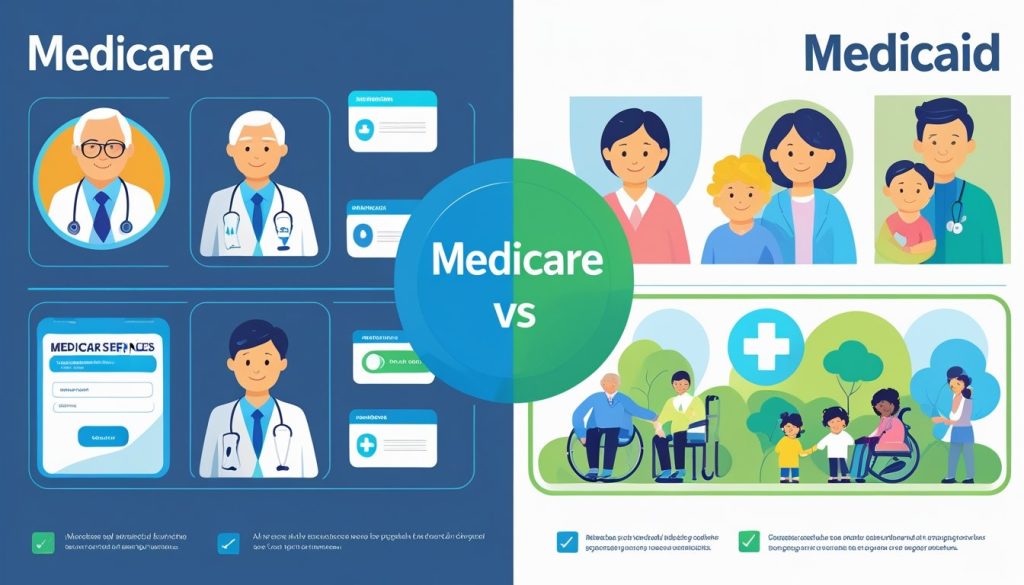
Choosing between Medicare and Medicaid can feel confusing, but it comes down to who qualifies and what each program pays for. Medicare mainly covers people 65 and older or those with certain disabilities, while Medicaid helps people with low income and can cover services Medicare does not.
Knowing this upfront helps you focus on the options that fit your situation.
You can get clear answers and one-on-one help from The Modern Medicare Agency. Our licensed agents talk with you directly, match Medicare plans to your needs, and aim to keep costs reasonable so you don’t pay for coverage you don’t need.
Understanding Medicare
Medicare helps pay for hospital care, doctor visits, and prescription drugs for people who meet specific age or health rules. You’ll learn who qualifies, how to sign up, what parts cover which services, and what costs to expect.
Eligibility Criteria
You qualify for Medicare if you are 65 or older and you or your spouse worked and paid Medicare taxes for at least 10 years. You may also qualify at any age if you have certain disabilities, end-stage renal disease (ESRD), or amyotrophic lateral sclerosis (ALS).
If you get Social Security or Railroad Retirement Board benefits, you usually get Part A and Part B automatically when eligible. Noncitizens with lawful presence must meet specific residency rules to enroll.
If you haven’t met work history requirements, you may still buy Part A by paying a premium. Check your exact status with Social Security before you enroll to avoid gaps in coverage.
Enrollment Process
Initial Enrollment runs from three months before your 65th birthday month through three months after it. If you miss that window, you can sign up during the General Enrollment Period (Jan 1–Mar 31), but coverage starts July 1 and you may owe late penalties.
If you still work and have employer insurance, you can delay Part B without penalty when certain conditions apply. You enroll in Part A and Part B through Social Security online, by phone, or at a local office.
For Part C (Medicare Advantage) and Part D (prescription drug plans), you choose private plans during Initial Enrollment or the Annual Election Period (Oct 15–Dec 7). Special Enrollment Periods may apply after major life events.
Coverage Options
Medicare has four main parts: Part A (hospital), Part B (medical services), Part C (Medicare Advantage), and Part D (prescription drugs). Part A covers inpatient hospital stays, skilled nursing facility care, and limited home health care.
Part B covers doctor visits, outpatient care, preventive services, and medical equipment. Medicare Advantage (Part C) bundles Part A and B and often Part D into private plans that may add vision, dental, or fitness benefits.
Part D plans help pay for prescription drugs; each plan has its own formulary. You can also buy Medigap (supplement) policies to cover Part A and B cost-sharing if you have Original Medicare instead of Advantage.
Costs and Premiums
Part A is usually premium-free if you or your spouse paid Medicare taxes for 40 quarters; otherwise you can buy it and pay a monthly premium. Part B has a standard monthly premium that most people pay, and higher earners pay an Income-Related Monthly Adjustment Amount (IRMAA).
Part C and Part D premiums vary by plan and region. Beyond premiums, expect deductibles, coinsurance, and copayments.
Original Medicare has a Part A deductible per hospital stay and a Part B deductible plus typically 20% coinsurance for many services. Medicare Advantage plans may have lower out-of-pocket costs for some services but can restrict provider choice and use network rules.
The Modern Medicare Agency can help you compare costs and plan rules. Our licensed agents speak with you one-on-one, find plans that match your needs, and do not charge extra fees.
Overview of Medicaid
Medicaid helps pay medical bills for people with low income, certain disabilities, pregnant people, and some seniors. Each state runs its own program within federal rules, so what you get and how you apply can change where you live.
Eligibility Requirements
Medicaid eligibility depends on income, family size, age, disability, pregnancy, and immigration status. Most adults qualify when their income is at or below a state-set percentage of the federal poverty level (FPL).
Pregnant people and children often have higher income limits than other adults. If you receive Supplemental Security Income (SSI) or certain disability benefits, you may automatically qualify.
States also run special categories for people who need long-term care or who are in nursing homes. Noncitizen eligibility varies; some lawful residents qualify after a waiting period.
You must meet your state’s residency and documentation rules. Expect to show proof of income, identity, and household members.
If your income changes, report it quickly—your coverage can start, stop, or shift based on updated information.
State Variations
States decide many details: covered services, income limits, asset rules, and provider payment rates. Some states expand Medicaid to all adults under a certain income level, while others keep stricter limits.
Coverage for things like dental care, vision, and transportation varies. For example, one state might include routine dental cleanings for adults while another covers only emergency dental care.
Long-term care and home health services also differ widely by state. Your state’s Medicaid website lists exact benefits and rules.
Compare state plans if you move or live near a border—your eligibility and covered services can change quickly.
Benefits and Services
Medicaid covers a broad range of services. Most plans include doctor visits, hospital care, lab tests, and prescription drugs.
For children, many states provide well-child checkups, vaccines, and dental care under the Early and Periodic Screening, Diagnostic, and Treatment (EPSDT) benefit. Medicaid often pays for long-term services that Medicare usually does not.
This includes nursing home care, personal care at home, and some in-home supports for daily living. Some states pay for transportation to medical appointments, physical therapy, and vision care.
Benefits can include care coordination and preventive programs. Check your state plan for limits, prior authorization rules, and whether you need a managed care plan or can use fee-for-service providers.
Application Process
You can apply for Medicaid through your state Medicaid office, online portal, or local social services office. Many states allow applications by phone or by mail.
You’ll need documents like proof of income, ID, Social Security numbers, and proof of residency. After you apply, the state usually has 45 days to decide; decisions for disability-based cases can take up to 90 days.
If you’re pregnant, many states make faster decisions. Expect interviews or follow-up requests for missing documents.
If denied, you have the right to appeal. Keep copies of all forms and written decisions.
The Modern Medicare Agency can connect you with licensed agents who explain state rules, help gather documents, and walk you through the application without charging extra fees. Our agents speak with you one-on-one to match plans to your needs.
Key Differences Between Medicare and Medicaid
Medicare mainly covers people 65 or older and some younger people with certain disabilities or conditions. Medicaid serves people and families with low income and can vary by state in what it pays and who qualifies.
Purpose and Target Population
Medicare serves adults 65+ and younger people with long-term disabilities or end-stage renal disease. It focuses on basic hospital and medical insurance, plus optional drug and private-plan choices.
You qualify for Medicare through age or specific health conditions, not income. Medicaid serves low-income children, pregnant people, adults, seniors, and people with disabilities.
States set income limits and some groups like children get broader coverage. You may qualify for both Medicare and Medicaid if you have low income and meet Medicare rules.
Funding Sources
Medicare gets most funding from federal payroll taxes, premiums that beneficiaries pay, and general federal revenue. Medicare Part A is mainly payroll-tax funded; Parts B and D rely on premiums and government funds.
These federal funds set standard national rules for what Medicare covers. Medicaid is funded jointly by federal and state governments.
The federal government matches state spending at rates that vary by state and by program. States add money and sometimes expand benefits beyond federal minimums, so what Medicaid covers and how generous it is can differ where you live.
Administration
Medicare is run by the federal Centers for Medicare & Medicaid Services (CMS). Because it’s federal, Medicare rules and covered services stay the same across all states.
You enroll through federal channels and can choose Original Medicare or a private Medicare Advantage plan approved by CMS. Medicaid is run by each state within federal rules.
States administer eligibility, enrollment, and many benefits. This leads to different application processes, covered services, and provider networks depending on your state.
Cost Responsibilities
With Medicare, you often pay premiums, deductibles, and coinsurance. Part A may be premium-free if you or your spouse paid Medicare taxes long enough; Parts B and D usually have monthly premiums.
You can limit out-of-pocket costs with Medigap (supplement) plans or Medicare Advantage, but those have extra costs. Medicaid generally has low or no premiums and minimal cost-sharing for eligible people.
States may charge small copays or premiums in some cases, but Medicaid aims to reduce financial barriers to care. If you have both Medicare and Medicaid, Medicaid often pays Medicare premiums and cost-sharing you cannot afford.
How Medicare and Medicaid Work Together
Medicare and Medicaid can combine to lower your health costs, cover services Medicare does not, and give you choices about plans and providers.
Dual Eligibility
If you qualify for both programs, you are “dual eligible.” Dual eligibility generally happens when you are 65 or older (or under 65 with a qualifying disability) and your income and assets meet your state’s Medicaid limits.
States set Medicaid financial rules, so qualification can vary by state and by program within a state. There are categories like Full Duals (Medicaid pays most Medicare costs) and Partial Duals (Medicaid helps with some Medicare costs).
You may also enroll in special plans for dual eligibles, such as Medicare Savings Programs or Dual-Eligible Special Needs Plans (D‑SNPs). Ask a licensed agent to check your status and options based on your state rules.
Coordination of Benefits
Medicare pays first for covered services when you have both programs. Medicaid steps in to pay costs that Medicare does not cover, such as Medicare premiums, deductibles, and certain long-term care services.
For services Medicare doesn’t cover at all, Medicaid may pay directly if the service is part of your state’s Medicaid plan. If you join a Medicare Advantage or Part D plan, coordination can change.
Some dual-eligible plans bundle Medicare and Medicaid benefits. Keep all insurance cards and give them to providers so billing goes to the right payer first.
Your licensed agent can review plan choices and explain how billing will work for your care.
Impact on Out-of-Pocket Costs
Having both programs usually lowers your out-of-pocket costs significantly. Medicaid can pay Medicare Part B and Part A premiums for many dual eligibles, and it can cover copays and coinsurance that Medicare would otherwise charge you.
This reduces what you pay at the doctor, hospital, and pharmacy. If you have a Medicare Savings Program or qualify for Extra Help, your Part D prescription costs can drop or disappear.
Remember: exact savings depend on your state’s rules and the specific plan you choose.
Changing Coverage and Special Circumstances
You may qualify for both Medicare and Medicaid at the same time, switch from one to the other, or change plans when life events happen. Each path has rules about eligibility, coverage, and timing that affect your costs and provider choices.
Qualifying for Both Programs
If you meet Medicare age or disability rules and your income and assets meet your state’s Medicaid limits, you can be “dual eligible.” Dual eligibility often reduces your out‑of‑pocket costs.
Medicaid may pay Medicare premiums, deductibles, and copays that Medicare does not cover. Dual eligibles get different levels of help.
Full duals get more Medicaid benefits and stronger financial help than partial duals. Your exact benefits depend on your state’s Medicaid rules, so check local limits and covered services.
The Modern Medicare Agency helps you confirm dual eligibility. Our licensed agents talk with you one on one, check your income and asset criteria, and explain which costs Medicaid may cover.
They do this without charging extra fees.
Transitioning Between Programs
Moving from Medicaid-only to Medicare, or vice versa, changes who pays for what. When you turn 65 or qualify for Medicare due to disability, Medicare becomes primary for most services.
Medicaid can then fill gaps left by Medicare, like nursing home care or long‑term supports. If you lose Medicaid because your income rises, you may need to enroll in a Medicare Part D plan or a Medicare Advantage plan quickly to avoid gaps in drug or medical coverage.
If you gain Medicaid later, tell both programs so benefits coordinate and you don’t miss cost assistance. The Modern Medicare Agency guides you through timing and paperwork when coverage shifts.
Our agents review your current benefits, estimate likely cost changes, and recommend plans that keep your access to providers steady.
Special Enrollment Periods
Special Enrollment Periods (SEPs) let you join, switch, or drop Medicare plans outside the yearly Open Enrollment window. Common triggers include moving, losing other insurance, or getting full Medicaid or Extra Help.
The SEP rules and how often you can change depend on the event. For dual eligibles and those with Extra Help, starting in 2025 you may change coverage monthly, giving you more flexibility.
Other SEPs may limit choices to certain plan types or require changes within set timeframes. Always confirm the SEP type and deadline before you act.
The Modern Medicare Agency can identify which SEP applies to your situation and assist with timely enrollment calls and forms. Our agents explain start dates, coverage limits, and how a change will affect your providers and costs.
Additional Resources for Navigating Medicare and Medicaid
You will find government programs, local services, and professional help that answer eligibility questions, guide enrollment, and lower your out‑of‑pocket costs. Use these resources to compare plan options, check state rules, and get one‑on‑one help.
Government Assistance Programs
Federal resources provide official information and tools you can trust. Visit the Medicare website to compare Part A, B, C, and D benefits, check enrollment periods, and use the plan finder to see drug coverage and estimated costs.
For Medicaid, check your state’s Medicaid office online for income limits, covered services like long‑term care, and how to apply. You can also learn about programs that reduce Medicare costs: Medicare Savings Programs help pay premiums, and Extra Help lowers prescription drug costs.
If you qualify for both Medicare and Medicaid (dual eligible), you can get coordinated benefits — your state Medicaid office or Medicare’s resources will explain how claims and cost‑sharing work. Keep printed ID numbers, recent income statements, and current medication lists handy when you apply.
That speeds processing and helps you choose the right plans.
State and Local Support
State agencies and local offices translate federal rules into actions you can take. Your state Medicaid office sets specific eligibility tests and covered services; call them or use their website to find your exact limits and application forms.
Local Area Agencies on Aging offer counseling on long‑term services, home care options, and how Medicaid may cover nursing home care. County or city health departments and community clinics can help you enroll, verify documents, and schedule in‑person appointments.
Some states run Medicaid managed care plans — contact the plan offices for provider networks and prior‑authorization rules. Keep a list of local phone numbers and office hours so you can get timely help.
Professional Guidance
You don’t have to navigate choices alone. Licensed agents can review your health needs, current prescriptions, and budget to match you with Medicare plans that fit.
The Modern Medicare Agency offers real licensed agents who speak with you one‑on‑one. They help compare coverage options and explain costs without charging extra fees.
Ask a licensed agent to run a side‑by‑side cost estimate for plans you’re considering. Get written summaries of premiums, deductibles, drug tiers, and provider networks.
Use that information when you call state Medicaid offices or enroll online. This helps you make confident, informed choices.