
Last Tuesday, Sarah discovered that her 14th insurance flyer of the month offered more confusion than actual help. Like so many people celebrating their birthday in 2026, she felt buried under a mountain of jargon and aggressive sales pitches. We understand that the "alphabet soup" of Parts A, B, C, and D feels designed to trip you up. It’s exhausting to sort through conflicting advice while worrying about lifelong late enrollment penalties. Our turning 65 medicare checklist is here to replace that stress with total clarity. We’ve created a simple, step-by-step timeline to ensure you secure your benefits without the pressure of a captive agent.
You deserve to know that your specific doctors and medications are covered before you ever sign a form. We’ll walk you through how to compare 43 different carriers and handle the 7-month enrollment window with ease. This guide provides the exact roadmap you need to move from confusion to confidence and protect your retirement savings for years to come.
Key Takeaways
-
Discover our 12-month countdown strategy designed to help you navigate your Initial Enrollment Period without the stress of missing critical 2026 deadlines.
-
Our turning 65 medicare checklist simplifies the confusing "alphabet soup" of Parts A, B, C, and D so you can clearly understand your hospital and medical coverage options.
-
We help you determine if you can safely delay enrollment while working or if you need to make the switch to avoid costly lifetime late-enrollment penalties.
-
Learn how to choose between the "Two Paths" of Medicare Advantage and Supplement plans with a simple 5-step action plan tailored for your unique needs.
-
Understand the peace of mind that comes from working with an independent guide who shows you the whole market rather than just one slice of the pie.
Table of Contents
The 12-Month Countdown: Your Medicare Timeline for 2026
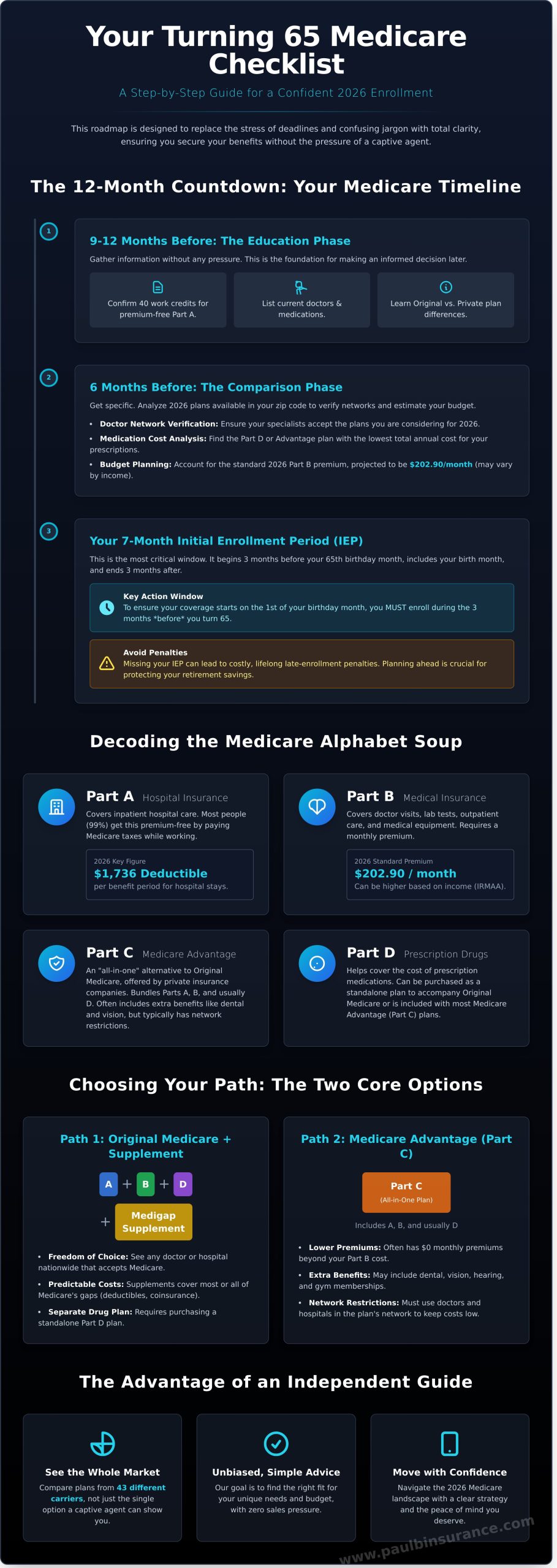
Approaching your 65th birthday in 2026 shouldn’t feel like a race against a ticking clock. We know the "crazy maze" of insurance can feel heavy, and the stack of mail on your counter probably isn’t helping. Starting your journey exactly one year before your birth month is the most effective way to replace anxiety with certainty. This 12-month window gives us plenty of time to build your personalized turning 65 medicare checklist, ensuring you don’t miss a single deadline or face a lifetime late enrollment penalty. We’re here to protect you from those costly mistakes while making the entire process feel simple and manageable.
Your Initial Enrollment Period (IEP) is the most critical timeframe you’ll encounter. It is a seven-month window that centers around your 65th birthday. It includes the three months before you turn 65, your birth month, and the three months following. If you want your healthcare coverage to begin the very first day of your birth month, you must complete your applications during that initial three-month lead-up. We’ve found that clients who wait until the last minute often feel rushed and pressured, which is exactly what we want to avoid. Our goal is to move you from confusion to confidence long before your birthday cake is even ordered.
9 to 12 Months Before: The Education Phase
The first step is simply gathering information without any pressure to sign anything. We recommend you start by reviewing your Social Security statement to confirm you have at least 40 work credits. This ensures you qualify for premium-free Part A. It is also helpful to Learn about the history of Medicare to understand how the program evolved into the four-part system we use in 2026. We help you organize your current health data, including a list of your 2025 prescriptions and the frequency of your specialist visits. We’ll also explain the core differences between staying with "Original Medicare" and choosing private alternatives, so you understand the foundation of your future coverage.
6 Months Before: The Comparison Phase
By the time you are six months away from your 65th birthday, it’s time to get specific. We’ll look at the Medicare Advantage plans available in your specific zip code for 2026. Since these plans can change their benefits and provider networks every year, looking at current 2026 data is vital. We’ll help you check if your favorite doctors and specialists are still in-network and estimate your actual monthly budget. For 2026, the standard Part B premium is projected to be approximately $202.90 per month, though this can vary based on your income. We’ll provide a clear, unbiased comparison of your options so you can see exactly how your out-of-pocket costs will look. This phase is all about clarity; we want you to know exactly how it works before you ever have to click "enroll."
To keep your transition organized, we recommend focusing on these three data points during your 2026 preparation:
-
Social Security Status: Confirming your enrollment in Part A and Part B if you are already receiving retirement benefits.
-
Doctor Network Verification: Ensuring your 2026 specialists accept the specific plans you are considering.
-
Medication Costs: Using your current dosages to find the 2026 Part D or Advantage plan with the lowest total annual cost.
By following this 12-month turning 65 medicare checklist, you’re not just signing up for insurance. You’re securing peace of mind. We act as your dedicated advocate, ensuring you’re never rushed and never pressured. When the three-month window finally opens, you won’t be guessing. You’ll be ready to move forward with total confidence in your 2026 healthcare strategy.
Understanding the Medicare Alphabet: A, B, C, and D Simplified
We know the "alphabet soup" of Medicare feels like a maze. It is easy to feel overwhelmed by the thick stacks of mail and conflicting advice from neighbors. When you are building your turning 65 medicare checklist, the first step is separating the core parts of the program from the optional add-ons. We simplify the jargon so you know exactly how it works. Our goal is to move you from confusion to confidence by breaking these down into simple, manageable pieces.
The Core: Parts A and B Explained
Medicare Part A is your hospital insurance. You have likely already paid for this through your payroll taxes over the years. For about 99 percent of seniors, the monthly premium is $0. However, it is not entirely free. In 2026, the Part A deductible is $1,736 for each benefit period. This covers the first 60 days of inpatient hospital care, but it does not cover everything. We help you understand these gaps so you aren’t surprised by a large bill after a hospital stay.
Medicare Part B handles your medical insurance. This includes doctor visits, lab tests, and medical equipment. This part requires a monthly premium. For 2026, the standard base premium is $202.90. This amount can increase if your income from two years ago was higher than $109,000 for an individual or $218,000 for a couple. This extra charge is called IRMAA. We suggest checking the Official Medicare enrollment guide to see if your current employer coverage is considered "creditable." If it is not, skipping Part B can lead to permanent late enrollment penalties that stay with you for life. We make sure you avoid those costly mistakes during your turning 65 medicare checklist process.
The Add-ons: Medicare Advantage and Part D
Parts C and D are where the real choices happen. Medicare Advantage, or Part C, is a private alternative that bundles A and B together. These plans often include dental and vision benefits. On the other hand, Medicare Part D is a standalone plan that protects you from high pharmacy costs. It is a critical piece of the puzzle for anyone taking regular maintenance medications.
The year 2026 marks a major win for seniors regarding prescription costs. The $2,100 out-of-pocket cap is now fully in effect for all Part D plans. This means once you spend $2,100 on your covered medications at the pharmacy, you will not pay a penny more for the rest of the calendar year. This change provides a massive financial safety net that helps you plan your retirement budget with much more certainty.
While Advantage plans are popular, many seniors choose to stay with Original Medicare and add a Medigap (Supplement) plan. We often recommend this route for people who travel across state lines or want total control over their healthcare providers. Unlike Advantage plans that often use restricted local networks, Medigap allows you to see any doctor in the United States who accepts Medicare. It offers a level of freedom and predictability that many of our clients find worth the monthly premium.
Choosing between these paths is the most personal part of your enrollment. If you feel stuck between two different options, we can help you find a plan that fits your lifestyle and health needs. We are here to ensure you feel protected and empowered as you start this new chapter.
The Working Senior’s Dilemma: Do You Need to Enroll at 65?
We know the pressure you feel when your 65th birthday approaches while you are still working. In 2026, nearly 26% of adults over age 65 remain in the workforce, and many of them feel trapped by the "crazy maze" of insurance rules. You don’t have to figure this out alone. Our goal is to take you from confusion to confidence by explaining exactly how your work insurance interacts with Medicare.
The first step on your turning 65 medicare checklist is determining if you have "creditable coverage." This is a specific term the government uses to describe insurance that is at least as good as Medicare. If your employer has 20 or more employees, your group health plan is generally considered primary. This allows you to delay Part B without worry. However, if your company has fewer than 20 employees, Medicare usually becomes the primary payer. If you fail to enroll in Part B in this situation, your employer plan might refuse to pay your medical claims, leaving you with 100% of the bill.
We want to help you steer clear of the lifelong 10% Part B penalty. If you don’t have creditable coverage and miss your initial enrollment window, you will pay an extra 10% on your monthly premium for every 12-month period you waited. With the projected 2026 Part B premium sitting around $202.90, a three-year delay could cost you an extra $58.65 every single month for the rest of your life. We believe your hard-earned savings should stay in your pocket, not go toward avoidable penalties.
Even if you stay on your employer plan, we often recommend enrolling in Medicare Part A. Since most people have paid Medicare taxes for at least 40 quarters, Part A usually has a $0 premium. It acts as secondary insurance, which can help cover hospital costs that your work plan might leave behind. It’s a simple way to add a safety net to your coverage at no extra cost.
Evaluating Your Employer Group Health Plan
We encourage you to compare your 2026 workplace benefits to Medicare’s costs. Many employer plans now carry annual deductibles of $3,500 or more. In contrast, the projected Medicare Part B deductible for 2026 is approximately $283. If you use a Health Savings Account (HSA), you must be careful. You need to stop all HSA contributions at least six months before you enroll in Medicare to avoid IRS tax penalties. If you plan to retire mid-year in 2026, we can help you coordinate the exact month your contributions should end.
The Special Enrollment Period (SEP)
When you finally decide to leave your job, you won’t be left without options. You will enter a Special Enrollment Period that lasts for eight months. To ensure a smooth transition, you must provide proof that you had continuous health coverage since you turned 65. This involves two specific forms: CMS-40B and CMS-L564, which your employer must sign. You can find these resources and more details on the Social Security Administration’s Medicare page. This documentation is a vital part of your turning 65 medicare checklist to ensure you aren’t charged late fees. COBRA is NOT creditable coverage for Medicare Part B.
We are here to provide the unbiased guidance you deserve. Whether you choose to stay on your work plan or transition fully to Medicare, we will make sure the process is never rushed and never pressured.
Your 5-Step Action Plan for a Smooth Enrollment
We understand that looking at a mailbox full of colorful brochures can feel like staring at a puzzle with missing pieces. Our goal is to take you from confusion to confidence by giving you a clear path forward. This 2026 turning 65 medicare checklist focuses on five simple moves that protect your health and your savings. We don’t want you to feel rushed or pressured; we want you to feel empowered.
-
Step 1: Create your "My Medicare" account. Head to the official government portal to set this up. It only takes about 10 minutes, but it serves as your digital command center. In 2026, this account is vital for tracking your $2,100 out of pocket maximum for prescription drugs, a benefit finalized by the Inflation Reduction Act.
-
Step 2: Choose your path. You’ll decide between Medicare Advantage or a Medicare Supplement plan. This is the most critical decision you’ll make, as it dictates which doctors you can see and what your monthly budget looks like.
-
Step 3: Audit your prescriptions. We’ll help you look at the 2026 formularies for every carrier. Since drug lists change every January 1, we ensure your specific medications are covered at the lowest possible tier.
-
Step 4: Secure your "Extra" benefits. Original Medicare won’t pay for your routine cleanings or new glasses. We’ll look at options to fill these gaps so a toothache doesn’t become a financial headache.
-
Step 5: Schedule an annual review. Your health needs will change, and so will insurance plans. We commit to reviewing your coverage every year during the Annual Enrollment Period to keep your plan optimized.
Choosing Your Path: Advantage vs. Supplement
Medicare Advantage plans often feature $0 monthly premiums and include "all in one" coverage. These are popular because they feel familiar, like the insurance you had through an employer. However, they usually require you to stay within a specific network of doctors. Medicare Supplement plans, on the other hand, allow you to visit any doctor in the country who accepts Medicare. While Supplements have a higher fixed monthly cost, they offer total freedom and predictable expenses. We act as your independent broker, comparing 42 different carriers to see which path aligns with your lifestyle and budget.
Closing the Gaps: Dental, Vision, and Hearing
It surprises many of our clients to learn that Original Medicare leaves your teeth, eyes, and ears unprotected. In 2026, the average cost of a single dental crown can exceed $1,500, which is a steep price to pay out of pocket. Many modern Advantage plans bundle these extras onto a single debit card for easy use. If you choose a Supplement path, we often recommend standalone dental insurance plans to ensure you aren’t left vulnerable. We simplify the jargon so you know exactly how these benefits work before you ever sit in a dentist’s chair.
The "crazy maze" of Medicare doesn’t have to be your reality. We are here to provide the unbiased guidance you deserve to make an informed choice. If you’re ready to stop the guessing game, schedule a call with Paul today and let’s build your personalized plan together.
Navigating the 2026 Medicare Landscape with Confidence
Turning 65 in 2026 means you’re entering the Medicare system at a historic moment. The Inflation Reduction Act has finally capped out-of-pocket prescription costs at $2,100 for the year, providing a massive safety net that didn’t exist for your older siblings or friends. While this is great news, it also means plan structures have changed significantly to account for these new rules. We don’t want you to feel buried under the mountain of mailers and constant "final notice" postcards filling your mailbox. Our team at The Modern Medicare Agency takes a different path; we listen to your specific health history and financial goals before we ever mention a specific plan name.
Captive agents work for the big insurance companies, not for you. If an agent is "captive," they can only show you plans from the one company that signs their paycheck. It’s like going to a car dealership that only sells trucks when what you really need is a fuel-efficient hybrid. We think you deserve to see every option available in your zip code. We compare the 40+ plans available in your area to find the one that actually fits your life. Our promise is simple: we provide a lifetime of support. We’ll be here to help you when your doctor leaves a network or when your medication tier changes in 2027 or 2028.
The Power of an Independent Broker
We act as your personal advocate in a system that often feels designed to confuse you. Instead of you spending 20 hours researching Part B premiums or the 2026 deductible changes, we do the heavy lifting. We simplify the jargon so you can make an empowered choice without feeling rushed. Our services are 100% free to you because the carriers compensate us directly. This allows us to remain unbiased and focused entirely on your needs. We’ve helped over 5,300 seniors find peace of mind, and we’re ready to do the same for you.
Our goal is to ensure you never feel like just another policy number in a giant corporate database. We take the time to explain how your Supplement or Advantage plan works in plain English. You’ll know exactly what you’ll pay at the pharmacy and the doctor’s office before you ever sign a form. We believe that clarity is the best cure for the anxiety that comes with this transition. You deserve an expert who is never rushed and never pressured to meet a sales quota.
With your healthcare plan confidently in place, you can turn your attention to personal projects, like creating a beautiful display of family photos and memories. For custom framing that honors those moments, many seniors trust the craftsmanship of Modern Memory Design.
Your Next Steps to Peace of Mind
Ready to stop the guessing game? You can move from confusion to confidence in 30 minutes or less by speaking with a professional who has seen it all. This turning 65 Medicare checklist is your roadmap to avoiding the common traps that catch many new retirees off guard, such as the 10% lifetime late enrollment penalties. We’ve designed our process to be as smooth as possible so you can focus on enjoying your retirement rather than worrying about medical bills.
Our team is here to guide you through every checkmark on your turning 65 Medicare checklist. Start by downloading our printable 2026 guide, then schedule your "No-Pressure" strategy session with Paul or one of our expert advisors. We’ll look at your current prescriptions, your preferred doctors, and your travel plans to build a strategy that works for your unique lifestyle. Let’s make your transition to Medicare the easiest part of your 65th year.
Take the Next Step Toward Your 2026 Medicare Security
Navigating the 2026 Medicare landscape doesn’t have to feel like a maze. We’ve mapped out your timeline and clarified how Parts A, B, C, and D work together to protect your health. Whether you’re staying at your job or retiring this year, following a clear turning 65 Medicare checklist helps you avoid the lifetime 10% Part B penalty. We believe you deserve unbiased guidance from an independent advocate who looks at options from 40+ insurance carriers. We’re licensed in over 34 states to ensure you get the right fit for your specific health needs. Our zero-cost, no-pressure consultations are designed to remove the stress from your enrollment transition. You don’t have to guess which plan is best or worry about missing a critical deadline. We’re here to simplify the jargon so you can move forward with total peace of mind. Schedule a Call With Paul: From Confusion to Confidence. You’ve worked hard for this milestone; let’s make sure your healthcare is ready for it.
Frequently Asked Questions
When is the exact date I should sign up for Medicare if I turn 65 in 2026?
You should sign up during your Initial Enrollment Period, which begins three months before the month you turn 65 in 2026. If your birthday is June 15, 2026, your window opens March 1 and closes September 30. We help you use a turning 65 Medicare checklist to track these specific dates. This ensures you have a July 1 start date and avoid any gaps in your medical protection.
What is the Part B penalty, and how can I avoid it?
The Part B penalty is a permanent 10 percent increase to your monthly premium for every 12 month period you lacked coverage. You can avoid this cost by enrolling on time or proving you have creditable coverage from an employer with 20 or more workers. We make sure your paperwork is filed correctly to protect your budget. This simple step prevents you from paying extra for the rest of your life.
Can I keep my current doctor when I switch to Medicare?
You can keep your doctor if they accept Medicare and you choose a plan that allows you to see them. About 98 percent of providers currently accept Original Medicare across the country. If you pick a Medicare Advantage plan, you must stay within a specific network to keep your costs low. We check your specific doctors against every 2026 plan to ensure you stay with the team you trust.
How much will Medicare cost me per month in 2026?
The standard Part B premium for 2026 is $202.90 per month for most beneficiaries. Your specific cost might be higher if your individual income from two years ago exceeded $109,000. We look at your unique financial situation to help you plan for these monthly expenses. This includes calculating any extra surcharges so you can transition into retirement with total financial confidence and no surprises.
What is the difference between Medicare Advantage and Medigap?
Medigap plans work alongside Original Medicare to pay for the 20 percent coinsurance that Medicare leaves behind. Medicare Advantage is a private alternative that bundles your hospital, medical, and often drug coverage into one plan. Using a turning 65 Medicare checklist helps you decide if you prefer the fixed monthly costs of Medigap. We simplify these choices so you can pick the path that feels right for you.
Do I need to sign up for Medicare if I am still covered by my spouse’s work plan?
You don’t need to sign up yet if your spouse’s employer has 20 or more employees and the coverage is primary. If the company has 19 or fewer workers, Medicare usually becomes your primary insurance at age 65. We recommend requesting a creditable coverage notice from the benefits department today. This document proves you can safely delay enrollment without facing late penalties when you eventually retire.
What are the major Medicare changes for 2026 that I should know about?
A major change for 2026 is the full implementation of the $2,100 out of pocket spending cap for prescription drugs under Part D. This new limit protects you from unlimited pharmacy costs. We also see updated income brackets for 2026 that determine if you’ll pay an extra surcharge. Staying informed about these 2026 updates helps us find the most cost effective plan for your specific health needs.
Is dental and vision coverage included in Original Medicare?
No, Original Medicare does not cover routine dental cleanings, vision exams, or eyeglasses. You’ll need to purchase a separate stand alone policy or choose a Medicare Advantage plan that includes these extra benefits. We can show you 15 different options that provide the coverage you need for your teeth and eyes. This ensures you aren’t surprised by expensive bills when you visit the dentist or optometrist in 2026.

Article by
Paul Barrett
Paul Barrett, CMIP is the founder of The Modern Medicare Agency, an independent Medicare-only brokerage based in Melville, NY. With 18 years of Medicare-exclusive experience, a CMIP designation, and more than 5,000 clients served across 37 states, Paul is one of the most credentialed independent Medicare specialists on Long Island — and one of the most direct.
He represents 40+ carriers with no quotas and no allegiances, which means his recommendations are based entirely on what fits each client's specific situation. He is the author of Medicare Mastery Unlocked and host of the Wise Guys Retirement Talk podcast. His content is grounded in primary sources, real carrier intelligence, and 18 years of watching what happens when people get Medicare right — and when they don't.
📞 631-358-5793 | paulbinsurance.com