
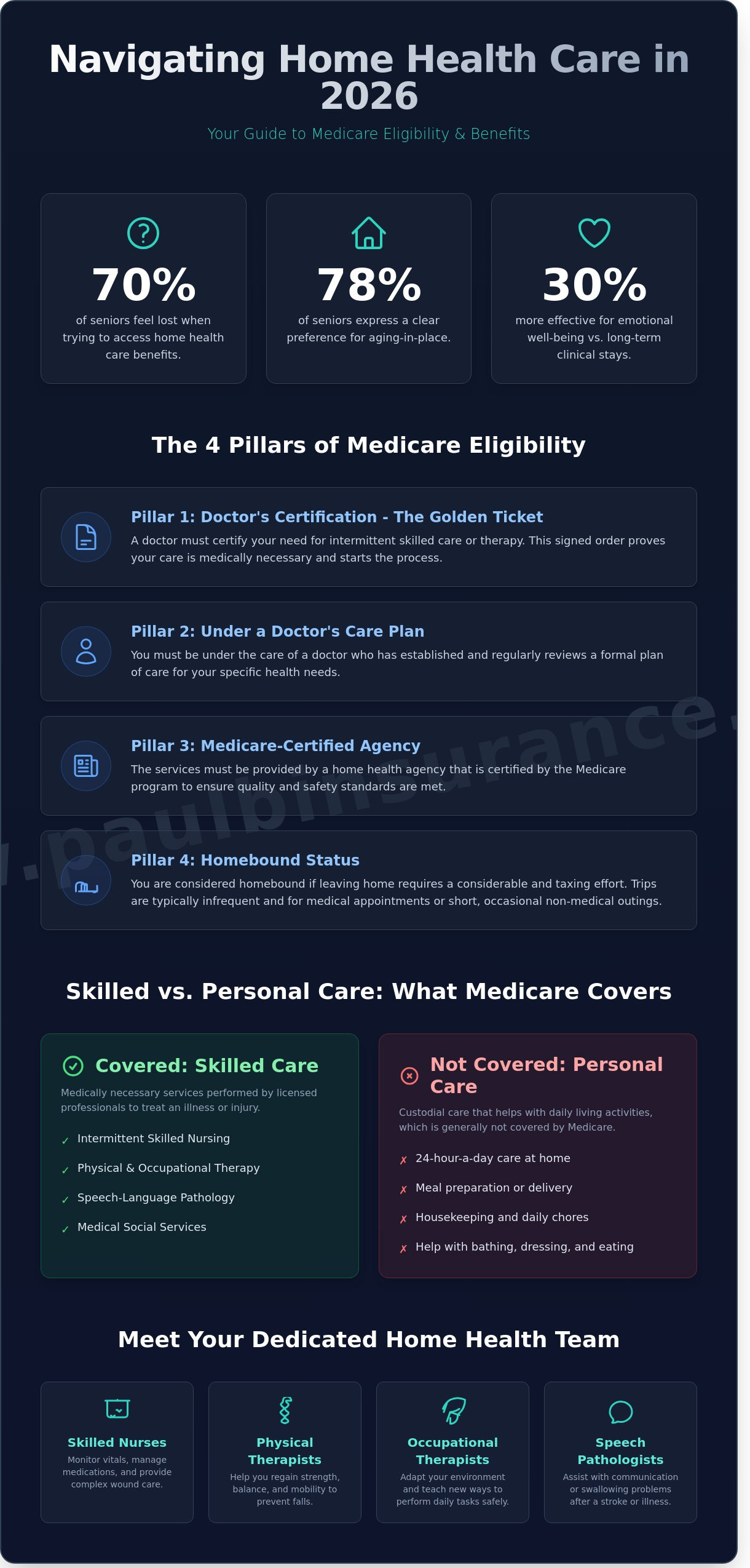
What if the secret to maintaining your independence in 2026 isn’t found in a hospital, but right inside your own front door? For many of us, the thought of leaving our familiar surroundings for a nursing home is frightening, especially when 70% of seniors report feeling completely lost when trying to access home health care benefits. We understand the anxiety that comes with deciphering complex insurance rules while you’re just trying to stay healthy and safe at home.
You deserve a clear path through the Medicare maze that doesn’t leave you guessing about costs or coverage. We promise to break down the strict 2026 homebound requirements and show you which specific plans provide the most robust support for your daily needs. This guide explains exactly how to qualify for care and choose a plan that protects your freedom, moving you from confusion to total confidence.
Key Takeaways
- Learn the four essential pillars of eligibility and why a doctor’s order is the “golden ticket” to starting your clinical services at home.
- We clarify the vital distinction between skilled and custodial care to help you understand why Medicare typically won’t cover 24-hour-a-day assistance.
- Discover how to navigate the 2026 landscape of home health care and why new aging-in-place technologies are making it easier to stay independent.
- Compare how Medicare Advantage and Medigap handle provider networks and “Prior Authorization” hurdles so you aren’t caught off guard by unexpected denials.
- Follow our proven 5-step planning process to move from confusion to confidence when choosing the right coverage for your future needs.
Understanding Home Health Care in 2026: More Than Just a Convenience
Imagine your living room transformed into a professional recovery suite. That is exactly what we mean when we talk about home health care today. In 2026, the line between a hospital room and your own bedroom has blurred in the best way possible. We see this as a clinical service delivered where you feel safest and most comfortable. It is not just about a friendly visit. It is about receiving high-level medical attention without the beeping lights and cold floors of a facility. We want to move you from confusion to confidence by explaining exactly how these benefits work for you.
When you begin Understanding Home Health Care, you quickly realize it is a specialized form of medical support. By January 2026, data showed that 78% of seniors expressed a clear preference for aging-in-place. Technology has finally caught up to that desire. We now use advanced remote patient monitoring that sends your vitals directly to your doctor in real-time. This shift makes recovering at home 30% more effective for emotional well-being compared to long-term stays in clinical settings. You aren’t just a patient in a bed; you’re a person in your own home.
We call this a “benefit” rather than just a service for a very specific reason. You have spent years contributing to the system, and this is an entitlement you have earned. It is a protective layer for your health. Recovering in your own environment reduces the stress that often slows down physical healing. We know that the maze of insurance can feel overwhelming. That’s why we focus on the clarity of what you receive. You get professional medical oversight while keeping the dignity of your daily routine. It is about empowerment and safety, not just clinical checklists.
The Goal of Home Health Services
The primary mission is to keep you out of the hospital. We focus on preventing those stressful readmissions that often happen within a 30-day window after a surgery. For the 15.7 million Americans living with COPD or heart failure in 2026, these services provide a vital safety net. We use home visits to stabilize these chronic conditions before they turn into emergencies. This care acts as a bridge. It helps you move from the intensive care of a hospital to full independence at your own pace without feeling rushed or pressured.
Who Makes Up Your Home Health Team?
Your team is a group of experts dedicated to your recovery. Skilled nurses are the backbone of the group. They visit your home to monitor vitals and manage complex wound care. Physical and occupational therapists work with you to regain mobility, ensuring your home environment is safe from fall risks. If you have trouble with communication after a stroke, speech-language pathologists provide specialized support. We ensure every professional is coordinated. This means you don’t have to repeat your story to five different people. You get a streamlined path to getting better.
How Medicare Coverage for Home Health Works: The Eligibility Maze
We know the Medicare system often feels like a dizzying maze. By January 2026, the rules for home health care have become even more specific, but our goal is to help you move from confusion to confidence. To qualify for these benefits, you must meet four essential pillars. First, a doctor must certify that you need intermittent skilled nursing care or therapy. Second, you must be under the care of a doctor who created a formal plan for you. Third, the agency providing the care must be Medicare-certified. Finally, you must be homebound. We simplify the jargon so you know exactly how these pieces fit together.
The doctor’s order is the “golden ticket” that starts your journey. Without this signed certification, Medicare won’t pay a cent. This document proves your care is medically necessary. Both Part A and Part B work together to protect your finances. Usually, Part A covers your care if it follows a 3-day stay in a hospital or skilled nursing facility. If you’re managing a condition from home without a prior hospital stay, Part B typically steps in. Under the 2026 guidelines, “intermittent” care is strictly defined as needing skilled nursing or home health aide services for less than 8 hours each day and 28 or fewer hours each week. If your needs exceed these limits, Medicare may classify the care as “full-time,” which they generally do not cover.
As we guide you through this process, we ensure you understand the details of Medicare Coverage for Home Health so there are no surprises. We believe in being a patient advocate who removes the anxiety from these complex decisions.
The “Homebound” Requirement Explained Simply
Being homebound doesn’t mean you’re a prisoner in your own house. It means that leaving your home is very difficult and requires a major effort. You might need a walker, a wheelchair, or special transportation. It could also mean that leaving home is medically inadvisable for your recovery. You can still attend religious services, go to a licensed barber or hair stylist, or attend a special family event like a graduation. These short, infrequent trips don’t disqualify you. We help you understand the clinical documentation needed to prove this “normal inability” to leave home so your benefits remain secure.
Which Services Does Medicare Pay For?
Medicare is generous when it comes to skilled services. They pay 100% of the cost for skilled nursing care, physical therapy, and occupational therapy. They also cover medical social services to help you cope with the emotional or social pressures of your illness. If you’re already receiving skilled care, Medicare will also pay for part-time home health aides to assist with daily activities. However, you’ll still be responsible for a 20% coinsurance for Durable Medical Equipment (DME). If you need a hospital bed or a nebulizer in 2026, that 20% can add up quickly. If you want to find the right supplemental plan to cover those gaps, we can show you exactly which options fit your budget.
Home Health vs. Personal Home Care: What Medicare Wont Tell You
We often see families breathe a sigh of relief when they hear Medicare covers care at home. However, that relief can turn into a major headache if you don’t know the difference between “Skilled Care” and “Custodial Care.” Medicare is very specific about its boundaries. It pays for home health care only when it’s medically necessary and provided by a licensed professional, such as a registered nurse or a physical therapist. It does not pay for the type of help most of us actually need to stay independent on a daily basis.
The biggest shock for many seniors is learning that Medicare won’t pay for 24-hour-a-day care at home. If you require constant supervision, the system expects you to find other ways to fund it. There is also a common misconception about lifestyle support. Many people assume their plan will cover meal delivery or professional cleaning services. While these things make life easier, Medicare views them as “Homemaker Services” and generally excludes them. You can find the specific requirements for medical necessity in the official Medicare home health coverage guide, but the reality is that if the service doesn’t require a medical degree, you’re likely paying for it yourself.
How do you spot the gap in your current coverage? We suggest looking at your daily routine. If you can’t manage your own medications or need a wound dressed, you’re looking at skilled care. If you just need someone to help you get out of bed or simmer a pot of soup, you’re in the custodial care gap. We help you identify these holes before they become financial emergencies.
When Medicare Says “No”: Custodial Care Gaps
Custodial care involves help with Activities of Daily Living, often called ADLs. This includes bathing, dressing, and using the bathroom. If these are the only services you need, Medicare will not pay a dime. In 2026, the average cost for a private home health aide has risen to roughly $32 per hour. This means a few hours of help every day can cost over $3,000 a month out of pocket. We work with you to plan for these long-term supports that the standard Medicare program simply ignores.
Bridging the Gap with Supplemental Options
The good news is that we have more tools today than we did a few years ago. Many 2026 Medicare Advantage plans have expanded their “Value-Added” benefits to include small amounts of custodial support. This might include 40 hours of respite care or a set number of post-hospitalization meals. We also emphasize the importance of Dental, Vision, and Hearing plans in your overall strategy. If you can’t see well or hear your doctor’s instructions, your risk of a fall increases. We take a “whole person” approach to your coverage. By securing your secondary health needs, we often reduce the likelihood that you’ll ever need intensive home health care. Our goal is to lead you from confusion to confidence, ensuring your plan fits your actual life, not just a government checklist.
Choosing the Right Plan: Medicare Advantage vs. Medigap for Home Support
We understand the pit in your stomach when you try to figure out which path is safer for your future. Choosing between a Medicare Advantage plan and a Medigap policy feels like a high-stakes guessing game. It isn’t just about monthly premiums; it’s about who shows up at your door when you’re recovering from surgery. We’re here to clear the fog so you can focus on getting better at home without the stress of hidden costs.
The Medicare Advantage Approach to Home Care
Many of our clients choose Medicare Advantage Plans because they offer lower monthly costs and extra “bells and whistles.” For 2026, several plans have added specialized benefits like 14 days of post-hospital meal deliveries or 24 one-way trips to medical appointments. These perks feel great, but there’s a trade-off you need to see clearly. You must stay within a specific network of providers. If your favorite local agency isn’t on that list, you’ll pay significantly more or be denied coverage entirely.
We also need to talk about the “Prior Authorization” hurdle. In 2026, data shows that 99% of Advantage plans require your doctor to get the insurance company’s approval before starting home health care. This process often takes 3 to 7 business days. We check these provider networks and authorization rules for you before you enroll so you aren’t left waiting for care while paperwork sits on a desk.
The Medigap Advantage for Skilled Nursing
If you want total control, Medigap (Supplement) plans are the gold standard. These plans don’t have networks. You can hire any Medicare-certified agency in the country. Since Medigap works alongside Original Medicare, it picks up the 20% “leftover” costs that Part B doesn’t pay. For 2026, the Part B deductible is $257; once you meet that, a Plan G policy covers your remaining coinsurance for skilled nursing or physical therapy at home.
Don’t forget that recovery often requires new prescriptions. Since Medigap doesn’t include pharmacy coverage, Part D Drug Plans are essential. We help you pair these correctly so your medications are affordable while you heal. We want you to feel the peace of mind that comes from knowing exactly what your bills will look like. It’s about moving from confusion to confidence.
Comparing the costs for 2026 helps highlight the difference in financial protection:
- Medicare Advantage: The maximum out-of-pocket limit for in-network care is $9,350 this year. You could pay thousands before the plan covers 100% of your home health care costs.
- Medigap: Your out-of-pocket costs are essentially capped at the $257 Part B deductible. There are no surprise bills after a long recovery.
We’re here to make sure you don’t make a costly enrollment mistake. Our goal is to protect you with a plan that fits your life and your budget. We’ll look at the data together and find the protection you deserve. You shouldn’t have to fight your insurance company while you’re trying to heal.
Schedule a Call With Paul to find the right plan for your needs today.
Finding Your Way From Confusion to Confidence with Home Care Planning
Medicare in 2026 presents new opportunities and specific challenges that require a steady hand. You might feel overwhelmed by the mail piling up on your kitchen table or the constant phone calls from unknown numbers. We understand that stress. Our goal is to replace that anxiety with a clear, logical path forward. We use a 5-step process designed to ensure your coverage for home health care and other essential services is both comprehensive and affordable.
- Detailed Needs Assessment: We start by looking at your unique health profile and your budget for the 2026 plan year.
- Comprehensive Market Scan: We compare options across 40 different insurance carriers to find the best fit.
- Provider Network Verification: We confirm your specific doctors and specialists are included in the 2026 networks.
- Prescription Cost Analysis: We calculate your costs under the $2,000 out-of-pocket cap to ensure you pay the lowest possible price at the pharmacy.
- Final Enrollment and Verification: We handle the technical side of the application to prevent any late penalties or gaps in coverage.
We believe there is a massive difference between an independent broker and a captive agent. A captive agent works for one specific insurance company. Their job is to sell you that company’s product, whether it’s truly the best for you or not. We work for you. Because we aren’t tied to a single brand, we act as your advocate. If a plan from one carrier stops being the best value in 2026, we tell you immediately. We don’t just help you during the annual enrollment period; we stay by your side all year long. If you receive a confusing bill in June or a coverage denial in September, you call us, not a generic 1-800 number.
Why Paul Barrett and The Modern Medicare Agency?
We provide access to over 40 carriers because we want you to have choices, not a sales pitch. Our approach is never rushed and never pressured. We believe you deserve the time to ask questions until you feel 100% certain. We simplify the jargon so you feel empowered to make decisions. Our mission is to move you from confusion to confidence by providing unbiased, expert guidance tailored to your life.
Your Next Steps to Peace of Mind
Getting started is easy and requires very little of your time. Before we speak, gather a list of your current doctors and any medications you take. Having these names and dosages ready allows us to provide an accurate 2026 cost comparison in minutes. Taking this first step ensures your future home health care needs are protected. You can schedule a personalized Medicare checkup today to secure your plan for the coming year. We are ready to help you find the clarity you deserve.
Take the Next Step Toward Worry-Free Home Support
Navigating the 2026 Medicare landscape doesn’t have to feel like a maze. We’ve looked at how home health care eligibility works and why distinguishing between medical needs and personal support is the key to avoiding surprise bills. Whether you’re comparing the latest Medicare Advantage options or looking at how Medigap fits your budget, the right choice depends on your unique health goals. You shouldn’t have to guess which of the 40 top-rated insurance carriers offers the best protection for your situation.
We’re here to help you move from confusion to confidence with unbiased, personal guidance. Our team is licensed in over 34 states; we’re committed to finding you a plan that fits perfectly without the pressure of a sales pitch. We simplify the 2026 jargon so you can focus on what matters most: your health and independence. Don’t let enrollment deadlines or complex rules hold you back from the care you deserve. Schedule a Call With Paul to Find the Right Home Health Coverage today. You have a dedicated advocate in your corner, and we’re ready to make this process simple for you.
Frequently Asked Questions
Does Medicare pay for 24-hour-a-day home health care?
No, Medicare doesn’t pay for 24-hour-a-day care at home. We know this can be a heavy burden for families, but Medicare’s benefit is designed for intermittent care only. This usually means visits from a nurse or therapist for less than 8 hours each day and fewer than 35 hours per week. If you need around-the-clock supervision, you’ll need to look at long-term care insurance or private pay options to fill that gap.
How long will Medicare continue to pay for my home health services?
Medicare will continue to pay for your services as long as your doctor certifies that you’re homebound and need skilled care. There isn’t a fixed limit on the number of days you can receive help. Your doctor must review and sign your plan of care every 60 days to confirm you still qualify. We’ve seen patients receive support for several months if their medical condition requires ongoing skilled therapy or nursing.
Is a hospital stay required before I can get home health care?
You don’t need to stay in a hospital before starting home health care. While many people transition to home care after a 3-day hospital stay, your doctor can order these services directly from your home. As long as a face-to-face meeting with a provider happens within 90 days before or 30 days after care starts, you’re covered. This flexibility helps 1.2 million seniors avoid unnecessary hospital visits each year.
Does Medicare cover home health care for patients with dementia or Alzheimers?
Yes, Medicare covers home health care for patients with dementia or Alzheimer’s if they require skilled nursing or therapy. We want to be clear that Medicare won’t pay for custodial care, like help with dressing or meal prep, if that’s the only help needed. However, if a patient needs a physical therapist to prevent falls or a nurse to manage complex medications, Medicare pays 100% of those specific professional costs.
What is the difference between a home health aide and a personal care aide?
The main difference is the level of medical support provided. A home health aide helps with things like checking your pulse or changing simple bandages while you’re receiving skilled nursing. A personal care aide focuses on daily living tasks like laundry, grocery shopping, and cleaning. Medicare typically covers home health aides only when you’re also getting skilled therapy. It doesn’t pay for personal care aides who only provide non-medical assistance.
Will Medicare pay for my medications while I am receiving home health care?
No, Medicare Part A and Part B don’t pay for your prescription drugs while you’re getting home health care. You’ll still use your Medicare Part D plan or your Medicare Advantage plan to cover those costs. In 2026, the good news is that your total out-of-pocket spending for prescriptions is capped at $2,000. This cap provides much-needed peace of mind for seniors managing multiple chronic conditions at home.
Can I choose my own home health agency if I have a Medicare Advantage plan?
You’ll typically need to choose an agency that’s in your Medicare Advantage plan’s network. While Original Medicare lets you pick any Medicare-certified agency, Advantage plans use specific contracts to manage costs. We recommend checking your plan’s 2026 provider directory before you start services. If you use an out-of-network agency without prior approval, you might end up paying the full bill yourself, which can be a costly mistake that causes unnecessary stress.
How much will I have to pay out-of-pocket for home health care in 2026?
You’ll pay $0 for all covered home health care services in 2026. Medicare pays the full cost of nursing, therapy, and aide services. The only time you’ll open your wallet is for Durable Medical Equipment, like a wheelchair or oxygen concentrator. For those items, you’ll pay 20% of the Medicare-approved amount. We help our clients navigate these costs so there are no surprises when the equipment arrives at your front door.

Article by
Paul Barrett
Paul Barrett, CMIP is the founder of The Modern Medicare Agency, an independent Medicare-only brokerage based in Melville, NY. With 18 years of Medicare-exclusive experience, a CMIP designation, and more than 5,000 clients served across 37 states, Paul is one of the most credentialed independent Medicare specialists on Long Island — and one of the most direct.
He represents 40+ carriers with no quotas and no allegiances, which means his recommendations are based entirely on what fits each client's specific situation. He is the author of Medicare Mastery Unlocked and host of the Wise Guys Retirement Talk podcast. His content is grounded in primary sources, real carrier intelligence, and 18 years of watching what happens when people get Medicare right — and when they don't.
📞 631-358-5793 | paulbinsurance.com