




Last Tuesday, a woman named Elena visited our office feeling deeply anxious because she believed her lack of a 10-year U.S. work history meant she had no healthcare options for 2026. We see this often. It’s easy to feel overwhelmed by a system that seems to speak a different language. We agree that the rules feel like a maze, and the fear of high premiums is a heavy burden to carry alone. You likely worry that the 5-year continuous residence rule or the recent 2025 law changes might leave you unprotected, but you don’t have to face these questions without a guide.
We’re here to simplify the jargon so you can understand medicare eligibility for green card holders with total clarity. We’ll explain the specific work credit requirements, how the “buy-in” costs are calculated, and how the 2025 legislation actually made it easier for you to secure your benefits. This guide outlines a clear, step-by-step path to enrollment so you can move from a state of confusion to a place of confidence. Let’s look at exactly what you need to do to protect your health and your peace of mind this year.
Key Takeaways
- We simplify the 5-year continuous residency requirement so you can confirm your medicare eligibility for green card holders without the stress of guessing.
- Understand the role of work credits and how you can still secure essential coverage even if you haven’t worked in the U.S. for 10 years.
- Navigate the updated 2026 premium costs for buying into Medicare Part A and B, giving you a clear and predictable financial path forward.
- Learn how to time your enrollment perfectly during your 7-month window to protect yourself from costly lifetime penalties.
- Discover how to move from confusion to confidence by exploring plans that offer extra benefits like dental, vision, and hearing.
Understanding Medicare Eligibility for Green Card Holders in 2026
Moving to a new country is a massive life event that brings a mix of excitement and deep-seated worry. We know that trying to understand a new healthcare system can feel like wandering through a crazy maze. You might feel overwhelmed by the paperwork and the rules, but you don’t have to face this alone. We’re here to help you move from confusion to confidence. Many people assume that the Medicare program is reserved strictly for U.S. citizens. That’s a common myth that causes unnecessary stress. In reality, green card holders have very clear and protected pathways to high-quality healthcare coverage.
As we look at the rules for 2026, it’s helpful to understand how we got here. In late 2025, federal regulations were updated to solidify who qualifies for these benefits. While these changes made things stricter for some temporary visa holders, they firmly protected the rights of Lawful Permanent Residents (LPRs). Our goal is to provide the unbiased guidance you need to make sense of these rules. We simplify the jargon so you know exactly how it works, ensuring you feel secure and protected as you plan your future in the United States.
The Basic “5-Year Rule” Explained
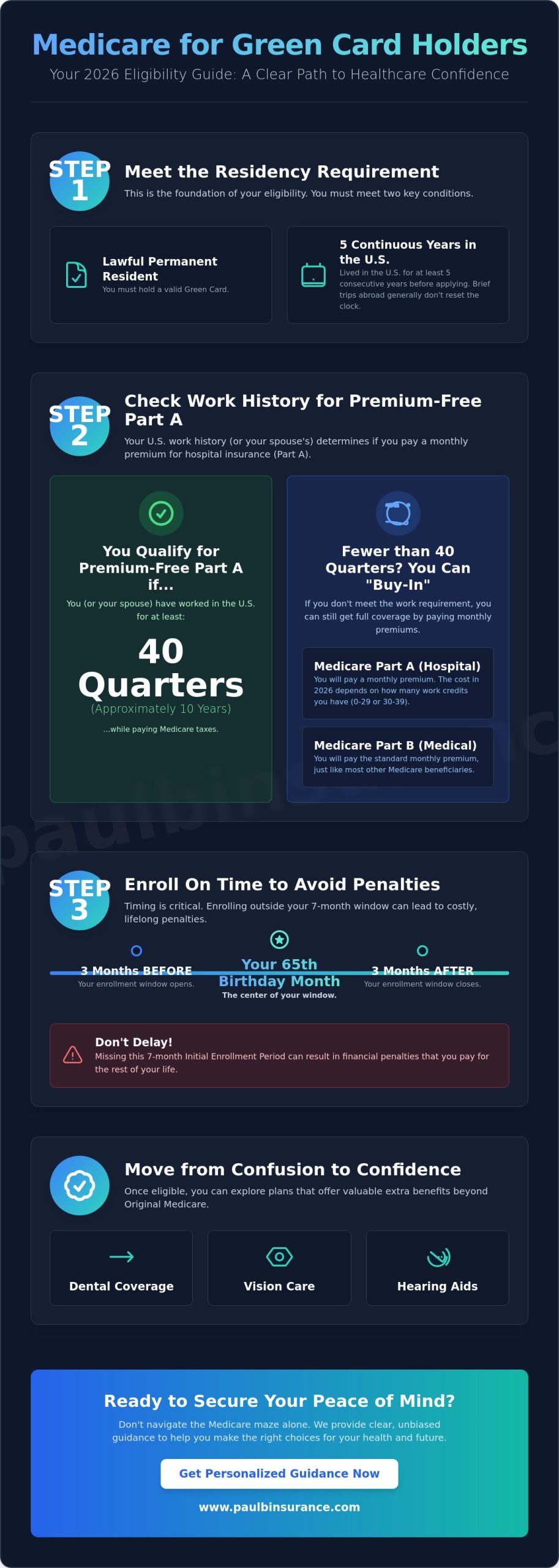
The most important factor in medicare eligibility for green card holders is what we call the five-year rule. To qualify for coverage, you must have lived in the United States as a Lawful Permanent Resident for at least five continuous years immediately before you apply. Social Security defines “continuous residence” as making the U.S. your primary home. We often get asked if visiting family back home will reset this clock. The answer is usually no. Brief trips abroad for vacations or family visits don’t typically break your residency. As long as you haven’t stayed away long enough for the government to decide you’ve abandoned your status, your five-year progress remains safe. Simply put, the five-year rule requires you to live in the U.S. as a Lawful Permanent Resident for five consecutive years before you can enroll in Medicare.
Who is Eligible Under the 2025 Law Changes?
The landscape shifted slightly with the implementation of new laws in late 2025. While the system became more complex for some, Green Card holders and Cuban-Haitian entrants remain fully eligible once they meet the residency requirements. It’s vital to stay informed because some other “lawfully present” statuses that were accepted in previous years no longer grant the same access in 2026. We want to help you steer clear of costly enrollment mistakes and late penalties that can last a lifetime. Our team acts as a dedicated advocate and educator, ensuring you have the facts. We’ve simplified these details in our Medicare Eligibility Explained guide to help you see exactly where you stand. We take a methodical approach so you’re never rushed and never pressured while making these vital decisions.
The Role of Work History: 40 Quarters and Premium-Free Part A
Most people think of Medicare as a benefit that simply appears when they turn 65. For many, the ability to get Part A without paying a monthly premium depends on “work credits.” You earn these credits by working in the United States and paying Medicare payroll taxes. In 2026, the rule remains that you generally need 40 quarters of coverage, which equals about 10 years of work, to qualify for premium-free Part A. This is a foundational part of understanding medicare eligibility for green card holders.
We see many seniors who feel a deep sense of frustration when they realize their hard work in another country doesn’t count toward these 40 quarters. It feels like starting over from zero when you are already at a stage of life where you want to relax. We understand that stress. It is a heavy burden to move to a new place and realize the safety net you expected has specific entry requirements. Our goal is to move you from that state of confusion to a place of total confidence.
The system tracks these credits through your Social Security record. Each year, you can earn up to four credits based on your total earnings. By the time 2026 arrived, the earnings threshold for a credit had adjusted slightly, but the 40-quarter target stayed the same. If you haven’t reached that 10-year mark yourself, don’t worry. There are other paths available to ensure you get the coverage you need. Knowing the Medicare eligibility rules for lawful permanent residents is the first step in finding your specific solution.
Qualifying Through Your Spouse
If you have zero US work credits, you might still qualify for premium-free Part A through your spouse. This is a huge relief for many families. To do this, you must be at least 65 years old. Your spouse must be at least 62 and have earned their 40 quarters of work. You also need to have been married for at least one year before applying. This rule allows many green card holders to access the same benefits as long-term residents without having to work another decade in the US.
What Happens if You Have Fewer Than 40 Quarters?
If neither you nor your spouse has the 40 quarters, you can still get Part A, but you will have to “buy in” by paying a monthly premium. The cost depends on how many credits you actually have. For those with 30 to 39 quarters, the premium is reduced. If you have fewer than 30 quarters, the cost is higher. We help families calculate these specific 2026 costs so there are no surprises when the bill arrives. Since these premiums can be high, we often look at Medigap options to help manage your out-of-pocket expenses once you are enrolled. We can sit down together and look at your specific history to find the most affordable path forward.
Buying Into Medicare: Costs for New Residents
We understand how overwhelming it feels to look at your work history and worry that you won’t qualify for health coverage. If you haven’t worked in the U.S. for at least ten years, you don’t have to go without protection. You have the option to “buy into” the system. This means you pay a monthly premium for the same coverage others receive through their payroll taxes. Learning how green card holders can qualify for Medicare through this buy-in process is a vital step toward your peace of mind. We simplify the jargon so you know exactly how it works and what to expect for your budget.
The Cost of Part A and Part B in 2026
For 2026, the costs for Medicare are structured clearly. Most people pay a standard premium for Part B, which covers your doctor visits and outpatient services. The 2026 standard monthly premium for Medicare Part B is estimated at $196.70. You must enroll in Part B even if you are buying into Part A. If you have zero work credits in the U.S., the full Part A premium for 2026 is projected to be $538.00 per month. If you have earned between 30 and 39 work credits, that cost drops to approximately $296.00. We want you to be aware that these rates change every January. Most of our clients pay the standard Part B rate, but if your individual income is over $109,000, your premium might be higher due to federal income adjustments. We can help you determine your exact costs so there are no surprises when your bill arrives.
The 5-Year Residency Requirement for Buying In
To access these buy-in options, the five-year continuous residence rule is still the primary factor for medicare eligibility for green card holders. If you turn 65 in 2026 but moved to the U.S. in 2023, you still have two years of waiting ahead of you. This gap can feel scary, but you have options. We often suggest looking at ACA Marketplace plans as a bridge. These plans provide essential coverage so you aren’t left unprotected while you wait for your five-year anniversary. Once you hit that milestone, we can help you transition into Medicare smoothly. This careful timing helps you steer clear of costly enrollment mistakes and late penalties that could follow you for years. Our goal is to move you from confusion to confidence by planning these steps well in advance.
How to Enroll: Timing and Avoiding Penalties
Missing your enrollment window isn’t just a headache; it’s a mistake that can follow you for the rest of your life. For most people, the Initial Enrollment Period (IEP) is a seven-month window that starts three months before you turn 65 and ends three months after your birthday month. However, medicare eligibility for green card holders adds a unique layer to this timeline. If you haven’t lived in the United States for five years by your 65th birthday, your personal enrollment window actually begins the very month you hit that five-year residency anniversary.
We see many people feel overwhelmed by these dates, but we’re here to help you track them with precision. Waiting too long triggers the Part B Late Enrollment Penalty. This isn’t a one-time fine. It’s a 10% increase in your monthly premium for every 12-month period you were eligible but didn’t sign up. In 2026, with healthcare costs continuing to rise, these extra costs add up quickly. We want to protect your hard-earned savings by getting you enrolled at the exact right moment.
Your Enrollment Window Checklist
- Step 1: Determine your start date. Pinpoint whether your window opens at age 65 or on your five-year residency anniversary.
- Step 2: Contact the Social Security Administration (SSA). You can start your application online or at a local office. In 2026, most residents find the online portal is the fastest way to get a timestamp on their application.
- Step 3: Gather your documents. You’ll need your Green Card (Form I-551) and proof that you’ve lived in the U.S. continuously for the last 60 months.
- Step 4: Consult with an independent broker. Once your basic Medicare is set, we can help you compare Medigap plans to fill the gaps that Part A and B leave behind.
Special Enrollment Periods for New Residents
You don’t always have to wait for the General Enrollment Period that runs from January to March each year. If you’re currently covered by a plan through the Health Insurance Marketplace and that coverage ends, you likely qualify for a Special Enrollment Period (SEP). This allows you to sign up for Medicare without waiting for the standard windows or facing those permanent penalties.
Life transitions are stressful enough without worrying about insurance gaps. If you’re losing your current plan or your residency status just changed, we can help you determine if an SEP applies to your situation. We take the guesswork out of the process so you can move from confusion to confidence. If you’re unsure when your specific window opens, schedule a call with us today to get a clear, personalized timeline.
Moving From Confusion to Confidence: Your Next Steps
By now, you have a clearer picture of how medicare eligibility for green card holders works in 2026. Understanding the rules is a huge first step, but it is only the beginning of your journey. Original Medicare, which consists of Part A and Part B, provides a solid foundation for your healthcare. However, it does not cover everything. Most people find that staying with just the basics leaves them responsible for 20% of their outpatient costs and high deductibles. We want to help you close those financial gaps before they become a problem.
One way to simplify your coverage is through Medicare Advantage. These plans often bundle your hospital, medical, and prescription drug coverage into one package. They frequently include extra benefits that seniors value, such as vision exams and hearing aids. If you prefer to keep your Original Medicare, you must look at Medicare Part D. Prescription drug costs can be unpredictable, and having a dedicated plan ensures you pay a fair price at the pharmacy. We simplify the jargon so you can make an unbiased choice that fits your life.
Building a Complete Coverage Plan
As a new resident, you have two main paths to consider for your 2026 coverage. If you want the freedom to visit any doctor in the United States who accepts Medicare, Medicare Supplement Insurance is likely your best option. These plans help pay for those 20% coinsurance costs, making your monthly budget much more predictable. If you prefer lower monthly premiums and don’t mind staying within a local network of doctors, an Advantage plan might work better.
Do not forget about the “missing pieces” in the federal system. We often see families surprised when they realize Original Medicare does not pay for routine dental work. Adding a Dental Insurance plan is a smart move to protect your smile and your savings. We help you compare these options side by side so nothing is left to chance.
Why Work With The Modern Medicare Agency?
We know that the American healthcare system can feel like a crazy maze. Our approach is simple: we are never rushed and never pressured. We treat every client like a member of our own family. Because we are independent brokers, we are not tied to just one insurance company. We compare plans from over 40 different carriers to find the specific match for your health needs and your budget.
- Unbiased Guidance: We work for you, not the big insurance corporations.
- Expert Analysis: We stay up to date on all 2026 regulations and cost changes.
- Stress-Free Process: We handle the paperwork so you can focus on your health.
Our goal is to help you steer clear of costly enrollment mistakes and late penalties that can last a lifetime. You don’t have to do this alone. We invite you to take the stress out of the process with a personal consultation. Let us help you move from a state of confusion to a state of total confidence. Schedule a call with us today and let’s get your coverage started.
Take the Next Step Toward Your Peace of Mind
Navigating the specific healthcare rules for 2026 doesn’t have to feel like a maze. We’ve explored how your 40 work quarters impact your costs and why the five-year residency requirement remains a critical milestone for your coverage. Understanding medicare eligibility for green card holders is the essential first step toward avoiding those lifelong late enrollment penalties that can quietly drain your retirement savings. You don’t have to figure out these complex government regulations on your own. Our team provides unbiased guidance from over 40 insurance carriers to ensure you find the right fit for your unique situation. We’re currently licensed in 34+ states and we’re committed to expert support that’s never rushed or pressured. We’ll help you swap that heavy feeling of overwhelm for genuine confidence. It’s time to stop worrying about the complicated paperwork and start focusing on your vibrant future here. We’re ready when you are.
Schedule a Call With Paul to clear up your Medicare confusion today
You’ve worked hard for your future, and we’re here to help you protect it every step of the way.
Frequently Asked Questions
Can a green card holder get Medicare before 5 years of residency?
No, you generally cannot enroll in Medicare until you have lived in the United States as a legal permanent resident for five continuous years. This five year rule is a strict requirement for green card holders who are 65 or older. We know this waiting period can feel stressful; however, it’s a firm federal guideline. There are very few exceptions, such as having a qualifying disability or End-Stage Renal Disease, which might allow for earlier enrollment.
Do green card holders get free Medicare Part A?
You only receive premium-free Medicare Part A if you have earned 40 work credits, which usually takes 10 years of working in the U.S. If you haven’t reached this 40 quarter milestone, you will likely have to pay a monthly premium. For 2026, the full premium for Part A is $522 per month for those with fewer than 30 credits. We help you check your Social Security statement so you know exactly where you stand.
What is the 2025 law change regarding immigrant Medicare eligibility?
The most significant recent change occurred on November 1, 2024, when the Department of Health and Human Services expanded eligibility for DACA recipients to enroll in Marketplace plans. While this 2025 implementation didn’t change the five year residency rule for Medicare, it provided a new pathway for many immigrants to access subsidized health insurance while they wait. This rule change helps bridge the gap for thousands of families seeking reliable coverage before they turn 65.
How much does Medicare cost for a green card holder with no US work history in 2026?
In 2026, a green card holder with no U.S. work history will pay approximately $522 per month for Part A and an estimated $192.50 per month for Part B. These figures represent the standard costs for those who haven’t paid into the system for at least 10 years. Totaling over $714 monthly, these costs can feel overwhelming. We work with you to find every available program to help lower these out of pocket expenses.
Can I qualify for Medicare if my spouse is a US citizen with a work history?
Yes, you can qualify for premium-free Medicare Part A based on your spouse’s work history if you have been married for at least one year. Your spouse must be at least 62 years old and have earned 40 work credits in the United States. This is a great way to simplify your medicare eligibility for green card holders and save money. We can help you verify your spouse’s records to ensure you get the benefits you deserve.
What happens to my Medicare if I travel outside the US for several months?
Your Medicare coverage will generally not pay for healthcare services you receive outside the 50 United States and its territories. If you travel for several months, you must continue paying your Part B premiums to keep your coverage active for when you return. We recommend looking into a Medigap policy or a travel insurance plan. These options provide a safety net for emergency care while you are visiting family abroad.
Does a green card holder need to be 65 to get Medicare?
Most green card holders must be at least 65 years old to enroll, though younger individuals with certain disabilities can qualify earlier. If you have received Social Security Disability Insurance for 24 months, you may become eligible regardless of your age. This path still requires you to meet the five year continuous residency requirement. We help you navigate these timelines so you don’t miss your initial enrollment window and face lifetime penalties.
What healthcare options are available for green card holders who don’t yet qualify for Medicare?
If you haven’t lived in the U.S. for five years, you can purchase a private health plan through the Health Insurance Marketplace. Many green card holders qualify for tax credits and subsidies that significantly lower monthly premiums based on their household income. We can also explore short term medical plans or employer sponsored coverage if you are still working. Our goal is to ensure you have protection and peace of mind during your waiting period.

Article by
Paul Barrett
Paul Barrett, CMIP is the founder of The Modern Medicare Agency, an independent Medicare-only brokerage based in Melville, NY. With 18 years of Medicare-exclusive experience, a CMIP designation, and more than 5,000 clients served across 37 states, Paul is one of the most credentialed independent Medicare specialists on Long Island — and one of the most direct.
He represents 40+ carriers with no quotas and no allegiances, which means his recommendations are based entirely on what fits each client's specific situation. He is the author of Medicare Mastery Unlocked and host of the Wise Guys Retirement Talk podcast. His content is grounded in primary sources, real carrier intelligence, and 18 years of watching what happens when people get Medicare right — and when they don't.
📞 631-358-5793 | paulbinsurance.com