
Last October, Mary sat at her kitchen table with a stack of notices, realizing her life-saving inhaler was no longer on her plan’s list for this year. It’s a frightening moment that many seniors face every enrollment season. We understand that finding a medicare plan that covers my specific medications feels like trying to solve a puzzle where the pieces keep changing shape. You shouldn’t have to choose between your groceries and your prescriptions.
We agree that the constant shifts in drug tiers can feel overwhelming even with the new protections in place. That’s why we’ve created this guide to give you back your peace of mind. You’ll learn exactly how to manage the 2026 landscape, including how the $2,000 out-of-pocket cap protects your savings. We’ll show you how to compare the latest formularies and ensure you’re never overpaying for your health.
Key Takeaways
- Stop relying on generic plan ratings and learn why your 2026 coverage requires a personalized approach to ensure your specific prescriptions are actually included.
- Discover our simple, step-by-step process for finding a medicare plan that covers my specific medications using the latest 2026 tools and your unique drug list.
- We simplify the complex world of formularies and tiers, showing you how to navigate these lists to lock in the lowest possible copays at the pharmacy.
- Understand the financial difference between Medicare Advantage and standalone Part D plans so you can choose the path that offers the most security for your budget.
- Learn how an independent broker can run your medication list against 40+ carriers to find your perfect match, moving you from confusion to total confidence.
Why Generic Medicare Advice Fails Your Medicine Cabinet
Choosing a plan based on a neighbor’s recommendation or a generic five star rating is one of the most common traps we see people fall into. A plan might be excellent for thousands of people, but if it places your specific maintenance medication on a high tier, or excludes it entirely, that rating won’t save you money at the pharmacy counter. We’ve seen cases where two plans from the same company have completely different drug lists. Relying on general popularity instead of personal data often leads to “sticker shock” during your first pharmacy visit of the year.
The reality of 2026 is that formularies, which are the lists of covered drugs, are more fluid than ever. Insurance companies often change these lists silently between enrollment periods. A drug that was covered in 2025 might require a high co-pay or a special exception today. This makes finding a medicare plan that covers my specific medications a task that requires precision rather than guesswork. We help our clients by using professional software to scan 40+ different carriers simultaneously. This ensures we aren’t just looking at one “captive” option, but searching the entire market to protect your health and your budget.
The 2026 Medicare Landscape: What’s Changed?
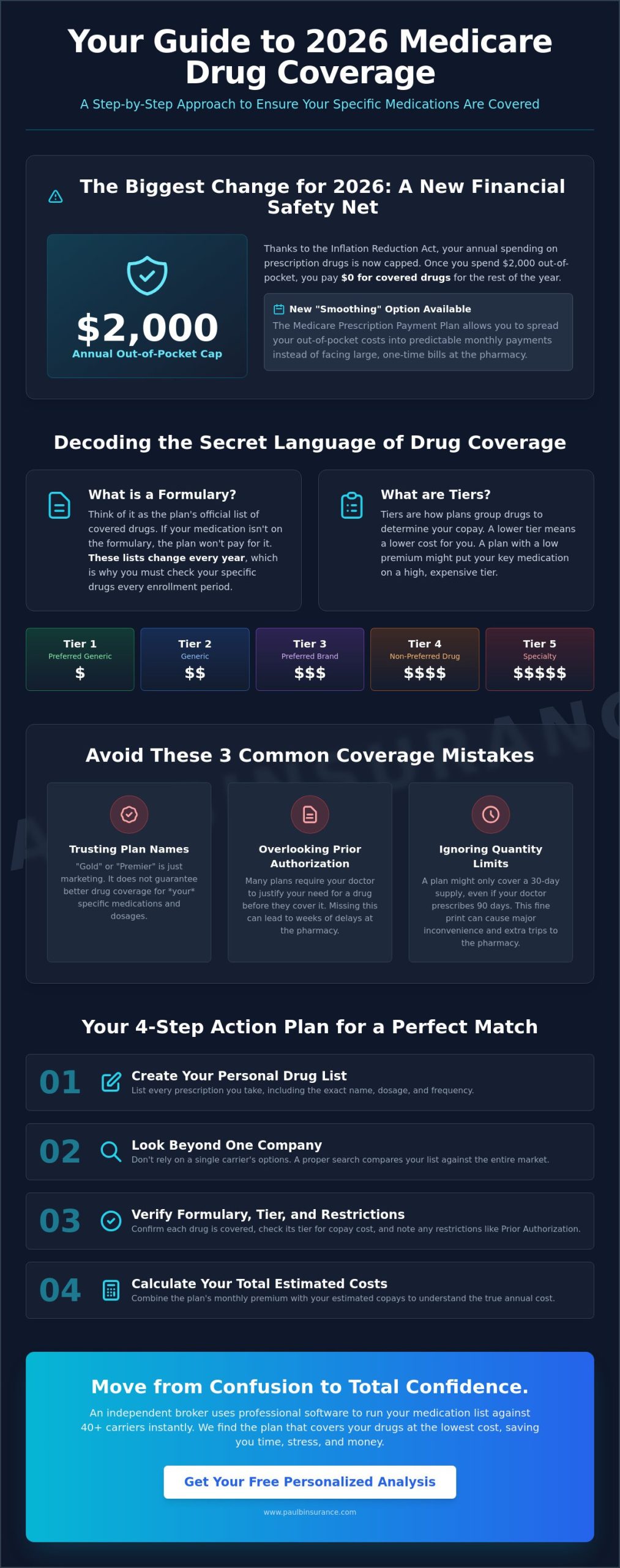
The most significant shift this year is the $2,000 annual out-of-pocket maximum for prescription drugs. This cap, established by the Inflation Reduction Act, provides a massive safety net for those taking expensive specialty medications. Before 2026, costs could spiral much higher, but now your financial exposure has a hard limit. This change requires a new way of Understanding Medicare Part D because we now focus more on how quickly you reach that cap rather than just the monthly premium. Additionally, the new “smoothing” option, officially called the Medicare Prescription Payment Plan, allows you to spread your out-of-pocket drug costs into monthly installments throughout the year instead of paying a large sum all at once at the pharmacy.
Common Mistakes When Checking Medication Coverage
We want to help you move from confusion to confidence by avoiding these three frequent errors:
- Trusting Plan Names: A “Gold” or “Premier” plan name does not guarantee better drug coverage. You must look at the actual formulary for 2026 to see your specific dosages.
- Overlooking Prior Authorization: Many plans now require your doctor to “prove” you need a specific drug before they will pay for it. If you don’t spot this requirement during enrollment, your first refill could be delayed by weeks.
- Ignoring Quantity Limits: Some plans only cover a 30-day supply of certain meds, even if your doctor prescribes a 90-day supply. We check these fine-print details on our Medicare Part D resource page to ensure your plan matches your lifestyle.
Finding a medicare plan that covers my specific medications doesn’t have to be a source of late-night stress. By looking at the hard data and ignoring the generic marketing, we can find a solution that fits your medicine cabinet perfectly.
Understanding Formularies and Tiers: The Secret Language of Drug Coverage
We know how it feels to look at a thick stack of insurance papers and feel your eyes glaze over. It’s confusing, and frankly, it’s a bit overwhelming. The first thing we need to clear up is the “formulary.” Think of this as a master shopping list. Every Medicare plan creates its own list of medications it agrees to cover. If your specific drug isn’t on that list, the plan won’t pay a dime toward it. This is why finding a medicare plan that covers my specific medications requires looking past the monthly premium and digging into the fine print of these lists.
Every plan organizes its formulary into tiers. These tiers are the secret code that tells you exactly what you’ll pay at the pharmacy counter. We’ve seen many people choose a plan because it has a low monthly cost, only to realize their most important medication is on a high tier with a massive copay. It’s our job to help you avoid that surprise. You can start your search by using the official Medicare Plan Finder tool to see how different companies categorize your prescriptions.
Breaking Down the 5-Tier System
- Tier 1 and 2: These are usually preferred and standard generics. In 2026, these remain your most affordable options, often costing you just a few dollars or even nothing at all.
- Tier 3: This tier is for preferred brand-name drugs. This is where we see the most variation. A drug that Plan A calls Tier 3 might be Tier 2 on Plan B because that company negotiated a better deal. We always check these closely for you.
- Tier 4 and 5: These are specialty drugs for complex conditions. While these are the most expensive, the 2026 rule changes mean your total out-of-pocket drug costs are capped at $2,000 for the year. This provides a huge sense of relief for our clients using these medications.
Utilization Management: More Than Just a Price Tag
Sometimes, a plan covers your drug but adds “utilization management” rules. Step therapy is a common one; it’s a policy where the insurance company requires you to try a cheaper, similar drug before they’ll “step up” to the brand-name one your doctor requested. We also look for quantity limits, which restrict how many pills you can get each month. If you’re managing a chronic condition, these small details matter just as much as the price.
If you switch plans and find your drug isn’t covered, don’t panic. Most plans offer a “transition fill,” a one-time, 30-day supply to give us time to file a formulary exception. We guide our clients through this paperwork to ensure they never skip a dose. If you’re feeling stuck, you can always learn more about how Part D works to gain more clarity. Our goal is to move you from confusion to confidence so you can focus on your health, not your insurance paperwork.
A Step-by-Step Guide to Verifying Your Medications in 2026
We know that staring at a long list of prescriptions can feel overwhelming. The 2026 Medicare landscape has changed, especially with the full implementation of the $2,000 out-of-pocket cap on prescription drugs. While this cap provides a safety net, finding a medicare plan that covers my specific medications still requires a methodical approach to avoid unnecessary costs. We want to move you from a place of confusion to a state of total confidence.
The first step in our process involves looking beyond the monthly premium. Many people make the mistake of choosing the plan with the lowest monthly bill, only to find out their specific drugs aren’t on the formulary or require high coinsurance. Instead, we focus on the “Total Annual Cost.” This number combines your premiums, deductibles, and estimated copays for the entire year. In 2026, the Plan Finder tools are more robust, allowing us to filter specifically by your drug list and pharmacy preference to see this bottom-line figure immediately.
Step 1: Building Your Accurate Medication Profile
Accuracy is your best defense against surprise bills. We recommend gathering every bottle you currently take. This includes “as needed” medications, such as inhalers or migraine pills, because even if you only fill them twice a year, they can impact your deductible. It’s vital to use the exact name printed on your bottle; some plans cover the generic but not the brand-name version. A 10mg dose of a common blood pressure medication might sit on Tier 1 with a $0 copay, while the 20mg version of that same drug could be classified as Tier 2, which significantly increases your out-of-pocket cost.
Step 2: Comparing Pharmacy Networks
Where you fill your scripts is just as important as what you take. Plans in 2026 typically categorize pharmacies into three groups: Preferred, Standard, and Out-of-Network. When you’re Comparing Medicare Advantage vs. Standalone Part D, the pharmacy network often dictates your final savings. Your favorite local pharmacy might be convenient, but if it’s listed as “Standard,” you could pay 20% more than you would at a “Preferred” location. We often find that mail-order options for 90-day supplies can lower your tier costs and provide the peace of mind that you’ll never run out of essential medicine.
We’re here to help you double-check the fine print. As independent brokers, we have no loyalty to a specific insurance company; our only goal is to protect your health and your wallet. If you’re feeling stuck, we can review your Medicare Part D options together to ensure your search for finding a medicare plan that covers my specific medications is successful and stress-free.
Comparing Medicare Advantage vs. Standalone Part D for Prescription Savings
Deciding between Medicare Advantage and a standalone Part D plan is often the biggest hurdle in your journey. We understand how overwhelming these choices feel. By 2026, the rules have changed because the $2,000 out-of-pocket cap on prescription drugs is now fully active for everyone. This makes finding a medicare plan that covers my specific medications even more critical. Your costs are more predictable now, but the plan structures remain very different.
The MAPD Path: Convenience and Bundled Costs
Medicare Advantage (MAPD) plans bundle your medical and drug coverage into one package. It’s often simpler for many seniors. We see many plans where a single deductible applies to both healthcare and prescriptions, which helps you reach your coverage limits faster. You might also get extra perks like over-the-counter (OTC) drug allowances. For 2026, many MAPD plans have increased these credits to help with everyday health costs like aspirin or vitamins. Our Medicare Advantage Guide explains this bundling in more detail. However, there’s a trade-off. If your doctor leaves the network or your pharmacist is no longer “preferred,” you might have to change where you get care or how much you pay. This risk can be stressful if you have established relationships with your providers.
The Medigap + Part D Path: Maximum Flexibility
If you prefer maximum flexibility, the Medigap plus Part D path is usually the winner. We often recommend this for people with high-cost specialty drugs. A standalone Part D plan (PDP) lets you pick a policy based solely on your Tier 4 or Tier 5 medications without worrying about which doctors you can see. Because Medigap allows you to visit any doctor who accepts Medicare, you aren’t locked into a network. This combo provides the most stable coverage year after year. Check out our guide on What Is Medicare Supplement Insurance? to see how this works. By 2026, standalone plans have become highly specialized. Some focus specifically on insulin costs while others target expensive biologics. This path is about finding a medicare plan that covers my specific medications without compromising on which specialist you visit.
What happens if your favorite doctor is in one plan, but your drugs are hundreds of dollars cheaper in another? This is where we help you run the math. We look at the total annual cost, not just the monthly premium. Sometimes, paying a slightly higher premium for a PDP saves you thousands on specialty drugs over the full year. We help you weigh the “extra benefits” of an MAPD plan against the freedom of Medigap so you can sleep better at night.
Ready to see which path saves you the most? Schedule a consultation with our team to get your personalized drug cost comparison today.
How an Independent Broker Simplifies Your Search for the Perfect Plan
Choosing a health plan shouldn’t feel like a second job. Many people start by talking to a captive agent, which is someone who represents just one insurance company. These agents can only show you products from that single brand, even if a better deal exists elsewhere. We do things differently. As independent brokers, we don’t work for the insurance companies; we work for you. This distinction is vital when finding a medicare plan that covers my specific medications because it gives you access to the entire market rather than a narrow slice of it.
We use professional, high-speed software to run your personal drug list against more than 40 different carriers simultaneously. In 2026, the $2,000 out-of-pocket cap is a game changer, but it has caused many carriers to tighten their formularies or move drugs to higher tiers. We analyze these tier shifts and pharmacy networks in real-time. Our goal is to ensure you never pay a penny more than necessary for your prescriptions. If a carrier drops your medication from their list mid-year, we’re here to help you file an exception or find an alternative. You’re never alone in this process.
Our 5-Step ‘Confusion to Confidence’ Process
We’ve developed a methodical approach to move you from a state of overwhelm to total clarity. We simplify the dense jargon of 2026 Medicare rules so you know exactly how your coverage works. Our ‘Right Plan Promise’ ensures your preferred doctors and specific drugs are protected before you sign anything. We invite you to a no-pressure medication review to see exactly how your current costs compare to the new 2026 options.
- Personalized drug list analysis across 40+ carriers.
- Doctor network verification to ensure your specialists are covered.
- Plain-English explanation of your total estimated annual costs.
- Seamless enrollment handling to avoid paperwork headaches.
- Year-round advocacy if you face issues at the pharmacy counter.
Ready to Secure Your 2026 Coverage?
The 2026 enrollment period is a critical window for your finances. Waiting until the final days can lead to rushed decisions or missing out on plans with the most convenient pharmacy networks. If you want to understand the basics first, read our guide on Medicare Part D Explained. Taking action now helps you steer clear of late enrollment penalties and ensures your coverage starts on January 1 without a hitch. Finding a medicare plan that covers my specific medications is simple when you have an expert in your corner. Schedule a Call With Paul today to get started.
Take Control of Your Prescription Costs for 2026
Navigating the Medicare system doesn’t have to feel like a maze. We’ve explored how the $2,000 annual out-of-pocket cap for Part D medications changes your strategy this year. You now understand that generic advice often fails because every medicine cabinet is unique. Finding a medicare plan that covers my specific medications requires a careful look at updated 2026 formularies and tier structures. We simplify this complex search by using specialized medication matching software to compare options from over 40 different carriers. This ensures you stay ahead of recent regulatory changes while avoiding costly enrollment mistakes. Our goal is to move you from a state of confusion to total confidence. You deserve a plan that protects both your health and your savings without the stress of hidden fees. Let’s secure your peace of mind together.
Schedule a Call With Paul to Review Your 2026 Medications
We look forward to helping you find the clarity you need for a healthy and worry free year ahead.
Frequently Asked Questions
What happens if my medication isn’t on any Medicare plan’s formulary?
You can request a formulary exception from your insurance provider if your doctor confirms the drug is medically necessary for your health. In 2026, most plans provide a 30 day transition supply while you and your doctor file this formal request. We help you gather the specific clinical evidence needed to prove that alternative drugs on the plan’s list won’t work for your unique situation.
Can I change my Medicare plan mid-year if my doctor prescribes a new medication?
Generally, you cannot switch plans mid-year unless you qualify for a Special Enrollment Period due to specific life events. If your new medication is expensive and not covered, you might have to wait until the Annual Enrollment Period begins on October 15. However, if you move to a new nursing home or lose other health coverage, you get a 60 day window to find a plan that fits your new needs.
How does the $2,000 out-of-pocket cap in 2026 work if I have multiple expensive drugs?
Starting January 1, 2026, you won’t pay more than $2,000 for all covered Part D prescriptions during the calendar year. This cap applies regardless of how many different medications you take or how high their retail prices are. Once you reach that $2,000 limit, your plan pays 100 percent of your covered drug costs for the rest of the year, providing a vital safety net for your retirement budget.
Is there a difference between a ‘preferred’ and ‘standard’ pharmacy for my drug costs?
Yes, using a preferred pharmacy usually results in much lower copays compared to a standard or out of network location. For example, a Tier 1 generic might cost $0 at a preferred pharmacy but $10 at a standard one. When finding a medicare plan that covers my specific medications, we always check which local pharmacies are in the preferred network to ensure you pay the lowest possible price.
Do Medicare Advantage plans always include drug coverage?
Most Medicare Advantage plans include Part D prescription coverage, but about 10 percent of available plans are designed without it. These specific plans are often intended for veterans who prefer to use VA benefits for their medications instead. If you choose a plan without drug coverage by mistake, you could face a permanent late enrollment penalty of 1 percent per month for every month you went without creditable coverage.
What is ‘Extra Help’ and do I qualify for assistance with my medication costs?
Extra Help is a federal program that assists people with limited income in paying for Medicare drug plan costs like premiums and deductibles. In 2026, the income limit for the full subsidy is approximately 150 percent of the Federal Poverty Level. If you qualify, your drug costs will be capped at just a few dollars for each prescription, which removes a massive financial burden from your shoulders.
Why did my copay change even though I stayed on the same plan for 2026?
Insurance companies update their drug lists every year on January 1, which can change how your medications are priced. Your plan might have moved your drug from a Tier 2 “preferred” status to a Tier 3 “non-preferred” status, which increases your out of pocket cost. This is why we recommend an annual review to ensure your current plan is still the most cost effective option for your health.
What should I do if my plan requires ‘Step Therapy’ for a drug I’ve taken for years?
You or your doctor can file an appeal for a step therapy override if you’ve already tried the cheaper alternatives without success. Finding a medicare plan that covers my specific medications without these hurdles is our primary goal, but we are here to help if a hurdle appears. Your doctor simply needs to provide records showing that the required lower cost drug was ineffective or caused bad side effects.

Article by
Paul Barrett
Paul Barrett, CMIP is the founder of The Modern Medicare Agency, an independent Medicare-only brokerage based in Melville, NY. With 18 years of Medicare-exclusive experience, a CMIP designation, and more than 5,000 clients served across 37 states, Paul is one of the most credentialed independent Medicare specialists on Long Island — and one of the most direct.
He represents 40+ carriers with no quotas and no allegiances, which means his recommendations are based entirely on what fits each client's specific situation. He is the author of Medicare Mastery Unlocked and host of the Wise Guys Retirement Talk podcast. His content is grounded in primary sources, real carrier intelligence, and 18 years of watching what happens when people get Medicare right — and when they don't.
📞 631-358-5793 | paulbinsurance.com