




On a Tuesday morning in early 2026, Sarah sat at her kitchen table surrounded by 14 different Medicare mailers, feeling more lost than ever about her upcoming birthday. It’s a common scene for the roughly 11,000 Americans reaching this milestone every single day this year, and it often leads to one stressful question: what happens to my health insurance when I turn 65? We understand that this transition feels like walking through a maze where every wrong turn might lead to a lifelong financial penalty. You’ve worked hard for decades, and you deserve a retirement that starts with clarity rather than a pile of confusing paperwork.
We believe that moving to Medicare should be a moment of security, not a source of anxiety. That’s why we’ve built this guide to help you move from confusion to confidence. We will show you how to evaluate your current employer plan, identify your specific enrollment windows, and ensure you don’t pay a penny more than necessary. This roadmap covers the exact steps you need to take in 2026 to secure a seamless transition without any gaps in your care.
Key Takeaways
- Learn how your 65th birthday triggers a change in how your current insurance works and why the seven-month enrollment window is your most important deadline in 2026.
- We help you determine if your current employer or private plan is still the best fit or if switching to Medicare will save you money and provide better protection.
- Understand exactly what happens to my health insurance when I turn 65 so you can avoid the permanent 2026 late enrollment penalties that could increase your monthly costs for life.
- Discover the simple differences between Medigap and Medicare Advantage plans to ensure your 2026 coverage fits your specific health needs and budget.
- Follow our step-by-step 2026 transition timeline to move from confusion to confidence, ensuring you have no gaps in coverage and total peace of mind.
The 65th Birthday Milestone: What Actually Changes with Your Health Insurance?
Turning 65 in 2026 is a significant milestone, but it often comes with a cloud of uncertainty. We know it can feel like you are standing at the edge of a cliff, wondering if your current coverage will just stop working when the clock strikes midnight. That is a common myth we hear every day. Your private insurance usually stays active, but the way it pays your medical bills undergoes a massive shift. This is the moment when we help you figure out what happens to my health insurance when I turn 65 so you can move forward with total confidence. We simplify the jargon so you know exactly how it works and steer clear of costly enrollment mistakes.
Understanding the Initial Enrollment Period (IEP)
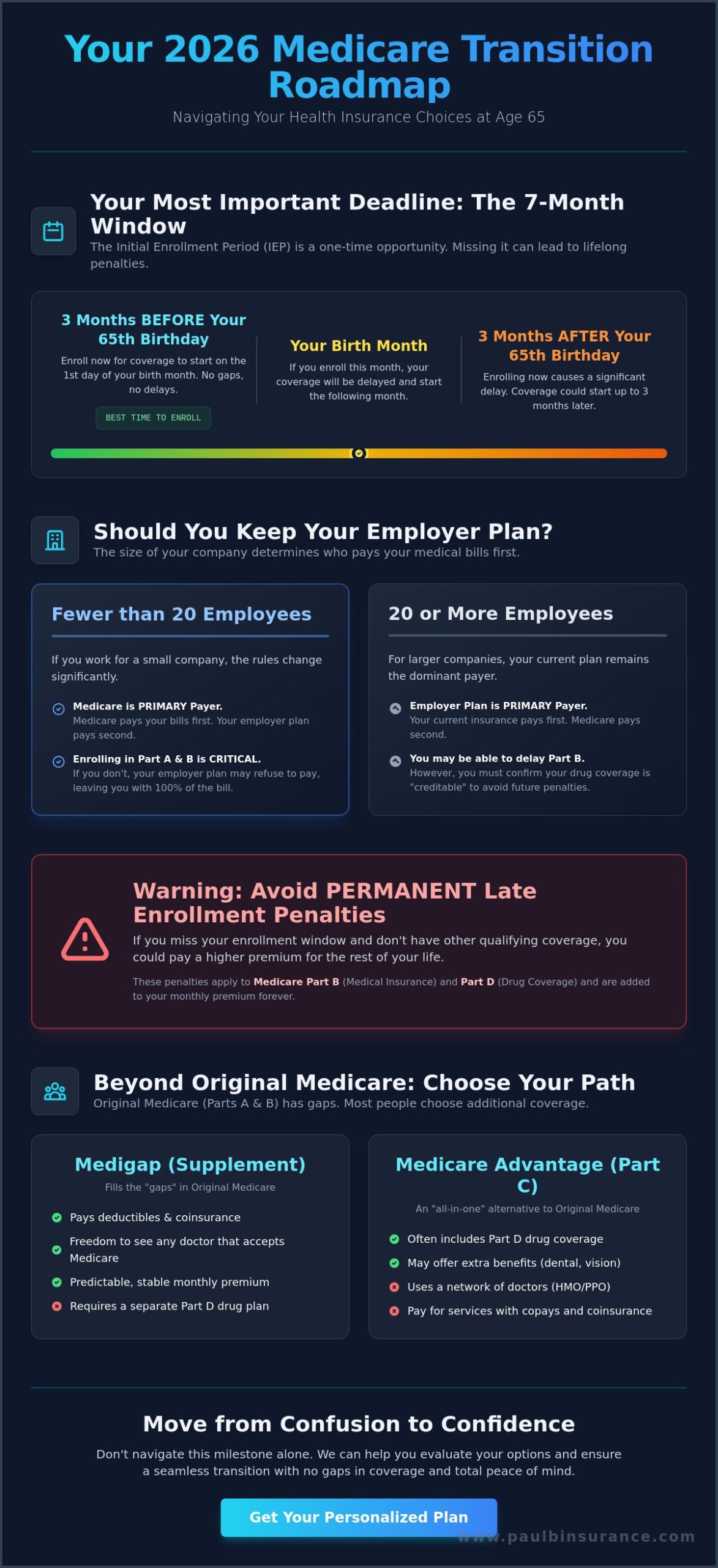
The IEP is your seven-month window to get your transition right. We call it the 3-1-3 rule. This window includes the three months before you turn 65, your birth month, and the three months after. If you want your coverage to start on day one of your birth month, you must sign up during those first three months. Waiting until your birth month or later can cause a delay in your start date, leaving you vulnerable. The Initial Enrollment Period is the only time most people can enroll without a special circumstance or a qualifying life event. We are here to ensure you don’t miss this window, moving you from confusion to confidence.
Primary vs. Secondary Payer: Who Picks Up the Bill?
When you reach this age, you trigger a process called Coordination of Benefits. This determines which insurance company is responsible for paying your claims first. For a deeper look at how this system was established and how its different parts function, Understanding the Medicare Program provides a comprehensive overview. The size of your employer is the deciding factor here. As of 2026, the 20-employee rule remains the standard for those still in the workforce.
- Companies with 20 or more employees: Your group health plan typically remains the primary payer, and Medicare acts as secondary.
- Companies with fewer than 20 employees: Medicare usually becomes the primary payer.
If your company has fewer than 20 employees, your current insurance might not pay a single dollar until Medicare pays its share first. You must notify your current insurer that you are now Medicare-eligible. If you don’t, you could be left with massive medical bills that your private insurer refuses to cover. We want to protect you from these surprises. If you find that your employer plan is no longer the best fit, exploring Medigap options can help fill the holes in your coverage. Understanding what happens to my health insurance when I turn 65 is the first step in our five-step process to securing your future.
Evaluating Your Current Coverage: Should You Keep It or Switch to Medicare?
Turning 65 in 2026 brings a lot of questions about your current plan. You might love your work benefits or feel comfortable with your Marketplace plan. However, staying put isn’t always the safest choice for your wallet or your health. We want to help you understand the official guide to getting started with Medicare so you can make a confident choice. Understanding what happens to my health insurance when I turn 65 is the first step toward moving from confusion to confidence.
Employer-Sponsored Insurance (The 20-Employee Rule)
If you work for a company with fewer than 20 employees, the rules change the moment you blow out your candles. In this scenario, Medicare typically becomes your primary payer. This means your work insurance only pays after Medicare has handled its share. If you skip Part B because you think you’re already covered, you might find yourself responsible for 100% of your medical bills. We recommend checking with your HR department immediately to confirm if your drug coverage is “creditable.” This term just means your current plan is officially recognized as being as good as a standard Medicare Part D plan. If it’s not creditable, you’ll face a permanent late enrollment penalty later.
The COBRA and Marketplace (ACA) Trap
We often see people fall into the COBRA trap. Many assume that because they’re paying for a premium plan, they don’t need Medicare yet. This is a mistake. COBRA doesn’t count as “creditable” coverage for Part B enrollment. If you wait until COBRA ends to sign up for Medicare, you’ll likely face lifetime late enrollment penalties and a gap in coverage. Marketplace plans are different but equally tricky. Your tax subsidies usually end once you’re eligible for Medicare. To avoid a surprise bill, we suggest starting your transition off the Marketplace at least 30 days before your 65th birthday. This is a critical part of knowing what happens to my health insurance when I turn 65.
Health Savings Accounts (HSA) and the 6-Month Rule
Managing a Health Savings Account requires precision in 2026. To avoid tax penalties, you must stop all HSA contributions before your Medicare Part A begins. If you wait until after age 65 to enroll, Medicare often backdates your coverage by six months. You’ll need to stop contributions six months before you apply to stay safe. You can still use your existing HSA funds to pay for Medicare premiums or other medical costs legally. Our goal is to ensure you’re never rushed and never pressured while making these decisions. If you’re feeling overwhelmed by these timelines, you can schedule a simple consultation with us to clear up the jargon and protect your savings.
The Consequences of Waiting: Understanding 2026 Late Enrollment Penalties
One of the most common worries we hear from our clients is the fear of making a mistake that costs them money for the rest of their lives. When you ask what happens to my health insurance when I turn 65, the answer often involves a strict timeline. If you miss your Initial Enrollment Period without having other coverage that Medicare considers “creditable,” the government applies financial penalties. These aren’t just one-time fees like a parking ticket. They are permanent monthly surcharges added to your premiums for as long as you are enrolled in the program.
- The Part B Penalty: Your monthly premium increases by 10% for every full 12-month period you could have had Part B but didn’t sign up.
- The Part D Penalty: You pay an extra 1% of the “national base beneficiary premium” for every month you went without Medicare Part D or other drug coverage.
- Lifelong Impact: These costs do not expire. They follow you every year, even as the base premiums naturally rise.
Calculating the Real Cost of Delay
To see how this adds up in 2026, let’s look at a hypothetical example. Imagine a neighbor who turned 65 in 2023 but decided to skip Part B because they felt healthy. If they finally join in 2026 after a three-year gap, they face a 30% penalty. The Part B late enrollment penalty is a permanent surcharge calculated as 10% of the standard monthly premium for every full 12-month period an individual was eligible but not enrolled, and this extra cost is added to the standard 2026 premium indefinitely. If the premium is $190, that person pays an extra $57 every month, totaling $684 in unnecessary costs every year.
We want to help you avoid this “Medicare tax” entirely. The best way to protect yourself is by keeping your “Creditable Coverage” letters. If you stay on a large employer plan after 65, your HR department must send you a notice every year confirming your health and drug plans meet Medicare’s standards. These letters are your proof to the government that you didn’t just “wait” without a reason, allowing you to skip the penalties when you eventually retire.
The Special Enrollment Period (SEP): Your Safety Net
If you are still working at 65, you don’t have to stress. You can qualify for a Special Enrollment Period (SEP) that lets you sign up later without any fines. The most common qualifying event is losing your employer group health coverage. When this happens, you have a specific window to act. You can find the official forms and instructions on how to sign up for Medicare through the Social Security Administration website to begin this process.
Timing is everything here. You have an 8-month window to sign up for Part B, but only a 63-day window to secure a Part D plan. We always tell our clients not to wait until their last day of work to start. Processing paperwork can take weeks, and we want to ensure your transition is seamless. By starting 60 days before your retirement date, we can move you from confusion to confidence, ensuring your new coverage starts the very day your old plan ends.
Building Your New Coverage: Beyond Original Medicare
Original Medicare is a solid foundation, but it isn’t a complete plan on its own. Parts A and B generally cover about 80% of your medical expenses. This leaves you responsible for the remaining 20%, which can become a heavy financial burden if you have a health emergency. We help you look at the two main paths to fill those gaps so you can feel secure in your choices.
When you start wondering what happens to my health insurance when I turn 65, it’s vital to recognize that Original Medicare has no annual limit on what you pay out of pocket. Without extra coverage, a single hospital stay could cost thousands of dollars. We simplify these options to ensure your savings stay protected and your future is secure.
The Medigap Path: Predictable Costs and Freedom
Medigap plans, also known as Medicare Supplement insurance, are designed to sit right on top of Original Medicare. They pay for the costs that Medicare leaves behind, such as coinsurance and deductibles. We often recommend this path for people who want total control over their healthcare. You can see any doctor in the country who accepts Medicare patients. There are no networks to worry about and no need for referrals to see a specialist.
- Predictability: You’ll know exactly what your medical costs are each month.
- Flexibility: Travel anywhere in the U.S. with the confidence that your coverage follows you.
- Simplicity: No need to check if a specific hospital or clinic is “in-network.”
Because Medigap doesn’t cover prescriptions, you’ll also need to look at Medicare Part D explained. In 2026, Part D plans have a $2,000 out-of-pocket limit on covered drugs, which provides incredible peace of mind for your pharmacy costs. You can learn more about how what is Medicare Supplement insurance works to decide if this is the right fit for your lifestyle.
The Medicare Advantage Path: All-in-One Convenience
Medicare Advantage plans, or Part C, offer a different approach. These plans are managed by private companies and combine your hospital, medical, and often prescription drug coverage into one single card. It’s an all-in-one solution that feels very similar to the insurance you likely had through an employer. Our Medicare Advantage Guide walks you through how these plans function in 2026.
The biggest draw for many seniors is the “extra” benefits. These plans often include services that Original Medicare doesn’t cover. This includes dental insurance for seniors, vision exams, and even hearing aid coverage. While you generally must use a specific network of doctors, these plans often have lower monthly premiums than the Medigap path, making them a budget-friendly choice for many.
Are you ready to move from confusion to confidence? Schedule a call with Paul today to find the plan that fits your life.
Your 65th Birthday Timeline: A Step-by-Step Transition Plan for 2026
Turning 65 in 2026 is a major milestone that should be celebrated, not feared. Many people feel overwhelmed by the “crazy maze” of Medicare, but we are here to provide a clear path from confusion to confidence. Understanding what happens to my health insurance when I turn 65 starts with a structured plan. We follow a simple, 5-step process to ensure you stay protected without any gaps in your care.
- 6 Months Before: Audit your current prescriptions and list your preferred doctors.
- 3 Months Before: Apply for Medicare Part A and Part B through the Social Security Administration.
- 2 Months Before: Compare Medicare Advantage and Medigap plans with an independent broker.
- 1 Month Before: Receive your red, white, and blue Medicare card and confirm your specific plan start date.
- Birthday Month: Celebrate your special day knowing your healthcare is secure and your costs are predictable.
Month 6 to Month 3: The Research Phase
Preparation is the key to peace of mind. During this window, we help you gather “Creditable Coverage” proof if you are leaving an employer plan. This document is vital to avoid late enrollment penalties later. We suggest listing every single medication you take. This is especially important in 2026 because the Inflation Reduction Act has now fully implemented the $2,000 annual out-of-pocket cap on Medicare Part D prescription costs. We use an unbiased comparison tool to look at over 40 different carriers. This ensures your specific doctors and drugs are covered at the lowest possible cost. We act as your advocate, not a salesperson for a single company.
Month 3 to Day 1: The Execution Phase
When you hit the three-month mark, it’s time to take action. If you already receive Social Security benefits, your enrollment is usually automatic. You’ll simply receive your card in the mail. If you aren’t taking benefits yet, you must manually apply via the Social Security website. We guide you through this step-by-step so you don’t get stuck in technical jargon. Once your Part A and B are set, we finalize your supplemental coverage. This step is crucial to answer the question of what happens to my health insurance when I turn 65; it ensures you aren’t left responsible for the 20% coinsurance that Original Medicare doesn’t cover. Our goal is to make sure your protection is active on Day 1 of your birth month. We are never rushed and never pressured, giving you the time you need to feel certain about your choices.
Take Control of Your 2026 Medicare Journey
Turning 65 in 2026 doesn’t have to feel like wandering through a maze. We’ve looked at how to avoid those lifelong late enrollment penalties and why comparing your current workplace coverage against Medicare is vital for your budget. Most importantly, we’ve mapped out your seven month timeline to ensure you don’t miss a single deadline. Understanding what happens to my health insurance when I turn 65 is about more than just paperwork; it’s about protecting your future peace of mind.
You don’t have to navigate these complex 2026 regulations alone. As independent brokers, we provide unbiased guidance and access to more than 40 top-rated insurance carriers. We currently support seniors across 34 states with year-round advocacy that never feels rushed or pressured. We’ll help you filter out the noise so you can make a choice with total certainty. Our goal is to move you from confusion to confidence by simplifying the jargon and outlining your best options. Let’s turn your uncertainty into a clear, actionable plan that fits your unique life.
Schedule a Call With Paul to build your custom 2026 Medicare transition plan today. We’re ready to help you step into this new chapter with absolute clarity.
Frequently Asked Questions
Do I have to sign up for Medicare at 65 if I’m still working and have good insurance?
You can delay Medicare enrollment if your employer has 20 or more employees and your coverage is considered primary. If your company has fewer than 20 employees, Medicare typically becomes the primary payer, meaning you must sign up during your Initial Enrollment Period to avoid coverage gaps. We help you look at your specific benefits so you don’t face unexpected bills. This ensures your transition is handled with total confidence.
What happens to my spouse’s health insurance when I turn 65 and switch to Medicare?
Your spouse will likely need to find new coverage if they’re currently on your employer plan and you transition to Medicare. Since Medicare is individual insurance, it doesn’t offer family plans. In approximately 40 percent of these cases, we help spouses find a bridge plan through the Health Insurance Marketplace. This ensures nobody in your family loses access to their doctors during this transition. We make the process simple and stress free.
Can I keep my Marketplace (Obamacare) plan instead of taking Medicare?
In 99 percent of cases, you cannot keep your Marketplace plan with tax credits once you’re eligible for Medicare Part A. While you can technically stay on a Marketplace plan, you’ll lose any premium subsidies, making the monthly cost much higher. It’s important to understand what happens to my health insurance when I turn 65 so you can transition to Medicare smoothly. We ensure you avoid paying full price for an individual plan.
What is the difference between creditable and non-creditable coverage?
Creditable coverage is insurance that is at least as good as the standard Medicare Part D prescription drug plan. The Centers for Medicare & Medicaid Services requires your current insurer to send you a notice by October 15 each year stating if your plan is creditable. If your coverage is non-creditable, you must join a Medicare drug plan or you’ll face a permanent late enrollment penalty. We simplify this jargon so you stay protected.
What happens if I missed my Initial Enrollment Period and I’m already 66?
You may face a 10 percent lifetime penalty for every 12 month period you went without Part B coverage. If you missed your window and don’t have a Special Enrollment Period, you must wait until the General Enrollment Period that runs from January 1 to March 31. We specialize in helping people navigate these late starts to minimize the financial impact. Our goal is to move you from confusion to absolute clarity.
Does Medicare cover dental and vision once I turn 65?
Original Medicare does not cover routine dental exams, cleanings, or eyeglasses in 2026. You’ll need to look at a Medicare Advantage plan or a separate private policy to get these benefits. Approximately 54 percent of beneficiaries choose Advantage plans because they typically include these extra services. We’ll help you compare these options so your teeth and eyes are fully protected. You deserve a plan that covers your whole health.
Is Medicare free once I turn 65, or are there monthly costs?
Medicare isn’t free for most people, as the projected Part B premium for 2026 is $195.40 per month. While Part A is usually $0 if you’ve worked for 10 years, you’ll still have deductibles and co-insurance to manage. Understanding what happens to my health insurance when I turn 65 helps you budget for these monthly costs. We provide a clear breakdown of all expenses so there are no surprises or hidden fees.
How do I stop contributing to my HSA before I turn 65?
You must stop contributing to your Health Savings Account (HSA) the month your Medicare coverage begins to avoid IRS tax penalties. If you’re enrolling in Medicare after age 65, you should stop contributions six months before you apply to account for retroactive coverage. We recommend sitting down with us at age 64 to create a timeline. This protects your savings from excise fees and keeps your transition simple and ethical.

Article by
Paul Barrett
Paul Barrett, CMIP is the founder of The Modern Medicare Agency, an independent Medicare-only brokerage based in Melville, NY. With 18 years of Medicare-exclusive experience, a CMIP designation, and more than 5,000 clients served across 37 states, Paul is one of the most credentialed independent Medicare specialists on Long Island — and one of the most direct.
He represents 40+ carriers with no quotas and no allegiances, which means his recommendations are based entirely on what fits each client's specific situation. He is the author of Medicare Mastery Unlocked and host of the Wise Guys Retirement Talk podcast. His content is grounded in primary sources, real carrier intelligence, and 18 years of watching what happens when people get Medicare right — and when they don't.
📞 631-358-5793 | paulbinsurance.com