
What if the price you pay at the pharmacy counter had less to do with the medicine itself and everything to do with a hidden number assigned by your insurance plan? We know how exhausting it is to feel like you’re at the mercy of fluctuating prices or to worry that a “specialty” label might suddenly drain your savings. It often feels like the system is intentionally confusing, which is why we want to get medicare part d drug tiers explained in a way that actually makes sense for your daily life and your budget.
We are here to tell you that you don’t have to guess anymore. In this guide, we’ll show you exactly how the 2026 five-tier system works and how it interacts with this year’s new $2,100 out-of-pocket maximum. You will learn how to spot the lowest-cost options for your specific medications and how to request a tiering exception if your plan places a vital drug in a high-cost category. By the time you’re finished reading, you’ll have a clear, step-by-step path to choosing a plan that protects both your health and your hard-earned retirement savings. Our goal is to move you from a state of uncertainty to one of total financial clarity.
Key Takeaways
- Discover how insurance companies use specific levels to set your medication costs and why having medicare part d drug tiers explained is the first step toward significant savings.
- Learn the difference between fixed copays for generics and percentage-based coinsurance for specialty drugs so you can avoid surprise bills at the pharmacy counter.
- We’ll show you how to work with your doctor to find lower-tier alternatives or request a formal tiering exception to lower your monthly expenses.
- Find out how a personalized medication review can compare dozens of carriers to find the one plan that places your specific prescriptions in the most affordable tiers.
Understanding the Basics: What Are Medicare Part D Drug Tiers?
Imagine walking into your local pharmacy and finding that your usual blood pressure medication now costs double what it did last month. This happens because insurance companies group medications into different levels called tiers. Each tier has a specific price tag attached to it. We think of these tiers as a roadmap that tells you exactly how much you will pay and how much the insurance company will cover. When you have medicare part d drug tiers explained clearly, you can start making choices that protect your wallet and your health.
These levels aren’t just random numbers. They are a core part of the Medicare Part D program designed to keep costs manageable for everyone. We see tiers as a way for plans to encourage the use of safe, lower-cost medications first. If a generic drug works just as well as a brand name, the plan puts the generic in a lower tier to save you money. Understanding these levels is the first step toward finding peace of mind in your healthcare planning. By knowing which tier your medication falls into, you can predict your monthly expenses with total accuracy. You won’t have to guess at the checkout counter. This clarity removes the anxiety of the unknown and lets you focus on your health instead of your bills.
The Role of the Formulary
A formulary is simply the master list of every drug your plan agrees to cover. Think of it as a menu. If a drug isn’t on this menu, you might have to pay the full retail price out of your own pocket. If your drug is missing from the formulary, it doesn’t mean you can’t get it. It just means the insurance company won’t help you pay for it unless you go through a specific appeal process. This is why we spend so much time helping our clients check their specific medications against multiple plan formularies. We want to make sure your doctors’ prescriptions are actually on the list before you sign up for a Medicare Part D plan. We help you look for these gaps early so there are no surprises in the middle of the year.
Why Plans Change Tiers Yearly
It’s common to feel frustrated when a drug you’ve taken for years suddenly gets more expensive. Plans adjust their tiers every year based on new medical data and drug pricing changes in 2026. A medication that was “Preferred” last year might move to a “Non-Preferred” tier this year if a cheaper alternative becomes available. A tiering change is a standard part of the annual Medicare cycle. Because these lists change every January, we recommend reviewing your coverage every autumn to ensure you’re still getting the best deal. We stay by your side during this process to make sure you’re never left unprotected by a sudden shift in how your medications are categorized.
The Standard 5-Tier Structure: How Your Medications Are Categorized in 2026
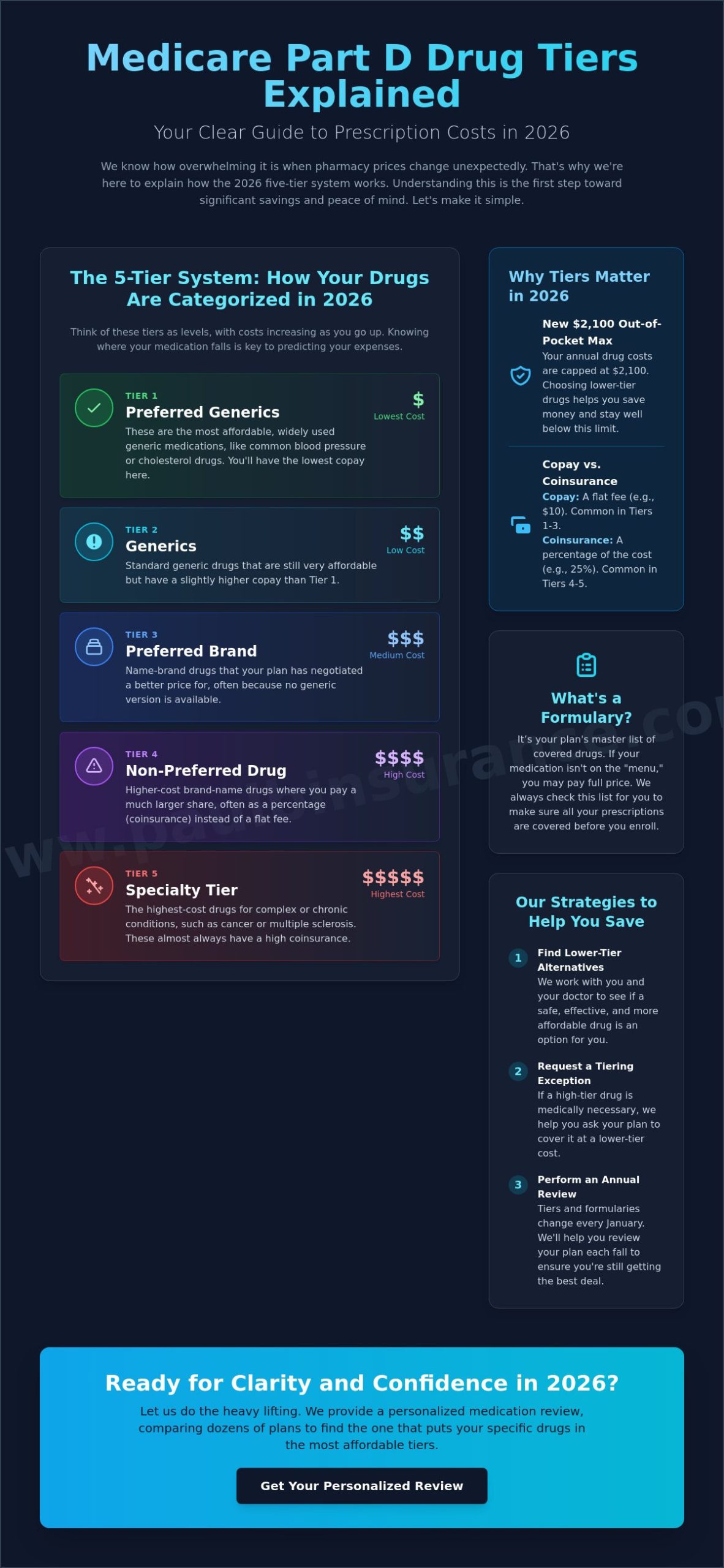
Most insurance companies organize their covered medications into five distinct levels. Having medicare part d drug tiers explained simply helps you understand why one pill costs five dollars while another costs fifty. These tiers are the foundation of your plan. They determine if you’ll pay a small, flat fee or a percentage of the drug’s total price. In 2026, these categories are more important than ever because they dictate how quickly you move toward your annual spending limit.
- Tier 1: Preferred Generics. These are the lowest-cost versions of common medications. They often include widely used drugs for high blood pressure or cholesterol.
- Tier 2: Generics. These are standard generic drugs. They have a slightly higher copay than Tier 1 but are still very affordable.
- Tier 3: Preferred Brand. These are name-brand drugs that the plan has negotiated a better price for because no generic version is available yet.
- Tier 4: Non-Preferred Drug. This tier contains higher-cost brand-name drugs and some non-preferred generics. You will usually pay a much higher share of the cost here.
- Tier 5: Specialty Tier. This is for the highest-cost drugs used for complex or chronic conditions, such as cancer or multiple sclerosis.
Preferred vs. Non-Preferred: The Price Gap
There is often a significant jump in cost when you move from Tier 2 to Tier 4. While Tiers 1 and 2 usually involve a predictable flat copay, Tier 4 often switches to coinsurance. This means you pay a percentage of the drug’s actual cost, which can be hundreds of dollars. “Preferred” status is the goal for most of our clients because it offers the most stability for a fixed budget. We spend our days identifying plans that list your specific brand-name medications as “Preferred” rather than “Non-Preferred.” If you’re worried about these price jumps, we can help you find a plan that keeps your most important prescriptions in the lowest possible tiers.
Specialty Drugs and Tier 5
Tier 5 drugs are almost always handled through coinsurance. You might be asked to pay 25% or more of the drug’s retail price. You’ll often find biologics or specialized injections in this category. While these numbers can look scary, there is a silver lining in 2026. The official Medicare website confirms that once your total out-of-pocket costs hit $2,100, you pay $0 for your covered drugs for the rest of the year. This cap is a massive safety net for anyone relying on Tier 5 medications. It provides the security of knowing your costs have a hard limit, no matter how expensive the medicine is. We can help you look at a Medicare Part D plan to see how quickly you might reach that protective limit.
Why Tiers Matter: Calculating Your Out-of-Pocket Costs in 2026
How much will you actually pay when you get to the pharmacy window? This is the question that keeps most people up at night. Having medicare part d drug tiers explained is about more than just definitions; it is about your monthly cash flow. Generally, Tiers 1 and 2 use copayments. These are fixed dollar amounts, like $5 or $10. You know exactly what they are before you leave the house. They offer a sense of control that is vital when you are managing a household budget.
Tiers 4 and 5 usually rely on coinsurance. Instead of a flat fee, you pay a percentage of the drug’s price, often 25%. If a specialty medication costs $1,000, your 25% share is $250. This is where costs can quickly feel out of control. According to a KFF analysis of Part D, these cost-sharing structures are designed to balance plan sustainability with member access, but they can still be stressful. We are here to help you navigate these percentages so you aren’t caught off guard by a bill you didn’t expect.
The Impact of the $2,100 Out-of-Pocket Cap
The biggest change for 2026 is the $2,100 annual out-of-pocket limit. While the limit was $2,000 in 2025, the 2026 cap remains a powerful shield for your savings. Once you spend $2,100 on covered drugs this year, your costs drop to $0 for the remainder of the year. This cap is a major victory for Medicare beneficiaries in 2026. It means that even if you require a Tier 5 specialty drug that costs thousands per month, your financial exposure is strictly limited. We help you calculate if you’ll hit this cap and, more importantly, when it might happen. Knowing your “zero-cost date” allows you to plan your other expenses with total certainty.
Tier Discrepancies Between Plans
One of the most confusing parts of this system is that tiers are not universal across every company. Drug X might be Tier 2 on Plan A, but Tier 4 on Plan B. This is why “one-size-fits-all” advice often fails. Your neighbor’s plan might be perfect for them but a financial burden for you. We use advanced tools to compare these differences side-by-side. You can find more details in our guide to Medicare Part D explained. We make sure the plan you choose treats your specific medications with the lowest possible tier assignment, protecting your retirement from unnecessary costs.
Navigating High-Cost Tiers: Exceptions and Saving Strategies
Discovering that your vital medication sits in a high-cost tier can feel like a heavy burden. It’s a moment of high stress when you realize your monthly budget might not stretch far enough. We want you to know that you have rights in this system. Having medicare part d drug tiers explained gives you the knowledge to push back against high costs. You are not just a policy number. You are a person who deserves access to affordable care. There are concrete steps we can take together to challenge these costs and find a better way forward.
- Step 1: Talk to your doctor about lower-tier therapeutic alternatives.
- Step 2: Request a Tiering Exception if a lower-cost drug won’t work for you.
- Step 3: Apply for a Formulary Exception if your drug isn’t covered at all.
- Step 4: Use the annual Open Enrollment period to switch to a plan with better tiers.
- Step 5: Let us review your plan annually to ensure your meds haven’t shifted tiers.
How to Request a Tiering Exception
A tiering exception is a formal request to your insurance company. You are essentially asking them to charge you the lower Tier 2 or Tier 3 price for a drug they have placed in Tier 4. To be successful, your doctor must provide a medical necessity statement. This letter needs to explain why the cheaper drugs on the plan’s list won’t work or might be harmful to you. We know this paperwork can feel like a mountain of red tape. We are here to guide you through it. We help you understand exactly what the insurance company is looking for so your request has the best chance of approval. If the plan denies your request, you still have options. The appeals process allows you to have your case reviewed by an independent party. This journey from distress to certainty is one we take with you, ensuring you never feel alone in the fight for your health.
Generic Alternatives and Therapeutic Substitution
Tier 1 and Tier 2 generics are the gold standard for saving money in 2026. Many of our clients find that they can save hundreds of dollars simply by switching to a different drug in the same class. We recommend having a direct “tier conversation” with your prescribing physician. Ask them if a therapeutic substitution is possible. This simply means using a different drug that treats the same condition but sits in a lower, more affordable tier. It’s also vital to remember that Medigap plans do not cover prescription drugs. Because of this, your Part D plan is your primary tool for managing medication costs. If you feel like your current plan is hiding the real costs, you can request a plan review with us. We will look at every available option to ensure you’re paying the lowest possible price for the medicine you need.
Finding the Right Plan: How We Help You Navigate Part D Tiers
Choosing a plan shouldn’t feel like a game of chance. We know the stress that comes with wondering if you picked the right option or if you’re overpaying for your prescriptions. When you have medicare part d drug tiers explained by an expert, that stress starts to fade. Our role is to act as your advocate and guide, ensuring you never have to face these complex systems alone. We don’t just look at one or two plans. As independent brokers, we represent over 40 carriers. This independence is our greatest strength because it allows us to prioritize your needs over any single insurance company’s bottom line.
We use advanced technology to take the guesswork out of the process. You provide us with your list of medications, and we run them through every available plan in your area for 2026. Our software identifies exactly which plans place your drugs on the lowest possible tiers. We look for that “sweet spot” where your monthly premiums and your at-the-counter costs are both as low as possible. This methodical approach turns a state of uncertainty into one of total financial clarity. We want you to feel confident every time you walk into a pharmacy, knowing you have the best possible coverage for your specific health needs.
The Advantage of an Independent Medicare Broker
A captive agent is restricted. They can only offer you products from the one company they represent. If that company moves your medication to a higher tier, that agent has no other options to help you save. We are different. Our unbiased approach means we can pivot to a different carrier if it serves you better. We have the freedom to shop around for you every single year. The best part is that our services come at no cost to you. You can learn more about how we structure these savings in our guide to Medicare Part D. We believe everyone deserves an expert in their corner who focuses on their security and reliability.
Your Path to Peace of Mind
Your journey with us is about moving from confusion to peace of mind. We have seen how the right tiered drug plan can change someone’s entire outlook on their retirement. We don’t just help you sign up and then disappear. We provide year-round support. If a tier changes for the 2027 plan year, we are already on it, reaching out to make sure you stay protected. We invite you to reach out for a personalized “Tier Review” today and ensure you have medicare part d drug tiers explained in the context of your own health. Let us do the heavy lifting so you can enjoy the security you’ve earned. You can schedule a free consultation with our team today to get started.
Take Control of Your Prescription Costs Today
You now know how the five-tier system dictates your pharmacy bills and how the $2,100 out-of-pocket limit protects your savings in 2026. Understanding these details is the first step toward a stress-free retirement. Having medicare part d drug tiers explained is just the beginning of your journey toward total financial peace of mind. You have the power to challenge high costs through exceptions and to choose a plan that actually fits your specific health needs.
Paul Barrett and our dedicated team are here to act as your personal advocates. We have access to over 40 insurance carriers and are licensed in more than 34 states to ensure you get the most reliable support available. We take pride in removing the anxiety from this process and replacing it with a clear, logical path forward. Let us simplify your Medicare journey—contact our experts for a free plan comparison. You don’t have to navigate these complex systems alone. We are ready to help you find the security and clarity you deserve.
Frequently Asked Questions
What is the difference between a preferred and non-preferred drug tier?
Preferred tiers mean your insurance company has negotiated a lower price for those medications, which results in a smaller bill for you. Non-preferred tiers, typically Tier 4, often require you to pay coinsurance instead of a flat copay. This means you pay a percentage of the drug’s full cost, which can lead to much higher expenses at the pharmacy counter.
Can my insurance company change a drug’s tier in the middle of the year?
Insurance companies generally cannot move a drug to a higher tier or remove it from their list during the plan year unless a new generic version becomes available or the FDA raises safety concerns. They do, however, update these lists every January. This is why we recommend an annual review to ensure your medicare part d drug tiers explained during enrollment are still the most affordable options for the coming year.
What should I do if my medication is placed in a specialty tier (Tier 5)?
If your medication is in Tier 5, you should prepare to pay coinsurance, often around 25%, until you reach your annual spending limit. Because these drugs are expensive, you’ll likely hit the $2,100 out-of-pocket maximum early in the year. We can help you calculate that exact date so you know when your costs will drop to $0 for the rest of 2026.
How does the 2026 $2,100 out-of-pocket cap affect my drug tiers?
The $2,100 cap acts as a total safety net that limits how much any drug tier can impact your savings. Once you spend $2,100 on covered prescriptions in 2026, your cost-sharing drops to $0 for every covered drug, regardless of its tier. This change is a huge relief for anyone who relies on Tier 5 specialty medications or expensive Tier 4 brand names.
Can I request that my drug be moved to a lower-cost tier?
Yes, you can file a request for a tiering exception if you and your doctor can show that lower-cost drugs on the plan’s list aren’t right for your health. If the plan approves the exception, they’ll charge you the lower cost associated with a different tier. We often assist our clients with this process to help remove the stress of dealing with insurance company paperwork.
Are generic drugs always in Tier 1 or Tier 2?
Most common generics fall into the lowest tiers, but some high-cost or non-preferred generics are placed in Tier 4. Insurance companies categorize drugs based on their own costs and negotiations, not just whether a drug is generic or brand name. This is why having medicare part d drug tiers explained for your specific list of medications is vital before you choose a plan.
Will Medicare Advantage plans have the same drug tiers as standalone Part D plans?
Medicare Advantage plans and standalone Part D plans both use the five-tier system, but each individual plan decides which drugs go into which tiers. While the structure is the same, the actual cost for your medication might be different between a Medicare Advantage plan and a standalone drug plan. We compare over 40 carriers to find the one that treats your prescriptions most favorably.
How do I know which tier my medications are in before I enroll?
You can find this information by looking at the plan’s formulary, which is the official list of every drug they cover and its assigned tier. These documents are often hundreds of pages long and difficult to read. We make this easy by using advanced tools to run your specific medications through every available plan, providing you with a clear, simple cost comparison.

Article by
Paul Barrett
Paul Barrett, CMIP is the founder of The Modern Medicare Agency, an independent Medicare-only brokerage based in Melville, NY. With 18 years of Medicare-exclusive experience, a CMIP designation, and more than 5,000 clients served across 37 states, Paul is one of the most credentialed independent Medicare specialists on Long Island — and one of the most direct.
He represents 40+ carriers with no quotas and no allegiances, which means his recommendations are based entirely on what fits each client's specific situation. He is the author of Medicare Mastery Unlocked and host of the Wise Guys Retirement Talk podcast. His content is grounded in primary sources, real carrier intelligence, and 18 years of watching what happens when people get Medicare right — and when they don't.
📞 631-358-5793 | paulbinsurance.com