




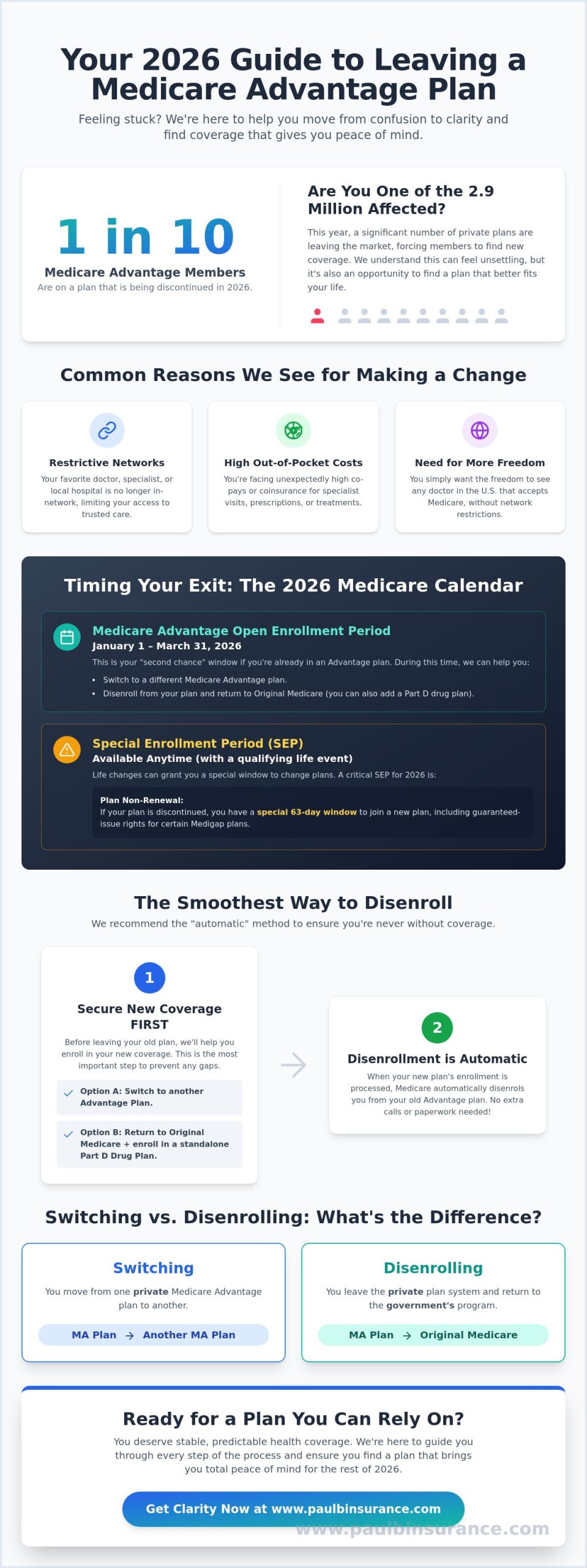
Did you know that in 2026, approximately 1 in 10 Medicare Advantage members are facing a forced disenrollment because their plans are leaving the market? It’s a startling figure that explains why so many people feel anxious about their healthcare right now. If you’ve discovered your doctor is no longer in-network or your out-of-pocket costs have spiked, you’re likely wondering how to disenroll from a medicare advantage plan without losing the protection you need. We understand how stressful this uncertainty feels, especially when you just want a plan that stays reliable.
We’re here to help you move from confusion to total clarity. In this simple guide, we’ll show you exactly how and when you can leave your current plan to find coverage that truly gives you peace of mind. We will outline the specific 2026 timelines for the Open Enrollment Period, explain the critical 63-day window for those facing plan non-renewals, and clarify the difference between switching plans and returning to Original Medicare. By the time you’re done reading, you’ll have a clear path forward to secure the stable health coverage you deserve for the rest of the year.
Key Takeaways
- Discover the specific 2026 enrollment dates so you can time your exit perfectly and avoid any stressful gaps in your healthcare.
- We’ll show you exactly how to disenroll from a medicare advantage plan using the automatic method to make your transition as smooth as possible.
- Learn why we recommend securing your new Medicare Supplement or Part D coverage before you leave your current plan to ensure you’re always protected.
- Understand your special 63-day guaranteed-issue rights if your specific plan was one of the many discontinued for the 2026 calendar year.
- Find out how returning to Original Medicare can give you back the freedom to choose your own doctors and regain control over your out-of-pocket costs.
Understanding Your Right to Disenroll from Medicare Advantage in 2026
Deciding to leave your current coverage is a significant step, but it’s one that often leads to much more stability and peace of mind. When we talk about disenrolling, we mean the process of opting out of your private Medicare Advantage (Part C) plan and returning to Original Medicare. We believe every person deserves a plan that fits their specific lifestyle, and for many in 2026, that means learning how to disenroll from a medicare advantage plan to regain control over their healthcare choices. A foundational step in this process is Understanding Medicare Advantage and how it differs from the federal program. This year is a particularly important time to re-evaluate your coverage. With approximately 2.9 million people being notified that their plans will not be renewed for 2026, the need for clear, reliable information has never been higher.
Why You Might Consider Leaving Your Current Plan
If you’re feeling a bit stuck lately, you aren’t alone. Many people find themselves in a plan that no longer works for their health needs. You might find that your favorite specialist or local hospital is no longer in the plan’s network, which can feel like a major roadblock to getting the care you trust. Others face unexpectedly high co-pays for specialized treatments like physical therapy or chemotherapy. We often hear from clients who simply want the freedom to see any doctor in the U.S. who accepts Medicare. Returning to Original Medicare, often paired with a Medicare Supplement (Medigap) plan, can remove those network barriers and provide a sense of security you might be missing.
Switching vs. Disenrolling: A Key Distinction
It’s helpful to understand that there are two ways to move on from your current coverage. Switching happens when you join a different Advantage plan; your enrollment in the new plan automatically ends your old one. However, if you want to leave the private plan model entirely, you’ll need to know how to disenroll from a medicare advantage plan to return to the government’s program. While Medicare Advantage plans serve many people well, they don’t fit every situation. If you choose to disenroll manually, you’ll typically return to Original Medicare and then have the option to add a standalone drug plan or supplemental coverage to fill the gaps. We’re here to make sure you understand every step of this transition so you don’t face a single day without the protection you need.
Timing Your Exit: The 2026 Medicare Enrollment Calendar
Timing is everything when you’re trying to figure out how to disenroll from a medicare advantage plan. We know that missing a deadline can feel like being locked into a room where the door only opens once a year. The primary window for most people is the Annual Enrollment Period, which runs from October 15 to December 7. However, if you are reading this in the early months of 2026, you might still be within a very important window. Understanding the various Medicare disenrollment periods is the first step toward regaining your peace of mind and finding coverage that actually works for you.
The Medicare Advantage Open Enrollment Period (Jan 1 – March 31)
If you’re currently enrolled in an Advantage plan and you’re unhappy with the network or costs, the first three months of 2026 are your “second chance.” During this time, you can either switch to a different Advantage plan or disenroll entirely to return to Original Medicare. We often see beneficiaries who feel stuck after the December deadline passes, not realizing this three-month link exists. It’s a straightforward way to step back from a private plan and move toward a more predictable system. Just keep in mind that if you return to Original Medicare during this time, you’ll also want to look at adding a standalone drug plan to avoid any gaps in coverage.
Special Circumstances for Disenrolling Anytime
Life doesn’t always wait for an enrollment window. You might qualify for a Special Enrollment Period (SEP) if you experience certain life changes in 2026. For example, if you move outside your plan’s service area, you typically have a window to choose new coverage. Given that 10% of beneficiaries are facing forced disenrollment this year because their plans are leaving the market, many people are currently eligible for an SEP. This includes a critical 63-day window to secure a Medigap policy without answering health questions. We can help you understand your options for 2026 if you think you qualify for one of these exceptions.
We also want to highlight a safety net that many people miss: the “Trial Right.” If you joined a Medicare Advantage plan for the very first time and you’re still within your first 12 months, you have a special right to leave that plan. You can return to Original Medicare and, in many cases, get your old Medigap policy back or buy a new one. It’s a protection designed to let you try a private plan without the fear of being “locked in” if it doesn’t meet your needs. Knowing how to disenroll from a medicare advantage plan using this trial right can be a huge relief for those who feel they made a mistake in their initial choice.
Automatic vs. Manual Disenrollment: How the Process Works
We want your transition to be as smooth as possible. When you look at how to disenroll from a medicare advantage plan, you’ll find two main paths. Most of our clients prefer the automatic route because it virtually eliminates the risk of a coverage gap. In 2026, with significant updates to how drug plans are managed, keeping your protection continuous is our top priority. We’ve seen too many people accidentally lose their prescription coverage because they didn’t realize how the process works. Our goal is to remove that anxiety by showing you the safest way forward.
The Automatic Switch: Seamless Transitions
This is the most popular method for a reason. If you decide to move to a different Advantage plan or simply want to pick up a standalone Medicare Part D plan, the process is handled for you. Once you enroll in your new plan, the insurance carrier notifies Medicare. This automatically triggers your disenrollment from the old plan. It’s a clean break that ensures your new coverage starts exactly when the old one ends. This is especially vital in 2026, as CMS has updated enrollment guidance to streamline these requests. By choosing this path, you avoid the paperwork and the stress of managing the handoff yourself. It’s the most reliable way to ensure you’re never left without the medications you need.
The Manual Request: When You Must Take Action
There are times when you might need to take the lead yourself. If you want to return to Original Medicare but aren’t ready to choose a new drug plan yet, you’ll need to submit a manual request. You can do this by sending a signed, written notice to your current insurance company or by calling 1-800-MEDICARE. Before you make that call, have your Medicare card and your current plan ID ready. We want to offer a word of caution here. If you disenroll manually without having a new drug plan lined up, you could be left without any prescription coverage. In 2026, being without a Part D plan can lead to late enrollment penalties that stay with you for years. This is a common trap that generic guides often overlook. We’re here to help you coordinate these steps so you never have to worry about a lapse in your security. A manual request requires precision, but with the right preparation, you can move forward with confidence.
Step-by-Step: How to Successfully Disenroll from Your Plan
We believe that moving from uncertainty to a place of confidence requires a clear, logical path. When you are ready to learn how to disenroll from a medicare advantage plan, following a structured process ensures you don’t leave your health to chance. The year 2026 has brought many changes to the Medicare landscape, but the steps to secure your freedom remain straightforward when you have a guide. We’ve simplified the process into five actionable steps to help you transition with ease.
- Step 1: Confirm your eligibility window. Most people will use the 2026 Open Enrollment Period between January 1 and March 31. If your plan was one of the many discontinued this year, you may have a Special Enrollment Period instead.
- Step 2: Secure your new coverage first. Before you let go of your current plan, make sure your new Medicare Supplement (Medigap) or Part D policy is approved. This prevents any dangerous gaps in your protection.
- Step 3: Notify the appropriate parties. You can submit a written notice to your insurance company or call 1-800-MEDICARE. If you are switching to a new plan, this step often happens automatically.
- Step 4: Keep a record of everything. Always ask for a confirmation number and write down the date, time, and name of the person you spoke with. These records are your safety net.
- Step 5: Verify your effective date. Watch your mail for a disenrollment letter from your old plan and a welcome packet from your new coverage. Both should confirm the same start date.
Preparing Your Paperwork
Having your documents ready reduces the stress of the phone call. You’ll need your red, white, and blue Medicare card to provide your unique Medicare number. It’s also helpful to have your current plan’s member ID card handy so you can give the exact name and ID of the plan you are leaving. We recommend keeping a “Medicare file” for 2026. This simple folder can hold your confirmation numbers, letters, and plan details, giving you peace of mind that all your information is in one secure place.
Avoiding Common Disenrollment Mistakes
The biggest mistake we see is people canceling their current plan before their new coverage is confirmed. This can leave you responsible for 100% of your medical costs if an emergency happens during the gap. It’s also vital to remember that disenrolling from an Advantage plan doesn’t automatically grant you a Medigap policy. Unless you are in a “Trial Right” period or have a guaranteed-issue right due to a plan non-renewal, you might have to answer health questions to qualify. If you’re feeling overwhelmed by these rules, we can help you find the right path for your 2026 coverage so you can move forward without fear.
What Comes After Disenrollment? Securing Your Future Coverage
Once you’ve learned how to disenroll from a medicare advantage plan, the next step is ensuring you aren’t left with a gap in your protection. Disenrolling from a private plan means you are returning to Original Medicare (Parts A and B). While this gives you the freedom to see any doctor in the country who accepts Medicare, it also means you are responsible for the 20% coinsurance that the government doesn’t cover. We don’t want you to trade network frustrations for financial ones. That is why we recommend looking at the “big picture” of your 2026 health needs to create a safety net that is both stable and predictable.
Moving to a Medigap Plan in 2026
For many of our clients, the most logical move after leaving an Advantage plan is to apply for a Medicare Supplement (Medigap) plan. These plans are designed to pay for the “gaps” in Original Medicare, such as your deductibles and coinsurance. In 2026, Plan G remains a top choice for those seeking maximum stability because it covers almost everything except the Part B deductible. However, it’s vital to understand the rules of the road. Unless you have a “Guaranteed Issue” right, you may have to go through medical underwriting, where an insurance company looks at your health history.
As we mentioned earlier, 2026 is a unique year. Since 10% of beneficiaries are facing forced disenrollment because their plans are ending, many people currently have a 63-day window to get a Medigap policy without any health questions. If you are in your first 12 months of having an Advantage plan, you also have a “Trial Right” to return to your previous coverage. We compare over 40 different carriers to help you find the most competitive rate, ensuring you don’t pay more than necessary for your peace of mind.
Don’t Forget Your Prescription and Dental Needs
When you leave an Advantage plan, you usually lose the bundled “extras” like drug coverage and dental benefits. You must pick up a standalone Part D prescription drug plan to avoid late enrollment penalties. In 2026, drug plan structures have changed significantly, so we’ll help you verify that your specific medications are still on the new plan’s list. Additionally, you’ll likely want to add a dental insurance plan to replace what you had before. Original Medicare doesn’t cover routine cleanings or fillings, so having a separate policy ensures your smile stays protected. Knowing how to disenroll from a medicare advantage plan is about more than just leaving; it’s about building a stronger, more reliable foundation for your future.
Your final 2026 checklist for a worry-free transition should include:
- Confirming your Original Medicare start date.
- Securing your Medigap policy to cap your out-of-pocket costs.
- Enrolling in a standalone Part D plan for your prescriptions.
- Adding a dental and vision policy to fill the remaining gaps.
Take Control of Your 2026 Healthcare Journey
We know that navigating these changes can feel overwhelming, especially with so many plans leaving the market this year. By understanding how to disenroll from a medicare advantage plan, you’ve already taken the most important step toward a more stable future. We’ve explored the critical 2026 enrollment windows, the safety of automatic transitions, and the importance of securing a Medigap policy to protect your savings. You don’t have to manage these complex steps alone.
Our team provides independent guidance from over 40 carriers, and our expert advisors are licensed in more than 34 states. We use a methodical, stress-free planning process to ensure you find the coverage that fits your lifestyle perfectly. We are committed to acting as your advocate and protecting your interests every step of the way. Let us help you navigate your 2026 Medicare choices with a free, simple consultation. You deserve the peace of mind that comes from knowing your health is in good hands.
Frequently Asked Questions
Can I disenroll from a Medicare Advantage plan at any time during 2026?
No, you generally cannot disenroll at any time; you must use a designated enrollment window. Most people use the Open Enrollment Period from January 1 to March 31 or the Annual Enrollment Period in the fall. However, if you qualify for a Special Enrollment Period due to a major life event, you may have more flexibility to make a change outside of these standard dates.
Will I automatically get a Medigap plan if I leave my Advantage plan?
No, Medigap coverage is never automatic and requires a separate application process. While disenrolling returns you to Original Medicare, you must actively choose and apply for a Medicare Supplement plan to cover the 20% coinsurance gaps. We help you check if you have a “guaranteed issue” right, which is especially important for the 2.9 million people whose plans were discontinued for 2026.
What is the fastest way to disenroll from my current Medicare plan?
The fastest and most reliable method to leave your plan is simply to enroll in a new one. When you join a new Advantage plan or a standalone drug plan, Medicare receives an automatic notification. This triggers the process of how to disenroll from a medicare advantage plan without you having to manage extra paperwork or make stressful phone calls to your current insurance carrier.
Do I lose my prescription drug coverage if I disenroll from my Advantage plan?
Yes, you will lose your drug coverage if it was bundled into your “all-in-one” Advantage plan. If you choose to return to Original Medicare, you must also enroll in a standalone Medicare Part D plan. This ensures you maintain your prescription benefits and helps you avoid late enrollment penalties that could stay with you for the rest of your life.
What happens if I miss the Open Enrollment Period in 2026?
If you miss the March 31 deadline, you typically must stay in your current plan for the remainder of the year. Unless you qualify for a Special Enrollment Period due to a life change like moving, your next chance to switch will be the Annual Enrollment Period starting October 15. We can help you review your specific situation to see if any 2026 exceptions apply to you.
Is there a specific form I need to fill out to leave my plan?
There isn’t one universal form, but you can send a signed, written disenrollment notice directly to your plan provider. As of January 1, 2026, the updated enrollment form for a new plan also serves as your request to leave the old one. If you prefer a manual exit, you can call 1-800-MEDICARE to process your request over the phone without needing a paper form.
Can an insurance company kick me off my Medicare Advantage plan?
Yes, an insurance company can end your coverage if they stop offering that plan in your area or if you move out of the service zone. In 2026, the projected forced disenrollment rate is 10%, which is a significant increase from previous years. If your plan is non-renewed, you are protected by a special window that allows you to find new coverage without health questions.
How do I know if I qualify for a Special Enrollment Period to leave my plan?
You qualify for a Special Enrollment Period if you experience specific life events such as moving to a new address, losing employer coverage, or having your current plan discontinued. These windows are your best tool for how to disenroll from a medicare advantage plan outside of the standard January to March window. We can review your 2026 circumstances to see if you meet the criteria for an exception.

Article by
Paul Barrett
Paul Barrett, CMIP is the founder of The Modern Medicare Agency, an independent Medicare-only brokerage based in Melville, NY. With 18 years of Medicare-exclusive experience, a CMIP designation, and more than 5,000 clients served across 37 states, Paul is one of the most credentialed independent Medicare specialists on Long Island — and one of the most direct.
He represents 40+ carriers with no quotas and no allegiances, which means his recommendations are based entirely on what fits each client's specific situation. He is the author of Medicare Mastery Unlocked and host of the Wise Guys Retirement Talk podcast. His content is grounded in primary sources, real carrier intelligence, and 18 years of watching what happens when people get Medicare right — and when they don't.
📞 631-358-5793 | paulbinsurance.com